
How Much Does an EZ-GO Golf Cart Cost?
Updated on | Written by Alec Pow
This article was researched using 14 sources. See our methodology and corrections policy.
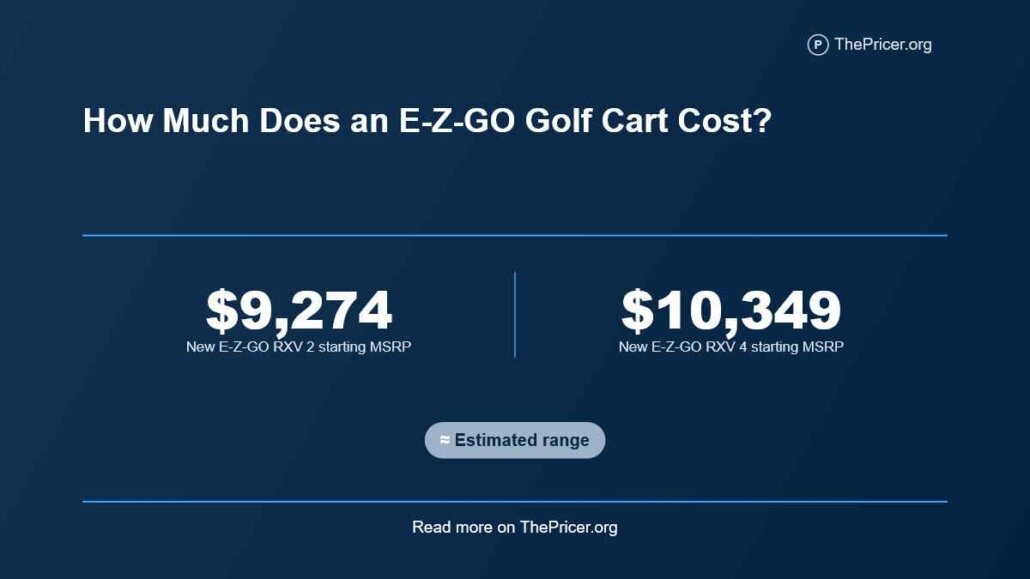
A new E-Z-GO golf cart starts at approximately $9,274 for a two-passenger RXV, $10,349 for a four-passenger RXV, and $12,149 for a six-passenger Express in the current US lineup. Premium lithium models and upgraded configurations can cost $15,000 to $18,000 or more. E-Z-GO’s certified pre-owned program offers vehicles starting at $5,995.
These are manufacturer starting prices, not necessarily what a buyer pays at delivery. Sales tax, freight, dealer preparation, accessories, and registration where applicable can increase the total. Battery chemistry, passenger capacity, and whether the vehicle is intended for golf-course use, neighborhood transportation, or street-legal driving also change its price.
Article Highlights
Jump to sections
- New E-Z-GO RXV models start at $9,274 for two passengers and $10,349 for four.
- The six-passenger Express starts at $12,149, before additional dealer charges.
- Certified pre-owned RXV carts start at $5,995 for two seats and $6,499 for four.
- Factory ELiTE lithium vehicles include an eight-year battery warranty, subject to its terms.
- Progressive advertises basic golf cart liability insurance from $75 per year, with actual premiums varying by coverage and driver.
- Battery condition and dealer exclusions can erase much of the apparent savings on a cheaper cart.
How Much Does an E-Z-GO Golf Cart Cost?
The manufacturer’s current personal golf cart lineup includes the RXV, Liberty, Express, and certified pre-owned vehicles. Prices vary with seating arrangements, powertrain, and trim package.
| E-Z-GO model | Starting US MSRP | Capacity and scope |
|---|---|---|
| RXV 2 | $9,274 | Two-passenger personal cart |
| RXV 4 | $10,349 | Four-passenger personal cart |
| Liberty 4 | $11,999 | Four passengers |
| Liberty 4F | $13,499 | Four forward-facing seats |
| Express 6 | $12,149 | Six-passenger personal cart |
| Certified pre-owned RXV 2 | $5,995 | Refurbished two-passenger cart |
| Certified pre-owned RXV 4 | $6,499 | Refurbished four-passenger cart |
These are advertised starting MSRPs, not a representative average of transaction prices. Availability may differ by dealer. An advertised model can also have several configurations priced above the base version.
The RXV provides a relatively accessible entry point for personal ownership. Liberty models emphasize seating arrangements and neighborhood transportation, while the Express family accommodates larger groups. Buyers whose principal purpose is golf should confirm that their preferred seating and accessory arrangement still provides the necessary golf-bag storage.
How Much Does Each RXV Cost?
The RXV family spans conventional 48-volt electric configurations, gasoline vehicles, and ELiTE lithium versions. The manufacturer lists the 2026 two-passenger RXV from $8,974, compared with the current lineup’s $9,274 starting point.
The model-year distinction matters. A lower price advertised for a remaining 2026 vehicle is not necessarily a discount on a newer configuration with identical equipment.
Four-passenger RXV models provide another comparison. The RXV 4 Valor S starts at $10,349 for 48-volt electric power. An upgraded Valor S+ starts at $10,929. Gasoline configurations are also available.
The 2026 RXV specification comparison identifies distinct Valor, Freedom, Touring, and Summit configurations. Some include lithium power, additional styling features, technology packages, or lifted suspension.
A buyer should compare the complete configuration rather than treating RXV as one product with a single price. A more expensive RXV may include seating, powertrain equipment, or accessories that would otherwise require separate purchases.
Liberty and Express Prices
The Liberty family targets owners wanting greater flexibility in passenger arrangements. The 2026 Liberty lithium model started at $12,999 and offered four seats with available low-speed-vehicle configurations.
Liberty 4F vehicles provide four forward-facing seats, a meaningful distinction from conventional rear-facing passenger arrangements. This can matter more to families using the vehicle for regular neighborhood travel than a cosmetic upgrade.
Six-seat capacity introduces another price tier. The Express 6 dealer model information lists a starting MSRP of $12,149 and identifies gasoline, 48-volt electric, and ELiTE lithium options. Upgraded trims include additional seating finishes, lighting, and technology features.
A separate 2026 dealer model catalog lists higher-trim Express 6 Summit XTL configurations at $17,749 for lithium and $17,949 for gasoline. These are listed manufacturer prices, not confirmed local sale offers.
The difference between the starting Express 6 and an advertised premium configuration exceeds $5,000. Buyers should evaluate which upgrades they will actually use rather than assuming that every six-passenger cart provides the same equipment.
Gas, Lead-Acid, or Lithium?
Powertrain choice affects charging, maintenance, driving characteristics, and eventual replacement expenses. E-Z-GO offers gasoline engines, conventional 48-volt lead-acid electric systems, and its ELiTE lithium technology across different vehicles.
Gas carts avoid charging downtime and may suit locations where convenient charging is unavailable. They require fuel and engine-related maintenance. Electric carts avoid gasoline purchases but depend on battery condition, charger compatibility, and available electrical power.
E-Z-GO describes its ELiTE lithium battery system as requiring no routine battery watering, unlike conventional flooded lead-acid batteries. The system uses Samsung SDI cells and a battery management system.
The company advertises an eight-year battery warranty on qualifying ELiTE vehicles. Warranty coverage is not the same as a promise that replacement will never be necessary. Buyers should review the vehicle-specific warranty statement, exclusions, and transfer provisions.
E-Z-GO’s January 2026 battery explanation also describes faster charging and reduced maintenance compared with lead-acid technology. The amount saved depends on electricity tariffs, charging frequency, and the vehicle’s use.
It would be misleading to claim that every electric E-Z-GO costs more than every gasoline version. The price difference depends on the exact model, battery technology, and included trim.
Used E-Z-GO Golf Cart Prices
Buying used can reduce the entry price, although the amount saved depends heavily on the vehicle’s condition and battery system. Older fleet vehicles and privately sold carts may cost substantially less than newer refurbished vehicles, but the cheapest examples often require the most careful inspection.
The manufacturer’s certified pre-owned pricing currently starts at $5,995 for an RXV 2 and $6,499 for an RXV 4. The program is distinct from an ordinary private-party used sale.
E-Z-GO states that certified vehicles undergo inspection and refurbishment at its Augusta, Georgia facility. The certification program description identifies component replacement and reconditioning as part of its process.
Before buying any used electric cart, request battery identification, age, diagnostic information where available, charging history, and warranty documentation. Inspect the frame for corrosion, check the brakes and steering, and confirm that the charger suits the installed battery system.
Changes to motor controllers, tires, suspension, or speed settings should also be investigated. A modified cart may require repairs that were not apparent from its appearance or advertised price.
When Used Costs Nearly as Much
Consider a buyer choosing between a current four-passenger RXV starting at $10,349 and a certified pre-owned four-passenger RXV starting at $6,499. The difference is $3,850, roughly 37% of the new vehicle’s starting price.
That discount looks substantial, but it is not the final comparison. Battery condition, included equipment, warranty provisions, dealer charges, and any required repairs determine whether the used cart remains the cheaper choice.
The golf cart battery replacement cost becomes particularly important for older electric vehicles. A conventional lead-acid battery set may cost roughly $600 to $1,200, while lithium conversions can cost considerably more after installation and any necessary charger changes.
Suppose a privately purchased electric E-Z-GO costs $4,500. The buyer then spends an illustrative $1,200 on batteries, $200 on fitting, and $300 on tires and minor repairs.
The total becomes $6,200, making the apparent $1,999 saving against a $6,499 certified pre-owned RXV 4 shrink to $299. The comparison assumes similar passenger capacity and useful condition, not identical warranties, lithium equipment, or model years.
This calculated example shows why a low purchase price alone cannot establish used-cart value. The condition-adjusted cost matters more than the advertised asking price.
What Does Ownership Cost Per Year?
After purchase, golf cart owners may pay for insurance, charging or gasoline, tires, servicing, storage, and repairs. Not every cart incurs all these expenses, and ownership costs vary significantly by use.
Progressive’s published golf cart insurance offer advertises basic liability coverage from $75 annually. Additional coverage, location, driving history, vehicle specifications, and permitted road use affect the premium.
Some homeowner policies provide limited protection while a cart is on the insured property. That should not be confused with comprehensive protection for neighborhood driving or course use.
Fuel and electricity costs depend on local rates and travel distance. Rather than assuming every owner spends the same amount, consider a defined electric-cart scenario using an illustrative charging budget of $10 per month.
For an owner who also budgets an assumed $200 annually for maintenance and purchases insurance at the advertised $75 entry price, the planned annual operating allowance is $395. This includes $120 in charging, $200 in maintenance, and $75 in insurance.
The electricity and maintenance amounts are budgeting assumptions, not measured averages. The calculation excludes depreciation, financing interest, storage charges, large repairs, and battery replacement.
For a more expensive or heavily used cart, recurring costs may be higher. A battery failure or motor repair can dominate several years of routine spending.
What the Out-the-Door Price Hides
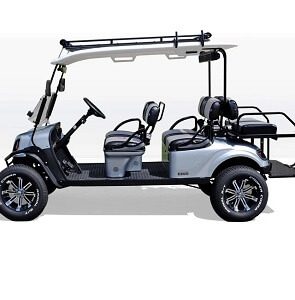
E-Z-GO states that its advertised prices can exclude tax, freight, setup, and dealer-added accessories. Those exclusions matter when comparing a manufacturer’s starting MSRP with a local dealer’s final quote.
An itemized illustration makes the distinction easier to see. Begin with an RXV 4 at $10,349. Assume dealer freight and preparation total $650, an optional accessory package costs $800, and sales tax is 7% on the combined amount.
- Base vehicle: $10,349
- Illustrative freight and preparation: $650
- Optional accessories: $800
- Assumed taxable subtotal: $11,799
- Illustrative sales tax at 7%: $826 rounded
- Calculated out-the-door total: $12,625
This scenario is approximately 22% above the manufacturer’s starting MSRP. The additional charges and assumed tax treatment are illustrative, not verified dealer fees or a universal state tax calculation. Actual taxable items vary by jurisdiction.
A buyer comparing two dealerships should request written totals for the same model, battery configuration, accessories, delivery arrangements, and warranty terms. Dealer financing advertisements also need scrutiny because monthly payment illustrations depend on credit approval, down payment, term, and applicable offers.
Street-Legal Models
A conventional golf cart is not automatically a street-legal low-speed vehicle. Permitted driving locations depend on vehicle classification and state or local rules. Adding lights or increasing maximum speed does not by itself establish compliance.
The National Highway Traffic Safety Administration explains federal low-speed vehicle requirements, including the applicable speed classification and vehicle safety standards. Low-speed vehicles are generally designed for speeds above 20 mph and no greater than 25 mph under federal classification rules.
Factory-configured LSVs may include equipment such as appropriate lighting, mirrors, seat belts, and other required components. Road access remains subject to state and local restrictions, insurance requirements, and registration where applicable.
Owners shopping for neighborhood transportation should establish whether they need a factory LSV before choosing a less expensive non-road-compliant cart. Conversion costs and the feasibility of registration can otherwise become expensive surprises.
E-Z-GO Versus Club Car
E-Z-GO is not the only major-brand option. Club Car’s published Onward starting prices are $10,099 for two passengers, $11,299 for four, and $15,799 for six.
Using the current manufacturer entry prices, the E-Z-GO RXV 4 starts $950 below the four-passenger Club Car Onward. The two vehicles are not necessarily equipment-identical, so the difference should be treated as an entry-price comparison rather than a confirmed saving on a matched package.
The broader golf cart market comparison includes other major brands and helps distinguish basic two-seat models from premium family carts and street-legal vehicles.
For buyers who only require transportation during an occasional round, ownership may be unnecessary. Compare course cart policies and the cost of golf practice outings before buying a vehicle that could sit unused for long periods.
Which E-Z-GO Is the Better Buy?
The RXV 2 is the lower-priced new option for an owner needing two seats. The RXV 4 adds passenger flexibility without moving immediately into higher-priced premium configurations. Liberty and Express models justify a closer look when seating arrangements, group capacity, or neighborhood use are important.
Buying a late-model or certified pre-owned E-Z-GO can also make financial sense, provided the battery and mechanical condition support the discount. An inexpensive privately sold cart requiring imminent repairs may offer less value.
Makes sense if
- The passenger capacity matches regular use.
- The dealer provides an itemized total including preparation and delivery.
- Used-cart battery condition and warranty terms are documented.
- Charging access or gasoline servicing is practical at the intended location.
Does not make sense if
- The lowest advertised price excludes required equipment or substantial repairs.
- The cart will be driven on roads where it does not qualify for legal operation.
- A higher trim adds features that will rarely be used.
- Ownership costs exceed the value of occasional rentals or existing course transportation.
Answers to Common Questions
How much does the cheapest new E-Z-GO cost?
The current E-Z-GO RXV 2 starts at $9,274. Remaining 2026 RXV 2 vehicles have been advertised from $8,974. Freight, setup, tax, and accessories may be additional.
How fast does an E-Z-GO golf cart go?
Maximum speed depends on model and configuration. Conventional personal carts generally operate below the federal low-speed-vehicle speed category, while eligible factory LSV configurations may reach 25 mph. Speed modifications do not automatically make a cart road legal.
How long do E-Z-GO golf cart batteries last?
Battery life depends on chemistry, charging practices, temperature, and use. E-Z-GO’s eligible ELiTE lithium vehicles include an eight-year battery warranty. Conventional lead-acid systems usually require more maintenance and may need replacement sooner.
Is an E-Z-GO golf cart cheaper than a Club Car?
The entry-level four-passenger E-Z-GO RXV starts at $10,349, compared with $11,299 for the Club Car Onward 4. The difference is $950 before comparing the exact equipment and dealer charges.
How much does a used E-Z-GO cost?
E-Z-GO Certified Pre-Owned RXV vehicles start at $5,995 for two passengers and $6,499 for four. Private used-cart prices depend on age, model, battery condition, equipment, and local availability.
Disclosure: Educational content, not financial advice. Prices reflect public information as of the dates cited and can change. Confirm current rates, fees, taxes, and terms with official sources before purchasing. See our methodology and corrections policy.