
How Much Does Foot Corn Removal Surgery Cost?
Updated on | Written by Alec Pow
This article was researched using 9 sources. See our methodology and corrections policy.
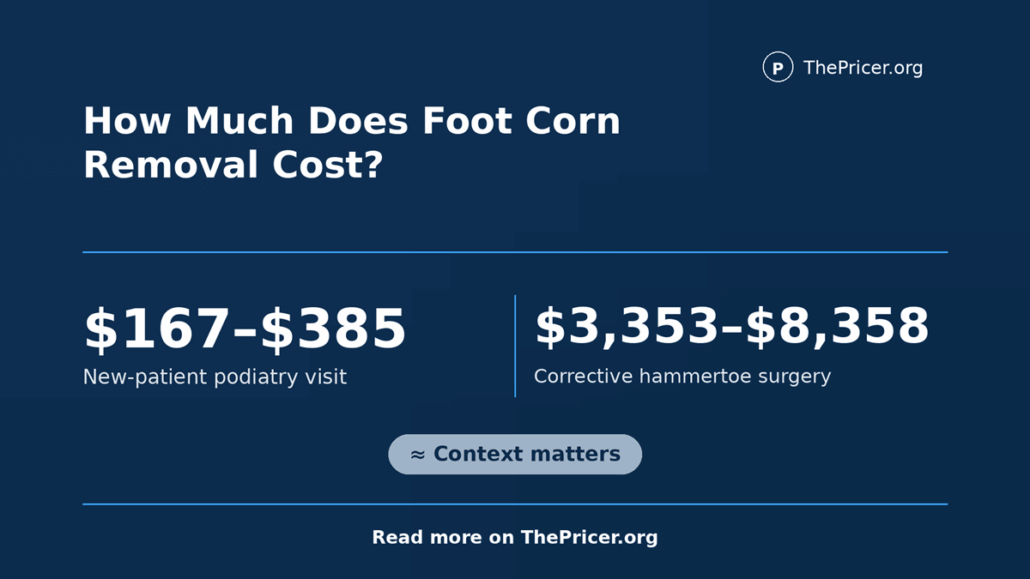
Foot corn removal can cost from about $150-$400 for an office-level podiatry visit and treatment to roughly $3,300-$8,400 for corrective outpatient surgery when a hammertoe or other structural problem is causing the corn to keep returning. Current MDsave cash prices for hammertoe surgery range from $3,353 to $8,358, with a national MDsave average of about $6,298.
The price difference exists because “corn removal surgery” can describe two very different treatments. A podiatrist can pare down thickened corn tissue during an office visit, which relieves pressure but does not necessarily stop the corn from returning. True foot surgery is usually aimed at correcting the bone or toe deformity that creates the repeated friction rather than removing a supposed “corn root.”
Corns are thickened areas of skin caused by repeated pressure or friction. They may have a hard central core, but they do not have roots that need to be extracted. Mayo Clinic, CMS, and the American Orthopaedic Foot & Ankle Society distinguish simple office paring from corrective surgery for conditions such as hammertoe.
Article Highlights
Jump to sections
- A new-patient podiatry visit currently costs about $167-$385 (at $30 per hour, earning that amount would take about 0.7 to 1.6 full-time workdays, before taxes) through MDsave.
- An established-patient podiatry visit currently costs about $136-$303.
- CMS classifies simple cutting or paring of corns and calluses under CPT codes 11055-11057.
- Corrective hammertoe surgery currently costs $3,353-$8,358 through MDsave.
- The current MDsave national average for hammertoe surgery is about $6,298.
- The broader estimated national average shown by MDsave is $11,471.
- Surgery treats an underlying toe or bone alignment problem rather than removing a “corn root.”
How Much Does Foot Corn Removal Cost?
| Treatment or expense | Current cost signal | What the price represents |
|---|---|---|
| New-patient podiatry visit | $167-$385 (about 0.7 to 1.6 full-time workdays at $30 per hour) | Current MDsave cash-price range |
| Established podiatry visit | $136-$303 | Current MDsave cash-price range |
| Simple corn paring | Usually office-level treatment | May be part of or billed with a podiatry visit |
| Hammertoe corrective surgery | $3,353-$8,358 | Current MDsave cash range |
| MDsave hammertoe average | About $6,298 | Current MDsave national average |
| Estimated national hammertoe cost | $11,471 | Broader estimated national average displayed by MDsave |
For someone paying cash, the first step is often a podiatry consultation rather than surgery. A new-patient podiatry visit currently costs $167-$385 through MDsave, with a national MDsave average around $217.
For an existing patient, a podiatry follow-up visit costs $136-$303, with the current MDsave national average close to $170.
Office Corn Removal
Many painful corns do not require an operating room. A doctor or podiatrist can pare down the hardened tissue with a scalpel during an office visit.
Mayo Clinic’s current corn and callus treatment guidance lists trimming excess skin as an office treatment. It separately lists surgery only when a bone causing the friction needs its alignment corrected.
CMS also treats ordinary corn and callus paring differently from reconstructive surgery. Its current routine foot-care coding guidance uses CPT 11055 for one benign hyperkeratotic lesion, 11056 for two to four lesions, and 11057 for more extensive paring.
That makes an office-level budget in the low hundreds more realistic than automatically expecting a $1,000+ (about 4.2 full-time workdays at $30 per hour) surgical bill for every corn.
A Corn Does Not Have a Root
A common misconception is that a corn returns because its “root” was not removed. Corns do not have roots.
They form because skin repeatedly experiences pressure or friction. A corn can develop a dense central core, which may feel as if something is embedded deeply in the toe, but simply cutting out that center does not remove the mechanical reason it developed.

The American College of Foot and Ankle Surgeons explains that corns are linked to pressure and friction. If the source of that pressure remains, such as a hammertoe repeatedly rubbing against a shoe, the thickened skin can return after it has been pared down.
This distinction changes the cost discussion completely. You may be paying to reduce the corn today or to correct the foot problem that keeps recreating it.
Corrective Surgery
When a painful recurrent corn is caused by a structural deformity, treatment can become a true surgical procedure.
Current MDsave hammertoe surgery prices range from $3,353 to $8,358. The current MDsave national average is about $6,298, while the site displays an estimated national average of $11,471.
That is a much more useful price range for a patient whose “corn surgery” actually involves correcting a hammertoe or similar toe deformity.
The difference between the low and high MDsave cash prices is:
$8,358 – $3,353 = $5,005
Location, surgeon, facility, procedure type, number of toes, implants, anesthesia, and what the cash package includes can all affect the final bill.
Paring the Corn vs. Fixing the Cause
The cheaper procedure and the more expensive procedure solve different problems.
Office paring removes some of the hardened skin. This can reduce pressure and pain quickly, but the corn may form again if the same spot continues rubbing against footwear or another toe.
Corrective surgery changes the anatomy that is creating the pressure. For a hammertoe, this can mean releasing or moving tendons, removing a small amount of bone, or stabilizing a toe joint.
The American Orthopaedic Foot & Ankle Society’s hammertoe surgery guidance explains that flexible deformities may be treated with tendon or ligament procedures, while fixed hammertoes can require bone removal and stabilization with pins, screws, or fusion.
That is why a true structural operation costs thousands of dollars while paring a corn does not.
$6,298 Surgery Price
Patients should not assume every advertised surgical price contains the same services. A bundled cash price may include more components than a hospital’s initial surgeon quote.
For a corrective procedure, ask whether the price includes:
- Surgeon’s professional fee
- Operating facility fee
- Anesthesia
- Preoperative evaluation
- Imaging
- Pins, screws, or other implants if required
- Postoperative shoe or boot
- Routine follow-up appointments
A quoted $5,000 surgical price that excludes the facility and anesthesia can turn into a different bill from an all-inclusive $6,000 cash package.
Before comparing two prices, ask each provider for the relevant procedure code and a written estimate showing which professional and facility charges are included.
The Hidden Cost
The corn itself may be inexpensive to pare. The larger expense can appear when the examination shows that the pressure is coming from a hammertoe, bunion, prominent bone, or another deformity.
Mayo Clinic notes that hammertoe and hallux valgus can increase pressure and friction on the foot. Its corn and callus overview also distinguishes painful corns from larger calluses and advises medical evaluation for very painful or inflamed lesions.
This means a patient who expects a $200 office treatment can discover that the long-term option is a $3,000-$8,000+ orthopedic or podiatric operation.
That does not mean surgery is automatically the better financial choice. It means the two prices are buying different outcomes.
Repeated Office Care
For illustration, use the current MDsave established-patient average of about $170 per podiatry visit.
If someone hypothetically required four similar visits in one year:
$170 × 4 = $680 per year
Over five years:
$680 × 5 = $3,400
This is only a cost model, not a recommended treatment schedule. Corns differ, and many people will not need repeated professional paring at that frequency. Procedure fees may also be billed separately from an office visit.
The calculation does show why someone with a recurring corn caused by a correctable deformity may eventually compare repeated conservative-care costs with the one-time cost and risks of structural surgery.
Insurance
Insurance coverage cannot be reduced to a claim that a plan will pay a fixed percentage such as 50%-80%.
Medicare, for example, normally excludes routine cutting or removal of corns and calluses from coverage. Its routine foot-care coverage policy contains exceptions for certain patients with systemic conditions severe enough that nonprofessional foot care would create medical risk.
Corrective surgery for a painful deformity is a separate medical-necessity question. Private insurance coverage can depend on the diagnosis, procedure code, network status, deductible, coinsurance, prior authorization, and whether conservative treatments have been tried.
Before scheduling surgery, ask for:
- The diagnosis code
- The surgical CPT code
- The surgeon’s estimated charge
- The facility estimate
- The anesthesia estimate
- Expected insurance adjustment
- Remaining deductible
- Coinsurance or copay
- Whether prior authorization is required
Recovery
Recovery from simple corn paring is not comparable with recovery from hammertoe correction.
For hammertoe surgery, patients commonly go home the same day. FootCareMD says many patients can bear weight after surgery, often while wearing a special shoe or boot. Stitches are commonly removed after about 2-3 weeks, while temporary pins may remain for several weeks.
Swelling can last much longer than the initial wound-healing period. The exact timeline depends on whether the surgeon performs a tendon procedure, removes bone, uses pins or screws, or fuses a joint.
Surgery also carries risks including infection, nerve or blood-vessel injury, bleeding, blood clots, stiffness, nonunion after fusion, instability, and recurrence of the deformity. No single “85%-90% permanent cure” percentage applies to every corn or every operation.
Three Foot Corn Treatment Budgets
Case 1: first podiatry evaluation. Current MDsave cash pricing for a new-patient podiatry visit ranges from $167-$385. If the corn can be treated conservatively or pared in-office, the total may remain in the hundreds rather than thousands, depending on how the provider bills the treatment.
Case 2: repeated conservative care. Four hypothetical established-patient visits using a $170 current MDsave average equal approximately $680 over one year before separately billed procedures, padding, orthotics, or other care.
Case 3: structural correction. Current MDsave hammertoe surgery prices range from $3,353-$8,358, with a national average near $6,298. A patient should confirm whether that price includes the surgeon, facility, anesthesia, implants, and routine postoperative care.
Home Treatment
People without underlying health problems may be able to reduce friction with roomier footwear, nonmedicated padding, and gentle skin care. Sharp objects should not be used to cut a corn at home.
Medicated corn removers also deserve caution because many contain salicylic acid, which can injure surrounding skin. This matters especially for people with diabetes, poor circulation, or reduced sensation in the feet.
Someone with diabetes or poor blood flow should seek professional advice before self-treating a corn. Even a small skin injury can become more serious when sensation or circulation is impaired.
What We Verified
- Checked: CMS classifies ordinary paring and cutting of corns or calluses under routine foot-care codes 11055-11057 rather than treating every corn as a surgical excision.
- Confirmed: current MDsave cash pricing for hammertoe surgery is $3,353-$8,358, with an average near $6,298.
- Cross-referenced: foot and ankle orthopedic guidance describes hammertoe surgery as correction of a deformity rather than extraction of a corn “root.”
- Verified: routine Medicare coverage for corn and callus care is limited, with exceptions based on qualifying medical conditions and risk.
Related Foot Surgery Costs
A recurring corn on top of a bent toe can sometimes be linked to a hammertoe. Our guide to the cost of hammertoe surgery looks more closely at the structural procedure and its associated expenses.
For a more complex difference in toe length and bone anatomy, see the cost of brachymetatarsia surgery, which involves a very different operation and recovery process.
Corns may also occur alongside other deformities that change pressure inside footwear. Our guide to the cost of bunion surgery covers another common corrective foot procedure.
Answers to Common Questions
How much does it cost to get a corn removed from your foot?
Office-level podiatry care often costs a few hundred dollars. Current MDsave prices are $167-$385 for a new-patient podiatry visit and $136-$303 for an established-patient visit. A separately billed corn-paring procedure can change the total.
How much does surgery for a recurring corn cost?
If the corn is caused by a hammertoe or another structural problem that requires corrective surgery, current MDsave hammertoe prices range from $3,353-$8,358. The current MDsave national average is about $6,298.
Can a podiatrist remove a corn permanently?
A podiatrist can pare down the thickened skin, but the corn can return if pressure or friction continues. When a foot deformity causes the repeated pressure, correcting that deformity may reduce recurrence, but no procedure can promise that every corn will be permanently eliminated.
Do corns have roots?
No. Corns are areas of thickened skin caused by pressure or friction. They can have a dense central core, but they do not have a biological root that must be extracted.
Does insurance cover corn removal?
Coverage depends on why the treatment is being performed. Routine foot care may not be covered, while medically necessary treatment for a painful structural deformity may qualify under different benefits. Ask the insurer to check the exact diagnosis and procedure codes before treatment.
When is surgery used for a foot corn?
Surgery is not the routine first treatment for a simple corn. It may be considered when repeated pressure comes from a bone or toe deformity, conservative treatment has not provided enough relief, and the patient continues to have pain or difficulty wearing shoes or performing normal activities.
Disclosure: Educational content, not medical advice. Pricing varies by provider, location, and insurance. Confirm eligibility, coverage, and out-of-pocket costs with a licensed clinician and your insurer. See our methodology and corrections policy.