How Much Do Hand Controls for Disabled Drivers Cost?
Updated on | Written by Alec Pow
This article was researched using 11 sources. See our methodology and corrections policy.
Professionally installed hand controls for a disabled driver usually cost about $800 to $3,000 for a basic mechanical setup, while a full electronic hand-control installation can cost $5,000 to $12,000+. First-time users may also pay $300 to $750 for a driver-rehabilitation evaluation, $100 to $200 per hour for behind-the-wheel training, and about $50 to $200 for a steering knob or grip. The final bill depends on the control type, the vehicle, the driver’s functional needs, installation labor, training, and any secondary controls.
The useful price distinction is mechanical versus electronic. Mechanical push/pull, push/rock, push/right-angle, and push/twist systems transfer accelerator and brake operation to the driver’s hand through levers and linkages. Electronic systems reduce the physical force needed and can integrate acceleration or other vehicle functions electronically, but they cost much more.
There is no universal U.S. rule that every driver needs a doctor’s prescription before hand controls can be installed. Licensing, assessment, documentation, and road-test requirements vary by state. A Certified Driver Rehabilitation Specialist, or CDRS, can assess which equipment fits the driver and provide training before the vehicle is put into regular road use.
Article Highlights
Jump to sections
- Mechanical hand-control equipment currently runs about $500 to $2,000 (at $30 per hour, earning that amount would take about 0.4 to 1.7 full-time workweeks, before taxes), with qualified installation adding roughly $300 to $1,000.
- A full electronic hand-control installation can cost about $5,000 to $12,000+.
- A CDRS evaluation commonly costs $300 to $750, while training runs about $100 to $200 per hour.
- The VA’s July 2026 adaptive-equipment schedule allows up to $1,604 for a mechanical column-mount hand control and $2,880 for a mechanical floor-mount control.
- The same VA schedule lists $209 for a steering knob and an in-shop labor ceiling of $130 per hour.
- Ford and Stellantis currently offer qualifying buyers up to $1,000 toward eligible adaptive equipment on new vehicles.
- NMEDA’s current guidelines call for a valid license plus either a qualified driver-rehabilitation assessment or documented current experience for primary driving equipment.

How Much Do Hand Controls for Disabled Drivers Cost?
A May 2026 cost guide from the Charcot-Marie-Tooth Association puts basic mechanical hand-control equipment at $500 to $2,000 (about 0.4 to 1.7 full-time workweeks at $30 per hour) and professional installation at roughly $300 to $1,000. Combining those two ranges gives a mechanical equipment-and-installation budget of about $800 to $3,000.
| Cost item | Current price evidence | What the number represents |
|---|---|---|
| Mechanical hand-control equipment | $500 to $2,000 | Equipment before professional installation |
| Mechanical installation | $300 to $1,000 | Qualified mobility-dealer installation, depending on vehicle |
| Full electronic installation | $5,000 to $12,000+ | Electronic hand controls with higher installation complexity |
| CDRS evaluation | $300 to $750 | Clinical and on-road adaptive-driving assessment |
| Behind-the-wheel training | $100 to $200/hour | Training after or during equipment selection |
| Steering knob or grip | $50 to $200 | One-handed steering aid often paired with hand controls |
The federal government provides another useful pricing benchmark. The VA Automobile Adaptive Equipment schedule, updated July 28, 2026, is a maximum reimbursement schedule rather than a retail price list. It allows up to $1,604 for a mechanical column-mount hand control, $2,880 for a mechanical floor-mount hand control, $1,757 for an electromechanical column-mount control, and $3,036 for an electromechanical floor-mount control.
That government schedule exposes a cost that broad hand-control averages hide. The mechanical floor-mount allowance is $1,276 above the column-mount allowance, or about 79.6% higher. The electromechanical floor-mount allowance is $1,279 above the column-mount amount, or about 72.8% higher. Mounting style and vehicle layout can matter almost as much as the operating motion of the control.
What You’re Buying

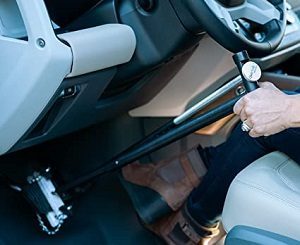
Hand controls transfer primary accelerator and brake functions from the foot pedals to a control operated by hand. The original pedals normally remain available so another licensed driver can operate the vehicle in the conventional way when the installation is designed for that use.
Ford’s adaptive-equipment guide shows several common operating patterns. A push/pull control brakes when pushed and accelerates when pulled toward the driver. A push/right-angle system brakes when pushed toward the instrument panel and accelerates when pulled downward at a right angle. Push/twist controls use a twisting motion for acceleration and a push for braking. Mechanical rotary controls brake when pushed forward and accelerate when rotated backward.
Mechanical controls use physical linkages to operate the pedals. Electronic or electromechanical systems can reduce operating effort and may integrate other functions. Secondary controls are separate devices for functions such as turn signals, horn, wipers, gear selection, or lighting. Adding secondary controls can move a project far beyond the price of a basic gas-and-brake lever.
Mechanical vs. Electronic Cost
Mechanical systems are the least expensive route when the driver’s strength, range of motion, and vehicle allow them. The equipment and installation range above puts many mechanical projects between $800 and $3,000 (about 0.7 to 2.5 full-time workweeks at $30 per hour) before evaluation or training.
Electronic systems have a much wider ceiling. The 2026 CMTA guide puts a full electronic hand-control install at $5,000 to $12,000+. The VA schedule shows why certain high-support controls can move higher still. Its maximum allowance is $5,411 for a steering-ring accelerator, $16,120 for a Darios/Kempf accelerator ring, and $34,818 for a lever gas/brake system. Those are specialized primary driving controls and should not be confused with an ordinary push/pull mechanical kit.
The vehicle also changes what can be installed. Current NMEDA guidelines state that mechanical/manual hand controls are to be installed in vehicles with power brakes, power steering, and automatic transmission unless a certified or licensed driver trainer authorizes otherwise. That is why applying a blanket “30% to 50% extra” surcharge to a manual-transmission car is not defensible. A manual-transmission case may require a different system, an explicit professional recommendation, or a different vehicle.
Evaluation and Training Costs
The equipment quote can be only part of a first-time driver’s cost. NHTSA recommends consulting a driver-rehabilitation specialist before buying a vehicle or adaptive equipment because the evaluation can identify what equipment is needed and what may be unnecessary. Its adapted-vehicle guidance also notes that vocational rehabilitation, workers’ compensation, insurance, and other programs may help with evaluation or modification costs in some cases.
Real provider prices fit the broader $300 to $750 evaluation range. En Route to Independence currently charges $375 for a full evaluation in its main service area. Drive-Rx lists an adaptive driving evaluation at $550 and in-vehicle lessons at $160 per hour.
The training bill depends on prior driving experience, the control style, and how quickly the driver becomes competent with the new equipment. The 2026 CMTA guide uses a broad $100 to $200 per hour training range and says many drivers need roughly four to 10 hours. Four hours at the midpoint rate of $150 adds $600. Ten hours at the same rate adds $1,500.
Three Realistic Budgets
Case 1: basic first-time mechanical setup. Use the midpoint of the current mechanical equipment range, $1,250, plus the installation midpoint of $650. Add a $525 evaluation, four hours of training at $150 per hour, and a $125 steering knob. The modeled total is $3,150. Every input comes from the current published ranges, but an actual CDRS recommendation and dealer quote can move the bill higher or lower.
Case 2: floor-mount benchmark. The VA’s current maximum allowance for a mechanical floor-mount hand control is $2,880. Add the same modeled $525 evaluation and four hours of $150 training, and the working total reaches $4,005 before a steering aid or other controls. This is reimbursement-schedule math, not a retail quote.
Case 3: electronic system. Start with the current full-install range of $5,000 to $12,000+. Add a $525 modeled evaluation and six hours of training at $150 per hour, or $900. The resulting working range is $6,425 to $13,425+. A specialized accelerator ring, reduced-effort steering, or integrated secondary controls can move beyond that range.
The Reimbursement Math
Automaker mobility programs can materially change the out-of-pocket cost when the vehicle and equipment qualify. Ford’s 2026 Accessibility Reimbursement Program pays up to $1,000 for eligible adaptive equipment, including hand controls, on qualifying new Ford vehicles. Used vehicles are not eligible under the program.
Stellantis also offers up to $1,000 through its DriveAbility program for qualifying adaptive equipment on eligible new Chrysler, Dodge, Jeep, Ram, FIAT, and Alfa Romeo vehicles. Program documentation and deadlines apply.
Toyota’s current mobility materials likewise advertise up to $1,000 in cash reimbursement for qualifying adaptive equipment. The company’s mobility program overview frames that reimbursement as help with equipment needed by people with disabilities.
Apply a $1,000 qualifying reimbursement to the $3,150 modeled mechanical setup above and the net modeled cost falls to $2,150. The reimbursement covers about 31.7% of that example. It does not necessarily pay for the evaluation or training, and each automaker sets its own vehicle, equipment, installation, and claim requirements.
Vehicle Fit and Installation
Hand controls can be fitted to many cars, SUVs, trucks, vans, hybrids, and electric vehicles, but compatibility is vehicle-specific. MobilityWorks currently says most hand-control installations take about three to six hours after parts arrive, while complex electronic systems can take longer. It also says mechanical and electronic systems are tailored to the vehicle and the driver’s requirements.
NMEDA’s 2024 guidelines require a current valid driver’s license plus either an assessment report from a qualified driver-rehabilitation specialist specifying the equipment and training or a statement showing current experience with the primary driving equipment. NMEDA strongly recommends a CDRS and behind-the-wheel instruction, especially when the driver is new to adaptive controls or changes to a different type.
That is different from saying every state requires a medical prescription. Driver-license restriction codes and DMV procedures vary by jurisdiction. A prescription or medical note may still be required by a rehabilitation program, funding source, automaker reimbursement program, tax rule, or local licensing process. Check the driver’s state DMV and the installer before ordering equipment.
Cheap portable controls should not automatically be treated as substitutes for a professionally specified primary driving system. The installed equipment has to fit the driver’s abilities, vehicle geometry, airbags, pedal travel, steering access, and licensing requirements. The cost of replacing or modifying equipment after buying the wrong system can erase the saving from an inexpensive online kit.
Other mobility expenses can sit beside the vehicle modification. Drivers comparing broader accessibility costs may also want to see current prosthetic leg costs and prosthetic finger costs.
Who This Cost Makes Sense For
Makes sense if:
- A driver-rehabilitation evaluation identifies hand controls as a suitable way to operate the accelerator and brake.
- The vehicle has been checked for compatibility before equipment is purchased.
- The quote includes the exact control, brackets, installation, fitting, orientation, and any steering or secondary controls.
- You have checked automaker, vocational-rehabilitation, workers’ compensation, VA, or insurance funding before paying the full amount yourself.
Does not make sense if:
- You are choosing a control only because it is the cheapest one sold online.
- You are pricing a mechanical kit when the driver needs reduced-effort electronic controls or secondary functions.
- You assume every manual-transmission vehicle can take ordinary mechanical hand controls for a fixed surcharge.
- You compare only hardware prices and leave evaluation, training, fitting, and installation out of the budget.
What We Verified
- Checked 2026 mechanical and electronic cost ranges against the Charcot-Marie-Tooth Association’s May 2026 adaptive-driving guide.
- Confirmed current government equipment ceilings and labor benchmarks with the VA Automobile Adaptive Equipment schedule updated July 28, 2026.
- Cross-referenced installation and documentation requirements with NMEDA’s current guidelines and current MobilityWorks installation guidance.
- Verified real driver-evaluation and training prices with two active U.S. driver-rehabilitation providers.
- Checked current reimbursement limits directly with Ford, Stellantis, and Toyota mobility-program materials.
Answers to Common Questions
How much do professionally installed hand controls cost?
A mechanical setup currently works out to roughly $800 to $3,000 for equipment and professional installation. A full electronic installation can cost about $5,000 to $12,000+.
How much does a hand-control driving evaluation cost?
A CDRS or adaptive-driving evaluation commonly runs about $300 to $750. Current provider examples include $375 and $550.
Do I need a doctor’s prescription for hand controls?
Not under one universal U.S. rule. State licensing requirements, installer documentation, rehabilitation programs, and funding sources differ. NMEDA’s current primary-control documentation accepts either a qualified driver-rehabilitation assessment or documented current experience, alongside a valid driver’s license.
Can another person still drive the car normally?
Many properly installed systems preserve normal operation of the original pedals and controls for another licensed driver. Confirm that feature for the exact control and vehicle before installation.
Can a car manufacturer help pay for hand controls?
Yes, when program rules are met. Ford and Stellantis currently offer up to $1,000 for qualifying adaptive equipment on eligible new vehicles, and Toyota also advertises up to $1,000 through its mobility assistance program.
Disclosure: Educational content, not medical advice. Pricing varies by provider, location, and insurance. Confirm eligibility, coverage, and out-of-pocket costs with a licensed clinician and your insurer. See our methodology and corrections policy.