
How Much Do Prairie Dogs Cost?
Updated on | Written by Alec Pow
This article was researched using 15 sources. See our methodology and corrections policy.
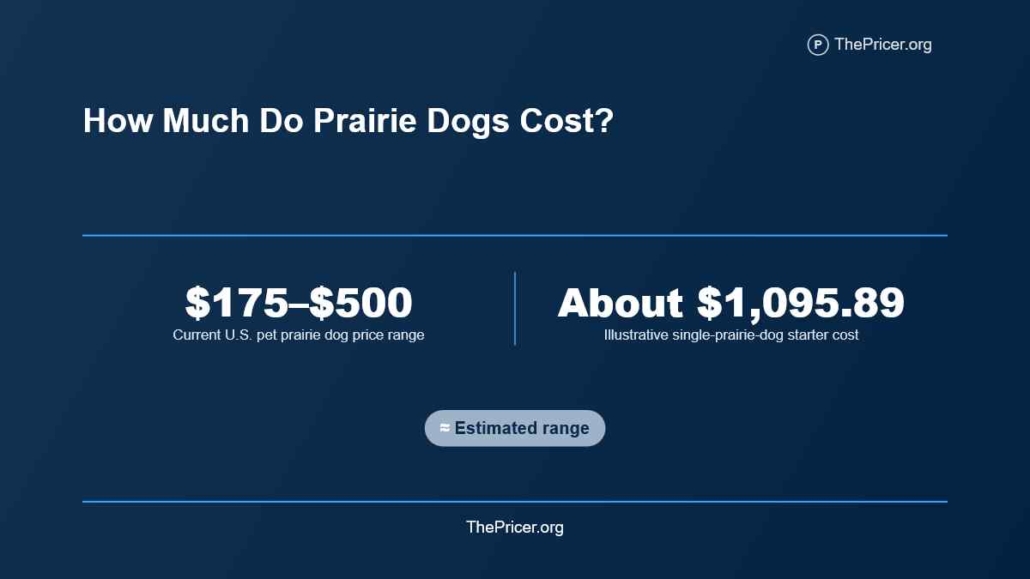
A pet prairie dog currently costs about $175 to $500 in public U.S. listings, although seller type, age, handling, season, sex, and location can move the price. One retailer lists baby prairie dogs from $174.99 for local pickup, while other 2026 listings have appeared around $350 to $500. A specialist already accepting reservations for 2027 lists individual pups at $300 to $375, depending on sex and preorder timing.
The animal price is only the start. Prairie dogs are highly social, burrowing rodents in the squirrel family, and the black-tailed prairie dog is the species most often kept as a pet. A strong enclosure, deep bedding, hay-based food, exotic-animal veterinary care, transport, and local legal requirements can push the real starting cost past $1,000 for a buyer beginning without supplies.
Article Highlights
Jump to sections
- Current public U.S. prairie dog listings span roughly $175 to $500 (at $30 per hour, earning that amount would take about 0.7 to 2.1 full-time workdays, before taxes) per animal.
- A specialist’s announced 2027 preorder prices range from $300 to $375 for one prairie dog and $525 to $675 for a pair.
- Ground transport from one specialist is $250, while its estimated air-transport package totals $345.
- A large chew-resistant small-animal enclosure can cost around $384 before bedding, digging areas, bowls, and enrichment.
- A current exotic-pet clinic lists a routine wellness exam at $90, before tests, medication, sedation, or treatment.
- One realistic starter scenario reaches about $1,096 before several recurring and emergency costs.
How Much Do Prairie Dogs Cost?
The strongest current retail evidence puts a pet prairie dog between roughly $175 and $500 (about 0.7 to 2.1 full-time workdays at $30 per hour) for the animal alone. Underground Reptiles lists a baby prairie dog from $174.99. That price works mainly as a local-pickup example because the seller states that its $350 shipping option is offered only for orders of five or more animals. At the other end, a Florida exotic-animal seller advertised 2026 babies around $499.98.
KyTy Critters is already accepting 2027 reservations and provides a useful structured price schedule. Its announced prairie dog prices are $300 for an early-order male and $325 for an early-order female. Regular preorder prices rise to $350 and $375. The seller also requires a starter kit for every pup, so the displayed animal price is not the entire invoice.
| Purchase example | Advertised animal price | What the price represents |
|---|---|---|
| Baby prairie dog, local-pickup seller | From $174.99 | Animal only, with restrictive shipping terms |
| 2027 early-order male | $300 | Future pup reservation, required starter kit extra |
| 2027 early-order female | $325 | Future pup reservation, required starter kit extra |
| 2027 regular-order male | $350 | Future pup reservation, required starter kit extra |
| 2027 regular-order female | $375 | Future pup reservation, required starter kit extra |
| High-end 2026 specialty listing | About $500 | Animal only before transport and supplies |
Rescue and rehoming prices are less consistent. Some organizations may charge an adoption fee that includes veterinary work, while private rehoming ads can bundle cages or supplies. There is not enough current standardized rescue pricing to support the old claim that a rescue prairie dog simply costs the price of spaying or neutering.
One Prairie Dog or a Pair
The number of animals changes the budget in a way that matters more than it would for many solitary pets. Prairie dogs naturally live in highly social colonies. Veterinary guidance on pet prairie dogs says keeping a single animal is not advised unless the owner can provide substantial daily interaction. That does not mean every household should automatically buy two. Sex, sterilization, compatibility, enclosure size, and veterinary advice still matter.
Current seller pricing shows that buying a compatible pair does not always double the livestock bill. KyTy’s 2027 early-order male price is $300 (about 1.3 full-time workdays at $30 per hour) each, or $525 for a pair. Two singles would cost $600, so the pair price saves $75, or 12.5%. Two early-order females would cost $650 separately, while the pair is $575. That is another $75 reduction.
The discount can be misleading if the buyer stops the calculation there. The seller requires a $30 starter kit for each pup, so two animals add $60 in required kits. Veterinary exams may also be charged per animal. Housing may need to be larger or modified, and an opposite-sex pair can create sterilization expenses. VCA notes that males housed together should be neutered and that a male kept with a female needs neutering to prevent breeding.
A pair can still be financially sensible when social compatibility is appropriate because some transport and housing costs may be shared. The savings come from shared expenses and the seller’s pair discount, not from the second animal becoming inexpensive to maintain.
Housing Costs More Than the Animal
Prairie dogs are powerful diggers and persistent chewers. Their enclosure needs go well beyond a small rodent cage. VCA’s housing guidance recommends the largest enclosure practical, strong materials such as stainless steel or plexiglass, secure closures, good ventilation, hiding areas, and substrate deep enough for digging. It also warns that a typical rabbit cage may not be strong enough for permanent housing.
A large commercial cage can give a useful retail benchmark even when an owner needs to modify the interior for a prairie dog’s digging behavior. Petco lists a MidWest Ferret Nation double unit at $383.99. It measures 36 inches long, 25 inches wide, and 62.5 inches high. Prairie dogs do not need a tall climbing layout in the way some other small mammals do, so floor area and a safe deep-digging zone matter more than shelves.

Bedding creates a recurring cost rather than a one-time purchase. Current paper-bedding examples range from about $18 to $24 for common large bags, while larger bulk packages can cost around $46. VCA recommends regular bedding replacement and daily removal of urine and fecal matter. A deep digging area can use much more material than a shallow hamster enclosure.
Bowls, a heavy water container or bottle, hiding boxes, chew-safe materials, a carrier, and an exercise area add to the setup. Outdoor housing is not a simple cheaper substitute. Escape prevention, weather, predators, local regulations, and the prairie dog’s digging ability make outdoor construction a specialized project.
Food and Veterinary Costs
Prairie dogs are hindgut fermenters that need a high-fiber diet. The old article was broadly right about fiber but too loose about rabbit feed and rodent chow. Current veterinary feeding guidance uses timothy, orchard, or brome grass hay as the dietary base, with only a small amount of suitable pellets and limited leafy vegetables. Large amounts of rich alfalfa are not recommended for healthy adults.
Hay cost changes sharply with package size. Current retail examples include a 6-pound bag of timothy hay around $17.95, or about $3 per pound. Larger forage packages can cost much less per pound. Storage space, freshness, dust, waste, and suitability for a small mammal all matter, so the cheapest agricultural bale is not automatically the best purchase.
Veterinary access can be the harder expense. Prairie dogs need a veterinarian comfortable treating exotic mammals, and VCA advises an examination soon after purchase. One current exotic-pet practice lists a small-animal wellness exam at $90 and a medical exam at $100. Urgent care is $150 before diagnostics or treatment. These figures come from one practice and should not be treated as national averages.
Dental disease deserves its own reserve. Prairie dog incisors grow continuously, and VCA identifies abnormal tooth growth and pseudo-odontoma among the conditions seen in captive animals. Sedation may be needed for a complete examination because a frightened prairie dog can deliver a deep bite. Imaging, anesthesia, dental work, medication, or emergency treatment can turn a modest wellness budget into a much larger bill.
Transport Is a Hidden Cost
A prairie dog that appears reasonably priced online can become expensive once legal transport is added. KyTy Critters lists $250 ground transport through its transport partner. Its estimated airline package totals $345, made up of a $200 flight, $70 health certificate, $35 travel crate, and $40 handling charge.
That means transport can cost almost as much as the animal. A $300 early-order male plus $250 ground transport becomes $550 before the required starter kit, enclosure, food, bedding, and veterinary visit. Air transport pushes the same animal to $645 before those expenses.
Shipping restrictions can also eliminate a low-price listing from consideration. The $174.99 retailer example offers a $350 shipping service only on orders of at least five animals. A buyer wanting one prairie dog would need local pickup rather than treating $174.99 as a nationwide delivered price.
Health certificates are not a universal federal document automatically handed to every prairie dog buyer. USDA APHIS explains that destination states set interstate pet-movement requirements. A Certificate of Veterinary Inspection may be required for a particular route, but buyers need to check the destination state’s rules rather than assume one paperwork package applies everywhere.
Species and Location
Prairie dog ownership cannot be reduced to a national yes-or-no rule. State wildlife laws, agriculture rules, public-health requirements, and city ordinances can all affect possession or transport. California, for example, classifies prairie dogs within its restricted Rodentia category. California wildlife authorities state that restricted-species permits are not issued for pet purposes.
Species identity matters too. There are five prairie dog species, and they do not share one legal or conservation status. The National Park Service identifies black-tailed, Mexican, white-tailed, Gunnison’s, and Utah prairie dogs. Black-tailed prairie dogs are the common pet-trade species. Native wildlife rules can be much stricter for another species, particularly where federal or state protections apply.
The old article also overstated USDA paperwork. Some commercial animal sellers and transporters fall under the Animal Welfare Act, but not every small seller is required to hold the same federal license. USDA guidance describes exemptions for some small breeders of exotic companion mammals, including prairie dogs. Buyers can use the USDA Animal Care public search when a seller claims to hold an Animal Welfare Act license or registration.
The 2003 mpox history needs the same precision. Prairie dogs were involved in transmission to people, but they were not the original source of the outbreak. CDC traced the outbreak to imported African mammals that were housed near prairie dogs at an animal vendor. Exposed prairie dogs were then sold as pets. Federal restrictions on domestic prairie dog sales and interstate movement followed in 2003 and were later rescinded. The event remains relevant history, not a reason to describe today’s prairie dog market as federally banned.
A Realistic First-Year Budget
A useful budget needs to combine costs that occur together. Consider a buyer reserving one early-order 2027 male from the specialist pricing above. The animal is $300, the required starter kit is $30, and ground transport is $250. Add the current $383.99 large-cage reference, one $90 wellness exam, a $17.95 bag of hay, and $23.95 of paper bedding. That produces a starter total of $1,095.89.
This is a floor-style scenario rather than a full first-year guarantee. It does not include cage modifications for deep digging, extra bedding, bowls, a carrier, replacement hay, vegetables, pellets, sterilization, tax, emergency treatment, dental care, or damage to household items. A different seller or local pickup could lower the bill, while air transport, two animals, a custom enclosure, or veterinary procedures could raise it sharply.
The same exercise for an early-order male pair shows the effect of shared costs. The pair costs $525, two required starter kits add $60, ground transport adds $250, the same enclosure reference is $383.99, two $90 wellness exams add $180, and the initial hay and bedding examples add $41.90. The result is $1,440.89. That is only $345 above the single-animal scenario because the pair discount, transport, and enclosure are partly shared.
Long-term cost deserves equal weight. Veterinary guidance places a well-cared-for pet prairie dog’s lifespan around 8 to 10 years. Even a modest recurring budget becomes substantial across that period. Emergency veterinary care, replacement bedding, enclosure repairs, and dental problems can matter more over time than the original $175 to $500 purchase price.
Who Is a Prairie Dog Suited For?
Prairie dogs can form strong bonds with people, but they are not low-maintenance substitutes for hamsters or guinea pigs. They need daily social contact, a large secure environment, digging opportunities, a carefully managed high-fiber diet, and access to an exotic-animal veterinarian. Their teeth, strength, digging behavior, and ability to bite make them a poor impulse purchase.
Comparing them with other unusual pets also helps frame the commitment. A ferret has its own substantial housing and veterinary expenses, while a kinkajou carries a much higher purchase price and a different level of exotic-animal care. Even a hamster’s real setup cost shows why the sticker price of a small mammal rarely represents the amount needed to house it properly.
Makes sense if
- You have confirmed that the exact species is legal where you live.
- You can provide extensive daily interaction or an appropriate compatible companion.
- You have access to an exotic-mammal veterinarian before purchase.
- You can afford an enclosure built around digging, chewing, ventilation, and escape prevention.
- You are prepared for an 8-to-10-year commitment.
Does not make sense if
- You are choosing the pet mainly because the animal itself costs under $500.
- You plan to use a basic rabbit or hamster cage permanently.
- You have not confirmed state, local, and transport rules.
- You cannot provide regular social interaction and supervised exercise.
- An unexpected exotic-vet bill would make continued care impossible.
Answers to Common Questions
How much does a baby prairie dog cost?
Current public U.S. examples range from about $175 to $500 for the animal alone. Specialist future-season reservations currently fall around $300 to $375 for one pup.
How much does it cost to ship a prairie dog?
One current specialist charges $250 for ground transport and estimates $345 for an airline package that includes the flight, health certificate, crate, and handling.
Should prairie dogs be kept in pairs?
Prairie dogs are highly social. A single pet needs extensive human interaction, while compatible pairs can provide animal companionship. Sex, sterilization, enclosure space, and individual compatibility still need to be addressed.
How long do pet prairie dogs live?
Veterinary guidance gives about 8 to 10 years with good captive care. That makes food, bedding, housing repairs, and veterinary expenses a long-term commitment rather than a one-season cost.
Are prairie dogs legal pets everywhere in the United States?
No. Laws differ by state, locality, and species. Some jurisdictions restrict or prohibit private possession, and transport requirements can add another layer of rules.
Disclosure: Educational content, not medical advice. Pricing varies by provider, location, and insurance. Confirm eligibility, coverage, and out-of-pocket costs with a licensed clinician and your insurer. See our methodology and corrections policy.