
How Much Does a Belgian Malinois Cost?
Updated on | Written by Alec Pow
This article was researched using 14 sources. See our methodology and corrections policy.
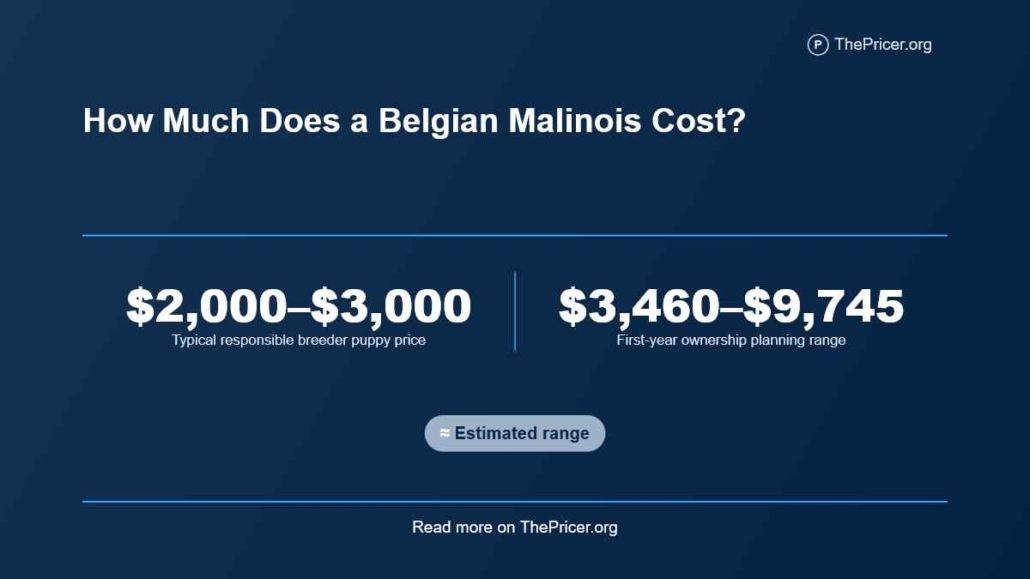
A Belgian Malinois puppy from a responsible U.S. breeder commonly costs about $2,000 to $3,000 in 2026, although current classified listings can fall below $1,000 or rise above $4,000. Breed-specific rescue can be much cheaper, with one breed-specific Malinois rescue listing a standard adoption fee of $500. A professionally trained protection dog belongs to a different market and can cost tens of thousands of dollars.
The purchase price is only the first part of the budget. Training, food, veterinary care, preventatives, crates, secure equipment, pet care, and emergency bills can add thousands during the first year. For a high-drive working breed such as the Belgian Malinois, the cheapest puppy is not automatically the lowest-cost path. Health-tested parents, temperament, early development, training needs, and the dog’s intended role can change both the upfront price and the money spent later.
Article Highlights
Jump to sections
- Responsibly bred Belgian Malinois puppies commonly run about $2,000 to $3,000 (at $30 per hour, earning that amount would take about 1.7 to 2.5 full-time workweeks, before taxes).
- Current classified examples include purebred puppies from about $700 to $4,500.
- One breed-specific rescue charges a general adoption fee of $500.
- A puppy purchase plus a broad 2026 puppy-care budget can put first-year spending around $3,460 to $9,745.
- Adult dog care can run about $1,930 to $5,305 per year before unusual emergencies.
- Professional training deserves its own budget because Belgian Malinois need sustained physical and mental work.
How Much Does a Belgian Malinois Cost?
Current market evidence shows why one price cannot describe every Malinois. Good Dog says responsibly bred puppies nationally usually cost $2,000 to $3,000 (about 1.7 to 2.5 full-time workweeks at $30 per hour). Puppies.com currently shows purebred examples from roughly $700 to $4,500 among its Belgian Malinois listings. Woof Project lists a general adoption fee of $500. At the far other end, one 2026 protection-dog provider quotes trained family protection dogs around $45,000 to $75,000.
| Belgian Malinois purchase route | Current price example | What the price represents |
|---|---|---|
| Breed-specific rescue | About $500 | Adoption through the cited rescue program |
| Lower-priced classified puppy | About $700 to $1,500 | Current purebred listing examples, quality and testing vary |
| Responsibly bred puppy | About $2,000 to $3,000 | National Good Dog range |
| Higher-priced listed puppy | About $3,000 to $4,500+ | Current classified examples |
| Trained protection dog | $45,000 to $75,000 | One provider’s family protection tier, not a puppy price |
The table should not be read as a quality ladder. A $700 puppy is not automatically poorly bred, and a $4,500 puppy is not automatically well bred. Health testing, pedigree, temperament, working titles, early development, contract terms, and the breeder’s support matter more than the sticker price alone. A trained protection dog is also not comparable with an eight-week-old puppy because much of its price reflects professional selection and training already invested in the adult dog.
What You Are Buying
 The Belgian Malinois is a medium, athletic herding dog developed around Malines, or Mechelen, in Belgium. In the United States, the American Kennel Club treats the Malinois as a distinct breed. AKC describes adults at 22 to 26 inches tall and 40 to 80 pounds, with a short coat ranging from rich fawn to deep mahogany and a dark mask. Its breed suitability guidance emphasizes high energy, strong work drive, early socialization, and substantial daily activity.
Those traits matter to cost. An active companion may need structured training, durable gear, frequent exercise, and enrichment. A sport prospect can add club and travel costs. A fully trained assistance or protection dog is a separate purchase from a pet puppy. Compare that market with the cost of a service dog rather than using a trained adult’s price as evidence for normal puppies.
What a Breeder Price Includes
A higher breeder price has more value when it is tied to verifiable health and breeding work. AKC lists three recommended Malinois tests from the national breed club, covering hips, elbows, and an ophthalmologist evaluation. The current American Belgian Malinois Club code requires referral-list breeders to use breeding dogs at least two years old with passing hips, normal elbows, and normal eyes under its 2026 breeder standards.
Paperwork alone is not the same as parental health testing. A puppy may come with registration, a microchip, vaccines, deworming, a veterinary exam, and a contract, yet buyers should still verify the sire and dam’s screening results. The Orthopedic Foundation for Animals explains that submitted normal results are available through its public health database. That gives a buyer a way to check records rather than relying only on a verbal statement.
Working titles and pedigree can raise the price because some buyers are paying for a particular sport or working background. That extra cost only makes sense when the buyer actually needs those traits. A household seeking an active companion does not automatically benefit from paying more for a puppy selected for an advanced working role. The contract, return policy, temperament match, breeder support, and proven health work can be more useful than a long list of titles that does not match the buyer’s plans.
Adoption and Rescue Costs
Adoption can cut the acquisition cost sharply. American Belgian Malinois Rescue says its adoption process includes an application, reference checks, and a home inspection, with fees varying by individual dog. Breed-specific rescues can also know more about a dog’s behavior in a home setting than a short shelter intake can reveal. That can be valuable with a breed whose drive and handling needs vary from dog to dog.
A rescue price should not be compared with a breeder price as if both purchases contain the same things. An adopted adult may already be spayed or neutered, microchipped, vaccinated, crate trained, or house trained. Another dog may need extensive behavior work, medical care, or secure management. The lower acquisition fee can leave more room for training and equipment, but it does not guarantee a lower first-year total.
Availability is another limit. A prospective owner may not find the right Malinois locally at the exact time they want one. Breed experience, household setup, other pets, children, fencing, and training plans can affect rescue placement. Readers comparing lower-cost companion breeds can also look at the American Eskimo purchase cost, but the Malinois has a much different activity and handling profile.
First-Year Ownership Cost
The purchase price can become a minority of first-year spending. Rover’s 2026 dog-cost research puts annual puppy care at about $1,460 to $6,745 (about 1.2 to 5.6 full-time workweeks at $30 per hour). Its category estimates include food at $575 to $4,775, training at $235 to $385, preventatives at $295 to $355, pet insurance at $175 to $880, and vet visits at $145 to $305. These are broad U.S. dog costs rather than Malinois-only figures.
Pairing the Good Dog breeder range with Rover’s puppy-care range creates a useful first-year planning scenario. A $2,000 puppy plus $1,460 in puppy-year care equals $3,460. At the higher ends, a $3,000 puppy plus $6,745 equals $9,745. The calculated range excludes unusual emergency treatment and avoids pretending every Malinois household will spend the same amount.
A more focused mid-price scenario starts with a $2,500 puppy. Add Rover’s low-end puppy figures for food at $575, training at $235, preventatives at $295, insurance at $175, and vet visits at $145. Those listed categories total $1,425, producing $3,925 before crates, beds, leashes, toys, dental care, and other supplies. If a breeder already covered early vaccines or microchipping, do not add those items twice.
Shipping should not be assigned one fixed national number. Buyer pickup, breeder delivery, ground transport, airline rules, distance, crate requirements, and health documentation can create very different totals. Ask for the transport method and exact charge before comparing an out-of-state puppy with a local one.
Training Is a Major Cost
Training is unusually important for this breed. AKC says Belgian Malinois need early socialization and puppy classes, and that ordinary daily walks are not enough for their physical and mental needs. Its Malinois breed guidance describes the breed as highly trainable but demanding, with extensive training and regular exercise required.
Rover’s current dog-cost data puts a typical professional training session around $113 and a puppy-year training budget around $235 to $385. Those figures can cover a modest amount of professional help, but a Malinois needing private lessons, sport training, behavior work, or advanced obedience can exceed that budget. The broader dog training price guide shows why group classes, private lessons, and board-and-train programs should not be treated as one service.
The hidden expense is repetition. One training package does not remove the owner’s daily work. A high-drive dog that lacks structure can create costs through damaged gear, replacement toys, extra walking or pet-care services, and later behavior help. Spending more on appropriate early instruction can be financially preferable to buying specialized training only after a serious handling problem appears. The exact program should match the dog’s temperament and the owner’s goals rather than the breed’s police-dog image.
Annual and Lifetime Costs
After puppyhood, Rover estimates adult dog care at about $1,930 to $5,305 per year. Its medium-dog monthly benchmark is $145 to $505. A Belgian Malinois can sit near the boundary between medium and large dogs, so food, medication, boarding, and equipment costs will depend on the individual dog’s weight and activity. The current benchmarks point to a much larger monthly budget.
Food is one of the largest variables. A fixed cups-per-day instruction is not appropriate because calorie density differs by food, and needs change with age, body condition, activity, reproductive status, and health. Use the feeding chart for the selected food as a starting point and adjust with veterinary guidance. A working or sport dog can have a very different energy requirement from a companion dog of the same weight.
Long-term totals are large enough to change the purchase decision. Rover reports a 2026 lifetime range of $35,415 to $43,285 for a medium dog and up to $58,875 for a large dog. Those are not Malinois-specific forecasts, but they show why arguing over a few hundred dollars in puppy price can miss the larger financial commitment. Veterinary emergencies can also create sudden bills, with Rover listing emergency visits starting around $300 and potentially rising into the thousands.
Pet sitting, boarding, dog walking, insurance, sport fees, replacement gear, and travel can push an active owner’s total higher. A household that cannot leave the dog alone for long periods may spend more on care services than one with a schedule built around the dog.
Choosing the Right Purchase Path
Price should follow the job the dog is expected to do. A household companion from health-tested lines, a sport prospect, an adopted adult, and a fully trained protection dog solve different needs. Comparing them by purchase price alone creates a false bargain. The responsible choice is the dog whose temperament, training demands, health background, and role fit the household’s time and budget.
A cheaper puppy can become expensive if health records are poor or the temperament is a bad match. A higher-priced puppy can also be a poor purchase if the buyer is paying for working traits they do not need. Rescue can reduce acquisition cost, yet some dogs need added training or management. Compare the expected first-year total with the purchase price before deciding.
Makes sense if
- You have substantial time for daily training, exercise, and mental work.
- You can verify parental health testing when buying from a breeder.
- Your first-year budget extends well beyond the puppy price.
- The selected dog’s drive and temperament fit your household and intended activities.
Does not make sense if
- You are choosing the breed mainly because of its police or military reputation.
- You expect one obedience course to cover the dog’s lifelong training needs.
- Your budget leaves little room for veterinary emergencies or professional help.
- You want a low-activity dog that can spend long periods without structured engagement.
What We Verified
- Checked the current ABMC referral list, valid from June 2026 through May 2027.
- Confirmed the official AKC standard gives males a height of 24 to 26 inches and females 22 to 24 inches.
- Cross-referenced the AKC lifespan listing, which places Belgian Malinois at 14 to 16 years.
Answers to Common Questions
How much is a Belgian Malinois puppy?
A responsibly bred Belgian Malinois puppy commonly costs about $2,000 to $3,000 in the U.S., although classified listings can fall below or above that range.
How much does it cost to adopt a Belgian Malinois?
Breed-specific rescue fees vary. One breed-specific Malinois rescue currently lists a general adoption fee of $500, while other rescues set fees by the individual dog.
How much can the first year cost?
Combining a $2,000 to $3,000 responsibly bred puppy with broad 2026 puppy-care estimates produces a planning range of about $3,460 to $9,745 before unusual emergency expenses.
What health tests should a Belgian Malinois breeder do?
The U.S. national breed-club recommendations include hip, elbow, and ophthalmologist evaluations for breeding dogs.
How long do Belgian Malinois live?
AKC lists the Belgian Malinois lifespan at about 14 to 16 years.
Disclosure: Educational content, not medical advice. Pricing varies by provider, location, and insurance. Confirm eligibility, coverage, and out-of-pocket costs with a licensed clinician and your insurer. See our methodology and corrections policy.