
How Much Does a Boat House Cost?
Updated on | Researched and reviewed by Alec Pow, Founder & Pricing Investigator
Prices, claims, and calculations checked against 10 cited sources. See our research methodology and corrections policy.
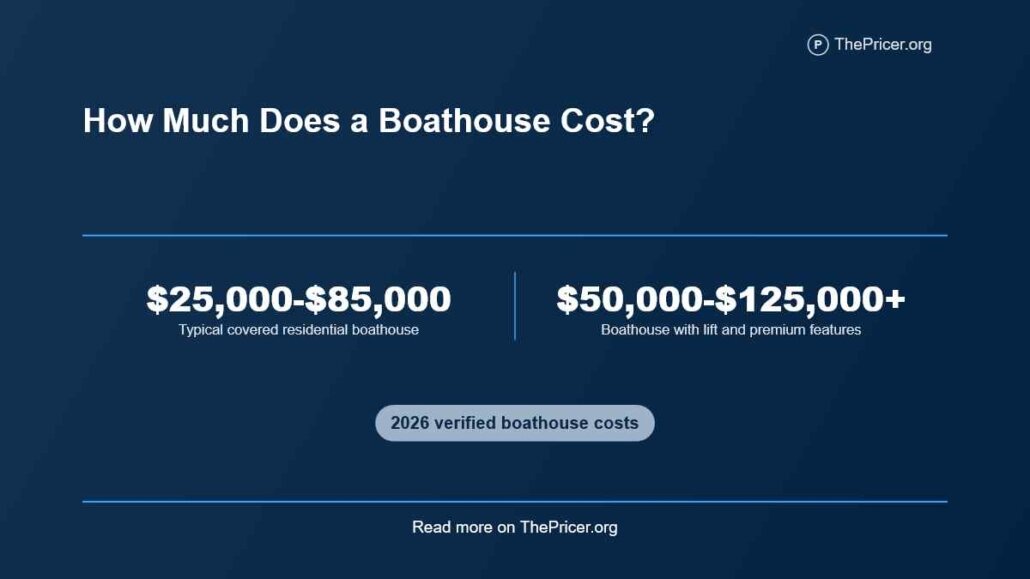
A residential boathouse typically costs about $25,000 to $85,000 in 2026 for a covered single- or double-slip structure. A more complete project with premium decking, electrical service, storage, and a boat lift commonly costs $50,000 to $125,000+. Large custom boathouses with multiple slips, heavy lifts, shoreline work, enclosed rooms, or difficult foundations can exceed $150,000 to $250,000.
The biggest cost difference is not simply square footage. Water depth, pile driving, dock structure, boat-lift capacity, shoreline condition, permitting, electrical work, materials, and whether local rules allow enclosed or habitable space can change the project by tens of thousands of dollars.
Article Highlights
Jump to sections
- A basic covered single-slip boathouse commonly costs about $25,000-$50,000.
- A standard boathouse with storage and better finishes usually costs $40,000-$85,000.
- A dock, lift, and covered boathouse package often runs $45,000-$125,000+.
- Premium double-slip and aluminum/composite structures can cost $75,000-$130,000+.
- A residential boat lift alone can add roughly $4,000-$20,000+.
- Shoreline or bulkhead work can add tens of thousands of dollars before the boathouse is even built.
- Federal, state, lake-authority, county, floodplain, HOA, and local approvals may all apply.
- Do not assume you can legally build living quarters over the water simply because the structure is called a boathouse.
How Much Does a Boathouse Cost?
Current contractor pricing gives a much clearer picture than older national estimates.
Texas Boat House currently quotes an average boathouse range of $20,000 to $85,000 for the lake and waterfront projects it builds.
A more detailed July 2026 Cedar Creek Lake market analysis based on licensed contractor pricing puts a basic covered single-slip structure at roughly $25,000 to $45,000. A standard single-slip boathouse with storage is about $40,000-$65,000, while a double-slip structure runs around $55,000-$85,000.
| Boathouse Type | Typical 2026 Cost |
|---|---|
| Basic covered single slip | $25,000-$50,000 |
| Single slip with storage / electrical | $40,000-$70,000 |
| Double-slip boathouse | $55,000-$90,000 |
| Composite / premium materials | $55,000-$100,000+ |
| Dock + lift + covered boathouse | $45,000-$125,000+ |
| Large custom waterfront structure | $100,000-$250,000+ |
On Lake Norman, a current 2026 guide puts a standard dock plus covered boathouse roof around $25,000 to $50,000 and a complete dock, lift, and boathouse at approximately $45,000 to $80,000+.
What Counts as a Boathouse?
The word “boathouse” covers several very different projects.
At the simple end, it may be little more than a dock with a roof over one boat slip.
A larger structure may include:
- one or two boat slips;
- boat lifts;
- storage lockers;
- an equipment room;
- covered deck space;
- lighting and electrical outlets;
- fish-cleaning or utility stations;
- upper sun decks.
That is very different from a structure with a kitchen, bathroom, bedrooms, HVAC, and permanent living space.
The old assumption that a typical “livable boathouse” is simply the next pricing tier should be approached carefully. Waterfront authorities, zoning codes, floodplain rules, wastewater rules, and lake operators can severely restrict enclosed or habitable structures over water.
Dock Cost First
The boathouse roof and walls are often being built on top of an already expensive marine structure.
Current 2026 Angi project data puts professional dock construction at an average of about $15,048, with most reported projects between $4,074 and $26,021.
Typical dock construction costs run around $15 to $40 per square foot, although specialized piling, crib, and suspension structures can reach much higher.
A simple dock and a roof may therefore be a $30,000 project, while the same roof over a large permanent piling dock with premium decking may quickly become a $60,000-$100,000 project.
Pilings and Water Depth
The foundation is one of the most difficult expenses to estimate without visiting the property.
Pilings may need to be driven through soft lakebed sediment until they reach sufficient bearing resistance. Deep water, poor soil, waves, tidal conditions, and limited barge access can increase the cost considerably.
Current dock-piling cost data puts many complete piling projects around $4,000 to $25,000, with water depth and site access among the largest variables.
This is why two identical-looking 24-foot boathouses on different shorelines can have radically different construction bills.
Boat Lift Cost
A lift is one of the largest optional components.
Current equipment prices show how quickly capacity changes the budget.
Boat Lift Warehouse currently lists a 5,000-pound four-piling aluminum lift around $9,453, a 7,000-pound model around $9,466, and a 10,000-pound lift around $10,023 before site-specific installation costs.
Other overhead boathouse lift kits can cost less. Boat Lift Distributors currently lists a saltwater-rated 8,000-pound boathouse cradle kit at about $4,070 before shipping and installation.
Our current guide to boat lift costs puts many professionally installed residential lifts around $4,000 to $20,000, with larger coastal and hydraulic systems costing significantly more.
The Hidden Price
The boathouse itself may not be the largest surprise.
A weak or eroding shoreline can require a new bulkhead, riprap, retaining work, dredging, or bank stabilization before marine construction begins.
Current 2026 estimates from one Texas marine contractor put residential bulkheads at approximately $330 to $830 per linear foot, depending mainly on access and site complexity.
A 75-foot shoreline at $500 per foot would therefore add:
75 × $500 = $37,500.
That cost has nothing to do with the roof, decking, or lift, yet it can completely change whether the project fits the owner’s budget.
Other hidden expenses can include:
- demolition of an old dock;
- engineering drawings;
- surveying;
- electrical trenching from the house;
- GFCI-protected marine electrical work;
- water lines;
- dredging;
- erosion control;
- lift remotes and accessories;
- permit drawings;
- HOA review;
- construction access by barge.
Permits Matter
Owning the waterfront property does not automatically give the owner the right to build into the water.
The U.S. Army Corps of Engineers states that work or structures in, over, or under navigable waters may require authorization under Section 10 of the Rivers and Harbors Act. Placing dredged or fill material into waters or wetlands can also trigger Section 404 requirements.
State agencies, lake authorities, cities, counties, floodplain administrators, and homeowners associations can impose additional requirements.
Interestingly, federal permit fees themselves are not necessarily expensive. The Corps says many general permits have no federal permit fee, while an individual permit is generally $10 for an individual or $100 for a business after approval.
The expensive part can be the drawings, engineering, survey work, environmental review, revisions, and delays required to obtain approval.
Before buying materials, confirm what structures are actually permitted on that specific shoreline.
Flood Rules
Flood-zone requirements can also affect the design.
FEMA classifies boathouses as potential accessory structures and notes that National Flood Insurance Program construction requirements can apply to new or substantially improved accessory structures in regulated flood areas.
Coastal construction can face additional requirements involving elevation, flood loads, wave action, breakaway construction, erosion, and obstruction of floodwater.
This is another reason a land-based price-per-square-foot estimate cannot simply be applied to a boathouse.
Worked Example
Consider a fairly typical one-slip freshwater boathouse with a lift and composite decking.
| Item | Example Cost |
|---|---|
| Piling dock / structural platform | $24,000 |
| Roof and boathouse framing | $16,000 |
| Composite decking upgrade | $7,000 |
| 8,000-10,000 lb boat lift | $9,000 |
| Electrical work and lighting | $4,000 |
| Engineering / permits / survey | $3,500 |
| Contingency | $6,500 |
| Total | $70,000 |
The roof and visible boathouse portion represents only about 23% of the $70,000 project. The supporting dock, lift, electrical system, professional fees, and contingency account for the majority.
If the shoreline also needs $30,000 of bulkhead work, the same apparent “$70,000 boathouse” becomes a $100,000 waterfront project.
At earnings of $30 per hour, a $40,000 boathouse represents about 1,333 hours of gross earnings. A $70,000 project equals roughly 2,333 hours, while a $125,000 premium project represents about 4,167 hours.
Real Project Example
Actual public construction bids provide another useful reality check.
In November 2025, a contractor submitted a public quote to the City of Aransas Pass, Texas, for a 22-by-35-foot open-gable boathouse.
The scope included treated saltwater pilings, glulam structural beams, treated framing, galvalume roofing, stainless hardware, an aluminum lift beam, and an electric winch.
The quoted labor-and-material total was $62,300.
That example is especially useful because it is neither a bare dock nor a luxury waterfront residence. It is a real marine structure with pilings, roof framing, and lift hardware, and its price lands directly inside the current $40,000-$85,000 mainstream boathouse range.
Living Space
A bathroom, kitchenette, guest room, or full living area changes the project completely.
Water and sewer service may trigger sanitary regulations. Habitable space may have to comply with residential building, structural, electrical, energy, flood, and egress codes.
More importantly, some waterfront authorities do not permit habitable boathouses at all, or limit the size and type of enclosure allowed over the water.
Do not design a $250,000 second-story apartment until the lake authority, zoning department, floodplain administrator, and building official confirm that such a structure is legal.
Where living space is permitted, pricing begins to resemble custom waterfront construction rather than ordinary dock construction, making $150,000 to $500,000+ entirely possible.
Materials and Lifespan
Treated wood still offers the lowest upfront cost for many freshwater docks.
Composite decking costs more but reduces staining and board-replacement work. Aluminum framing can substantially increase initial cost while reducing rot and insect concerns.
The current Cedar Creek analysis puts a treated-wood single-slip boathouse around $40,000-$65,000 but a comparable composite-deck structure around $55,000-$90,000. A double-slip aluminum-frame and composite project reaches roughly $75,000-$130,000.
Stainless fasteners, marine-grade electrical components, corrosion-resistant hardware, and properly treated structural lumber are worth budgeting for because the waterfront environment is unusually hard on building materials.
Maintenance Costs
The source article’s $500-$1,500 per month utility estimate is not a sensible general rule for an ordinary boathouse.
A simple dock with LED lighting and a boat lift may use very little electricity. A climate-controlled habitable structure with plumbing is a completely different case.
Maintenance costs should instead be tied to the actual structure.
Texas Boat House currently advertises pressure washing starting at $399 and piling protection at $80 per piling, providing a current benchmark for smaller maintenance items.
Longer-term expenses can include:
- deck staining or sealing;
- roof repair;
- replacing damaged boards;
- electrical repairs;
- boat-lift cable and motor work;
- piling repair;
- storm damage;
- shoreline stabilization.
For owners deciding whether private waterfront storage is worth the capital expense, our guide to boat storage costs provides a useful comparison with marina slips, dry storage, and indoor storage.
Is It Worth Building?
 The economics depend heavily on how much the owner boats and what the alternative costs.
A $60,000 boathouse does not make financial sense purely because it eliminates a $1,000 annual storage bill.
But the calculation changes for someone already paying $4,000-$6,000 per year for a marina slip and who values immediate access from their own property.
At $5,000 per year, avoiding marina storage for 15 years represents $75,000 in nominal avoided slip costs before considering maintenance, financing, property value, or the time value of money.
The boathouse may also protect an expensive boat from UV exposure and weather and eliminate repeated launching and trailering.
Before choosing lift capacity, use the fully loaded weight of the actual boat rather than the hull’s dry weight. Our guide to boat costs helps put the storage project in context with the underlying vessel purchase.
What We Verified
We compared current 2026 contractor pricing in Texas, Cedar Creek Lake, Lake Norman, and Lake Anna with national dock-cost data, current boat-lift pricing, marine construction bids, shoreline construction costs, and federal permitting guidance from the U.S. Army Corps of Engineers and FEMA.
The strongest current evidence supports roughly $25,000 to $85,000 for many conventional covered residential boathouses. Adding premium materials, a major lift, double slips, substantial electrical work, or difficult marine construction commonly pushes the budget into the $50,000 to $125,000+ range.
We also corrected the old treatment of large “livable boathouses” as though they were simply a normal upgrade tier. Whether habitable construction over water is permitted is highly location-specific and should be established before using residential construction costs in the budget.
Answers to Common Questions
How much does a boathouse cost?
A conventional residential boathouse typically costs about $25,000 to $85,000. A premium project with lift, composite decking, multiple slips, electrical work, and difficult foundations can cost $100,000 to $250,000 or more.
How much does a boathouse with a boat lift cost?
A realistic current budget is about $45,000 to $125,000+. The lift alone can add roughly $4,000 to $20,000 or more depending on boat weight and installation conditions.
How much does a simple covered dock cost?
Current regional pricing commonly starts around $25,000 to $50,000 for a straightforward covered single-slip dock, although easy sites can cost less and difficult marine construction can cost more.
Do I need a permit for a boathouse?
Usually some form of approval is required. Depending on the waterway, that can involve a lake authority, local building department, floodplain office, state agency, homeowners association, or the U.S. Army Corps of Engineers.
Can I build living quarters above a boathouse?
Only where local regulations specifically allow it. Some jurisdictions restrict enclosed or habitable space over water, so confirm zoning, flood, wastewater, and lake-authority rules before designing living quarters.
How much does it cost to maintain a boathouse?
A simple structure may cost only hundreds of dollars in routine annual maintenance, while larger structures with lifts, electrical systems, premium decking, shoreline structures, and storm exposure can require thousands in periodic repairs.
Disclosure: Educational content, not financial advice. Prices reflect public information as of the dates cited and can change. Confirm current rates, fees, taxes, and terms with official sources before purchasing. See our methodology and corrections policy.