
How Much Does a Corgi Cost?
Updated on | Written by Alec Pow
This article was researched using 14 sources. See our methodology and corrections policy.
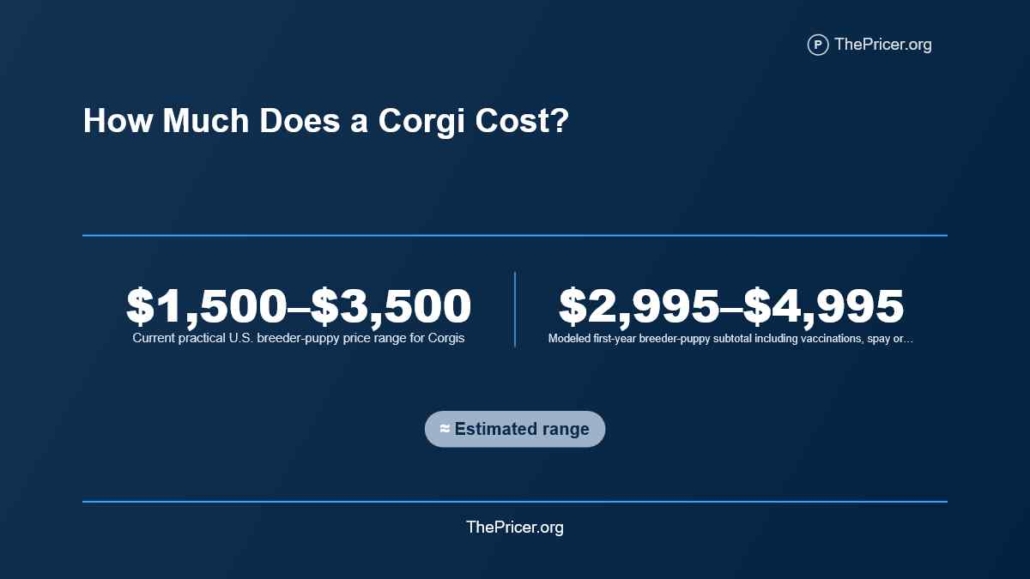
A practical current U.S. breeder budget for a Corgi puppy is about $1,500 to $3,500, with higher prices for full registration, breeding rights, specialty coats, or older started puppies. Good Dog’s national Pembroke price guidance places many puppies at $1,500 to $2,500, while current Hallebrook breeder pricing is $2,500 to $3,500. Rescue adoption can cost far less, though breed-specific rescues rarely have young puppies available.
The Corgi name covers two distinct breeds, the Pembroke Welsh Corgi and the Cardigan Welsh Corgi. Purchase price is only the opening expense. Vaccinations, sterilization if applicable, insurance, food, training, grooming, supplies, and transport can move the first-year cash requirement well above the puppy’s advertised price.
Article Highlights
Jump to sections
- A practical breeder-puppy budget is about $1,500 to $3,500 (at $30 per hour, earning that amount would take about 1.3 to 2.9 full-time workweeks, before taxes).
- Current Cardigan listings reach $4,000 with full registration.
- A current started Pembroke puppy program begins at $4,200.
- One breed rescue requests about $400 for adoption.
- A modeled breeder-puppy first-year subtotal reaches about $2,995 to $4,995 before food, supplies, training, grooming, and unexpected care.
How Much Does a Corgi Cost?
Current prices span several distinct markets. The national Pembroke range in the opening is lower than some direct breeder price lists. Shadey Lane currently lists Cardigan puppies at $3,000 with limited registration and $4,000 (about 3.3 full-time workweeks at $30 per hour) with full registration. Celtic Corgis lists a standard Pembroke at $3,000, a full-fluff puppy at $3,800, and a started puppy from $4,200. Pembroke Welsh Corgi Club of the Potomac Rescue asks for an adoption donation near $400.
These figures should not be blended into one national average. A companion puppy sold on limited registration, a full-registration puppy with breeding rights, a trained older puppy, and an adult rescue dog are different purchases. Location also matters, but breeder program, registration status, age, health screening, and included care often explain more of the price difference than sex alone.
| Corgi option | Current price | Scope |
|---|---|---|
| Pembroke breeder market | $1,500 to $2,500 | National Good Dog guidance |
| Direct Pembroke breeder | $2,500 to $3,500 | Hallebrook companion puppies |
| Cardigan breeder example | $3,000 limited or $4,000 full | Shadey Lane current litter |
| Started Pembroke example | $4,200+ | Celtic Corgis, about four months old |
| Pembroke rescue example | About $400 | PWCCP Rescue adoption donation |
The lowest price is not automatically the best value. A breeder price can include registration, early veterinary care, socialization, a contract, health guarantees, and documented screening of the parents. A rescue fee can include medical work that would otherwise be paid separately. The buyer has to compare the package behind the number.
Pembroke vs. Cardigan
Pembroke Welsh Corgis and Cardigan Welsh Corgis are separate breeds, not two varieties of the same breed. The American Kennel Club’s breed comparison explains that they have different ancestry, structure, coat-color standards, and tail characteristics. Cardigans are heavier-boned and can reach about 38 pounds, while Pembrokes are smaller and top out around 30 pounds. Both are members of the Herding Group. Those differences matter when comparing breeder programs.
Current asking prices overlap heavily. A buyer should not assume Cardigans always cost more because they are less common, or that Pembrokes always cost less because they are more familiar. The direct Cardigan example above reaches $4,000 (about 3.3 full-time workweeks at $30 per hour) with full registration, while current Pembroke programs can reach $3,500 to $4,200+ depending on coat, age, registration, and included training.
The breed choice also changes future expenses in small ways. Cardigans are larger, which can affect food use, equipment sizing, and some service prices. Both have double coats and need regular brushing. Readers comparing another compact companion breed can also look at current Pug purchase costs, but the health profile, build, exercise needs, and breeder market are different.
Breeder vs. Rescue Costs
Buying from a breeder gives the widest puppy selection, but the price can be several times a rescue fee. The breeder market also contains very different programs. Some puppies are sold strictly as companions on limited registration. Others include full registration or breeding rights, and some breeders charge more for a specialty coat or for an older puppy that has received extra training and veterinary work.
Breed rescue works differently. The PWCCP program cited above requests about $400 and says its dogs are up to date on vaccinations, heartworm negative, spayed or neutered, and treated for existing medical conditions before placement. Most of its rescues are adults rather than puppies. That means the lower acquisition price can also replace some initial veterinary spending, but the buyer gives up the predictable age, litter choice, and timing that come with a breeder purchase.
Rescue availability can be limited. Applicants may wait for a dog that fits their household, and some programs serve only specific states. A rescue fee should not be compared with a breeder puppy price as though the products are identical. The right comparison includes age, included veterinary care, temperament information, registration rights, and how much choice the buyer has.
What Raises the Puppy Price?
Registration rights can create a large premium. Using the Shadey Lane Cardigan prices already listed, limited registration costs $3,000 and full registration costs $4,000. The extra breeding-rights access adds $1,000, or about 33% above the limited-registration price. That is a breeder-specific example, not a rule that every full-registration Corgi carries the same markup.
Age and included work can also raise the bill. Celtic’s standard smooth-coat puppy is $3,000, while its started puppy begins at $4,200. The $1,200 difference is a 40% premium in that program. The started puppy includes more time with the breeder, completed vaccinations, established potty training, crate and leash introduction, and a known temperament profile. Paying more for an older puppy can buy services that the owner would otherwise arrange separately.
Transport is another hidden purchase cost for buyers shopping outside driving distance. Cargo, a flight nanny, ground transport, airline carriers, and breeder travel can all change the final amount. Some breeders also use waitlist fees or deposits, so buyers should ask which payments apply to the final purchase price and which are nonrefundable.
Sex alone is a weak pricing rule. Some breeders charge one price for males and females, while other sellers may have demand-driven differences. Registration rights, breeder program, health screening, coat, age, training, and transport are stronger variables to check before assuming a female puppy must cost more.
First-Year Corgi Cost
The purchase price can be only part of the first-year cash requirement. A current U.S. puppy vaccination series has a typical price of $291 in Vetpriced’s 2026 published-price dataset, though its documented range is much wider. A dog spay or neuter has a typical price of $455 in the same 2026 dataset, with low-cost clinics and full-service hospitals pricing the procedure very differently.
Pet insurance can add another recurring bill. NAPHIA’s latest publicly surfaced U.S. average in its 2025 industry report puts dog accident-and-illness coverage at $749.29 per year, or $62.44 per month. A Corgi quote can differ by age, ZIP code, deductible, reimbursement level, and insurer, so that figure is a market benchmark rather than a Corgi-specific quote.
A ThePricer modeled breeder-puppy subtotal uses a $1,500 to $3,500 purchase price, $291 for the vaccination series, $455 for spay or neuter if applicable, and $749.29 for one year of accident-and-illness insurance. The result is about $2,995.29 to $4,995.29. Rounded for planning, that is roughly $2,995 to $4,995 before food, crate, bed, collar, leash, toys, parasite prevention, grooming, training, routine exams outside the cited vaccine series, and unexpected care.
A rescue can produce very different first-year math. Using the PWCCP $400 adoption figure and the same $749.29 insurance benchmark gives $1,149.29 before recurring ownership costs. That rescue already reports vaccinations and sterilization as completed, so adding the $291 vaccine series and $455 procedure again would double-count those services. The comparison is not like-for-like because rescue dogs are usually older and availability is limited.
Ongoing Ownership Costs
Food is one of the steady monthly expenses. A Corgi’s exact bill depends on body weight, calorie needs, food type, package size, and whether the dog needs a veterinary diet. A medium-size Cardigan can eat more than a smaller Pembroke, so owners should budget by the individual dog’s feeding amount rather than use one breed-wide bag price. Current dog food costs show how dry, wet, and premium diets can produce very different annual totals.
The double coat also creates recurring grooming work. Many owners can handle routine brushing and bathing at home, while professional visits add a service bill. Corgis normally need brushing, bathing, nail care, and seasonal de-shedding rather than routine full-body clipping. Readers who use a salon can compare current dog grooming prices with the cost of brushes, shampoo, nail tools, and home bathing.
Training belongs in the budget too. Both breeds were developed to move cattle and can be active, vocal, and persistent. Puppy classes or private coaching can help with leash manners, recall, handling, and household rules. Current dog training costs vary sharply between group classes, private sessions, and residential programs.
Insurance is optional, but the annual premium can become one of the larger predictable expenses. Owners comparing coverage can use the current pet insurance cost guide to separate accident-only, accident-and-illness, deductibles, reimbursement rates, and wellness products. Routine care and insurance should be budgeted separately because standard accident-and-illness policies do not automatically pay every preventive expense.
Health and Breed Differences
Responsible breeder screening has financial value because inherited orthopedic, eye, cardiac, and neurologic problems can create large veterinary bills later. The AKC’s current parent-club testing requirements list hip and ophthalmologist evaluations for Pembrokes. For Cardigans, the listed recommendations include patella, hip, elbow, eye, and basic cardiac evaluations. A breeder should be able to show results for the parents rather than rely on a verbal claim that the line is healthy.
Health screening reduces uncertainty but cannot guarantee a disease-free dog. Both breeds can face orthopedic and neurologic problems, and the relevant risks are not identical. Weight management matters because extra body weight can add stress to a long-backed, short-legged dog. Veterinary advice should guide feeding, exercise, and any medical screening rather than a generic breed checklist.

The breeds also differ physically. Cardigans are larger and have long foxlike tails. Pembrokes are smaller and are commonly associated with a shorter tail in the U.S. breed standard. Both carry double coats and shed. Neither should be described as a Working Group breed today. They are Herding Group dogs with cattle-driving ancestry.
Life expectancy for a well-cared-for Corgi can extend into the low-to-mid teens, which turns recurring food, veterinary, grooming, training, and insurance spending into a long commitment. Purchase price deserves attention, but health and care costs shape the larger lifetime budget.
Choosing a Corgi Seller
A lower asking price can become expensive if the seller cannot document parent health screening, veterinary care, pedigree, registration status, or a written contract. The Pembroke Welsh Corgi Club of America advises buyers to check breeder records carefully, including the sales contract, parent information, health guarantee, veterinarian history, and pedigree. It also warns about online puppy scams where the advertised dog does not exist.
Ask what the purchase price includes before paying a deposit. Useful items are registration status, vaccination and deworming records, microchip if supplied, health certificate, return policy, breeder support, and any restrictions on breeding. If the seller charges a waitlist or reservation fee, find out whether it is refundable and whether it is credited toward the puppy price.
Makes sense if
- The breeder provides documented health screening for both parents.
- The contract states the puppy price, registration status, health terms, and return policy.
- You have budgeted beyond the purchase price for the dog’s first year and long-term care.
- The breed’s activity, shedding, barking, and training needs fit your household.
Does not make sense if
- The seller refuses live communication or current proof that the puppy exists.
- The only selling point is a rare color, sex, or vague champion-line claim.
- The breeder cannot explain health testing or provide a written agreement.
- Your budget covers the puppy but not veterinary care, food, training, grooming, and emergencies.
Answers to Common Questions
How much does a Corgi puppy cost?
Many breeder-sold Corgi puppies cost about $1,500 to $3,500, while full-registration, specialty-coat, or started puppies can reach $4,000+.
How much does it cost to adopt a Corgi?
Current breed-rescue examples run around $400 to $500, with fees varying by organization and age.
Are Cardigan Corgis more expensive than Pembrokes?
Not automatically. Current prices overlap, and registration rights, health screening, age, and included care can matter more.
How much should I budget for the first year?
The modeled breeder-puppy subtotal above is about $2,995 to $4,995 before food, supplies, training, grooming, and unexpected veterinary care.
Why can an older puppy cost more?
A started puppy may include extra care, completed vaccinations, basic training, and a more established temperament profile.
Disclosure: Educational content, not medical advice. Pricing varies by provider, location, and insurance. Confirm eligibility, coverage, and out-of-pocket costs with a licensed clinician and your insurer. See our methodology and corrections policy.