
How Much Does a Road Force Balance Cost?
Updated on | Written by Alec Pow
This article was researched using 7 sources. See our methodology and corrections policy.
A road force balance typically costs about $20 to $40 per tire, or roughly $80 to $160 for all four tires. Some shops charge less when the service is part of a tire installation package, while dealerships, specialty performance shops, large wheels, and difficult vibration problems can push a four-wheel road-force service above $150 to $200.
Road force balancing is different from a normal spin balance. A standard balancer corrects weight imbalance, while a road-force machine also loads the tire against a roller to measure stiffness variation, wheel runout, and other conditions that can cause vibration even when the wheel is technically balanced. It is most useful when a car still shakes after conventional balancing, when new tires never feel completely smooth, or when a bent wheel or out-of-round tire is suspected.
Article Highlights
Jump to sections
- Road force balancing typically costs about $20 to $40 (at $30 per hour, earning that amount would take about 0.7 to 1.3 hours of work, before taxes) per tire.
- Expect roughly $80 to $160 for all four tires.
- Standard wheel balancing is cheaper, commonly around $10 to $18 per tire.
- Hunter’s current Road Force Elite uses a load roller capable of applying up to 1,250 pounds of force.
- Road force balancing is especially useful when a normal balance does not eliminate highway-speed vibration.
- The procedure can identify tire stiffness variation, radial or lateral runout, bent wheels, and tire-to-wheel mismatch.
- Some retailers include road-force balancing when needed as part of their tire-purchase service rather than charging a separate fee.
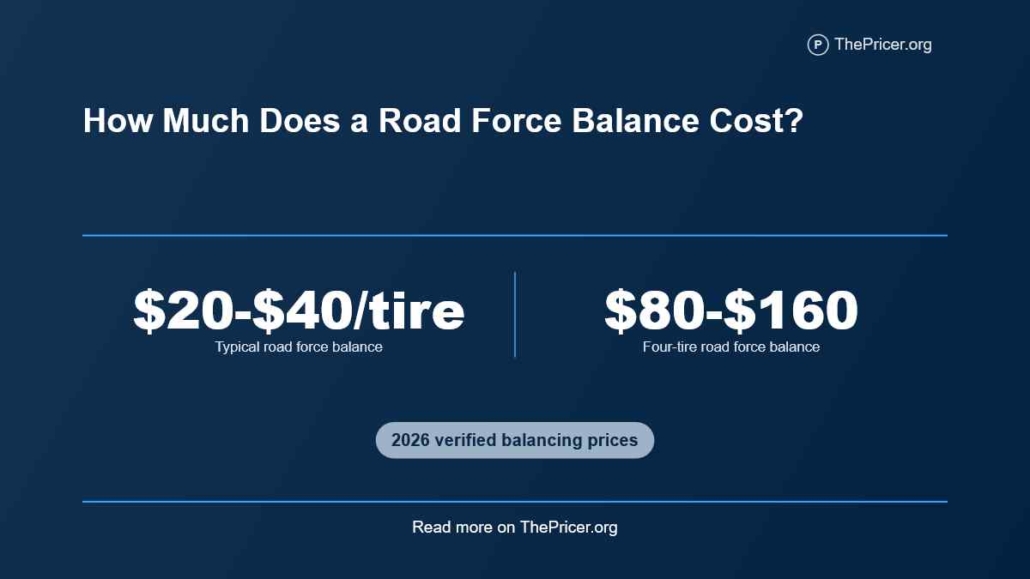
How Much Does a Road Force Balance Cost?
| Service | Typical Cost |
|---|---|
| Standard tire balance | $10-$18 (about 20 to 36 minutes at $30 per hour) per tire |
| Road force balance | $20-$40 per tire |
| Four-tire road force balance | $80-$160 |
| Dealer / performance-shop service | $120-$200+ |
| Road force with match mounting | $100-$200+ |
Our current guide to wheel balancing costs puts a normal balance around $10 to $18 per tire, or about $40 to $72 for four wheels. Road-force balancing generally costs more because the technician performs additional measurements and may need to dismount and rotate the tire on the wheel.
Current tire-shop pricing remains highly local. One 2026 shop operating Hunter Road Force Elite equipment currently charges the equivalent of roughly $80 to $100 for four passenger-car wheels depending on size, while SUV and large-wheel packages cost more.
That pricing is consistent with the broader U.S. market, where shops commonly quote around $20 to $40 per wheel for a full road-force test and balance.
What Road Force Does

A conventional balancing machine spins a wheel and tire in the air and identifies where weight needs to be added or removed to correct static and dynamic imbalance.
A road-force machine goes one step further.
The Hunter Road Force Elite presses a powered load roller against the tire while it spins. The current machine can apply a variable load of up to 1,250 pounds, depending on tire diameter and stiffness.
Hunter says the system measures road-force variation, wheel runout, tire uniformity, and related conditions while also performing the normal balancing operation.
The result is closer to how the tire behaves when supporting the weight of the vehicle on the road rather than spinning freely in the air.
Why Standard Balancing Fails
A wheel can be perfectly balanced by weight and still cause vibration.
MotorWeek explains that a conventional balancer can correct weight distribution while missing an out-of-round tire or a stiff section of the sidewall or tread.
Imagine an egg-shaped wheel that weighs exactly the same on every side. Its weight may be balanced, but it still would not roll smoothly.
Road-force variation is similar. A tire may have one section that compresses less than the rest as it contacts the road, creating a repeating force once per revolution.
This becomes especially noticeable on modern low-profile tires because their shorter, stiffer sidewalls absorb less variation than the taller sidewalls common on older vehicles.
Current Roller Force
Older articles often state that road-force machines apply around 1,400 pounds to the tire. That is not the current Hunter specification.
The latest Hunter Road Force Elite operating manual states that the load roller can apply up to 1,250 pounds.
Hunter also explains that the actual load varies with tire diameter and stiffness and that the machine does not simply apply the maximum force to every tire.
A recent MotorWeek demonstration with Hunter Engineering likewise describes the machine applying approximately 1,250 pounds while measuring tire and wheel behavior.
Match Mounting
The most valuable part of a road-force service may happen after the first measurement.
If the machine finds excessive road-force variation, it can recommend rotating the tire on the wheel so the stiffest point of the tire better matches the lowest point of the rim.
Hunter calls this process ForceMatch.
The company’s technical documentation describes it as matching the tire’s stiffest radial point with the wheel’s low point to reduce the force transmitted through the assembly.
MotorWeek gives a useful real-world example: one tested tire produced 15 pounds of road force, but the machine calculated that repositioning the tire on the rim could reduce the result to about 8 pounds.
This is why the technician may need to deflate and dismount the tire, rotate it on the rim, reinflate it, and test it again.
When It Is Worth It
Road-force balancing is not necessary every time tires are rotated or serviced.
Discount Tire currently recommends it particularly when:
- a vibration remains after standard balancing;
- the problem appeared after striking a pothole or curb;
- new tires have vibrated since installation;
- repeated balancing attempts have not solved the problem.
Les Schwab gives similar guidance, explaining that road-force equipment can identify tire stiffness and runout that ordinary balancing cannot.
Performance cars, EVs, and vehicles with low-profile tires can also benefit because they may transmit small tire imperfections more clearly into the cabin.
EVs and Performance Cars
Road-force balancing has become particularly relevant for electric vehicles.
In MotorWeek’s 2025 demonstration, Hunter Engineering noted that EV powertrains remove much of the vibration normally created by an internal-combustion engine. That quieter and smoother baseline can make wheel-and-tire vibration easier for occupants to notice.
Performance cars create another demanding environment. Large wheels, stiff suspension, low-profile tires, and high highway speeds can amplify a tire uniformity issue that would be much less noticeable on a soft-riding crossover.
That does not mean every EV or sports car automatically needs road-force balancing. It means unexplained vibration is more likely to justify the extra diagnostic step.
What It Can Find
Road-force equipment can help identify several problems beyond ordinary weight imbalance.
These include:
- tire stiffness variation;
- radial runout;
- lateral runout;
- an out-of-round tire;
- a bent wheel;
- poor tire-to-wheel matching;
- possible tire-pull conditions.
The current Hunter Road Force Elite also includes StraightTrak capability designed to predict tire pull and suggest wheel placement.
That makes road-force equipment partly a diagnostic tool rather than simply a more expensive balancing machine.
Bent Wheels
A road-force balance cannot make a severely bent wheel straight.
If the machine detects excessive rim runout, the technician may recommend repairing or replacing the wheel instead of continuing to add weights.
A minor bend can sometimes be professionally straightened. Our guide to the cost of wheel and curb-rash repair puts bent-wheel straightening around $150 to $300+ (about 0.6 to 1.3 full-time workdays at $30 per hour) in many cases.
If the wheel is cracked, badly distorted, leaking air, or structurally compromised, replacement may be the safer option.
This is one reason road-force balancing can save money. It can reveal that the vibration is not actually a balance problem before the shop repeatedly moves weights around the rim.
The Hidden Price
The advertised road-force fee may not be the final bill if the test identifies another problem.
Match mounting can add labor if the tire must be dismounted, rotated, and remounted.
Bent-wheel repair may add $150 to $300 or more per wheel.
Replacement tires become necessary when the tire itself has excessive road-force variation that cannot be corrected through match mounting.
Alignment is a separate service. Road-force balancing addresses wheel and tire vibration, while alignment changes suspension angles. One does not substitute for the other.
If the tires are wearing unevenly or the car pulls, our current wheel alignment pricing guide shows current alignment prices starting around $120 to $135 at one large national chain.
TPMS service can also appear if a tire needs to be removed and an aging sensor or valve component is damaged or due for replacement.
Worked Example
Consider a driver who still feels steering-wheel vibration at 65 mph after paying for a standard four-wheel balance.
| Service | Example Cost |
|---|---|
| Road-force test on four wheels | $120 |
| Match mounting one tire | $30 |
| Additional balancing weights | $10 |
| Total | $160 |
The road-force measurement identifies one tire with excessive variation. Rotating that tire on its wheel brings the assembly back within an acceptable range without replacing the tire.
If the alternative were replacing a $250 performance tire, spending an additional $40 on match mounting saves approximately $210.
At earnings of $30 per hour, an $80 road-force balance represents about 2.7 hours of gross earnings. A $120 service equals four hours, while a $160 diagnostic and match-mounting job equals about 5.3 hours.
Standard vs Road Force
| Feature | Standard Balance | Road Force Balance |
|---|---|---|
| Measures weight imbalance | Yes | Yes |
| Uses load roller | No | Yes |
| Measures tire stiffness variation | No | Yes |
| Checks runout | Usually limited | Yes |
| Can recommend match mounting | No | Yes |
| Typical cost per tire | $10-$18 | $20-$40 |
For routine maintenance, normal balancing is usually sufficient. Road-force balancing becomes valuable when ordinary balancing has failed to solve the vibration or when the technician suspects a tire or wheel uniformity problem.
Does Discount Tire Charge?
Discount Tire currently says that standard lifetime rotation and rebalancing are included when tires are purchased through the company.
More importantly, the chain says that when persistent vibration requires road-force balancing, the road-force procedure can be included as part of its balancing service for those customers rather than appearing as a separate road-force purchase.
If the tires were purchased elsewhere, pricing varies by store, so the customer should ask the local location directly.
This is an important correction to older articles that automatically treated Discount Tire road-force balancing as a $15-to-$40-per-tire add-on.
Will It Extend Tire Life?
Road-force balancing can help a tire run more smoothly, but it should not be marketed as a guaranteed way to dramatically extend tire life.
Proper balancing can reduce vibration and abnormal dynamic loading. Tire rotation can also improve tread-wear consistency, which is why our guide to the cost of tire rotation treats rotation and balance as related but separate services.
Tire longevity still depends heavily on inflation pressure, alignment, suspension condition, driving style, road conditions, tire compound, and rotation schedule.
Road-force balancing is primarily a ride-quality and diagnostic service, not a substitute for normal tire maintenance.
DIY?
Road-force balancing is not realistically a home DIY service.
A Hunter Road Force Elite is specialized commercial equipment requiring precise mounting, calibration, tire-pressure setup, and interpretation of the machine’s readings.
A home mechanic can inspect tires for visible damage, check inflation pressure, look for missing wheel weights, and verify that lug nuts are properly torqued. But measuring road-force variation requires dedicated equipment.
If the vibration remains after a conventional balance, paying a properly equipped tire shop is generally cheaper than repeatedly changing parts by guesswork.
What We Verified
We checked current Hunter Engineering specifications and operating documentation, current Discount Tire policies, Les Schwab road-force guidance, current MotorWeek demonstrations, current balancing prices, and present-day tire-shop service menus.
The strongest evidence supports approximately $20 to $40 per tire, or $80 to $160 for four tires, as a useful current planning range when road-force balancing is charged separately. Regular balancing remains cheaper at roughly $10 to $18 per tire.
Answers to Common Questions
How much does road force balancing cost for four tires?
Expect roughly $80 to $160 for four tires when the service is billed separately. Dealerships, performance shops, very large wheels, or extensive match mounting can push the bill higher.
Is road force balancing better than regular balancing?
It provides more diagnostic information. A normal balance corrects weight imbalance, while road-force equipment also measures tire stiffness and wheel or tire runout under load. For routine service, standard balancing is usually enough; road-force balancing is more useful when vibration persists.
How much pressure does a road force balancer put on a tire?
Hunter’s current Road Force Elite can apply a variable load of up to 1,250 pounds. The actual force depends on tire diameter and stiffness.
Can road force balancing fix a bent rim?
No. It can identify excessive wheel runout and help diagnose a bent wheel, but a structurally bent rim may need professional straightening or replacement.
Do new tires need road force balancing?
Not automatically. Standard balancing is normally sufficient. Road-force testing becomes useful if the new tires still produce vibration or feel rough despite being correctly balanced.
Does Discount Tire offer road force balancing?
Yes. Discount Tire currently says road-force balancing is available for persistent vibration and may be included as part of its balancing service when needed for customers who purchased their tires through the chain.
Disclosure: Educational content, not financial advice. Prices reflect public information as of the dates cited and can change. Confirm current rates, fees, taxes, and terms with official sources before purchasing. See our methodology and corrections policy.