
How Much Does a Rolleiflex Cost?
Updated on | Researched and reviewed by Alec Pow, Founder & Pricing Investigator
Prices, claims, and calculations checked against 13 cited sources. See our research methodology and corrections policy.
A classic Rolleiflex camera can cost about $250 to $3,700+ on the used market in 2026, but the useful answer depends heavily on the model and whether the camera has been serviced. Recent sold examples include Automats around $250 to $500, a serviced Rolleiflex 3.5F at $1,400, and Rolleiflex 2.8F sales from $1,300 to $3,680. Later 2.8GX cameras have recent sales around $2,955 to $3,500. Condition matters, but shutter health, lens condition, meter function, service history, accessories, and the exact Planar or Xenotar version can change what a sensible buyer should pay.
Article Highlights
Jump to sections
- Recent 2026 sales put older Rolleiflex Automats around $250 to $500, far below the old article’s $800 starting point.
- A film-tested Rolleiflex 2.8F sold for $1,300, while another 2.8F sold for $3,680.
- A freshly serviced Rolleiflex 3.5F sold for $1,400 in July 2026.
- Recent Rolleiflex 2.8GX sales reached about $2,955 to $3,500.
- A bargain camera that needs a full CLA can erase hundreds of dollars of apparent savings.
- Ten rolls of Portra 400 plus processing and large scans can add about $347.40 before shipping.
How Much Does a Rolleiflex Cost?
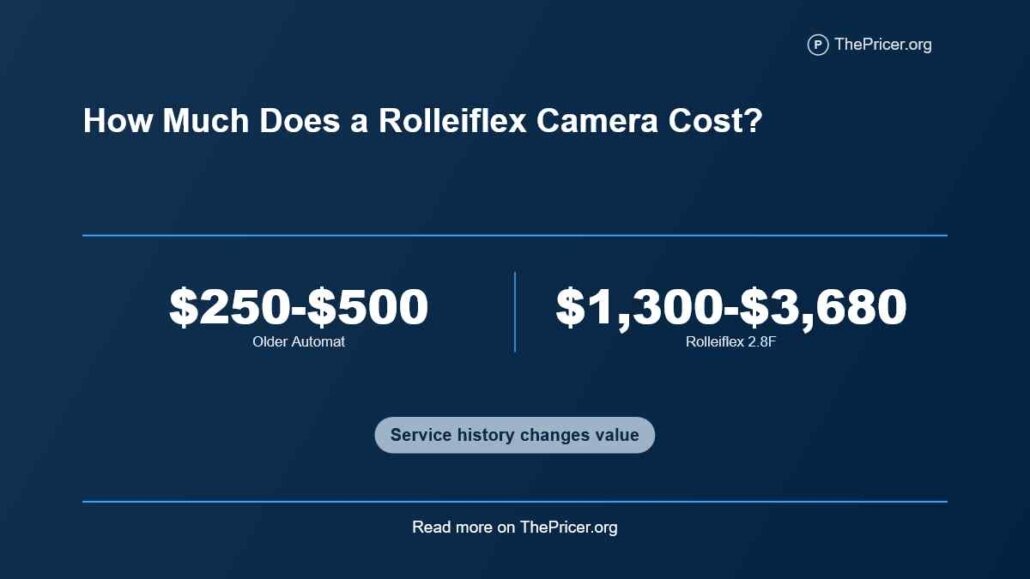
The current market is wider than the old $800 to $3,000 estimate. A basic working Automat can sell for only a few hundred dollars, while desirable 2.8F and 2.8GX cameras can reach several thousand. One 2026 one 2026 Automat sale closed at $250, while another 2026 Automat sale closed at $500. At the other end, a film-tested 2.8F sold for $1,300 and a dealer-listed Xenotar example sold for $3,680.
The later 2.8GX belongs in a different price tier from an early Automat. CameraWorth records recent U.S. 2.8GX sales at $2,955 and $3,500, with collector editions sometimes selling for still more. Its 2.8GX sales history tracks realized prices rather than only seller asking prices. A buyer shopping for a user camera should separate ordinary working examples from special editions, mint boxed sets, and dealer pieces with fresh service.
| Rolleiflex model | Current price evidence | What the figure represents |
|---|---|---|
| Rolleiflex Automat | $250-$500 | Two 2026 sold examples |
| Rolleiflex 3.5F | $1,400 | Freshly serviced 2026 sold example |
| Rolleiflex 2.8F | $1,300-$3,680 | Two 2026 sold examples with different condition and seller context |
| Rolleiflex 2.8GX | $2,955-$3,500 | Recent 2026 U.S. sales tracked by CameraWorth |
What You Are Buying
Rolleiflex is best known for its medium-format twin-lens reflex cameras. The classic design uses one lens for viewing and focusing and a second lens for exposing the film. Many of the most sought-after models produce 6×6 negatives on 120 film. The familiar 3.5F and 2.8F names refer to the maximum aperture of the taking lens, with the 2.8F carrying a faster 80mm f/2.8 lens and the 3.5F using a 75mm f/3.5 lens.
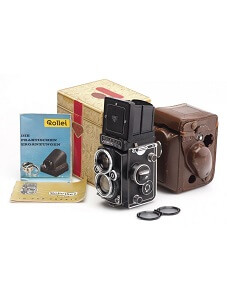
That distinction matters because buyers are not shopping for one interchangeable Rolleiflex product. An early Automat, a 3.5F Planar, a 2.8F Xenotar, and a later 2.8GX differ in age, lens, metering, production period, collector demand, and service complexity.
The brand name alone does not justify a premium. The useful questions are whether the shutter runs correctly at every speed, the focus tracks properly, the taking lens is clear, the film transport works, the meter functions if fitted, and there is evidence of recent professional service. Two cameras with the same badge can deserve very different prices if one has documented mechanical work and the other has sat unused for decades.
Current Prices by Model
The Rolleiflex 3.5F is often the middle ground for someone who wants a late classic TLR without paying the highest 2.8F prices. A fresh-CLA Planar 3.5F that was film tested a fresh-CLA 3.5F sold for $1,400 in 2026. Price-guide data places many 3.5F variants below top 2.8F values, though version, lens, meter, and cosmetic grade can move the number. A clean 3.5F can be a much more expensive purchase than an early Automat even though both carry the Rolleiflex name.
The 2.8F is where the market spreads sharply. UsedLens showed a September 2026 asking-price range with the middle half of tracked listings between about £1,597 and £2,447, while live examples ranged from £1,199 to £1,995 on the page when checked. Those are asking prices rather than completed sales, but the 2.8F listing history helps explain why a clean dealer camera can sit far above a private-sale user body.
CollectiBlend also separates average, very good, and mint 2.8F values, placing its condition-based 2.8F values from roughly $1,400 to $3,200. Those figures reinforce a practical point for shoppers. The exact version and grade need to be matched before one listing is compared with another.
Condition Changes the Price
Cosmetic wear matters less than mechanical and optical condition when the goal is to shoot the camera. Small paint loss or worn leather can be tolerable if the shutter, focus, transport, and optics are sound. A beautiful body with a sticky slow-speed shutter, haze, fungus, separation, a dim finder, or a bad meter can become the more expensive camera after repair. A case, cap, hood, strap, filters, Rolleinar close-up accessories, manuals, and the original box can also raise collector value.
The serial number and exact lens should be checked before paying a premium. Sellers sometimes use broad labels such as Rolleiflex 3.5 or Rolleiflex Automat even though several versions exist. For someone building a professional photography kit, the same budgeting discipline used for professional photography equipment applies here.
Buy the function you need rather than the prettiest listing. A camera with documented service can justify a higher price because it reduces the chance that the first months of ownership begin with a shutter or transport overhaul. Fresh service paperwork also gives the buyer a date, a technician, and a clearer record of what was actually adjusted or repaired.
Service Can Change the Deal
A cheap Rolleiflex is risky when there is no service history. One current specialist in Korea lists a Rolleiflex full overhaul or general repair at $150, with international shipping paid by the owner. That published Rolleiflex overhaul price is unusually low compared with some specialist quotes reported in the United States. A 2026 owner reported a quote of about $789 for a complete CLA on a 1951 Rolleiflex 3.5 MX, while another owner reported a $1,240 2.8F CLA quote in the same discussion. Those are individual user reports, not a national repair tariff. The reported specialist CLA quotes show how large the repair exposure can become.
That creates a useful buying test. Suppose an unserviced 3.5-class Rolleiflex is offered for an assumed $700. Add the reported $789 CLA and the camera becomes a $1,489 purchase before shipping. That is $89 more than the documented freshly serviced 3.5F sale at $1,400. The math does not prove every serviced camera is the better purchase, but it shows why an apparently cheap body should be priced with a repair reserve rather than compared directly with a serviced example.
Real Purchase Scenarios
A budget shooter who wants the Rolleiflex experience without chasing the prestige models can start with an Automat. Using the two current sold examples above, a realistic purchase could land around $250 to $500 before service, tax, and shipping. At that level, a buyer should care far more about shutter behavior, lens clarity, film advance, and focus than about minor cosmetic marks. A low-priced Automat that works well can cost less than half of a serviced 3.5F.
A photographer choosing a 2.8F faces a very different market. The two documented 2026 sales of $1,300 and $3,680 are separated by $2,380. The higher transaction is about 2.8 times the lower one. That spread is too large to treat “Rolleiflex 2.8F” as a single price. Seller type, exact lens, cosmetic grade, recent service, meter operation, accessories, and collector appeal can matter as much as the model badge.
A collector looking at a 2.8GX should expect a later-model premium. Recent tracked sales near $2,955 to $3,500 put the GX above many working 3.5F cameras and into the same territory as premium 2.8F examples. Special editions can move higher again. That is a collector and late-model market, not a useful benchmark for what someone must spend to begin shooting 6×6 Rolleiflex film.
Film and Ownership Costs
The camera purchase is only the first expense. Rolleiflex TLRs use 120 film, and a 6×6 camera normally yields 12 exposures per roll. B&H currently lists a five-pack of Kodak Portra 400 in 120 format at $84.95, equal to $16.99 per roll. A film lab then adds processing and, for many shooters, scanning. These costs matter more with a Rolleiflex than with a digital camera because every roll creates another variable expense. A buyer planning to shoot the camera regularly should budget film and lab work alongside the purchase price instead of treating them as incidental costs.
NYC Film Lab lists 120 C-41 processing from $9.75, with large JPEG scans adding $8. Using those published figures, processing plus large scans costs $17.75 per roll. Add $16.99 of Portra 400 and the consumable-plus-lab cost is about $34.74 per roll. Ten rolls cost about $347.40. A buyer who pays $1,300 for a 2.8F would spend about $1,647.40 after the first ten rolls, before tax, shipping, accessories, or repairs. Readers comparing lab choices can also see how film developing costs are built from processing, scanning, prints, and shipping.
Is a Rolleiflex Worth the Premium?
A Rolleiflex makes the strongest financial case for someone who wants the 6×6 TLR shooting process, a fixed high-quality lens, waist-level composition, and a mechanical camera that can remain usable for decades when maintained. It is harder to justify as a casual experiment if the buyer has never used medium-format film, because the purchase price is only one part of the commitment. Film, processing, scanning, service, and accessories can add hundreds of dollars quickly.
The 3.5F often gives a buyer access to the classic late Rolleiflex experience for less than a comparable 2.8F. The Automat can be dramatically cheaper. The 2.8F and 2.8GX make more sense when the faster lens, exact model, condition, or collector appeal has real value to the buyer. Paying extra only because a listing says “rare” is weak reasoning unless the serial number, edition, condition, and completed-sale evidence support the claim.
Makes sense if
- You specifically want a 6×6 twin-lens reflex shooting experience.
- You are comfortable paying for 120 film and lab work.
- You can inspect the camera or buy from a seller with a useful return policy.
- You value documented service more than flawless cosmetics.
Does not make sense if
- You mainly want the cheapest route into medium-format photography.
- You cannot budget for a possible CLA or repair.
- You are paying a collector premium for features you will not use.
- You want interchangeable lenses or modern digital convenience.
What We Verified
- Checked CameraWorth’s 2.8F database, which tracks 220 recorded sales and showed August 2026 activity when reviewed. Review tracked 2.8F sales.
- Cross-referenced CameraWorth’s Automat data, which includes a 2026 U.S. MX sale at $425. Review tracked Automat sales.
- Verified B&H’s current Portra 400 five-pack price of $84.95 and 120-film format. Check current Portra pricing.
- Checked NYC Film Lab’s published 120-film processing price from $9.75 and large-scan add-on of $8. Check 120 processing prices.
Answers to Common Questions
How much is a Rolleiflex 2.8F worth?
Recent 2026 sold examples we found ranged from $1,300 to $3,680. Condition, service history, lens version, meter operation, accessories, and seller type can create a very wide spread.
How much is a Rolleiflex 3.5F worth?
A freshly serviced and film-tested 3.5F sold for $1,400 in July 2026. Other versions and conditions can sell for less or more, so the exact camera should be identified before setting a value.
What is the cheapest classic Rolleiflex?
Older Automats are among the cheaper Rolleiflex TLRs. Current sold examples include prices around $250 to $500, though a low purchase price can be offset by repair needs.
How much should I reserve for Rolleiflex repairs?
Published and reported service prices vary sharply. One overseas specialist lists a full Rolleiflex overhaul at $150, while individual U.S. owners reported specialist CLA quotes around $789 to $1,240 in 2026.
How much does it cost to shoot a roll of 120 film?
Using Portra 400 at $16.99 per roll and the lab example in this article at $17.75 for processing plus large scans, the combined cost is about $34.74 per roll before shipping.
Disclosure: Educational content, not financial advice. Prices reflect public information as of the dates cited and can change. Confirm current rates, fees, taxes, and terms with official sources before purchasing. See our methodology and corrections policy.