
How Much Does it Cost to Ride The Bus?
Updated on | Written by Alec Pow
This article was researched using 14 sources. See our methodology and corrections policy.
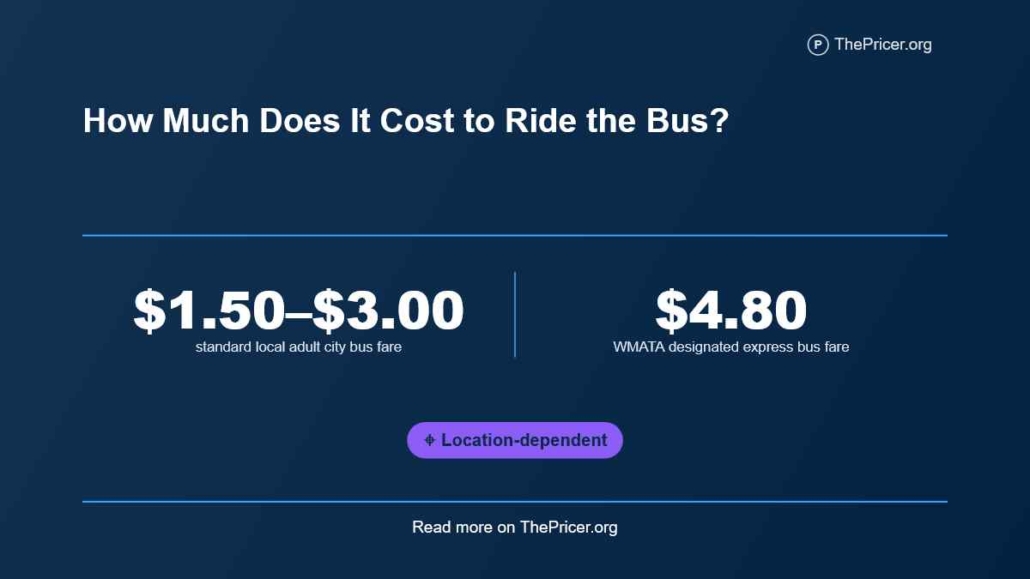
A practical U.S. budget for a standard local city bus ride is about $1.50 to $3.00. Across five current fare schedules reviewed here, the published local adult fare runs from $1.50 in Ann Arbor to $2.90 in Philadelphia. The fare printed on the schedule is only part of the cost question. Free transfers, daily or weekly fare caps, reduced-fare eligibility, cash-payment rules, and express routes can change what a rider pays for the same day of travel.
City bus pricing is local. A rider in Los Angeles pays $1.75 for a regular Metro trip, while Washington Metrobus charges $2.25, while San Francisco Muni charges $2.85 with eligible electronic payment. Some agencies sell passes. Others use automatic fare caps that stop charging after a spending threshold. That makes ride frequency and payment method as important as the base fare.
Article Highlights
Jump to sections
- A practical planning range for a standard local adult bus trip is about $1.50 to $3.00.
- Current fares in the five-system sample run from $1.50 to $2.90.
- LA Metro caps regular-fare spending at $5 per day and $18 (at $30 per hour, earning that amount would take about 36 minutes, before taxes) within seven days.
- Express bus service can cost much more than a normal local route, such as $4.80 on designated WMATA express routes.
- Reduced fares can cut the ride price substantially, while some eligible riders travel at $0.
How Much Does It Cost to Ride the Bus?
The table uses current official fare schedules rather than an old national average. Ann Arbor’s current TheRide fares start at $1.50. LA Metro fares list a $1.75 regular trip. Washington’s current Metrobus fare is $2.25. San Francisco’s current Muni pricing is $2.85 with eligible electronic payment and $3.00 cash. Philadelphia’s current SEPTA fare is $2.90.
| Transit system | Adult local fare | Day fare or cap | Longer pass or cap |
|---|---|---|---|
| Ann Arbor TheRide | $1.50 | $3.00 day pass | $45 (about 1.5 hours of work at $30 per hour) 30-day pass |
| Los Angeles Metro | $1.75 | $5 daily cap | $18 seven-day cap |
| Washington Metrobus | $2.25 | Pay per ride | Regional passes available |
| San Francisco Muni | $2.85 electronic, $3.00 cash | $5.70 day pass | $86 Muni monthly pass |
| Philadelphia SEPTA | $2.90 | $7.50 one-day pass | $116 monthly TransPass+ |
This is a five-system price sample, not a statistical national average. It covers flat-fare local service in several major and midsize markets. Zone-based suburban buses, airport routes, commuter express buses, fare-free systems, and paratransit can sit outside this range. For a local trip in an unfamiliar city, about $3 is a sensible single-ride allowance until the agency’s own fare page is checked.
What One Fare Buys
A single fare may cover more than one vehicle. TheRide’s fixed-route transfer policy gives free transfers for 90 minutes. A rider who boards one bus and changes to another within that window can avoid treating each vehicle as a separate paid trip. That distinction matters when estimating a commute with one transfer in each direction.
The payment rule can matter too. Using the Muni rates cited in the table, electronic payment costs $2.85 while cash costs $3.00. The difference is small on one boarding, but it becomes visible across repeated trips. A rider should compare the rules attached to the payment method, not only the headline single-ride number.
Twenty Muni rides at the cited electronic rate cost $57 (about 1.9 hours of work at $30 per hour). The same 20 rides at the cited cash rate cost $60, a $3 difference before any pass is considered. A commute with transfers can create an even larger gap if one payment method preserves the agency’s transfer benefit and another does not. The number of vehicles used is not always the same as the number of fares paid on a normal trip.
Day Passes and Fare Caps
Short passes still exist, but fare capping has changed how frequent riders pay in some cities. LA Metro’s automatic fare caps hold regular-fare spending to $5 in one day and $18 within seven days when the rider uses an eligible payment method. The rider does not have to predict the number of trips and buy a separate unlimited pass before traveling.
The first useful calculation appears after the second LA ride. Two rides cost $3.50. Three rides would cost $5.25 at the $1.75 base rate, but the daily cap limits payment to $5. Four uncapped rides would total $7, so the cap saves $2 by the fourth trip. Additional eligible Metro rides that day do not increase the amount beyond the cap.
A purchased day pass needs different math. The table shows TheRide at $3 per day against a $1.50 single fare, so two rides equal the pass price. San Francisco’s $5.70 day pass also equals two electronic fares of $2.85, making the third eligible ride the point where the pass moves ahead. SEPTA’s $7.50 day pass costs more than two $2.90 rides but less than three. Three separate rides would cost $8.70, leaving a $1.20 difference in favor of the day pass before transfer rules are applied. The correct product depends on paid boardings, not the word “unlimited.”
Monthly Passes
A monthly pass can still beat pay-as-you-go for a regular commuter, but the break-even point varies sharply. Using TheRide’s $45 30-day pass and $1.50 base fare from the cited table, 30 individual rides also cost $45. The 31st paid ride is where the pass becomes cheaper than separate fares, assuming every trip would otherwise require a new fare.
Use a commuter making two paid trips per workday for 22 workdays as a worked example. That is 44 boardings. The itemized comparison is straightforward.
- 44 separate rides at $1.50 each equal $66.
- One 30-day Flex Pass costs $45.
- The pass lowers the defined 44-ride cost by $21.
The table shows why the same rule cannot be copied to every city. San Francisco’s $86 Muni monthly pass divided by its $2.85 electronic fare is a little over 30 rides. Thirty rides cost $85.50, while 31 separate rides cost $88.35, so the pass moves ahead on the 31st paid ride. SEPTA’s $116 monthly TransPass+ equals 40 base fares of $2.90, putting its simple base-fare break-even after 40 paid rides. Los Angeles takes another path because its seven-day cap replaces the need to buy a traditional monthly Metro pass for ordinary capped travel.
Express and Premium Bus Fares
Local bus fares should not be mixed with express service. WMATA’s current new-rider fare guide lists most Metrobus routes at $2.25 and designated express routes at $4.80. The express premium is $2.55 per trip, so a rider using an express route twice in one workday pays $5.10 more than two regular Metrobus rides.
Across 20 commuting days, that same defined premium becomes $102. The calculation does not mean express service is overpriced. It shows why the route category belongs in the budget. Express buses often cover longer corridors or make fewer stops, and the rider is paying for a different service pattern. Airport buses, regional commuter routes, and zone-based suburban systems can have their own structures too.
The same distinction applies to tourist routes. Las Vegas uses special pass products on its Strip service, which is why Deuce bus pricing should not be treated as a nationwide city-bus benchmark. A rider comparing ordinary transit with taxi ride costs should match the same origin, destination, and number of passengers. A bus fare is usually per rider, while a taxi fare covers the vehicle trip.
Reduced Fares and Free Rides
Reduced-fare programs can cut bus spending substantially, but eligibility is set by each agency. WMATA’s reduced-fare programs provide a 50% discount for qualifying riders, including people age 65 and older and eligible riders with disabilities. Metro Lift also serves qualifying SNAP recipients in the Washington region. The regular Metrobus fare of $2.25 becomes $1.10 under the current reduced schedule because agency fares are rounded to their published amounts.
The city sample shows that reduced pricing is not one national formula. King County Metro currently lists a reduced fare of $1.00 for eligible seniors and riders with disabilities, while youth ages 18 and younger ride for $0. Other agencies use different age cutoffs, discount percentages, or local program cards. A national statement such as “children under five ride free” or “seniors 65 to 79 receive half fare” will be wrong in many cities.
Identification belongs to this eligibility question, not ordinary boarding. A rider using a standard adult fare does not need a universal transit ID card. A rider claiming a senior, disability, student, income-based, or other restricted fare may need an agency-issued card or supporting identification. Check the local qualification rules before assuming a discount will be accepted at the farebox.
Paying and Transferring

City buses now use a mix of cash, transit cards, bank cards, mobile wallets, and agency apps. WMATA launched contactless Metrobus payment in late 2025, allowing riders to tap a bank card or Apple Pay and Google Pay. Cash still works on Metrobus with exact change. San Francisco, Los Angeles, Philadelphia, and other large systems in the fare sample also support electronic payment.
Using the same payment credential can be part of the fare rule. Fare systems identify the card, transit account, or device used for a trip, so a rider should follow the local agency’s payment instructions when making a transfer or trying to reach a fare cap. Switching between cash, a physical bank card, and a mobile wallet can change which benefits the system can recognize.
Cash is still useful, but it can carry tradeoffs. Muni charges $3.00 cash versus $2.85 electronically. Metrobus accepts cash with exact change, while its newer tap option accepts contactless cards and mobile wallets. Before boarding in a new city, check three details: accepted payment, whether exact change is required, and whether the chosen method receives transfers or fare caps.
When Riding the Bus Fits
The bus is easiest to budget when the trip stays inside a flat-fare local network and the rider knows the transfer policy. Two paid trips per workday can make a pass or cap valuable. An occasional rider may spend less by paying one fare at a time. A visitor making several stops in one day may cross a day-pass or daily-cap threshold quickly. The right choice depends on paid boardings after free transfers, not merely how many vehicles appear in the itinerary.
Bus travel also solves a different problem from intercity rail. A reader moving between cities should compare U.S. train travel costs rather than using a local bus fare as the benchmark. Within one metro area, buses can be much cheaper than a taxi when one person is traveling, but the comparison changes with multiple passengers, long waits, luggage, late service, and routes that require several transfers.
Makes sense if
- Your origin and destination are served by a local route with a manageable transfer.
- You can use a pass or fare cap often enough to reduce the effective ride cost.
- You qualify for a reduced-fare or sponsored transit program.
- You value predictable transit pricing over variable car, parking, or taxi costs.
Does not make sense if
- The needed trip requires premium service that removes most of the expected savings.
- Service frequency or operating hours do not match your required arrival time.
- A group can split another transportation option for a similar total.
- The route creates several unpaid waiting periods or detours that matter more than the fare saving.
Answers to Common Questions
How much is a city bus ride in the United States?
A practical planning amount is about $1.50 to $3.00 for a standard adult local trip. The five current systems sampled here range from $1.50 to $2.90.
Is a day pass cheaper than paying for each bus ride?
It depends on the number of paid trips and transfer rules. A $3 TheRide day pass equals two $1.50 rides, while SEPTA’s $7.50 day pass moves below three separate $2.90 fares.
Do bus transfers cost extra?
Many systems include time-limited transfers when the rider uses an eligible payment method. The number of transfers and the allowed time differ by agency.
Can I pay a city bus fare with a credit card?
Many major systems now accept contactless bank cards or mobile wallets, but payment options still vary. Some buses also accept cash, often with exact-change rules.
Do seniors and children ride the bus for less?
Many agencies offer reduced or free fares by age, disability, income, student status, or local program eligibility. There is no single national age cutoff or discount rate.
Disclosure: Educational content, not financial advice. Prices reflect public information as of the dates cited and can change. Confirm current rates, fees, taxes, and terms with official sources before purchasing. See our methodology and corrections policy.