
How Much Does Permanent Jewelry Cost?
Updated on | Researched and reviewed by Alec Pow, Founder & Pricing Investigator
Pricing research reviewed using our editorial methodology. See our research methodology and corrections policy.
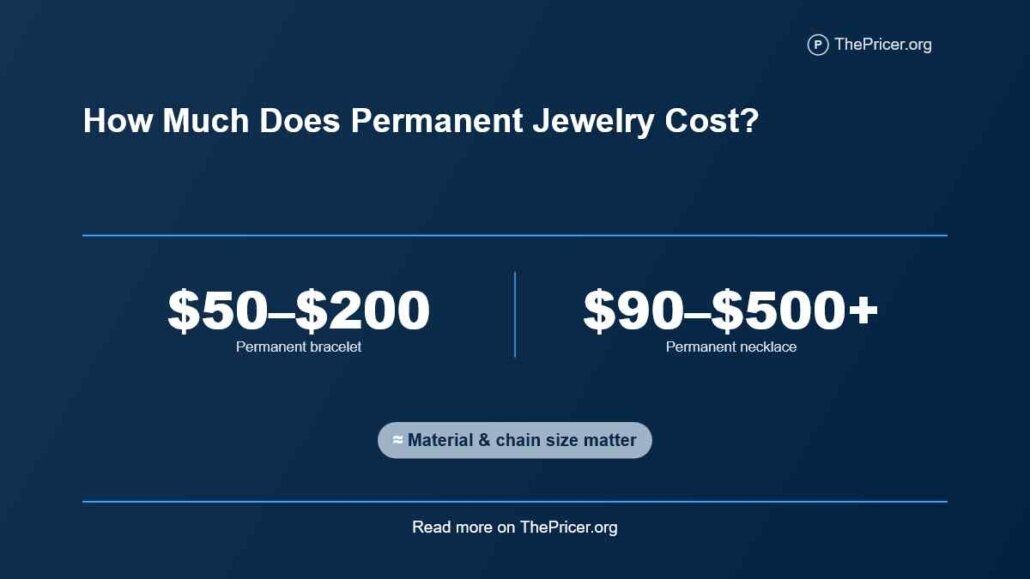
Permanent jewelry typically costs $50 to $200 for a bracelet, although very simple chains can start around $40 to $60 and premium solid-gold or diamond styles can cost $200 to $500 or more.
Placement makes a big difference. A permanent ring may start at roughly $38 to $60, while an anklet usually costs $70 to $250+. Permanent necklaces require considerably more chain and commonly start around $90 to $300, with heavier 14k gold chains costing much more.
Permanent jewelry is simply claspless jewelry. The jeweler sizes a chain around your wrist, ankle, finger, or neck and welds the final jump ring closed. Despite the name, it can be removed by cutting the small connecting ring and can often be welded back on later.
How Much Does Permanent Jewelry Cost?
Jump to sections
The typical permanent-jewelry customer will spend somewhere around $50 to $200, but there is no single standard price. The amount of precious metal used is one of the biggest variables, which is why bracelets usually cost much less than necklaces.
| Permanent jewelry | Typical price |
|---|---|
| Ring | $38–$100+ |
| Bracelet | $50–$200+ |
| 14k gold bracelet | $100–$250+ |
| Anklet | $70–$250+ |
| Necklace | $90–$500+ |
| Hand chain | $150–$400+ |
| Charm or connector | $20–$150+ |
| Diamond addition | $50–$300+ |
Those ranges are deliberately wider than one store’s menu because today’s permanent-jewelry market includes everything from lower-priced chains to fine 14k gold jewelry with natural diamonds.
For example, Loveweld currently advertises starting prices of about $38 for rings, $54 for bracelets, $74 for anklets, and $94 for necklaces. Move into its solid 14k gold collection and individual bracelet styles rise to roughly $118 to $188, with diamond versions and heavier chains costing more.
That means the old rule that a good permanent bracelet automatically costs $100 to $200 is no longer particularly useful. You can spend less than $100, but shoppers looking specifically for solid 14k gold should still expect prices around or above the $100 mark.
What Changes the Price?
Metal type is usually the most important factor. Sterling silver and some demi-fine materials cost less, while solid 14k gold raises the price considerably. An 18k piece will generally cost more again because it contains more gold.
Chain weight matters just as much as karat. Two bracelets can both be solid 14k gold but have very different prices if one uses a whisper-thin chain and the other uses larger links.
Placement also affects the amount of chain required. A necklace may use three or four times as much chain as a bracelet, explaining why the same chain style can jump dramatically in price when worn around the neck.
Charms and diamonds can turn a relatively inexpensive bracelet into a several-hundred-dollar purchase. Initials, birthstones, diamonds, connectors, and decorative links are usually priced separately.
Finally, brand and location matter. Permanent jewelry sold through a fine-jewelry studio in New York or Los Angeles may cost considerably more than a simple chain offered by a local permanent-jewelry artist.
The Catbird Example
Catbird is closely associated with the modern permanent-jewelry trend, but there is an important distinction in its history. The jewelry company itself was founded in Brooklyn in 2004. Catbird says it began offering its welded Forever Bracelet in 2017 and has since welded more than 150,000 permanent pieces.
Catbird describes the process as “zapping.” A jeweler custom-fits a solid-gold chain to the wrist and welds together the small connecting ring instead of adding a traditional clasp.
The welding itself is not the dramatic part it may sound like. The electrical arc is applied to the jewelry connection rather than the wearer’s skin. The visible flash is where the “zap” terminology comes from.
Catbird’s regular solid-gold jewelry also gives some useful context for today’s gold prices. Its Sweet Nothing chain bracelet currently starts around $138, showing why a delicate solid-gold permanent bracelet around the $100-to-$200 mark is perfectly plausible even though cheaper permanent jewelry exists.
Is It Really Permanent?
No. “Permanent” means that the jewelry has no clasp and is intended to stay on continuously. It does not mean the chain cannot be removed.
A permanent bracelet can normally be removed by carefully cutting the small jump ring that was originally welded shut. Catbird recommends cutting at that connecting ring so that as much of the original chain as possible remains intact.
Keeping the chain intact matters because it may be possible to have it welded back onto you later.
Permanent jewelry can also break on its own. That is not necessarily a defect. Extremely delicate chains are still delicate chains, and sufficient force can snap or stretch them. In fact, having a chain capable of breaking under enough force is preferable to having something dangerously strong attached permanently around a wrist or ankle.
How Long Does It Last?
A well-made solid-gold permanent bracelet can potentially be worn for years, but there is no guaranteed lifespan.
Solid gold works well for everyday jewelry because it does not have a plated outer layer that simply wears away. It can still scratch, bend, stretch, accumulate residue, or eventually break. Thin permanent chains are particularly vulnerable to being caught on clothing, furniture, gym equipment, or other objects.
The fit therefore matters. Too loose and the chain is more likely to snag. Too tight and ordinary wrist movement can become uncomfortable.
The original article suggested leaving a couple of centimeters of extra room, but that is much more than most permanent-jewelry wearers need. The jeweler should fit the chain closely enough to be comfortable while leaving enough movement that it does not pull against your skin.
Silver can also be used for permanent jewelry, although some jewelers prefer gold for pieces intended to stay on continuously. Silver is more prone to tarnishing and may need periodic cleaning.
What $150 Buys
A budget of around $150 puts you in an interesting part of the market. It is enough for many solid 14k gold permanent bracelets, while still being far below what some heavier designer chains cost.
Using a working value of $30 per hour, a $150 permanent bracelet represents about five hours of work.
If you wear that $150 bracelet continuously for three years, however, the cost works out to roughly $0.14 per day. A $60 bracelet worn for the same period costs around $0.05 per day.
That cost-per-day calculation is one reason permanent jewelry can make financial sense for someone who already wears the same bracelet every day. Someone who enjoys regularly changing jewelry may get much less value from the permanent format.
Extra Costs
The chain price is not always the final price.
Charms are one of the easiest ways to increase the bill. A tiny initial or simple connector might add a few dozen dollars, while diamonds and more elaborate gold charms can add $100 or considerably more.
Re-welding can also cost extra. Some stores include future reattachment or repair with the original purchase, while others charge a service fee. Catbird currently quotes a small fee for having a previously removed Forever piece welded back on, while Loveweld offers complimentary ongoing re-welding and resizing on its own Forever-Bound jewelry.
Loveweld charges around $40 to repair certain permanent jewelry purchased elsewhere, demonstrating why it is worth checking the aftercare policy before choosing the cheapest initial option.
You may also pay more if additional chain has to be added during resizing or if the original chain has broken in a way that cannot simply be welded back together.
Hidden Costs
The biggest hidden price of permanent jewelry is often not the initial weld. It is what happens when your circumstances change.
You may need to remove the jewelry for a medical procedure. MRI facilities generally instruct patients to remove metallic jewelry before entering the MRI room because metal can interfere with imaging and, depending on the material and circumstances, create safety concerns.
That means someone who cuts off a $150 bracelet for an MRI might later pay another $20 to $40 to have it reattached if their jeweler does not include free re-welding.
There is also the risk of losing the chain after removal. Once you’ve cut off permanent jewelry, place it somewhere safe rather than treating it like a disposable item. Losing a removed solid-gold bracelet means replacing the entire piece instead of paying a small re-welding fee.
Another hidden expense is choosing a delicate chain for an active lifestyle. Repeated snagging, stretching, and repair can make a very thin inexpensive chain more expensive over time than a slightly stronger option.

Airport Security
You normally do not have to cut off permanent jewelry simply because you are flying.
TSA permits jewelry through airport security and recommends that passengers keep valuable jewelry with them rather than placing it in checked baggage. Large or bulky jewelry can occasionally require additional screening, but a delicate permanent bracelet is very different from an MRI situation.
If a security officer needs to inspect an item more closely, follow the instructions given at the checkpoint.
Skin Reactions
Permanent jewelry sits against your skin continuously, so the metal composition is worth checking before you buy.
Nickel is a common cause of allergic contact dermatitis and is found in some jewelry alloys. Symptoms can include itching, redness, bumps, dry skin, or a rash where the metal contacts the body.
This does not mean everyone with sensitive skin has to avoid permanent jewelry. It does mean that someone with a known metal allergy should ask exactly what the chain contains rather than relying solely on descriptions such as “premium” or “hypoallergenic.”
The American Academy of Dermatology recommends nickel-free jewelry and lists metals such as higher-karat yellow gold, sterling silver, platinum, and certain stainless steels among alternatives for people with nickel allergy.
If jewelry repeatedly causes a rash, a dermatologist can determine whether allergic contact dermatitis or another condition is responsible. Patch testing may be used when a metal allergy is suspected.
Is It Worth It?
Permanent jewelry makes the most sense for someone who already likes leaving the same piece of jewelry on day and night.
It can also work particularly well as a friendship bracelet, anniversary piece, family keepsake, or other piece intended to represent an ongoing relationship or event.
It makes less sense if you frequently switch jewelry, work somewhere jewelry must be removed, regularly participate in activities where chains could snag, or expect frequent medical imaging.
The cheapest chain is not necessarily the best deal. For a piece designed to stay on continuously, the metal, fit, chain strength, repair policy, and availability of future re-welding matter almost as much as the initial price.
You might also like our articles about the cost of a jewelry engraving or how much it costs to get a ring cleaned.
How to Save
Start by comparing the same metal and approximately the same chain weight. A $60 chain and a $150 chain may appear similar in photos while containing very different amounts or types of metal.
If you are going with a friend or partner, ask about multi-piece discounts. Catbird, for example, has offered a discount when buying multiple Forever Bracelets.
Also check what happens if the jewelry breaks or needs to be temporarily removed. Complimentary re-welding can easily save $20 to $40 later.
Finally, consider a simple chain without charms at first. Charms can often be added later, while buying several embellishments during the original appointment can double the cost surprisingly quickly.
Answers to Common Questions
How much does a permanent bracelet cost?
Most permanent bracelets cost around $50 to $200. Simple options can start below $60, while solid 14k gold, heavier chains, diamonds, and designer styles can cost $200 to $500 or more.
How much does a permanent anklet cost?
A permanent anklet usually costs around $70 to $250+. It normally costs more than a bracelet because more chain is required.
How much does a permanent necklace cost?
Permanent necklaces commonly start around $90 to $300, although solid-gold and heavier-chain necklaces can easily cost $400 to $500 or more.
How much does a permanent ring cost?
Permanent chain rings can start at roughly $38 to $60, with gold, diamond, and more decorative options costing more.
Does getting permanent jewelry welded hurt?
No. The welding arc closes the small jewelry connection rather than welding the chain to your skin. You may see a bright flash during the process, but the procedure itself should not hurt when performed correctly.
Can permanent jewelry be removed?
Yes. Permanent jewelry can normally be removed by cutting the small connecting ring with appropriate scissors or cutters. Saving the chain may allow it to be re-welded later.
Disclosure: Educational content, not financial advice. Prices reflect public information as of the dates cited and can change. Confirm current rates, fees, taxes, and terms with official sources before purchasing. See our methodology and corrections policy.