
How Much is a Blue Lobster Worth?
Updated on | Written by Alec Pow
This article was researched using 16 sources. See our methodology and corrections policy.
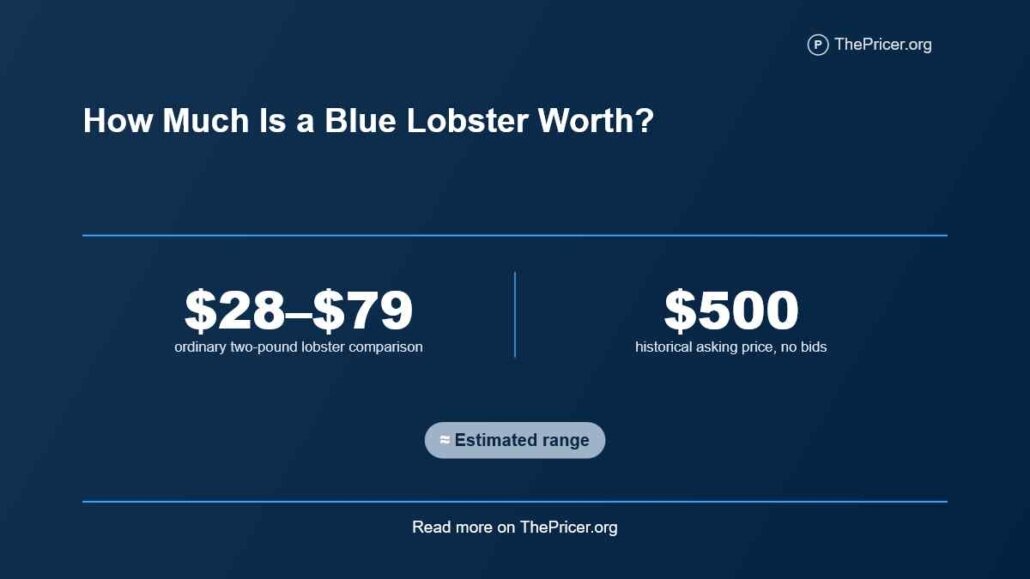
A rare blue lobster has no established market price. Although an American blue lobster was reportedly advertised on eBay for $500, the listing attracted no bids. That makes $500 an asking price, not evidence of what someone paid.
For food, a blue American lobster has essentially the same value as another lobster of the same species, size, and condition. A two-pound live Maine lobster currently sells for approximately $28 to $79 in the U.S. examples reviewed, depending on whether it is purchased locally or shipped. A genuinely blue specimen could attract a collector or aquarium, but there is no dependable premium to add to its seafood value.
The distinction matters because unusually colored lobsters are frequently donated to research centers or public aquariums. Their rarity creates educational and display value without necessarily producing a commercial sale.
Article Highlights
Jump to sections
- There is no verified standard selling price for a naturally blue American lobster.
- A reported $500 eBay asking price received no bids, so it does not establish a sale value.
- Current ordinary two-pound live lobster examples range from approximately $28 to $79, depending on seller and delivery arrangements.
- Blue American lobsters are commonly estimated to occur in about one out of every two million lobsters, although that figure is uncertain.
- Recent blue-lobster discoveries have been donated to aquariums and marine research institutions.
- A pet-shop animal labeled an electric blue lobster is often a freshwater crayfish, not a rare marine lobster.
How Much Is a Blue Lobster Worth?
The strongest evidence comes from separating real transactions, advertised prices, and donations. An ordinary seafood listing shows what a buyer can pay for a comparable lobster, while an aquarium donation establishes where a rare specimen went without supplying a commercial price.
| Example | Price or value | What it establishes |
|---|---|---|
| Reported blue lobster eBay listing | $500 asking price | No bids reported, so no completed sale |
| Blue lobster caught in Cornwall, 2024 | About £25 (roughly $31) ordinary seafood value | Estimated food value, not an auction result |
| Large lobster with blue markings, Massachusetts, 2026 | About $150 asking price | Approximately 10 pounds, not a fully blue lobster |
| Ordinary live lobster, Maine pickup market | $13.99/lb for jumbo sizes | Local seafood benchmark |
| Ordinary two-pound live Maine lobster, online | $62.99–$79 per lobster | Published retail offers, not rare-color prices |
The reported eBay listing appeared in coverage of a Welsh fisherman’s unusual catch in 2022. The reported lack of bids is the important detail. A seller can ask hundreds of dollars without establishing that anyone will pay the amount.
A second documented case came from Cornwall in May 2024. Fishmonger Jacqueline Spencer estimated that a vividly blue lobster would ordinarily have sold for about £25 based on its weight. Instead, it was rehomed at an aquarium, according to reporting on the catch.
A different example appeared at a Massachusetts Market Basket in March 2026. A nearly ten-pound lobster with conspicuous blue markings was offered for approximately $150, or $14.99 per pound. It was not an entirely blue lobster. The local reporting later noted that a science center would take it in. Its unusual size and coloring make it a poor direct comparison with a two-pound blue lobster.
What Is a Fair Valuation?
For a blue lobster caught legally and destined for the seafood trade, the most defensible starting point is the current price of an ordinary live lobster with comparable weight and shell condition. There is no published formula that converts blue coloration into a consistent extra charge.
The distinction between a seafood valuation and a collectible valuation is substantial. A seafood buyer primarily pays for an edible animal. An aquarium may value a living specimen because visitors can observe an unusual color variation. A private collector might have an entirely different budget, but an unconfirmed willingness to pay is not a transaction.
Actual seafood benchmarks help put the speculative $500 figure into perspective. At a local Maine counter, Perry Butcher’s posted prices included jumbo lobsters at $13.99 per pound as of September 29, 2026. A two-pound lobster at that rate would cost $27.98.
For shipped purchases, Maine Lobster Now advertised a two-pound live lobster at $62.99 on promotion. Another online retailer, LobsterAnywhere, listed a two-pound specimen at $79, with lower per-animal prices for larger quantities.
Those differences reflect retail channel, delivery arrangements, and promotional terms. They do not measure a color premium. Readers comparing ordinary live-lobster offers can also consult the cost of lobster for broader size and product comparisons.
How Much Is the Rarity Premium?
A useful way to evaluate the historic $500 claim is to compare it with the ordinary food value of the same assumed two-pound weight. This is a comparison of an unsuccessful asking price with current retail offers, not a calculation of an established blue-lobster market.
Worked Example: A Two-Pound Catch
Assume a legally landed, two-pound blue American lobster is being valued as seafood at the reviewed Maine local-market rate:
- Assumed live weight: 2 pounds
- Comparable ordinary lobster rate: $13.99/lb
- Calculated ordinary retail food value: 2 × $13.99 = $27.98
- Historical blue-lobster asking price: $500
- Difference between the two figures: $472.02
The historic asking price was about 17.9 times the calculated ordinary retail food value. Yet the reported listing drew no bids, so the comparison demonstrates the size of the proposed premium, not a premium realized by a seller.
A separate calculation shows how much buying channel alone can change an ordinary lobster’s price. The same assumed two-pound animal costs $27.98 using the local-market rate and $62.99 at the reviewed online promotional price. That is a $35.01 difference before checking any additional delivery charges.
In this comparison, the ordinary lobster’s retail channel produces a larger documented price difference than any verified blue-color surcharge, because a completed blue-lobster sale at the claimed premium has not been established.
Why Are Blue Lobsters Rare?
Most American lobsters have dark, mottled shells that blend into the seafloor. A striking blue specimen has an unusual expression of the proteins and pigments responsible for shell coloration.
The New England Aquarium describes blue American lobsters as occurring in about one out of every two million animals. The figure is a widely used estimate, not an exact frequency established by a complete population count.

Scientists associate the coloration with crustacyanin, a protein involved in how pigments appear within a lobster’s shell. The blue appearance is a shell-color difference rather than evidence that the animal belongs to a more expensive edible species.
The Shaw Institute explained the genetic basis in its September 2026 blue-lobster account. Its blue lobster, named Blucifer, was donated by Atwood Lobster Company in Maine in June 2026.
The institute also cautioned that the rarity estimate is uncertain. Young blue lobsters may be easier for predators to detect, and the animals noticed by fishermen are only a portion of those that hatch or survive. The October 2026 animal profile explicitly describes the one-in-two-million figure as an estimate.
If the estimate were applied to a hypothetical catch of two million American lobsters, it would predict one blue lobster on average. That is not a guarantee that precisely one would appear in any specific catch. Real catches also differ by fishing area, age group, and reporting practices.
Do Aquariums Buy Them?
Public aquariums sometimes receive blue lobsters from fishing businesses, restaurants, and individuals. The available documented cases more commonly describe donations than published purchase agreements.
In February 2020, the New England Aquarium received a blue lobster from Patriot Seafoods. The animal completed a 30-day quarantine before being displayed. This confirms an actual transfer of a rare specimen, but the aquarium did not publish a purchase price for that donation.
More recently, Northeastern University reported that a two-pound blue lobster named Neptune was donated to its marine science center in August 2025. Its weight makes it particularly relevant to claims about two-pound blue lobsters, yet the documented outcome was a donation, not a $500 sale.
The UMass Dartmouth marine laboratory also welcomed a rare blue lobster in 2025. These transfers show why an unusual lobster can have educational value without a publicly established market price.
A prospective donor should contact an aquarium before arranging delivery. Acceptance depends on the institution’s capacity, animal-health procedures, and exhibit needs. A rare specimen is not automatically eligible for admission or payment.
Can You Sell a Blue Lobster?
A blue American lobster remains subject to the rules governing ordinary American lobsters. Its shell color does not create an exemption from fishing licenses, legal-size restrictions, or protected-female requirements.
Maine provides a clear example. Under Maine’s lobster protection law, taking, possessing, transporting, or selling an egg-bearing lobster or a protected V-notched female is prohibited except under narrowly defined circumstances. The restriction applies regardless of whether the shell is blue, brown, or another color.
The Maine lobster fishery program provides links to current fishing rules, licensing, and commercial fishery requirements. Other states and fishing areas have their own applicable restrictions.
Even if an unusual lobster can lawfully be retained, selling it alive requires a suitable buyer and appropriate seafood handling. An online advertisement is not proof that a sale will occur. A buyer may also decline an unfamiliar specimen because of shipping, aquarium care, or legal questions.
Anyone considering catching lobster should account for the equipment and licensing involved. The lobster trap cost comparison explains why harvesting a rare specimen cannot reasonably be planned as a reliable source of income.
Other Rare Lobster Colors
Blue is unusual, but some American lobster color variations are believed to occur even less frequently. These estimates describe rarity, not a schedule of collectible prices.
The New England Aquarium has reported approximate frequencies of one in 20 million for orange lobsters, one in 30 million for yellow or calico lobsters, and one in 50 million for half-black, half-orange specimens. The estimates should be read as rough comparisons rather than precise probabilities.
White lobsters are commonly placed among the rarest examples. In September 2026, the University of New England announced the arrival of a white lobster named Casper, describing the estimated occurrence as one in 100 million. The lobster had been donated by the Maine State Aquarium for genetics research.
One unusual shell pattern does not automatically make an animal more commercially valuable than another. A rare color may attract greater interest from an aquarium, while a private buyer may prefer a different appearance. Without verified sales, arranging the colors into a price ranking would be misleading.
What Do Blue Lobsters Taste Like?
A naturally blue American lobster is edible if legally harvested and handled properly. Its shell color does not make the meat a special culinary grade.
When cooked, a blue American lobster ordinarily turns red, much like a typical lobster. Heat changes the interaction between shell pigments and proteins. The color variation does not provide evidence of a different meat flavor.
This is why a restaurant premium based only on the animal’s blue shell would be a novelty charge rather than a food-quality premium. The original article’s claim that luxury restaurants routinely serve blue lobsters for $600 is not supported by verified current menu offers.
A prepared lobster dinner can cost more than a live lobster because it includes cooking, service, accompaniments, and restaurant overhead. That is a separate product comparison. The lobster tail price guide covers another common source of confusion between whole-animal and prepared seafood prices.
Buying a Blue Lobster
Before paying extra for a purported blue lobster, establish which animal is actually being offered. A genuinely rare blue American lobster is a saltwater species, Homarus americanus. Many pet shops use the name “electric blue lobster” for a brightly colored freshwater crayfish.
That distinction changes the cost dramatically. Upscale Aquatics listings have advertised electric blue crayfish, Procambarus alleni, starting at $14.99, although the reviewed listing was sold out. Those are selectively bred aquarium animals, not rare wild American lobsters.
A separate aquarium-store listing advertised an electric blue lobster at $29.99, with availability requiring confirmation. The name alone is not enough to establish the species.
Keeping a marine American lobster requires a suitable cold-water saltwater system, which is a different undertaking from maintaining a freshwater crayfish. Anyone interested in an aquarium animal should identify the species before budgeting for the animal or its enclosure.
Makes Sense If
- You are comparing a verified blue American lobster with ordinary lobster food values.
- An aquarium has expressed interest in receiving a legally retained animal.
- You can document the species, origin, size, and condition.
- You understand that unusual coloration does not guarantee a profitable sale.
Does Not Make Sense If
- You assume an unsuccessful $500 listing establishes a standard selling price.
- You plan to catch blue lobsters regularly as a business strategy.
- You confuse a freshwater electric blue crayfish with a marine American lobster.
- You attempt to retain an animal protected by applicable fishing rules.
Answers to Common Questions
Is a blue lobster really worth $500?
Not as an established market price. A $500 asking price was reported, but it attracted no bids. Verified transactions would be needed to establish what buyers actually pay for rare blue American lobsters.
How rare is a blue lobster?
The most frequently cited estimate is approximately one in two million American lobsters. Researchers caution that the figure is uncertain because the true frequency in wild populations has not been measured precisely.
Can you eat a blue lobster?
Yes, if it was legally harvested and handled safely. Its unusual shell color does not change the meat into a different culinary product, and the shell ordinarily turns red when cooked.
What is the rarest lobster color?
White lobsters are commonly described among the rarest, with an estimated occurrence of one in 100 million. The estimates for other rare colors vary, and rarity alone does not establish resale value.
Why are blue lobsters donated to aquariums?
They can help visitors learn about shell pigmentation, genetics, and lobster biology. Donation records are common, while verified commercial sale prices for genuinely blue American lobsters are scarce.
Disclosure: Educational content, not financial advice. Prices reflect public information as of the dates cited and can change. Confirm current rates, fees, taxes, and terms with official sources before purchasing. See our methodology and corrections policy.