
How Much Does a Lemon Tree Cost?
Updated on | Written by Alec Pow
This article was researched using 12 sources. See our methodology and corrections policy.
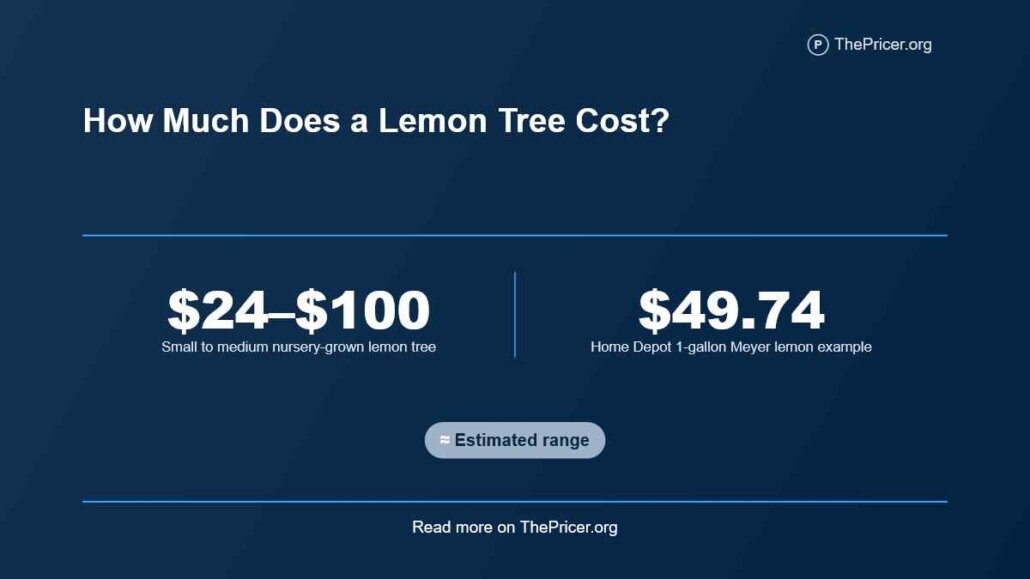
A lemon tree costs approximately $24 to $100 for many small and medium nursery-grown plants in the United States. Tiny starter trees begin around $23.99, while 1-gallon Meyer lemons commonly sell for $45 to $65. Larger grafted trees, established container specimens, and fruiting-size citrus can cost $100 to $200 or more. The final amount depends on the cultivar, height, rootstock, container size, and nursery.
Growing a lemon tree also involves expenses beyond its purchase price. A patio or indoor tree may need a larger container, suitable potting mix, fertilizer, supplemental lighting, and protection from cold weather. Delivery and state citrus-shipping restrictions can affect where a tree can be purchased. Buyers should compare the complete first-year cost rather than choosing a tree solely because its advertised price is low.
Article Highlights
Jump to sections
- Stark Bro’s advertises a 4- to 6-inch Meyer lemon starter at $23.99.
- Home Depot lists a Garden State Bulb 1-gallon Meyer lemon tree at $49.74.
- Four Winds Growers offers grafted semi-dwarf Meyer and Lisbon lemon trees starting at $65.
- Madison Citrus Nursery lists dwarf Meyer lemon trees around $48 to $51, with shipping calculated separately.
- A modeled container-growing setup costs $172.73, including a small tree, pot, potting materials, fertilizer, and assumed shipping.
- Citrus quarantine restrictions can prevent shipment to certain states, even when a tree is advertised as available online.
How Much Does a Lemon Tree Cost?
Nurseries sell lemon trees as tiny starter plants, larger container trees, grafted semi-dwarf trees, and mature specimens. The container label does not guarantee a particular height or fruiting stage, so actual dimensions matter when comparing prices.
The Stark Bro’s Meyer lemon selection lists a 4-inch potted plant shipped at 4 to 6 inches tall for $23.99. Its 1-quart offerings cost $27.99, while an advertised 1.5- to 3-foot option is $89.99 but was out of stock when inspected.
Home Depot’s Garden State Bulb Meyer lemon costs $49.74 for a 1-gallon container. The retailer warns that local prices and inventory can differ from the online display.
| Lemon tree | Published price | Size or format |
|---|---|---|
| Stark Bro’s Meyer | $23.99 | 4-inch pot, 4–6 inches tall |
| Stark Bro’s Meyer | $27.99 | 1-quart container |
| Home Depot Meyer | $49.74 | 1-gallon container |
| Madison dwarf Meyer | $48–$51 | Dwarf grafted tree |
| Four Winds Meyer | $65 starting price | 24–36-inch grafted tree |
| Four Winds Lisbon | $65 | 24–36-inch grafted tree |
| Trees.com Meyer | $65.95 sale price | 1–2-foot tree |
| Home Depot Lisbon | $99.48 | No. 3 container |
These are individual U.S. retailer offers checked in October 2026, not a statistical average across all nurseries. Prices may change with container selection, discounts, inventory, delivery location, and purchase date.
A larger tree is not automatically ready to produce a significant harvest. Graft maturity, light, growing conditions, and how well the plant establishes after delivery all affect when fruit becomes available.
Meyer, Lisbon, Eureka
Meyer lemons are popular among home gardeners because of their relatively compact growth habit and sweeter, less acidic fruit. Their manageable size makes them attractive for container growing, although they still need strong light and protection from freezing temperatures.
The Four Winds Improved Meyer tree starts at $65 for a 24- to 36-inch grafted semi-dwarf tree. The nursery also offers a larger 36- to 48-inch size, with the actual selection affecting the final price.
Lisbon lemons have the tart flavor commonly associated with supermarket lemons. The Four Winds Lisbon offering also starts at $65 for a 24- to 36-inch semi-dwarf tree. Its vigorous growth and thornier habit may make it less suitable for a narrow indoor location.
Eureka lemons are another traditional tart variety. Home Depot lists an Alder & Oak Eureka in a No. 3 container at $86.47, versus $99.48 for the comparable retailer’s Lisbon offering. These prices come from its lemon tree assortment.
Variegated pink lemons have distinctive foliage and striped fruit. They are not necessarily far more expensive than common citrus at the smallest nursery sizes. The Madison Citrus Nursery catalog has listed small variegated pink lemons from $34, alongside Meyer and Yuzu offerings at similar starting prices.
The practical distinction is plant size, rootstock, and availability. An unusual cultivar in a small pot can cost less than a larger ordinary Meyer tree.
Dwarf Lemon Trees
A dwarf lemon tree is not simply a young tree. Many dwarf varieties are grafted onto rootstocks selected to slow growth and produce a smaller mature plant, while retaining normal-sized fruit.
Madison’s dwarf citrus collection describes trees grafted onto Flying Dragon rootstock. Its recent catalog lists dwarf Meyer, Lisbon, Eureka, and variegated pink lemon trees near $48 each.
Dwarf citrus can be a better choice for someone with a patio, sunroom, or limited growing space. A smaller tree may also be easier to move indoors before cold weather, although its container can become heavy as the plant matures.
Standard or semi-dwarf nursery trees may grow substantially taller when planted in suitable outdoor conditions. Four Winds describes its semi-dwarf Meyer lemon as capable of reaching approximately 8 to 12 feet in the ground, compared with about 6 to 8 feet in pots.
Choosing the right final size can prevent later spending on oversized containers, pruning equipment, and difficult seasonal moves. The larger tree is not automatically the better purchase.
Where to Buy a Lemon Tree
Home improvement stores, online citrus specialists, local nurseries, and mail-order fruit-tree suppliers offer different advantages. Local stores make it possible to inspect the plant before buying, while specialist nurseries may provide a wider selection of grafted cultivars and rootstocks.
The Trees.com Meyer lemon listing, formerly FastGrowingTrees.com, advertises a 1- to 2-foot tree at a sale price of $65.95, reduced from $104.95. Its published shipping terms charge $19.95 on orders below $99, with free shipping at qualifying higher amounts.
That means a single sale-priced Meyer lemon would cost $85.90 including the stated shipping charge, before applicable tax. Shipping alone adds approximately 30.2% to the advertised tree price.
This is a useful warning against comparing one website’s sale price with another nursery’s in-store pickup price. A tree costing slightly more locally may be cheaper once delivery is included.
For small container trees, Stark Bro’s Meyer potted kit offers a tiny starter tree with a 10-inch pot and saucer for $34.99. The kit arrives with a 4- to 6-inch plant, so it should not be compared directly with a larger nursery-grown tree.
First-Year Cost
For a homeowner growing citrus in a container, the tree is only part of the initial spending. The setup may also require a suitable pot, drainage-compatible potting mix, fertilizer, and a tray or saucer.
Consider a hypothetical buyer purchasing Stark Bro’s $23.99 Meyer starter rather than its prepackaged kit. The following budget uses the published tree and fertilizer prices; other amounts are explicitly assumed for an illustrative project.
- Small Meyer lemon starter: $23.99
- Assumed suitable pot and saucer: $30.00
- Assumed citrus potting materials: $25.00
- Jack’s Classic Citrus Feed: $14.99
- Assumed shipping: $18.75
- Assumed small indoor grow light: $60.00
- Modeled startup total: $172.73
The fertilizer price appears among the nursery’s recommended citrus supplies. The pot, soil, light, and shipping figures are planning allowances, not a verified checkout basket from one supplier.
ThePricer calculated result: $172.73 for a small tree with a basic indoor setup. The supporting supplies and assumed delivery total $148.74, more than six times the price of the starter tree itself.
This demonstrates why the least expensive lemon tree can have a surprisingly high first-year budget. Someone who already owns suitable containers and has adequate sunlight could avoid much of the additional spending.
Electricity consumption for a grow light is not included in this model, nor are sales tax, unexpected plant losses, or future repotting costs.
Indoor and Outdoor Lemon Trees
Lemon trees grown outdoors in suitable climates may not need a movable container or supplemental lighting. Their ongoing costs still include watering, appropriate fertilization, and inspection for pests and diseases.
The University of Minnesota citrus guide, reviewed in 2026, explains that Meyer and Ponderosa lemon trees can be grown indoors but fruit production can be difficult. It recommends direct sunlight, suitable potting media, and fertilizing during active growth.
Indoor citrus also needs attention to air temperature and pollination. Where pollinating insects are absent, gentle manual pollination may improve fruit set. A sunny window may support the plant’s survival without consistently providing the light needed for abundant fruit.
For outdoor planting, the climate is the main constraint. The nursery descriptions for Meyer and Lisbon trees commonly recommend protecting citrus below freezing and using containers where winters are too cold for permanent outdoor planting.
Someone comparing a lemon tree with other ornamental plants can review the costs of Japanese maple trees and cactus plants. Their water, light, climate, and transplant requirements differ, so the plants are not interchangeable from a maintenance perspective.
Shipping Restrictions
One of the most easily missed lemon-tree costs is not a fee at all: a nursery may be unable to ship the plant to the buyer’s state.
The USDA citrus nursery protocol, updated in January 2026, explains that interstate movement of citrus nursery stock from quarantined areas is restricted unless applicable certification or permit requirements are satisfied.
Madison Citrus Nursery, for example, identifies Arizona, California, Florida, Hawaii, Louisiana, and Texas among its excluded shipping destinations. Other nurseries may have different restrictions based on origin, certification, and destination.
Buyers should not assume that a tree legally sold within one state can be transported across state lines. The USDA citrus disease guidance discusses citrus greening and Asian citrus psyllids, including precautions against moving plants or plant material from regulated areas.
Purchasing an eligible, healthy, appropriately certified tree is more valuable than saving a small amount through a questionable seller. Nursery guarantees also differ: some cover survival for a period but require a separate shipping payment for a replacement.
Regular pest inspection is another ownership task. University of Minnesota identifies scale, whiteflies, and spider mites as common indoor citrus problems. Pest-control purchases should be based on an actual identified problem rather than automatically included as an annual expense.
Does Growing Lemons Save Money?

A lemon tree can produce fruit for many years in favorable conditions, but annual harvests are not guaranteed. Variety, sunlight, climate, age, growing space, and care all affect production.
For an illustrative household calculation, assume a fully established tree produces 60 usable lemons annually and a purchased lemon would cost $0.75. That harvest would represent $45 in grocery spending avoided per year, before ongoing growing expenses.
Against the $172.73 modeled startup cost, it would take approximately 3.8 full 60-lemon harvests to recover the initial outlay at that assumed grocery price. The calculation excludes fertilizer, electricity, watering, replacement pots, losses, and the time needed for the tree to begin producing.
Changing the supermarket price matters. If comparable lemons cost $0.50 each, the same harvest would save $30 per year, extending simple startup-cost recovery to roughly 5.8 such harvests.
These figures are scenarios rather than predicted yields. In a low-light apartment, a lemon tree may be much more valuable as an ornamental plant than as a cost-saving source of fruit.
Buyers who primarily want decorative greenery can also compare the cost of bamboo plants, which serve a different purpose and involve different growing conditions.
Choosing the Best Lemon Tree Value
For a first-time citrus grower, the best value may be a modest grafted Meyer lemon from a reputable nursery. Buying a large tree can provide more immediate visual impact, but it does not eliminate the need for acclimation, suitable sunlight, and consistent care.
Check the health of the graft union, leaf color, branch structure, root condition, and signs of insects. Compare actual plant height and container size, along with the nursery’s guarantee and shipping eligibility.
Makes sense if
- You have strong sunlight or suitable supplemental lighting.
- You can protect the tree from freezing weather.
- You have room for the tree’s eventual container or outdoor size.
- You value ornamental appearance and homegrown fruit beyond simple grocery savings.
Does not make sense if
- The growing location has insufficient light and no practical alternative.
- You cannot provide suitable winter protection.
- The seller cannot legally ship citrus to your destination.
- You expect guaranteed harvests that immediately repay the purchase price.
Compare the full delivered tree cost and any necessary growing supplies before buying. A healthy, appropriately sized plant that suits the available conditions is usually a better purchase than the largest tree the budget can accommodate.
Answers to Common Questions
How much does a small lemon tree cost?
Small starter lemon trees begin around $23.99 in current nursery listings. Larger 1-gallon plants commonly cost around $45 to $65, depending on the supplier.
How much does a Meyer lemon tree cost?
Current examples range from a $23.99 miniature starter to a $65 grafted semi-dwarf tree, with larger or specialty specimens costing more.
Can a lemon tree grow indoors?
Yes. Meyer and Ponderosa lemons are suitable candidates for indoor container growing, but sufficient light, appropriate temperatures, watering, and pollination are important for fruit production.
How long does it take for a lemon tree to bear fruit?
Some grafted nursery trees may begin producing within a few years, while tiny plants and poorly lit indoor trees can take longer. Fruiting depends on cultivar, maturity, health, and growing conditions.
Is a lemon tree worth the money?
It can be worthwhile for fresh fruit and ornamental value. However, fertilizer, containers, lighting, and other care expenses may prevent it from being cheaper than purchasing lemons at the grocery store.
Disclosure: Educational content, not financial advice. Prices reflect public information as of the dates cited and can change. Confirm current rates, fees, taxes, and terms with official sources before purchasing. See our methodology and corrections policy.