
How Much Does Parotidectomy Surgery Cost?
Updated on | Written by Alec Pow
This article was researched using 13 sources. See our methodology and corrections policy.
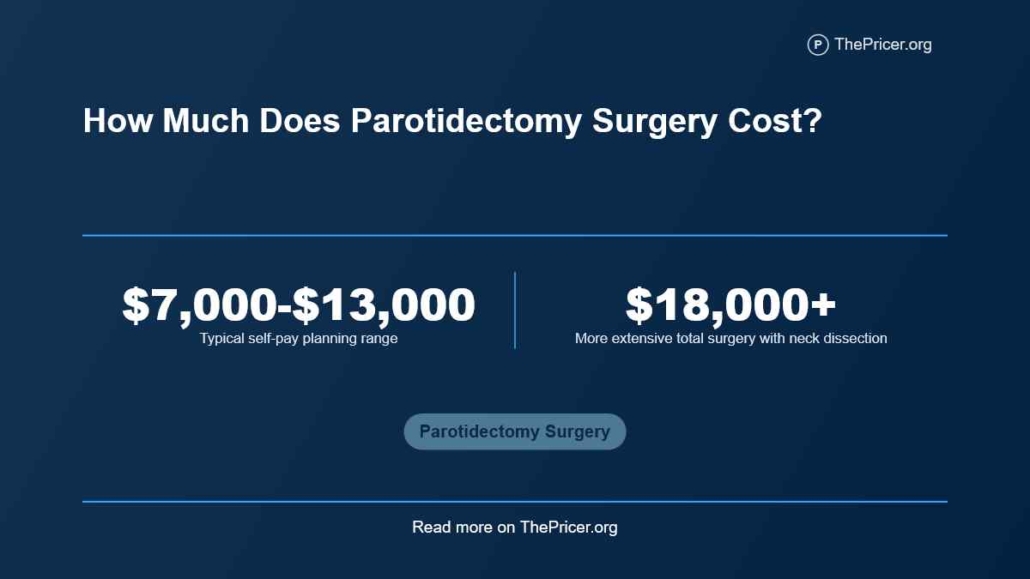
Parotidectomy surgery typically costs about $7,000 to $13,000 for many self-pay procedures in the United States, while more extensive total parotidectomy with neck dissection can reach about $18,000 or more before additional cancer treatment. The exact price depends heavily on how much of the gland is removed, whether the facial nerve requires extensive dissection, whether neck lymph nodes or other tissue are removed, and whether the quote includes the surgeon, anesthesia, facility, pathology, and follow-up care.
One current all-inclusive surgery package is $8,000. Hospital price-transparency data for a common lateral-lobe parotidectomy code shows a median published cash price of $7,218, while a recent U.S. economic study estimated approximately $13,316 for partial parotidectomy and $18,456 for total parotidectomy with neck dissection.
Article Highlights
Jump to sections
- Common self-pay planning range: roughly $7,000 to $13,000 (at $30 per hour, earning that amount would take about 5.8 to 10.8 full-time workweeks, before taxes).
- Hospital cash-price median: about $7,218 for CPT 42415 across 531 hospitals publishing a cash price.
- All-inclusive example: Surgery Center of Oklahoma publishes $8,000 for parotidectomy, including surgeon, anesthesia, facility, consultation, uncomplicated follow-up, and an overnight stay.
- More extensive surgery: a recent economic analysis estimated $18,456 for total parotidectomy plus neck dissection.
- Outpatient care: many uncomplicated patients can now go home the same day.
- Hidden price: a hospital’s quoted surgery price may not include every physician, pathology, imaging, or follow-up bill.
- At $30 per hour: earning an $8,000 self-pay package takes about 267 hours of work before taxes.
How Much Does Parotidectomy Surgery Cost?
One of the strongest current price benchmarks comes from hospital transparency data. MedRates currently tracks CPT 42415, which describes removal of a parotid tumor or lateral portion of the gland with facial-nerve dissection and preservation. Among 531 hospitals publishing a cash price, the median is approximately $7,218 (about 6 full-time workweeks at $30 per hour).
The middle portion of those hospital prices falls roughly between $3,100 and $9,200. That spread shows how much hospital and geographic pricing can vary, but it needs an important warning: the hospital’s published price is not automatically the patient’s complete bill. Surgeon, anesthesia, pathology, imaging, or other professional charges can be billed separately.
An unusually useful comparison is an actual bundled price. The Surgery Center of Oklahoma publishes a $8,000 prepaid parotidectomy price. Its listing says that price includes the facility, surgeon, anesthesiologist, initial surgical consultation, uncomplicated follow-up care, and an overnight stay.
That makes the $8,000 figure different from a hospital-only charge. When comparing quotes, the useful question is not simply “Which number is lower?” but “Which medical bills are already included in this number?”
| Pricing Example | Cost | What It Represents |
| Hospital cash-price median | $7,218 | CPT 42415 among 531 reporting hospitals |
| All-inclusive surgery package | $8,000 | Surgeon, anesthesia, facility, consultation and routine follow-up |
| Modeled partial parotidectomy | $13,316 | 2025 U.S. cost estimate used in a 2026 economic study |
| Total parotidectomy + neck dissection | $18,456 | More extensive modeled cancer surgery |
The 2026 cost-effectiveness study estimated the U.S. cost of partial parotidectomy at $13,316 and total parotidectomy plus neck dissection at $18,456. These are modeled healthcare costs rather than retail cash quotes, but they provide a useful measure of how surgical extent changes the economics.
The difference between those two procedures is $5,140. Total parotidectomy with neck dissection is therefore about 38.6% more expensive in that model.
What Changes the Cost?
The largest price driver is how extensive the operation needs to be.
A superficial parotidectomy removes a tumor or affected tissue in the outer portion of the gland. A total parotidectomy removes tissue from both the superficial and deep portions. Surgery becomes more complicated when cancer involves lymph nodes, surrounding tissue, or the facial nerve.
Johns Hopkins Medicine explains that the facial nerve runs through the parotid gland and controls facial movement. Surgeons frequently have to identify and dissect the nerve and its branches while removing the tumor. The size, position, and relationship of the mass to that nerve can therefore affect operating time and complexity.
For cancer, the procedure can expand further. The National Cancer Institute notes that superficial surgery may be enough for some low-grade superficial malignancies, while other lesions can require total parotidectomy. Facial-nerve resection may be necessary if the nerve itself is involved by tumor.
The American Cancer Society also notes that neck dissection may be added when nearby lymph nodes need to be evaluated or removed. Surgery can include other nearby tissues when cancer has spread beyond the gland.
Pre-Surgery Costs
A parotidectomy bill often begins before the operating room.
Johns Hopkins’ parotid tumor guidance says evaluation commonly includes imaging and tissue sampling. MRI is often preferred for evaluating the tumor and its relationship to surrounding structures, although CT or other imaging can also be used. Fine-needle aspiration is a common biopsy method.
A current MDsave ENT consultation benchmark ranges from about $174 to $559 (about 0.7 to 2.3 full-time workdays at $30 per hour), with an MDsave national average of approximately $230.
Imaging, ultrasound-guided biopsy, laboratory testing, pathology review, and additional specialist visits can be separate charges. Cancer cases may also involve scans for lymph nodes or distant disease.
This is one reason a surgical price alone should not be labeled the total cost of treatment.

Outpatient vs Hospital
The old assumption that a parotidectomy normally requires one or two nights in the hospital no longer describes many uncomplicated procedures.
Johns Hopkins says many patients return home the same day. Hospital admission is more likely when the operation also involves procedures such as neck dissection or reconstruction.
This has a measurable financial effect. A study published in Otolaryngology–Head and Neck Surgery found that outpatient parotidectomy increased substantially without a corresponding increase in the measured complication rate. At that institution, outpatient treatment saved approximately $3,838 compared with overnight admission.
A separate review of 335 patients likewise found comparable postoperative outcomes between outpatient and inpatient groups and calculated average savings of about $1,529 for outpatient treatment.
Those figures are institutional cost differences, not guaranteed discounts for an individual patient. They do show why the planned place of service deserves to be part of every price discussion.
Hidden Price: Separate Bills
The largest hidden expense may be the difference between a “procedure price” and an “all-in price.”
Parotidectomy can generate charges from the surgeon, hospital or surgery center, anesthesiologist, radiologist, pathologist, laboratory, and other specialists. If cancer surgery includes neck dissection or reconstruction, still more clinicians can become involved.
A hospital advertising $7,000 for the procedure could therefore be more expensive in the end than an $8,000 bundled package that includes the major professional charges.
Ask for the billing codes and whether the quote includes:
- Surgeon’s professional fee
- Facility or operating-room charges
- Anesthesia
- Pathology
- Imaging
- Facial-nerve monitoring
- Any planned neck dissection or reconstruction
- Routine postoperative visits
Our separate guide to anesthesia costs explains why professional anesthesia charges and facility charges can appear separately. Readers comparing major operations may also find our guides to Tommy John surgery costs and carpal tunnel surgery costs useful examples of how facility and surgeon pricing change a medical procedure’s total bill.
Work-Hour Math
An $8,000 bundled surgery package equals about 266.7 hours of work at $30 per hour before taxes. The $13,316 partial-parotidectomy estimate equals about 443.9 hours, while the $18,456 total-parotidectomy-plus-neck-dissection estimate equals approximately 615.2 hours.
Recovery can create another financial cost. Johns Hopkins says many people need about two weeks before returning physically to work, although some can work remotely sooner. Two unpaid 40-hour weeks at $30 per hour would represent another $2,400 in lost gross wages. That is a budgeting example, not a guaranteed recovery schedule.
Insurance Costs
Parotidectomy performed to treat a tumor, cancer, significant infection, or another medically necessary condition may be covered by health insurance, but there is no reliable rule that private insurance simply pays a fixed 70%, 80%, or 90% of the bill.
The patient’s share depends on deductible, coinsurance, copays, network status, the place of service, authorization requirements, and what has already been spent during the plan year.
For Marketplace plans, HealthCare.gov says the 2026 out-of-pocket limit can be no more than $10,600 for an individual or $21,200 for a family for qualifying covered in-network services. Premiums, uncovered services, out-of-network care, and certain amounts above the insurer’s allowed charge do not count toward that ceiling.
Medicare treatment depends in part on whether the surgery is outpatient or the patient is formally admitted. CMS lists the 2026 Part B deductible at $283. The 2026 Part A inpatient hospital deductible is $1,736 per benefit period. Part B-covered services commonly involve coinsurance after the deductible, while inpatient Part A follows different cost-sharing rules.
That makes the surgery’s official admission status financially important as well as medically important.
Self-Pay Protections
Patients paying without insurance should request a written Good Faith Estimate before scheduled surgery.
CMS says uninsured and self-pay patients are generally entitled to an estimate when care is scheduled at least three business days ahead or when they request one.
If one provider ultimately charges at least $400 more than that provider’s estimate, the patient may qualify for the federal patient-provider dispute process. Because surgery can involve several separate providers, ask which organizations will issue their own estimates.
Patients who cannot afford the resulting bill should also ask about hospital financial assistance. CMS notes that nonprofit hospitals must provide financial assistance to eligible patients, while other facilities may have voluntary assistance or payment-plan programs.
Recovery and Risks
Parotidectomy involves operating around the facial nerve, so facial movement is an important part of both surgical planning and postoperative monitoring.
Johns Hopkins lists temporary facial weakness as a possible complication because the nerve can be manipulated during surgery. Permanent weakness is less common and depends on factors such as the tumor’s size, location, type, and whether the nerve is involved.
Other recognized complications include bleeding, infection, salivary leakage, sialocele, fluid collection, numbness around the ear, Frey’s syndrome, and first bite syndrome.
Many patients go home the day of surgery and recover at home. Johns Hopkins recommends avoiding lifting more than 10 pounds or strenuous activity for about two weeks, with recovery varying by the extent of the procedure and the individual patient.
Cancer treatment can extend well beyond surgical recovery. NCI notes that postoperative radiation can be recommended for some higher-risk salivary gland cancers, including certain high-grade tumors, close or involved margins, larger tumors, or lymph-node disease. Those oncology costs should not be folded into a standard benign parotidectomy price.
What We Verified
Answers to Common Questions
How much does parotidectomy surgery cost without insurance?
A useful planning range is roughly $7,000 to $13,000 for many uncomplicated self-pay procedures. More extensive total parotidectomy, neck dissection, reconstruction, or cancer treatment can increase the total substantially.
How much does a superficial parotidectomy cost?
Hospital transparency data for the common lateral-lobe parotidectomy code shows a median cash price of approximately $7,218. One bundled provider currently charges $8,000. The complete cost depends on which professional and facility fees are included.
How much does total parotidectomy cost?
More extensive surgery generally costs more. One recent U.S. economic analysis estimated $13,316 for partial parotidectomy and $18,456 for total parotidectomy with neck dissection.
Do you have to stay overnight after parotidectomy?
Not necessarily. Johns Hopkins says many patients with uncomplicated surgery go home the same day. Neck dissection, reconstruction, medical conditions, complications, or other factors can require hospital admission.
Does insurance cover parotidectomy?
Medically necessary surgery is commonly eligible for coverage, but the patient’s actual cost depends on the individual policy, network, deductible, coinsurance, authorization requirements, and whether the procedure is outpatient or inpatient.
What is the biggest hidden parotidectomy cost?
The biggest pricing trap is often assuming that one quoted surgical number includes everything. Ask separately about the surgeon, facility, anesthesia, pathology, imaging, nerve monitoring, follow-up care, neck dissection, and reconstruction before comparing two prices.
Disclosure: Educational content, not medical advice. Pricing varies by provider, location, and insurance. Confirm eligibility, coverage, and out-of-pocket costs with a licensed clinician and your insurer. See our methodology and corrections policy.