
How Much Does a Pomeranian Cost?
Updated on | Written by Alec Pow
This article was researched using 14 sources. See our methodology and corrections policy.
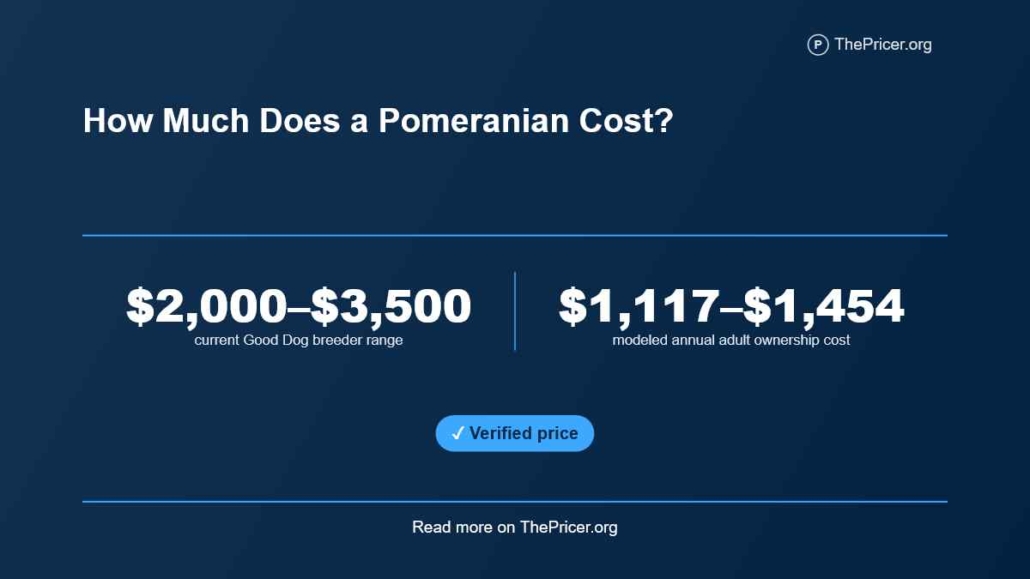
A Pomeranian puppy in the United States can cost from about $550 to $1,000 in a lower-priced breeder marketplace sample, while Good Dog currently places its national Pomeranian breeder range at $2,000 to $3,500.
Breed rescue can cost far less, with one long-running Pomeranian rescue listing a usual adoption fee of $350. The purchase channel matters because these figures do not describe the same package, breeder standards, medical work, or contract terms.
Pomeranians are toy dogs that usually weigh 3 to 7 pounds and have a 12 to 16 year life expectancy. Their small size keeps food consumption modest, but grooming, dental care, insurance, training, and veterinary work can outweigh food in the ownership budget. A low puppy price can also hide missing health screening or included care, so the useful comparison is the puppy or adoption fee plus what the seller or rescue has already paid for.
Article Highlights
Jump to sections
- Good Dog currently puts its national Pomeranian breeder range at $2,000 to $3,500 (at $30 per hour, earning that amount would take about 1.7 to 2.9 full-time workweeks, before taxes).
- A July 2026 sample of 15 active marketplace listings ran from $550 to $1,000, with a $788 average inside that limited sample.
- One dedicated breed rescue lists a usual adoption fee of $350.
- A current rescue listing at $500 included spay, dental cleaning, microchip, tests, and core vaccines.
- A documented annual service subtotal for an adult Pom can land around $1,117 to $1,454 before dental work, emergencies, treats, supplies, licensing, boarding, or dog walking.
How Much Does a Pomeranian Cost?
The market splits into distinct price bands. Good Dog says Pomeranians in its breeder network usually cost $2,000 to $3,500 nationally. A July 2026 PetExpenses analysis of 15 active Greenfield Puppies Pomeranian listings found a much lower $550 to $1,000 listing range, with an average of $788 (about 3.3 full-time workdays at $30 per hour) across that sample. The sample covered 11 locations and should not be treated as a national breeder average.
Rescue sits in a third band. The Pomeranian Rescue Group in Northern California states that its usual adoption fee is $350. These prices answer different questions. A marketplace listing price tells you what a seller is asking. A breeder-network range reflects a different pool of breeding programs. A rescue fee may include medical services already completed before adoption.
| Purchase route | Current price evidence | What the figure represents |
|---|---|---|
| Good Dog breeder network | $2,000 to $3,500 | Current national expected range on that breeder platform |
| Greenfield marketplace sample | $550 to $1,000 | 15 active listings, $788 sample average |
| Pomeranian Rescue Group | $350 | Usual fee published by one dedicated breed rescue |
The midpoint of Good Dog’s sourced range is $2,750. Compared with the marketplace sample average of $788, the purchase-price gap is about $1,962. That gap does not prove one dog is healthier. It shows why the buyer has to compare what sits behind the price.
Why Breeder Prices Differ
A breeder price can include costs that never appear in a bare puppy listing. The American Kennel Club says Pomeranians weigh 3 to 7 pounds, live about 12 to 16 years, and responsible breeders screen breeding stock for conditions that include luxating patellas, cardiac concerns, and eye disease. Its recommended Pomeranian health tests are a patella evaluation, cardiac exam, and ophthalmologist evaluation. Copies of parental results give a buyer something concrete to check before paying a premium.
Pedigree, registration, show prospects, breeding rights, age, location, and breeder demand can also move the asking price. Coat color may affect what an individual seller charges, but a color premium is not evidence that the parents completed health screening. A buyer paying several thousand dollars should separate appearance marketing from documented breeding work, veterinary records, registration terms, and the contract.
Ask what leaves with the puppy. Useful inclusions can include initial vaccinations, deworming records, microchip information, registration paperwork, a veterinary examination, a health guarantee, and return terms. Transport can be another charge if the breeder is not within driving distance. The seller should state whether a deposit is refundable and whether the advertised puppy price includes breeding rights. Those details can make two similar-looking Pomeranians financially different purchases.
What Adoption Really Costs
Adoption can carry a higher fee than the old $50 to $100 (about 1.7 to 3.3 hours of work at $30 per hour) shelter stereotype, especially when a rescue has already paid for veterinary work. A recent Petfinder Pomeranian listing carried a $500 adoption fee that included spay surgery, dental cleaning, microchip, heartworm testing, wellness bloodwork, fecal testing, and core vaccines. That package is materially different from paying a fee for a dog with none of those services completed.
Current CareCredit veterinary cost research lists a dog spay at $353, microchipping at $48, dental cleaning at $395, and a routine dog visit at $56 to $129. Its current veterinary cost table shows why an adoption fee can represent substantial prepaid care. The spay, dental cleaning, and microchip alone total $796 using those national procedure figures, before assigning any value to vaccines or testing.
That does not mean every rescue dog comes with $796 of transferable savings. The dog may not need the same procedures in the same year, local prices differ, and not every rescue includes dental work. It does show why comparing a $350 or $500 adoption fee with a puppy purchase price on sticker price alone misses part of the financial picture.
Food, Grooming, and Training
The Pom’s small body keeps food quantities low, but premium breed-specific food can still create a measurable annual bill. Royal Canin currently sells Pomeranian Adult dry food with a 10-pound bag at $61.99. Its feeding chart lists 48 grams per day for a 4.4-pound moderately active adult and 64 grams for a 6.6-pound moderately active adult. At those feeding rates, one 10-pound bag lasts about 95 days at the lighter weight and about 71 days at the heavier weight.
That produces a food-only example of roughly $239 to $319 per year, or $20 to $27 per month, using that product and those feeding amounts. Treats, wet food, calorie needs, and puppy feeding can change the number.
Grooming can cost more than food. AKC recommends professional grooming every four to six weeks when the owner is not comfortable maintaining the coat at home, and its Pomeranian grooming guidance calls for frequent brushing. Petco lists bath-and-haircut service starting at $46 for dogs up to 10 pounds. Nine to 13 visits at that starting price equal about $414 to $598 per year.
Training has a smaller predictable entry cost. PetSmart currently lists its six-week puppy class as a six-week puppy class at $149. Owners who want a broader grooming comparison can also review current professional pet grooming costs.
Health, Vet Care, and Insurance
Pomeranian health costs are not captured by one annual emergency allowance. The breed’s small size does not remove the possibility of expensive dental, orthopedic, respiratory, or gastrointestinal care. Health screening before purchase can reduce uncertainty about breeding stock, but it cannot guarantee that a dog will never develop a medical problem.
Fetch reports that active U.S. policies for Pomeranians averaged $34 per month across its policy configurations for the stated 2025 measurement period. That is $408 per year. The same insurer’s claims data says one in ten Pomeranian policyholders in its dataset incurred more than $1,792 for oral inflammation, more than $3,844 for walking abnormality, and more than $2,883 for gastric issues over the dog’s lifetime. Those are insurer-specific claim observations, not odds for every Pomeranian.
Insurance price depends on age, location, deductible, reimbursement rate, annual limit, and coverage design. Pre-existing-condition rules also matter. Someone comparing policies should examine exclusions and dental coverage rather than choosing by monthly premium alone. The broader pet insurance cost page explains how deductibles and reimbursement settings change the bill.
Dental care deserves its own budget line. The CareCredit figure cited earlier puts a cleaning at $395 before extractions or more involved treatment. It is not an annual certainty, but one dental procedure can materially change that year’s ownership cost.
First-Year Cost
The acquisition price changes the first year sharply. This calculation holds several sourced services constant and changes only the purchase route. It uses one routine dog visit at $56 to $129, one six-week training class at $149, nine professional grooms totaling $414, and one year of insurance at $408. Food, supplies, extra vaccines, prevention, transport, tax, licensing, and emergency care are excluded.
With the dedicated rescue fee of $350, that documented service subtotal is about $1,377 to $1,450. Using the marketplace sample’s $550 to $1,000 purchase band produces about $1,577 to $2,100. Using Good Dog’s $2,000 to $3,500 breeder range produces about $3,027 to $4,600. These are calculated scenarios, not published national first-year averages.
The low-end breeder scenario is reproducible. A $2,000 puppy plus a $56 exam, $149 training class, $414 in grooming, and $408 for insurance totals $3,027. Food, supplies, and puppy veterinary needs remain outside that subtotal.
Some adopted dogs already include spay or neuter, microchip, vaccines, and dental work. A breeder puppy may include veterinary work too. Compare inclusions before adding the same procedure twice.
Annual Cost After Year One
After the acquisition fee and starter training disappear, the adult service budget is easier to model. The sourced figures put breed-specific dry food at $239 to $319 per year, professional grooming at $414 to $598, the insurance average at $408, and one routine veterinary visit at $56 to $129.
Those four items produce a calculated annual subtotal of about $1,117 to $1,454. Without the insurance premium, the same subtotal falls to about $709 to $1,046, but the owner then retains more direct exposure to an unexpected veterinary bill. Neither subtotal includes vaccines, flea or heartworm prevention, treats, replacement supplies, licensing, boarding, dog walking, medications, or emergency treatment.
Dental work can move the year sharply. Adding one $395 dental cleaning to the documented annual subtotal raises it to about $1,512 to $1,849. An extraction or other treatment would raise it further. A Pom with no professional grooming expense because the owner performs the work at home would move in the other direction.
Across a 12 to 16 year lifespan, recurring care keeps accumulating after the purchase fee disappears. Readers comparing another companion breed can use the Teacup Yorkie cost article or the Corgi cost guide.
How to Compare Sellers
A cheaper Pomeranian is not automatically a bad purchase, and a high price is not proof of responsible breeding. Ask for parental health-test results, vaccination records, registration terms, the sales contract, return terms, and the services completed before pickup. If breeding rights or transport change the price, those terms should be stated before payment.
For rescue, ask which veterinary services are included and whether known needs are disclosed. For a breeder puppy, confirm age, parents, health records, and post-pickup support.
Makes sense if
- The seller or rescue provides records that match the claims attached to the price.
- The purchase price fits after grooming, routine veterinary care, food, and emergency planning are added.
- You can maintain the double coat or budget for professional grooming on the schedule the dog needs.
- The contract and return terms are available before payment.
Does not make sense if
- A premium is based mainly on size or color language while health documentation is missing.
- The seller will not identify the puppy’s parents or provide veterinary records.
- The budget works only if grooming, dental care, and veterinary expenses are ignored.
- Transport or deposit terms remain unclear before payment.
Verification checks
- Checked a second Good Dog breed page, which reports a typical puppy price around $2,600.
- Confirmed current dog emergency exam pricing, with a national average of $135 before added diagnostics or treatment.
- Cross-referenced the AKC explanation of breed health testing and its role in evaluating breeding stock.

Answers to Common Questions
How much is a Pomeranian puppy?
Current evidence spans $550 to $1,000 in one lower-priced marketplace sample and $2,000 to $3,500 in Good Dog’s breeder range. The seller pools differ, so the figures should not be blended into one average.
How much does it cost to adopt a Pomeranian?
One dedicated breed rescue publishes a usual fee of $350, while recent Pomeranian rescue listings can reach about $500. Some fees include spay or neuter, microchip, vaccines, testing, or dental work.
How much can a Pomeranian cost in the first year?
The documented service subtotal runs about $1,377 to $1,450 for the rescue scenario and $3,027 to $4,600 using Good Dog’s breeder range. Food, gear, extra veterinary work, transport, and emergencies are excluded.
How much does a Pomeranian cost per year after that?
The adult service model totals about $1,117 to $1,454 per year for food, grooming, one routine veterinary visit, and the cited insurance average. Dental care, emergencies, and other services can add more.
Why do some Pomeranians cost much more?
Breeder program costs, parental health screening, pedigree, registration terms, show prospects, breeding rights, location, demand, and included veterinary work can affect the asking price. A high price by itself does not verify those items.
Disclosure: Educational content, not medical advice. Pricing varies by provider, location, and insurance. Confirm eligibility, coverage, and out-of-pocket costs with a licensed clinician and your insurer. See our methodology and corrections policy.
I won’t this dog can you tell me how. please tell me please tell me please tell me……?????