
How Much Does a Puffer Fish Cost?
Updated on | Written by Alec Pow
This article was researched using 14 sources. See our methodology and corrections policy.
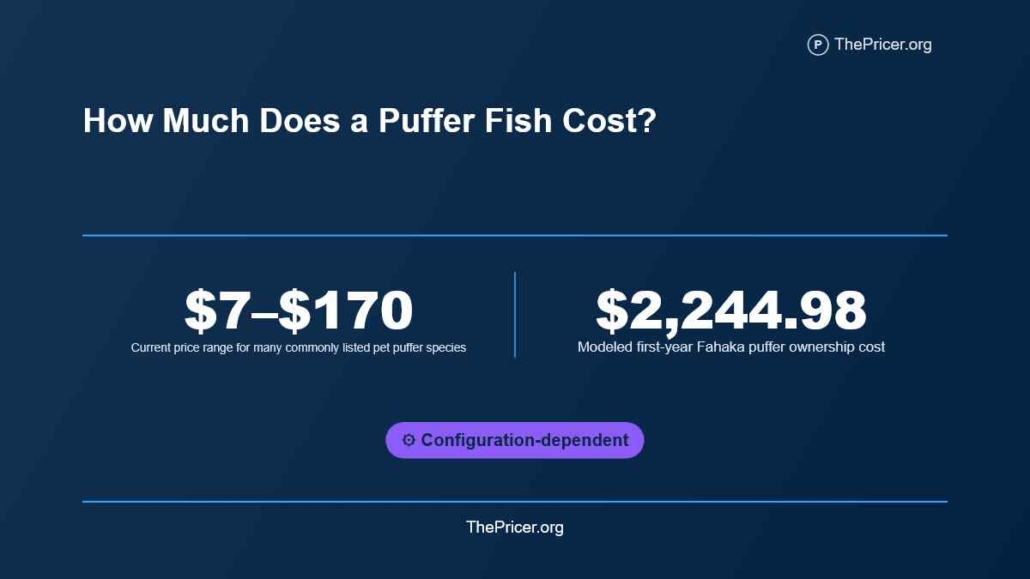
A pet puffer fish currently costs about $7 to $170 for many commonly listed species, while large or rare forms can cost $250 to $1,000, based on current freshwater puffer pricing and a specialty marine puffer catalog. The fish price can be the smallest part of ownership because adult tank size, filtration, heating, saltwater equipment, shipping, and species-specific food vary sharply.
A pea puffer can live in a small planted freshwater aquarium. A Fahaka may need a 120-gallon or larger freshwater system. Some large marine puffers need around 180 gallons. That difference is why one blanket puffer-fish budget is misleading.
Article Highlights
Jump to sections
- Current advertised puffer prices reviewed for this update run from about $7 to $1,000 (at $30 per hour, earning that amount would take about 4.2 full-time workdays, before taxes).
- Current common marine puffer listings include prices from $44.99 to $107.49.
- A current Fahaka costs $24.99 but needs at least a 120-gallon aquarium according to its seller.
- A modeled Fahaka first year reaches about $2,245 before emergency costs.
- A current 180-gallon marine aquarium and stand system costs $4,432.99 before the puffer and several support items.
How Much Does a Puffer Fish Cost?
Freshwater puffers occupy very different price and size classes. Tiny pea puffers sit at the low end of the market, while large freshwater species can require far more expensive housing even when their livestock price looks modest. Stock status matters too. A low advertised fish price has little value if the animal is unavailable, undersized for the buyer’s plan, or paired with an aquarium that will need replacement as it grows.
Common marine puffers already span a much higher band than nano freshwater species. Petco currently lists a spotted sharpnose from $44.99 (about 1.5 hours of work at $30 per hour), a Valentini from $58.49, a porcupine puffer from $82.99, a Stars & Stripes puffer from $103.49, and a blackspotted dogface from $107.49. Those current marine puffer prices cover common retail choices, while the rare specialty example in the opening shows how much farther the high end can run.
Size, rarity, color form, collection source, quarantine, and current inventory all move the livestock price. Online availability can disappear before a buyer is ready, and the displayed animal price may exclude overnight shipping. Selling size matters too because a cheap juvenile can still require the adult aquarium within a short ownership period. A shopper comparing puffers with another specialty aquarium animal such as a lionfish should compare the adult system and feeding plan, not only the livestock tag.
Species Changes Everything
“Puffer fish” covers animals with radically different adult sizes and water requirements. The pea puffer, Carinotetraodon travancoricus, is a tiny freshwater species. A Fahaka, Tetraodon lineatus, grows far larger and needs a substantial freshwater aquarium. Marine Arothron and Diodon puffers can mature into large fish too, with the added costs of marine salt, larger water changes, circulation, and saltwater filtration.
Diet changes with species too. Aquarium Co-Op’s pea puffer care guidance says these tiny puffers eat live and frozen foods such as bloodworms, brine shrimp, small snails, and white worms. It also notes that pea puffers do not share the same tooth-wear problem seen in many larger puffers. That distinction matters because advice to feed every puffer hard shellfish for dental wear is too broad.
Temperament changes the budget as well. Some puffers are kept alone, which means a large aquarium may house a single fish. Others can work in carefully planned groups or with selected tank mates. The correct purchase question is not simply how much a puffer costs. It is which puffer, at what adult size, in what water type, with what stocking plan.
Small Freshwater Setup
A pea puffer is the low-cost end of puffer ownership, but the tank still costs much more than the fish. A current 10-gallon Aqueon LED aquarium kit sells for $99.99 (about 3.3 hours of work at $30 per hour) and includes a power filter, a preset heater, lighting, and starter samples. The 10-gallon starter kit does not include the fish, plants, gravel, or decor. A planted layout with sight barriers is useful because pea puffers can be territorial.
Using the current $12.99 pea puffer listing plus the $99.99 kit gives only $112.98 before the tank is planted or cycled. Add a chosen $100 allowance for substrate, plants, a liquid test kit, and small tools, plus $120 for a year of frozen and live foods, and the illustrative first year becomes about $332.98. Those two allowances are planning inputs, not published market averages.
This small setup should not be used as a template for every puffer. A pea puffer is a true freshwater nano species. It does not justify putting a juvenile Fahaka, Mbu, or large marine puffer in a similar aquarium with plans to upgrade later. Readers comparing small aquarium pets can also look at current pet jellyfish costs, where the specialized tank rather than the animal often drives the first-year bill.
Fahaka First-Year Cost
A Fahaka shows why a cheap fish can be an expensive purchase. LiveAquaria currently lists a small Fahaka at $24.99 and gives a 120-gallon minimum tank size. Its Fahaka product page also lists a maximum size of 15 inches and an aggressive temperament. That makes the animal price a poor shortcut for the budget.
The scenario below uses a current 125-gallon aquarium-and-stand ensemble at $999.99 from a 125-gallon aquarium listing. It then uses a chosen $450 allowance for heavy filtration and redundant heating. That allowance is not a market average. It keeps the scenario reproducible without pretending that every Fahaka owner buys the same filter and heater combination.
| Fahaka first-year item | Modeled cost | Basis |
|---|---|---|
| Small Fahaka | $24.99 | Current advertised price |
| Livestock shipping | $40 | Chosen planning allowance |
| 125-gallon tank and stand | $999.99 | Current retail example |
| Filtration and heating | $450 | Chosen planning allowance |
| Substrate, hardscape, tests, tools | $250 | Chosen planning allowance |
| First-year food | $360 | Chosen $30 monthly allowance |
| Water care and maintenance supplies | $120 | Chosen annual allowance |
| Modeled first-year total | $2,244.98 | Before electricity, tax, and emergencies |
The model uses $40 as a chosen live-fish shipping allowance rather than treating one seller’s rate as universal. In this scenario, the $24.99 fish is only about 1.1% of the $2,244.98 first-year total. The tank plus the chosen filtration-and-heating allowance costs about 58 times the fish price. The financial lesson survives small changes in shipping because the adult system, not the juvenile livestock tag, dominates the budget.
Large Marine Puffer Costs
Large marine puffers move the budget into another class. The earlier common-price sample included a blackspotted dogface starting at $107.49. That livestock price is useful for a matched ownership scenario, but it does not establish the minimum aquarium size or equipment package for every dogface. Adult size, species, and the seller’s husbandry requirements still decide the correct system.
A current 180-gallon aquarium and stand with an integrated sump and auto top-off reservoir is priced at $4,432.99. The 180-gallon marine system is a premium retail example, not a required national price or a claim that every dogface needs this exact package. Paired only as an illustrative comparison with the previously cited $107.49 livestock input, the aquarium and stand cost about 41 times as much as the fish before heaters, rock, marine salt, test supplies, food, and electricity.
A less expensive used or basic system can cut that gap, while a fully equipped reef-style package can cost far more. The right comparison keeps adult volume and included hardware matched. A $100 marine puffer in a 180-gallon system is not financially comparable with a $13 pea puffer in a 10-gallon planted tank. A reader considering other saltwater animals can compare the same system-first logic with pet octopus ownership.
Food and Dental Costs
 Puffer food is not one universal bag of pellets. Larger species have fused dental plates that keep growing and often need hard-shelled foods to create natural wear. Current Fahaka husbandry guidance calls for snails, mussels, clams, and crab legs, with strong filtration and large weekly water changes. The Fahaka care recommendations also place the species in a 125-gallon minimum and describe it as a solitary fish.
That feeding pattern can make a large puffer much more expensive to feed than a nano fish. The Fahaka scenario uses $30 per month as a planning allowance, but a large adult fed retail shellfish can exceed it. Owners who culture feeder snails may lower the cash cost while adding another tank, electricity use, water changes, and time. Soft frozen foods can add variety, yet relying only on soft foods can leave dental wear unresolved for species that need hard prey.
Pea puffers are an exception worth stating. Aquarium Co-Op reports that they do not require the same crunchy-food tooth management as larger puffers, even though they readily eat small snails. That difference is another reason the phrase “puffer fish food cost” needs a species name attached to it. The amount, food type, feeding frequency, and dental role can all change with adult size.
Shipping, Water, and Power
Online livestock shipping can materially change the delivered price of a small puffer. The Fahaka scenario uses a chosen $40 shipping allowance on a $24.99 fish, which shows how an inexpensive listing can become a much larger delivered purchase before the aquarium is counted. Actual live-fish shipping depends on the seller, order value, destination, delivery day, and packaging policy, so buyers should price the shipment before comparing two livestock offers.
Water costs split sharply between freshwater and marine tanks. A freshwater Fahaka needs large water changes because a big carnivore produces a heavy waste load. A marine puffer adds salt mix and salinity testing, so every partial water change consumes another batch of marine salt. Large systems magnify that recurring expense because the same percentage water change means many more gallons than it does in a nano freshwater aquarium.
Electricity also scales with equipment rather than the fish price. Large tanks can run canister filters or return pumps continuously and may use several hundred watts of thermostatic heating during colder periods. Exact annual power cost depends on room temperature, heater duty cycle, lighting, pumps, and local electricity rates, so a blanket $100 to $300 monthly puffer-care claim is not defensible. A stable small freshwater setup and a 180-gallon marine system should not share one utility budget.
Legal, Safety, and Ownership Fit
The old claim that Fahaka puffers need a special annual toxic-animal permit is not supported by the federal food rules. The U.S. Food and Drug Administration regulates pufferfish intended for human consumption because tetrodotoxin poisoning can cause paralysis and death. Its puffer poisoning guidance concerns eating contaminated fish, not a blanket federal ban on keeping an aquarium Fahaka. Separate wildlife import rules can apply when live wildlife crosses U.S. borders, and state rules still need to be checked for the exact species and destination.
Makes sense if
- You choose the exact species before buying the aquarium.
- You can fund the adult tank, filtration, food, and water changes.
- You can source the live or frozen foods that species actually eats.
- You are comfortable maintaining a species-only tank when aggression requires it.
Does not make sense if
- You are choosing by fish price without checking adult size.
- You expect every puffer to eat ordinary flakes or pellets.
- You plan to buy a juvenile now and solve the adult tank later.
- You want a fish that can be routinely touched or handled.
Answers to Common Questions
How much does a pet puffer fish cost?
Current U.S. listings reviewed for this update span about $7 to $1,000. Small freshwater species sit near the low end, many common marine puffers cost roughly $40 to $170, and rare marine forms can approach $1,000.
How much does a Fahaka puffer cost?
A current small Fahaka listing is $24.99, but the seller calls for at least a 120-gallon aquarium. The modeled first-year Fahaka setup above reaches about $2,244.98 before electricity, tax, and emergency expenses.
Do all puffer fish need hard-shelled food?
No. Many larger puffers need shell-on prey to help control continuously growing dental plates. Pea puffers are a meaningful exception and do not have the same tooth-wear requirement.
Are puffer fish poisonous to touch?
Tetrodotoxin is best known as a poisoning risk from eating toxic pufferfish. Aquarium puffers should still be handled as little as possible because handling stresses the fish, inflation is defensive, and larger species can bite.
Disclosure: Educational content, not medical advice. Pricing varies by provider, location, and insurance. Confirm eligibility, coverage, and out-of-pocket costs with a licensed clinician and your insurer. See our methodology and corrections policy.