
How Much Does Rear Main Seal Replacement Cost?
Updated on | Researched and reviewed by Alec Pow, Founder & Pricing Investigator
Prices, claims, and calculations checked against 7 cited sources. See our research methodology and corrections policy.
Rear main seal replacement usually costs about $650 to $1,500 for many vehicles, while trucks, SUVs, AWD models, luxury cars, and labor-heavy designs can reach $1,500 to $2,000+. The surprising part is that the rear main seal itself may cost only about $20 to $80. Most of the bill is labor because the transmission usually has to be removed to reach the seal.
Current estimates put many car and sedan jobs around $650 to $1,100, trucks and SUVs around $1,000 to $1,500+, and luxury or high-performance vehicles around $1,500 to $2,000+. A typical job can require about 6 to 10 labor hours.
Before authorizing a transmission-out repair, make sure the rear main seal is actually the source. Oil from an oil pan gasket, oil-pressure sensor, galley plug, or another leak higher on the engine can travel toward the bellhousing and imitate a failed rear main seal. A professional engine-oil leak inspection currently runs around $122 to $179 in RepairPal estimates.
Article Highlights
Jump to sections
- Rear main seal replacement commonly costs about $650 to $1,500.
- Trucks, SUVs, AWD vehicles, and luxury models can reach $1,500 to $2,000+.
- The seal itself commonly costs only about $20 to $80.
- Most modern vehicles require transmission removal to access the rear crankshaft seal.
- Many jobs require roughly 6 to 10 labor hours.
- Almost half of U.S. repair shops currently charge about $120 to $159 per labor hour, according to AAA’s cited industry data.
- An oil-leak inspection can cost about $122 to $179 and may prevent an expensive misdiagnosis.
- A blocked PCV system or excessive crankcase pressure can contribute to a rear main seal leak and should be checked before the new seal is installed.
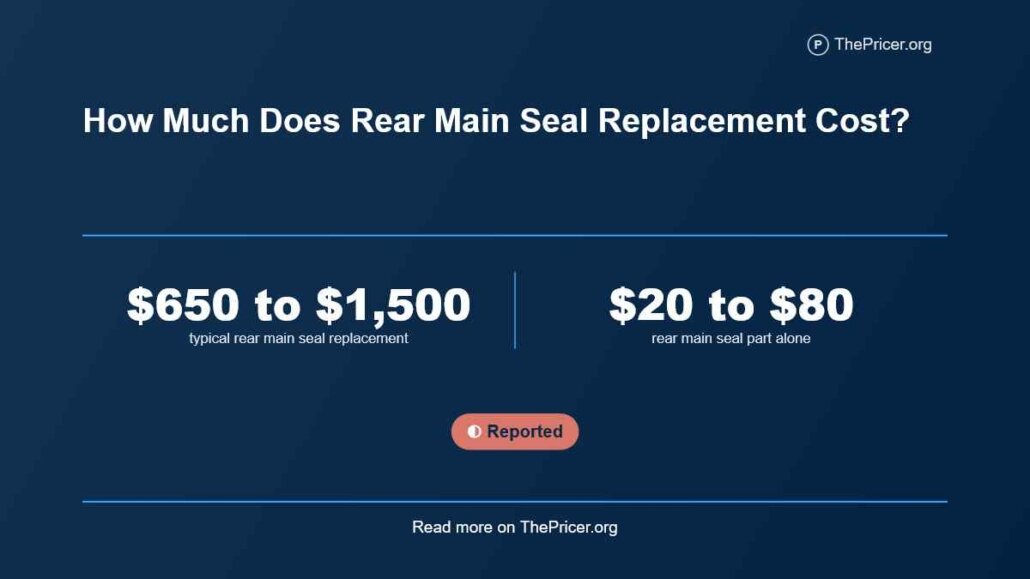
How Much Does Rear Main Seal Replacement Cost?
| Expense | 2026 planning cost | What affects it |
|---|---|---|
| Car or sedan replacement | $650 to $1,100 | Transmission access, drivetrain, engine layout, local labor rate |
| Truck or SUV | $1,000 to $1,500+ | Larger drivetrain components, 4WD hardware, access time |
| Luxury or high-performance vehicle | $1,500 to $2,000+ | Higher labor rates, tight packaging, specialized parts and procedures |
| Rear main seal part | $20 to $80 | OEM vs aftermarket, seal-only vs seal-and-retainer assembly |
| Common labor time | 6 to 10 hours | Vehicle layout and transmission removal complexity |
| Engine-oil leak diagnosis | $122 to $179 | Inspection, cleaning, dye testing, location |
A current 2026 rear main seal cost guide places cars and sedans around $650 to $1,100, trucks and SUVs around $1,000 to $1,500+, and luxury or performance vehicles around $1,500 to $2,000+. It also estimates the seal itself at only about $20 to $80.
That enormous difference between the part price and the repair price is the defining feature of this job.
$50 Seal Becomes a $1,500 Repair
The rear main seal, also called the rear crankshaft seal, sits where the crankshaft exits the rear of the engine. RepairPal describes the seal as the working seal around the rotating crankshaft at the back of the engine.
On most modern vehicles, the seal is hidden behind the transmission, flexplate or flywheel, and torque converter or clutch assembly. Replacing it frequently means removing much of that hardware simply to expose a relatively inexpensive piece of rubber or PTFE sealing material.
Cars.com also notes that rear main seal repairs commonly cost at least $600 because transmission removal is typically required.
Current AAA repair-shop data show that labor rates vary from below $100 per hour to more than $200 per hour, with almost half of shops charging about $120 to $159 per hour. See AAA’s 2026 labor-rate analysis.
At six hours and $120 per hour:
6 × $120 = $720 in labor
At ten hours and $159 per hour:
10 × $159 = $1,590 in labor
That is before the seal, fluids, shop supplies, tax, diagnosis, or related repairs.
Confirm the Leak
An oil puddle near the transmission does not prove the rear main seal has failed.
Oil can travel down the engine and collect near the bellhousing. Possible look-alikes include an oil pan gasket, oil-pressure sensor, galley plug, valve-cover leak, or another engine seal located above the rear main.

A current RepairPal engine leak inspection estimate is around $122 to $179. The diagnostic process can include cleaning oily areas and adding ultraviolet dye to the oil so the technician can trace where fresh oil first appears.
This creates one of the most important cost decisions in the entire repair.
Suppose diagnosis costs $150 and confirms that a $300 oil-pan or sensor repair is responsible rather than a $1,500 rear main seal job.
$1,500 – ($150 + $300) = $1,050 potentially avoided
The numbers are illustrative, but the principle is real. Diagnose first when the leak source is uncertain.
For a broader comparison of possible sources, see our guide to oil leak repair costs.
What Causes a Rear Main Seal Leak?
Age and seal degradation can cause a rear main seal to leak, but technicians should also look for conditions that may have caused or accelerated the failure.
A blocked Positive Crankcase Ventilation system is particularly important. Excessive pressure inside the crankcase can force oil past the seal. Worn piston rings and excessive blow-by can create similar pressure problems.
Underhood Service’s technical guidance recommends checking crankcase pressure, PCV operation, oil condition, crankshaft wear, crankshaft endplay, and installation conditions when investigating rear main seal failures.
This matters financially because installing a new seal without correcting excessive crankcase pressure can allow the replacement seal to leak again.
Other possible contributors include:
- Age and hardened sealing material
- Crankshaft sealing-surface wear
- Excessive crankshaft movement
- Blocked or faulty PCV components
- Excessive engine blow-by
- Incorrect oil level
- Poor seal installation or incorrect installation tools
- Old or badly contaminated engine oil
What Happens During Replacement?
The exact procedure depends on the vehicle, but the normal one-piece rear crankshaft seal job is much more involved than replacing an exposed gasket.
A typical repair can require:
- Disconnecting drivetrain and transmission-related components.
- Supporting the engine and transmission safely.
- Removing the transmission or transaxle.
- Removing the torque converter or clutch assembly.
- Removing the flexplate or flywheel.
- Removing the old rear crankshaft seal or seal housing.
- Inspecting the crankshaft sealing surface and surrounding area.
- Installing the new seal with the correct alignment and installation procedure.
- Reinstalling the flywheel or flexplate and transmission.
- Refilling any fluids removed during the repair and checking for leaks.
YourMechanic’s crankshaft-seal guidance likewise notes that accessing a rear seal can require removal of the transmission, clutch, and flywheel assembly.
Some older engines and unusual designs use different rear main seal arrangements, so the exact procedure and labor time should be checked for the specific year, engine, transmission, and drivetrain.
Related Repairs
A mechanic may recommend inspecting other parts once the transmission has already been removed. That does not mean every related component should automatically be replaced.
On a manual-transmission vehicle, a rear main seal leak can contaminate the clutch. RepairPal notes that a leaking seal may cause a clutch to slip or grab. If the clutch is already worn or oil-soaked, replacing it while the transmission is out can avoid paying much of the same access labor twice.
The same principle can apply to the flywheel, pilot bearing, transmission seals, or other parts that are directly accessible during the repair.
If the flywheel is worn or damaged, compare the separate flywheel replacement cost. If the leak turns out to be lower on the engine, see the oil pan replacement cost.
A transmission fluid leak can also be mistaken for an engine-oil leak at this junction. Our guide to transmission front seal leak repair explains the cost difference.
Three Rear Main Seal Cost Scenarios
Lower-cost sedan repair
A relatively accessible vehicle needs six hours of labor at $120 per hour.
- Labor: 6 × $120 = $720
- Rear main seal: $40
- Fluids and shop supplies: $80
- Modeled repair total: $840
Tax and any separate diagnostic fee would be additional.
Worked example: typical labor-heavy repair
A shop quotes eight labor hours at $140 per hour, a $60 seal or retainer, and $120 in fluids and supplies.
Labor:
8 × $140 = $1,120
Repair:
$1,120 + $60 + $120 = $1,300
If a separate diagnostic charge of $150 is not credited toward the repair:
$1,300 + $150 = $1,450
That is how a roughly $60 sealing component can produce a bill approaching $1,500.
AWD or luxury vehicle
Suppose a more complicated drivetrain requires ten hours at $190 per hour.
10 × $190 = $1,900 labor
Add a $75 seal assembly and $150 in fluids and supplies:
$1,900 + $75 + $150 = $2,125
This is an illustrative example, but it shows why a national maximum of only $1,200 does not fit every modern vehicle.
Can You Drive With a Rear Main Seal Leak?
The urgency depends on how badly the vehicle is leaking.
A light seep with a stable oil level is different from oil pouring out quickly enough to lower the dipstick level between drives. Prompt diagnosis is still worthwhile because a rear main seal repair is expensive enough that you want to know both the source and severity.
Stop driving and address the problem more urgently if the vehicle has a low-oil-pressure warning, rapidly falling oil level, heavy oil loss, burning oil on hot components, smoke, or severe clutch contamination.
Engine oil is meant to lubricate internal engine components such as bearings, crankshaft surfaces, and valvetrain components. Belts and hoses do not need engine-oil lubrication. A severe leak becomes dangerous because the engine can eventually lose enough oil to compromise the components that actually depend on it.
Oil leaking onto a manual-transmission clutch can also cause slipping, grabbing, or chatter and may turn a seal-only repair into a clutch repair as well.
Should You Use Seal Stop-Leak?
Products marketed as rear main seal stop-leak are much cheaper than removing a transmission, but they are not equivalent to replacing a physically failed seal.
RepairPal’s current oil-leak guidance recommends against products that claim to stop engine-oil leaks because of the risk of problems such as blocked oil passages or clogged filters. The company recommends identifying and repairing the actual leak instead.
A chemical additive also cannot repair a damaged crankshaft sealing surface, torn seal, excessive crankshaft movement, or crankcase-pressure problem.
For that reason, we would not treat a $20 to $30 bottle of seal conditioner as an alternative to a confirmed $650 to $2,000+ mechanical repair. If the repair is being postponed because of the vehicle’s value or budget, discuss the leak severity and temporary options with the technician who diagnosed the car.
Before You Approve the Repair
Makes sense if:
- The shop has confirmed that fresh engine oil is coming from the rear crankshaft seal.
- The PCV system and crankcase pressure have been checked where appropriate.
- The estimate lists labor hours, labor rate, seal or retainer price, fluids, and shop supplies separately.
- You know whether the clutch, flywheel, or another component has actually been damaged by the leak.
- You have compared the cost of the repair with the vehicle’s value and condition.
Does not make sense if:
- The shop is assuming “oil near the transmission” automatically means rear main seal.
- No one has checked for leaks above the bellhousing.
- You are being sold several unrelated replacement parts simply because the transmission is already removed.
- The root cause may be excessive crankcase pressure but the PCV system has not been inspected.
- The quote gives one total with no explanation of labor time or related repairs.
What We Verified
- Checked a current July 2026 cost guide placing many rear main seal replacements between $650 and $1,500, with luxury and high-performance vehicles reaching $1,500 to $2,000+.
- Confirmed the seal itself may cost only about $20 to $80.
- Verified a common labor requirement of roughly 6 to 10 hours.
- Cross-referenced AAA data showing almost half of repair shops charging about $120 to $159 per labor hour.
- Confirmed current RepairPal engine-leak inspection estimates of about $122 to $179.
- Verified that oil-pressure sensors, oil-pan gaskets, galley plugs, and leaks above the bellhousing can imitate a rear main seal leak.
- Confirmed excessive crankcase pressure and PCV problems can contribute to rear main seal failure.
Answers to Common Questions
How much does it cost to replace a rear main seal?
Budget about $650 to $1,500 for many vehicles. Trucks, SUVs, AWD models, luxury cars, and difficult engine layouts can reach $1,500 to $2,000+.
Why is rear main seal replacement so expensive?
The seal may cost only $20 to $80, but the transmission normally has to be removed to access it. Many jobs require about 6 to 10 labor hours.
How much of the repair is labor?
Using the current common shop-rate band of $120 to $159 per hour, six to ten hours represents roughly $720 to $1,590 in labor before parts and other charges.
How do you know the rear main seal is actually leaking?
Oil commonly appears where the engine and transmission meet, but other leaks can run into the same area. A technician may clean the engine and use UV dye to trace the oil source. Current engine-leak inspection estimates are about $122 to $179.
Can a bad PCV system cause a rear main seal leak?
Yes. A blocked or malfunctioning PCV system can increase crankcase pressure and force oil past the rear main seal. The cause should be addressed so a replacement seal is not exposed to the same condition.
Can you replace a rear main seal yourself?
It is an advanced repair on most modern vehicles because transmission removal requires heavy lifting equipment, drivetrain support, correct torque procedures, and precise seal installation. A DIY mistake can create another leak or damage drivetrain components.
Disclosure: Educational content, not financial advice. Prices reflect public information as of the dates cited and can change. Confirm current rates, fees, taxes, and terms with official sources before purchasing. See our methodology and corrections policy.