
How Much Does Secession Golf Club Membership Cost?
Updated on | Written by Alec Pow
This article was researched using 8 sources. See our methodology and corrections policy.
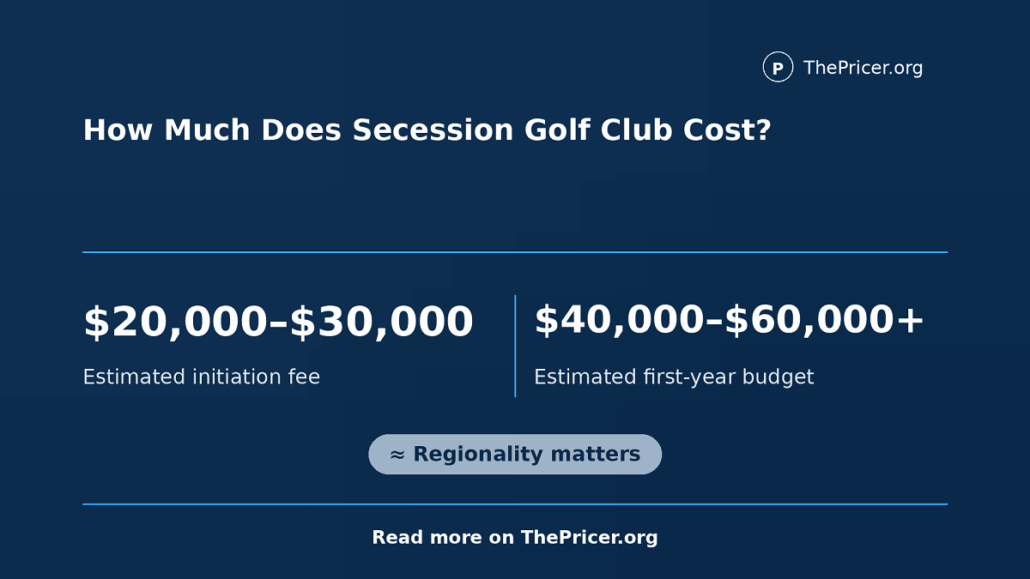
Secession Golf Club does not publish its current initiation fee or annual dues. Based on publicly available golfer reports, a reasonable planning estimate is approximately $20,000 to $30,000 for initiation and $8,000 to $12,000 per year in dues. One of the most frequently cited reports places the cost near $25,000 to join and $10,000 annually, but that figure dates from a member discussion rather than an official club fee sheet.
The true cost of belonging can be considerably higher than dues alone. Secession operates as a national destination golf club, so members may also pay for repeated travel to Beaufort, accommodations, hosted guests, required caddies, dining, club merchandise, and transportation. An active member visiting several times per year could reasonably spend $15,000 to $30,000+ annually beyond the initiation payment.
Because Secession keeps membership information private, every figure in this article should be treated as an independent budgeting estimate. The club may have changed its fees, categories, admission standards, or payment terms, and a candidate’s actual offer could differ materially from reported amounts.
Article Highlights
Jump to sections
- Estimated initiation fee: $20,000 to $30,000 (at $30 per hour, earning that amount would take about 3.8 to 5.8 months of full-time work, before taxes)
- Estimated annual dues: $8,000 to $12,000
- Likely first-year budget with travel and golf spending: $40,000 to $60,000+
- Secession has one private 18-hole course, not 54 holes.
- The course is intended to be walked with a Secession caddie.
- The current recommended caddie payment is $120 per bag.
- Secession follows a national membership model rather than a conventional residential country-club model.
- Membership prices and admission requirements are not publicly disclosed.
Estimated Secession Membership Costs
| Cost category | Planning estimate | Confidence |
|---|---|---|
| Initiation fee | $20,000 to $30,000 (about 3.8 to 5.8 months of full-time work at $30 per hour) | Anecdotal member-market estimate |
| Annual dues | $8,000 to $12,000 | Anecdotal member-market estimate |
| Caddie payment | $120 per bag | Current club guest policy |
| Guest golf | Not publicly disclosed | Varies by visit and member arrangement |
| Lodging and dining | $2,000 to $8,000+ annually | Depends on number and length of visits |
| Travel | $2,000 to $12,000+ annually | Depends on the member’s home and travel style |
| Estimated first year | $40,000 to $60,000+ | Illustrative all-in budget |
A GolfWRX membership discussion from 2021 reported an initiation fee near $25,000 and annual dues around $10,000. That is the clearest publicly accessible fee report, but it is still an unverified golfer account and may no longer reflect the club’s current pricing.
A private-club database states that the average initiation fee among Beaufort-area clubs is approximately $35,000 but hides Secession’s specific data behind a subscription. That broader market figure does not prove that Secession currently charges $35,000, although it suggests that an older $25,000 report should not be treated as a permanent ceiling.
Price Is Difficult to Confirm
Secession’s public website consists primarily of a secure member login, contact information, and selected guest materials. It does not present a public membership application, list of categories, initiation schedule, dues table, or guaranteed admission timeline.
This lack of disclosure is consistent with the club’s highly private structure. Secession is not selling memberships as part of a residential development, resort package, or public-facing recreation complex. Candidates generally enter through personal relationships with existing members, and the financial details are handled within that process.
The absence of published pricing also means that online numbers can become stale quickly. A report may describe a former fee, an age-based category, a legacy arrangement, or a special offer that no longer exists. Claims about family, corporate, legacy, or local memberships should not be published without a dated club document identifying those categories.
A National Golf Club
Secession is commonly described as a national golf club whose members come from across the United States and, in some accounts, from outside the country. A detailed Travelling Golfer profile reported approximately 750 members and stated that the club historically did not accept members living within 100 miles. It also described many members as visiting three or four times per year and bringing guests.
Those figures are useful for understanding the model, but they should not be treated as a current membership rule without confirmation from Secession. The essential point is that membership is built around destination golf. Members travel to Beaufort for concentrated visits rather than commuting to the club every weekend.
That structure changes the economics. A conventional local-club member may drive 20 minutes, play a round, and go home. A Secession member may purchase airfare, rent a car, stay overnight, host several guests, pay multiple caddies, dine at the club, and play several rounds over a long weekend. Dues can therefore represent only a portion of the annual commitment.
ThePricer First-Year Budget
Consider a new member paying a reported-style initiation fee of $25,000 (about 4.8 months of full-time work at $30 per hour) and annual dues of $10,000. During the first year, the member makes four three-night visits and brings guests on two of them.
- Initiation fee: $25,000
- Annual dues: $10,000
- Four round-trip journeys at $600: $2,400
- Local transportation at $300 per trip: $1,200
- Lodging at an illustrative $300 per night for 12 nights: $3,600
- Twelve member caddie payments at $120: $1,440
- Guest golf, guest caddies, dining, and drinks: $5,000
- Pro-shop purchases and miscellaneous spending: $1,500
The resulting first-year total is approximately $50,140. This example is not a Secession invoice. The club does not publicly disclose its room, guest, dining, or membership prices, and members living within driving distance may spend far less on travel.
What Five Years Could Cost
If the same member spends $25,000 to join and averages $25,000 per year in dues, travel, caddies, lodging, dining, and guest expenses, five years of membership would cost approximately $150,000. A more active member hosting several groups each year could move well beyond that amount, while a member visiting only twice per year might remain closer to $100,000 over the same period.
This calculation illustrates an important distinction. Secession’s reported initiation fee is not unusually high compared with many elite private clubs. The larger financial commitment comes from using a destination membership as intended. Paying dues while rarely visiting makes the cost per round very high, but frequent trips create substantial travel and hosting expenses.
One 18-Hole Golf Course

Secession has one private 18-hole golf course. The original article incorrectly claimed that membership included 54 holes spread across Secession, Bermuda Run, and Oak Point. Bermuda Run is a separate North Carolina club, while Oak Point is part of Kiawah Island Golf Resort. Neither is an additional Secession course.
The Golf.com course database describes Secession as an 18-hole private course measuring approximately 7,068 yards. Golf Digest places it among notable South Carolina courses and has included it within America’s Second 100 Greatest. Its reputation comes from one carefully defined golf experience rather than the scale of a multi-course resort.
Bruce Devlin and the Course’s Design
The course has an unusual architectural history. Pete Dye and P.B. Dye prepared early routing work but left the project after a disagreement with the developer. Australian professional golfer and architect Bruce Devlin then took over and completed the design, which opened in 1991.
Golf Digest’s architectural profile of Secession credits Devlin with finishing a course influenced by the Dye style of the period. Low-profile greens, stacked-sod pot bunkers, ground-level approaches, and room to run the ball create strategic options without relying on dramatic elevation.
There has been long-running debate among architecture enthusiasts about how much of the original Dye routing survived. People close to Devlin have maintained that he adjusted the routing and created the principal design features, making Secession properly a Bruce Devlin course rather than a Dye-Devlin collaboration.
Golf Through the Lowcountry Marshes
Fourteen of Secession’s holes run along the tidal marshes surrounding Gibbes Island. The open terrain exposes shots to wind, while changing tides alter the appearance of the hazards and the visual character of the course. The Devlin Foundation describes the experience as different from round to round because of those shifting coastal conditions.
The course is predominantly flat and tightly routed, with short walks between greens and tees. There is no surrounding residential development, which preserves the sense of isolation. A Top 100 Golf Courses profile notes both the lack of housing and the rule that golfers walk with caddies.
The par-three 17th is one of the most recognizable holes, with a green surrounded by marsh and water. Golf Digest included it in a recent survey of notable island greens. The finishing hole returns players toward the clubhouse and completes a layout designed to feel like a traditional golf retreat rather than a real-estate amenity.
Walking and Caddie Costs
Secession’s published guest policy says a Secession caddie must be used for every 18-hole round. The policy currently recommends a payment of $120 per bag. Players should confirm whether that amount includes gratuity, whether forecaddies are used for some groups, and how payment is handled.
The all-walking policy is central to the club’s identity. It slows the experience to the pace of the course, keeps ordinary cart traffic away from the turf, and places local course knowledge beside every player. A 2026 USGA local qualifying page also highlighted Secession’s strong caddie program and allowed competitors to request club caddies for practice and qualifying rounds.
For an active member playing 30 rounds per year, the recommended caddie payment alone would total $3,600. At 50 rounds, it reaches $6,000. Hosting three guests for a three-round visit could generate $1,440 in recommended caddie payments before any guest golf charges, food, drinks, or lodging.
Guest Golf Can Be a Major Expense
Secession’s national model appears to depend heavily on members bringing guests. Older club profiles have reported that guests account for a substantial share of all rounds. That creates a social and destination character, but it also means the member may assume costs that do not appear in the annual-dues figure.
The club does not publicly list its current guest golf rate. Charity packages show how valuable access can be without revealing the normal member charge. Forbes reported that a three-day Secession experience for six players, including unlimited golf, two nights of accommodations, private air travel, and an oyster roast, sold for $25,000 at auction. That was a fundraising package, not a normal guest fee, but it demonstrates the market value of a hosted visit.
A current charity listing separately confirms the club’s $120 required caddie payment. Applicants should ask for an illustrative member statement showing the guest fee, caddie amount, lodging, dining, and service charges for a typical three-day visit with three guests.
Accommodations
Secession is more than a golf course with a locker room. LINKS Magazine describes an international membership, a thriving caddie program, no surrounding real estate, and a range of accommodation options. Golf Club Atlas has also described dormitory-style rooms in the clubhouse and cottages used by members and guests.
Public information does not provide a current room inventory or rate schedule. Lodging may be charged separately, bundled into a member visit, or priced differently by room type. Those details matter because a destination member may stay on or near the property for several nights during every visit.
The broader atmosphere is deliberately golf-centered. Golf Digest has described the club’s fellowship, member commitment, caddie culture, and informal spaces, including a “party barn.” This is different from the original article’s unsupported picture of a large family country club with multiple restaurants, junior programs, book clubs, a Callaway Performance Center, and extensive non-golf recreation.
Membership and Application Process
Secession does not publish a current application guide. The original article stated that candidates require sponsorship from two member families, undergo a credit check and interview, and receive a decision within two or three months. Those claims may sound plausible, but no public club document was provided to support them.
Secession is regularly described as invitation-only, so personal sponsorship and committee approval are likely important. However, applicants should not expect a fixed process based on an online article. The number of sponsors, eligibility radius, admission schedule, required meetings, and payment timing should be confirmed privately through a current member or the club.
The Name and Its Historical Context
The club takes its name from Beaufort’s connection to South Carolina’s withdrawal from the United States in 1860. Golf Digest reported that the Articles of Secession were written in Beaufort and has examined the uncomfortable historical associations attached to Secession and other Southern club names.
Older Secession traditions included tee names associated with Union and Confederate generals. The subject deserves factual treatment rather than romantic language. The name is part of the club’s identity and regional history, but it is also connected to the political movement that protected slavery and precipitated the Civil War.
Readers seeking more context can review Golf Digest’s examination of Confederate-linked golf-club names. A membership-cost article does not need to become a full historical essay, but omitting the origin entirely leaves an important part of the club unexplained.
Hidden Costs to Ask About
- Guest golf charges
- Required caddie payments and gratuities
- On-property lodging
- Dining and hosted-group meals
- Airfare or long-distance driving
- Rental cars and ground transportation
- Locker and club-storage charges
- Lessons and professional services
- Club events and merchandise
- Dues increases or capital assessments
- Resignation and initiation-refund terms
Travel is likely the largest overlooked category. A member taking four annual trips from the Northeast, Midwest, or West Coast could easily spend several thousand dollars on transportation before paying for a round. A private-flight or high-end hosted-trip pattern would increase the annual total dramatically.
Secession vs Other Clubs
Direct price comparisons with Augusta National, Pine Valley, Seminole, or the Country Club of Charleston are unreliable because those clubs also keep their fees private. Repeating unverified six-figure numbers beside Secession’s uncertain price creates the appearance of precision without improving accuracy.
The more useful comparison is structural. Secession belongs in the category of golf-first national clubs where members travel for concentrated visits, walk with caddies, stay overnight, and host guests. It should not be compared only with residential country clubs offering pools, tennis, children’s camps, and daily local access.
Readers evaluating different private-club models can also review estimated membership costs at Coto de Caza Golf & Racquet Club, Exmoor Country Club, and MountainGate Country Club.
Who Gets the Most Value From Membership?
Secession makes the strongest case for an avid golfer who appreciates walking, caddies, architecture, firm playing conditions, repeat visits, and hosting friends. Someone who expects a broad family recreation complex or needs frequent local access may find that another club better fits the household.
Using the earlier $25,000 annual recurring budget, a member playing 20 rounds effectively spends $1,250 per round before assigning value to guests, lodging, dining, and social relationships. At 40 rounds, the figure falls to $625 per round. The calculation is not a literal green fee, but it shows why regular visits are necessary to justify a destination membership financially.
What We Verified
- Confirmed that Secession does not publish its membership fees publicly.
- Replaced the unsupported $80,000 initiation claim with labeled estimates.
- Removed invented family, corporate, and legacy categories.
- Corrected the club from 54 holes to one 18-hole course.
- Verified the all-walking model and current caddie requirement.
- Verified the recommended $120 caddie payment.
- Removed the false claim that golf carts are required.
- Added the club’s national-membership, lodging, and travel-cost context.
- Corrected the Pete Dye and Bruce Devlin design history.
- Removed unsupported application timelines and credit-check claims.
Answers to Common Questions
How much does it cost to join Secession Golf Club?
Secession does not publish its fees. Public golfer reports suggest approximately $20,000 to $30,000 for initiation, with one often-cited estimate of $25,000. The current fee may be different.
How much are the annual dues?
A cautious unofficial estimate is $8,000 to $12,000 per year. Travel, caddies, lodging, guests, and dining are additional.
How much could the first year cost?
An active member paying $25,000 to join and making several visits could spend approximately $40,000 to $60,000+ during the first year.
How many courses does Secession have?
Secession has one private 18-hole course. It does not operate Bermuda Run or Oak Point.
Are golf carts required?
No. Secession is known as an all-walking club. Its current guest policy requires a Secession caddie for every 18-hole round.
How much does a Secession caddie cost?
The current guest policy recommends $120 per bag. Players should confirm whether any additional gratuity is customary.
Can the public play Secession?
Secession is private. Access generally requires an invitation from a member, participation in an approved event, or a charity experience specifically offering a hosted round.
Does Secession have lodging?
Published club profiles describe accommodations for members and guests, including clubhouse-style rooms and cottages. Current room types and rates are not publicly listed.
Disclosure: Educational content, not financial advice. Prices reflect public information as of the dates cited and can change. Confirm current rates, fees, taxes, and terms with official sources before purchasing. See our methodology and corrections policy.