
How Much Do Document Shredding Services Cost?
Updated on | Written by Alec Pow
This article was researched using 9 sources. See our methodology and corrections policy.
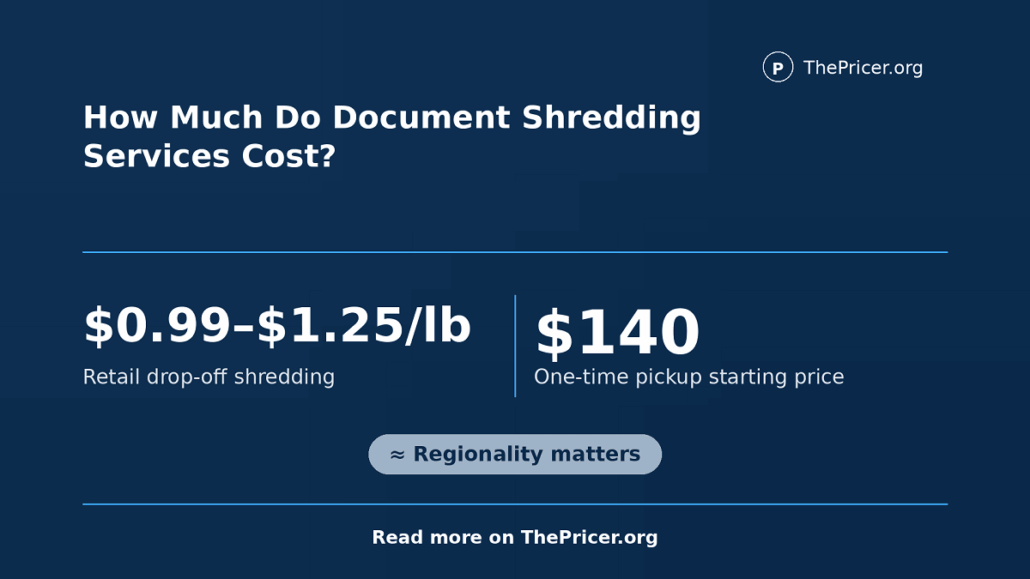
Document shredding costs $0.99 per pound at a current Office Depot store page for same-day in-store drop-off, while a current UPS Store location publishes $1.25 per pound. One-time pickup costs much more at low volume. Iron Mountain currently advertises one-time off-site shredding starting at $140, while recurring business shredding from national providers is usually quote-based.
The cheapest choice depends less on a national “price per pound” and more on how much paper you have and whether you can carry it to a drop-off point. A 30-pound box costs $29.70 at Office Depot’s published $0.99-per-pound rate. Paying for a pickup can make more sense when the load is large, the records cannot be casually transported, or staff time and chain-of-custody requirements matter.
Professional document destruction covers several different purchases: retail drop-off, one-time purge pickup, mobile on-site shredding, plant-based off-site shredding, and recurring locked-bin service. Those services should not be blended into one broad $0.10 to $1.00 per pound average because minimum charges and service structure can matter more than weight.
Article Highlights
Jump to sections
- Office Depot currently charges $0.99 per pound for same-day in-store shredding.
- Current local drop-off examples include about $0.99 to $1.25 per pound, with store-level pricing varying by location.
- Iron Mountain advertises one-time off-site shredding starting at $140 (at $30 per hour, earning that amount would take about 4.7 hours of work, before taxes).
- At $0.99 per pound, 30 pounds costs $29.70, 50 pounds costs $49.50, and 100 pounds costs $99.
- Shred-it prices recurring service by frequency, volume, bin count, service level, and geography rather than one national per-pound rate.
- For regulated records, the cheapest service is not automatically the right service. Vendor controls and disposal procedures can affect the buying decision.
How Much Do Document Shredding Services Cost?
The prices below show what a consumer or small business can actually encounter. They are not a national tariff. Retail locations can change rates, pickup pricing can change by ZIP code, and business contracts are commonly quoted after the provider knows the service frequency and volume.
| Shredding option | Current price example | Best fit |
|---|---|---|
| Office Depot in-store drop-off | $0.99/lb | Small and medium paper loads you can transport yourself |
| Shred Nations drop-off example | $0.99/lb | Local secure-bin drop-off |
| The UPS Store Coralville example | $1.25/lb | Small local drop-off jobs |
| Iron Mountain one-time off-site service | Starts at $140 (about 4.7 hours of work at $30 per hour) | Home or business purge requiring pickup |
| Shred-it one-time shredding | Quote-based | Box or container-based purge jobs |
| Shred-it recurring shredding | Quote-based | Businesses needing scheduled locked-bin collection |
Current Office Depot store pages advertise same-day in-store destruction at $0.99 per pound. The store page also states that the paper is placed in store bins and securely recycled after destruction.
What You’re Actually Paying For
Drop-off shredding is the simplest purchase. You carry the paper to a retail or local service point, the load is weighed, and the documents go into a secure collection bin for later destruction. Current published examples checked here run from $0.99 to $1.25 per pound, showing why the nearby store’s posted rate matters more than a claimed national average.
One-time pickup adds transportation and handling. Iron Mountain’s current starting price is $140 (about 4.7 hours of work at $30 per hour). Shred-it uses a different model. Its current pricing page says one-time charges are based on volume or box type, while recurring prices depend on pickup frequency, paper volume, number of bins, service level, and geography.
Mobile on-site shredding means the destruction equipment comes to the customer’s location. Plant-based service means the secured material is collected and transported for destruction at the provider’s facility. The price difference is not just about the shredder. Route time, containers, labor, site access, service frequency, and how the records move through custody all affect the quote.
On-site mobile shredding lets the customer have records destroyed at the service location. Off-site shredding puts the records into the provider’s secured collection and transport process before destruction at a plant. Shred-it offers both curbside mobile and plant-based options for one-time work and says minimum fees vary by location. Buyers should ask whether pickup, containers, travel, difficult site access, destruction, recycling, and a certificate of destruction are included in the quote.
The Hidden Price
A per-pound rate looks cheap until it is compared with a pickup minimum. At Office Depot’s published $0.99 per pound, a 10-pound load costs $9.90, a 30-pound load costs $29.70, a 50-pound load costs $49.50, and a 100-pound load costs $99.
Compare that with Iron Mountain’s $140 starting point for one-time off-site pickup. A 30-pound customer would pay $110.30 more than the simple Office Depot drop-off calculation. At 100 pounds, the difference falls to $41.
Worked scale calculation: $140 ÷ $0.99 = about 141 pounds. At roughly 141 pounds, the mathematical cost of Office Depot drop-off reaches $140. That is not a guaranteed pickup break-even point because an actual Iron Mountain order can cost more than its starting price, and pickup services follow a different pricing structure. The calculation shows why minimum charges dominate small jobs while convenience becomes easier to justify as volume rises.
Three Shredding Budgets
Home tax-file cleanup: a household with 25 pounds of old tax papers and statements would spend $24.75 at a $0.99-per-pound drop-off rate. Paying a three-figure pickup minimum would be a much larger expense unless transportation or privacy procedures make home pickup preferable.
Five-box office purge: assume five boxes average 30 pounds each, or 150 pounds total. At $0.99 per pound, drop-off math reaches $148.50. At this volume, getting pickup quotes becomes reasonable because the paper is bulky and the nominal drop-off total is already near the starting price of some pickup services.
Recurring professional office: a business filling locked consoles every month should compare recurring contracts rather than multiplying a retail per-pound rate. Shred-it states that scheduled pricing depends on frequency, paper volume, bin count and geography, and it lists no enrollment fee for its ProtectPLUS recurring plans. The cost advantage comes from matching container size and pickup schedule to actual paper generation rather than paying for repeated one-time purges.
Recurring Business Shredding

Recurring service is commonly sold around a locked container and scheduled route rather than a retail pound rate. Weekly, biweekly, monthly, or custom pickups can be matched to the amount of paper an office creates. Shred-it says its recurring subscription has no enrollment fee, though account changes and some service options can carry added charges.
The economic test is bin utilization. A company paying for frequent collection of nearly empty consoles is buying route visits it does not need. A company allowing confidential paper to overflow because pickups are too infrequent creates a handling problem. Before signing, ask for the cost of each container size, regular pickup, extra pickup, missed or rescheduled service, replacement containers, and contract cancellation.
Businesses that also pay for document creation can compare these disposal costs with Office Depot printing costs. A paper-heavy workflow creates expense at both ends, first when documents are printed and later when sensitive copies must be stored or destroyed.
Medical, Financial, and Consumer Records
Professional shredding can support a compliance program, but buying a shredding service does not by itself make an organization HIPAA, FTC, or GDPR compliant. The rule depends on the records, organization, jurisdiction, safeguards, and vendor relationship.
For paper protected health information, HHS says proper disposal methods may include shredding, burning, pulping, or pulverizing records so the information is unreadable and indecipherable so the information cannot be reconstructed. HHS also states that a covered entity may hire a disposal vendor as a business associate, subject to the required agreement and safeguards.
The FTC’s Disposal Rule uses a flexible standard. Covered businesses must take reasonable and appropriate measures when disposing of consumer-report information. Shredding paper so information cannot be read or reconstructed is one listed method, and hiring a document-destruction contractor after due diligence is another.
Financial institutions covered by the FTC Safeguards Rule must maintain safeguards for customer information and address service-provider controls. The FTC’s current business guidance explains that the program must fit the size and complexity of the business, its activities, and the sensitivity of the information.
When Professional Shredding Makes Sense
Makes sense if:
- You have more paper than a small office shredder can process without a large labor commitment.
- You need documented pickup and destruction procedures for business records.
- You want locked collection containers for paper produced throughout the month.
- You have a purge large enough that carrying boxes to a retail location becomes inconvenient.
Does not make sense if:
- You have only a few pounds of ordinary paper and can safely destroy it with equipment you already own.
- You are paying a three-figure pickup minimum for a tiny load that can be dropped off locally for under $20.
- You choose a recurring pickup schedule that repeatedly collects mostly empty containers.
- You assume a certificate or vendor marketing claim replaces your own legal, records-retention, or vendor-management duties.
Consumers comparing local retail options can also check current UPS shredding costs. Store-level rates can differ, so the nearby location’s posted price is more useful than a chain-wide assumption.
What We Verified
- Checked: current Office Depot store pages publish $0.99 per pound for same-day in-store shredding.
- Confirmed: Iron Mountain currently advertises one-time off-site shredding starting at $140.
- Cross-referenced: Shred-it does not publish one nationwide recurring per-pound rate. Its pricing changes with service frequency, volume, bin count and location.
- Verified: NAID AAA certification is an audited third-party data-destruction certification maintained by i-SIGMA. Buyers can use certification status as one vendor-screening input rather than assuming every shredding business follows the same controls.
Related Office and Data Costs
Shredding is only one part of document handling. Businesses still using paper can compare the disposal bill with UPS fax service costs when hard-copy transmission is part of the same workflow.
For personal information that may already have been exposed, LifeLock costs provide a separate look at identity-monitoring expenses. Shredding lowers disposal risk, while identity monitoring addresses a different problem after personal data may already exist outside your control.
Answers to Common Questions
How much does it cost to shred documents by the pound?
A practical current drop-off benchmark is around $0.99 to $1.25 per pound in the examples checked for this article. Office Depot publishes $0.99 per pound, while one current UPS Store location publishes $1.25 per pound. Local rates can be higher or lower.
How much does 30 pounds of shredding cost?
At $0.99 per pound, 30 pounds costs $29.70. At $1.25 per pound, the same weight costs $37.50.
How much does pickup shredding cost?
Iron Mountain currently advertises one-time off-site shredding starting at $140. The final charge can vary with the selected service and location.
Is on-site shredding more expensive than drop-off?
It often carries a higher total charge because a truck and crew come to the customer’s location, but there is no reliable national surcharge that applies to every provider. Compare full quotes, including minimum charges and containers.
Does professional shredding make a company HIPAA compliant?
No. Secure disposal can be one part of a HIPAA-compliant privacy program. HHS requires reasonable safeguards for protected health information and permits outside disposal vendors under the applicable business-associate rules.
Disclosure: Educational content, not financial advice. Prices reflect public information as of the dates cited and can change. Confirm current rates, fees, taxes, and terms with official sources before purchasing. See our methodology and corrections policy.