
How Much Does InventHelp Cost?
Updated on | Written by Alec Pow
This article was researched using 11 sources. See our methodology and corrections policy.
InventHelp does not publish one standard price for its invention services. Current public evidence suggests an inventor might spend under $1,000 for an initial service or research stage, while more extensive invention-submission and promotion agreements can reach roughly $9,000 to $19,000+. Patent-attorney work, government filing fees, prototypes, drawings, manufacturing, and other development costs may be separate.
That makes a realistic all-in invention budget much larger than the first payment. An inventor who buys a $10,000 to $19,000 promotion package and also pursues a professionally prepared utility patent could ultimately spend $20,000 to $40,000+ before manufacturing a commercial product.
The more important question is not simply what InventHelp charges, but what you receive for that money and how often clients achieve licensing or financial success. InventHelp now reports that from 2023 through 2025 it signed Submission Agreements with 2,674 clients. Of those, 118 received license agreements and just 9 received more money than they paid InventHelp for the services.
Article Highlights
Jump to sections
- InventHelp does not publish a universal price list for its submission services.
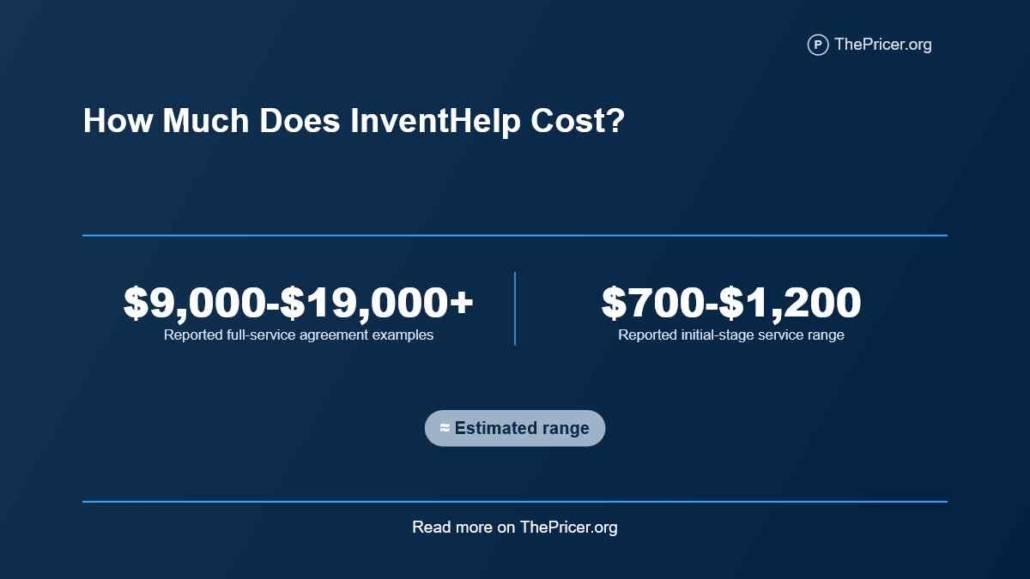
- Recent public customer records show some comprehensive agreements costing approximately $9,000 to $19,000+ (at $30 per hour, earning that amount would take about 1.7 to 3.7 months of full-time work, before taxes).
- Smaller initial-stage services have been reported at roughly $700 to $1,200, although these should not be mistaken for the full invention-development cost.
- Patent legal services are different from InventHelp’s submission and marketing services and may add thousands to tens of thousands of dollars.
- InventHelp says it signed agreements with 2,674 clients during 2023-2025, with 118 receiving licensing agreements.
- Only 9 of those 2,674 clients received more money than they paid InventHelp, according to InventHelp’s own disclosure.
- InventHelp says its patent referral services have resulted in more than 10,000 patents, but getting a patent is not the same as making money from an invention.
- A 2023 federal court approved a $3 million class-action settlement involving InventHelp and related defendants over allegations concerning earlier invention-promotion services.
How Much Does InventHelp Cost?
There is no verified current number such as “InventHelp costs $10,000 (about 8.3 full-time workweeks at $30 per hour)” that applies to every customer.
InventHelp’s own current FAQ confirms that the company charges for invention-submission services but does not post dollar amounts publicly. It says costs are explained before a customer signs an agreement.
InventHelp also states that its business relies on fees paid by inventors to perform its services rather than implying that the company primarily gets paid only when an invention succeeds.
That distinction matters because several different costs can exist:
- Initial invention information or research services
- Submission and promotion packages
- Prototype or 3D-model services
- Technical or production drawings
- Invention websites and presentation materials
- Patent search and legal work through referred attorneys
- Optional additional marketing or development services
InventHelp describes services including company submissions, invention websites, patent referrals, prototype models, and production drawings on its current service overview.
Reported Costs
Because InventHelp does not publish a normal retail price list, current customer contracts and reviews provide useful clues, but they must be treated as individual examples rather than companywide prices.
A recent complaint published by the Better Business Bureau described a 2025 InventHelp contract totaling $18,950 (about 3.6 months of full-time work at $30 per hour), with $5,000 paid upfront and $13,950 remaining. The customer reported monthly payments of $430.
Another BBB complaint described paying approximately $9,273 for invention-assistance services.
These are customer allegations published by BBB, not InventHelp’s advertised standard rates, so they should not be used to claim every customer pays $9,000 to $19,000. They do show that InventHelp agreements can reach well into five figures.
ConsumerAffairs, which continues to collect InventHelp reviews, says the company customizes contracts and does not publicly disclose its rates. Recent reviews include customers who describe the service as expensive, while others say they were satisfied with the value.
| Cost stage | Planning amount | Important limitation |
|---|---|---|
| Initial service/research stage | About $700-$1,200 reported | Not necessarily the complete InventHelp program |
| Extensive submission/promotion agreement | About $9,000-$19,000+ reported | Based on individual customer records, not a published price list |
| Professional utility patent process | $10,000-$30,000+ possible | Patent attorney and USPTO expenses can be separate |
| Prototype/manufacturing | Highly variable | Can range from hundreds to many thousands |
The Real Total
The biggest mistake is assuming an InventHelp quote represents the entire cost of turning an idea into a protected product.
InventHelp is an invention-services and submission company. It can refer clients to patent attorneys, but InventHelp itself says it is not providing the attorney’s legal opinion.
A utility patent can therefore become another major expense.
The USPTO’s current patent fee schedule lists separate filing, search, and examination fees. For a standard nonprovisional utility application, the baseline government fees alone total approximately:
- $2,000 for a large entity
- $800 for a qualifying small entity
- $400 for a qualifying micro entity
Those are government fees, not the cost of having an attorney prepare and prosecute the application.
Current legal-market estimates from UpCounsel put attorney-assisted utility-patent spending at roughly $15,000 to $30,000 from preparation through issuance in many cases, although simpler applications can cost less and complicated technologies can cost considerably more.
For a closer look at the first step, see our guide to the cost of a provisional patent application.
Worked Example
Suppose an inventor signs an InventHelp submission agreement for $12,000.
The inventor later pays:
| Expense | Example cost |
|---|---|
| InventHelp services | $12,000 |
| Professional patent search/opinion | $1,500 |
| Patent attorney preparation and prosecution | $10,000 |
| USPTO fees | $800 |
| Professional prototype | $2,500 |
| Example total | $26,800 |
The $12,000 service agreement represents only about 45% of the $26,800 example development budget.
And that total still does not include manufacturing tooling, inventory, packaging, product testing, liability insurance, fulfillment, advertising, retailer margins, or patent enforcement.
If you eventually start selling the product yourself, our guide to business liability insurance costs covers another expense worth budgeting.
Success Rates
This is where the current version of the article becomes much more useful than repeating an old “1 in 44” internet statistic.
InventHelp itself currently publishes outcome information. On its invention stories and disclosure page, the company states:
- 2,674 clients signed Submission Agreements from 2023 through 2025.
- 118 clients received license agreements as a result of InventHelp’s services.
- 9 clients received more money than they paid InventHelp for the services.
Those numbers let us calculate two useful rates.
118 ÷ 2,674 × 100 = approximately 4.4%
About 4.4% of that client cohort received licensing agreements.
For clients who reportedly received more money than they paid:
9 ÷ 2,674 × 100 = approximately 0.34%
That is about 1 in 297 clients in this particular 2023-2025 group.
This is not the same as saying everyone else permanently lost money, because some inventions may still be in development or could produce future results. It does, however, show why inventors should not treat an invention-promotion purchase as an investment with a predictable financial return.
Patents vs Profit
InventHelp currently says its patent-referral services have resulted in more than 10,000 patents being secured for clients.
That is a materially different claim from saying InventHelp itself issued, guaranteed, or obtained those patents. Patents are issued by the USPTO, and InventHelp says it refers inventors to licensed patent attorneys.
More importantly, a patent is not a commercialization result.
An inventor can:
- Receive a patent but never license the invention
- License a product but earn very little
- Sell a product without recovering development costs
- Have a valuable invention without obtaining broad patent protection
The financial-gain statistic is therefore more relevant to a person asking whether thousands of dollars spent on invention-promotion services are likely to be recovered.
What InventHelp Does

InventHelp has operated since 1984 and describes itself as an invention-services company that helps everyday inventors present ideas and navigate parts of the commercialization process.
The company’s current website says its services include presenting client inventions to companies in its Data Bank and referring clients to licensed patent attorneys.
InventHelp says thousands of companies are in its Data Bank and have agreed to confidentially review invention submissions.
Its current services include combinations of:
- Invention submission
- Executive summaries and presentation materials
- Virtual invention presentations
- Invention websites
- Prototype models
- Production drawings
- Patent-attorney referrals
- Publicity services
Exactly what is included depends on the agreement an inventor purchases.
Licensing
InventHelp has an affiliated licensing company called Intromark. InventHelp’s published success stories describe Intromark negotiating licensing arrangements for certain successful client inventions.
This is another reason to read the contract rather than assume all services come within one upfront fee. Ask specifically:
- Whether Intromark becomes involved automatically or only after interest from a company
- What percentage or compensation Intromark receives
- Whether that amount comes from royalties, advances, or another payment
- Which expenses continue after a licensing agreement
Do not rely on an old online article for the royalty percentage. Use the percentage written in the current agreement offered to you.
Legal History
Anyone considering a substantial contract should also know about InventHelp’s litigation history without confusing allegations with proven findings.
A federal court in Pennsylvania approved a class-action settlement in 2023 involving InventHelp, related companies, Intromark, and other defendants. The consolidated cases involved allegations under the American Inventors Protection Act and state law concerning invention-promotion services.
The federal court’s settlement opinion shows that the settlement class included 53,223 people who purchased covered services between January 1, 2014 and June 30, 2021.
The settlement included a $3 million gross settlement fund plus other credits and service benefits depending on the class member’s contract status.
The existence of a settlement does not mean every allegation in the lawsuits was judicially proven. It is nevertheless relevant background for someone evaluating an expensive invention-promotion agreement.
Customer Reviews
Current reviews remain mixed.
ConsumerAffairs displays both strong positive reviews from customers praising individual representatives and negative reviews alleging high prices, weak communication, disappointing prototypes, limited marketing results, or years spent without meaningful commercial traction.
One important limitation is that an online review cannot tell you whether an invention itself had commercial potential. A company can perform every contractual service and an invention can still fail in the marketplace.
Conversely, satisfaction with customer service does not prove that the financial return from the service is good.
The best review question is therefore not merely, “Were employees friendly?” Ask whether customers received the specific deliverables in their contracts and whether those services produced outcomes relevant to your own objective.
FTC Warning Signs
The Federal Trade Commission’s guidance on invention-promotion companies applies to the industry generally and provides a useful checklist before signing any agreement.
The FTC recommends that inventors:
- Get the total service cost before signing
- Ask exactly how market research will be performed
- Request the company’s legally required performance disclosures
- Investigate complaints
- Verify references independently
- Avoid anyone guaranteeing financial success
- Get verbal promises written into the contract
- Consider having an attorney review the agreement
The FTC also emphasizes that very few inventions ever reach the market or make money.
Your Disclosure Rights
The federal American Inventors Protection Act gives prospective customers important disclosure rights when dealing with invention promoters.
The FTC says firms must provide information covering the previous five years, including the number of inventions evaluated, the number receiving positive and negative evaluations, the number of clients, how many clients achieved a net financial profit, and how many obtained license agreements through the promoter.
The USPTO also publishes invention-promoter complaints and company responses. The agency notes that it publishes these materials for public awareness and does not investigate or adjudicate the complaints.
Ask for InventHelp’s current statutory disclosure before signing and compare it with the figures presented during any sales conversation.
Hidden Costs
The biggest hidden price is that an invention-promotion contract may represent only one part of commercialization.
An inventor might still face:
- Patent attorney fees
- USPTO application and prosecution fees
- CAD and engineering
- Functional prototyping
- Safety or compliance testing
- Tooling and molds
- Manufacturing minimum orders
- Packaging
- Trademark work
- Product liability insurance
- Freight and warehousing
- Advertising
- Retail commissions
- International patent protection
A $10,000 invention-promotion agreement can therefore be the beginning of the spending rather than the end.
Is InventHelp Worth It?
InventHelp may be useful to an inventor who understands exactly what services are being purchased, values help preparing promotional materials and submitting the invention to participating companies, and is financially comfortable losing the entire amount paid if no licensing agreement results.
It is much harder to justify treating the service as an investment expected to generate a profit.
InventHelp’s own current numbers show why. If 2,674 recent clients signed Submission Agreements and only nine had received more money than they paid the company, an inventor should build the decision around the cost of the service and value of the deliverables, not an assumption that royalties will repay the fee.
Before spending $10,000 or $20,000, compare at least three alternatives:
- InventHelp’s written proposal
- A direct consultation with an independent patent attorney or patent agent
- A DIY or smaller-service route combining patent advice, a prototype, and direct manufacturer outreach
A cheaper route is not automatically better, but the comparison makes clear what portion of the budget is going toward legal protection, product engineering, and actual market outreach.
What We Verified
We verified that InventHelp does not currently publish a universal service price and that the company says fees are disclosed before signing an agreement.
We also verified InventHelp’s current 2023-2025 disclosure: 2,674 Submission Agreement clients, 118 licensing agreements, and 9 clients receiving more money than they paid InventHelp.
We removed the old claim that inventors have a “1 in 44” chance of receiving a patent because we could not substantiate it as a current InventHelp statistic. Patent referrals, granted patents, licensing success, and financial profitability are different metrics and should not be combined.
We also removed the old $7,500-to-$52,000 InventHelp price range as a supposed standard company cost. Current public evidence supports saying that individual agreements can reach five figures, but InventHelp’s customized pricing prevents us from honestly presenting one universal total.
We verified current USPTO government fees, current independent patent-cost estimates, the 2023 class-action settlement, FTC consumer guidance, and InventHelp’s description of its patent-referral and submission services.
Answers to Common Questions
How much does InventHelp charge?
InventHelp does not publish a standard price. Current customer records suggest substantial submission agreements can cost approximately $9,000 to $19,000+, while smaller initial services may cost under $1,000. Your actual written quote can differ substantially.
Does InventHelp charge upfront?
InventHelp charges fees for its services. Public customer agreements show examples involving an upfront payment followed by monthly installments. The exact payment schedule depends on the contract offered.
Does InventHelp pay for your patent?
Do not assume so. InventHelp provides patent-referral services and can connect clients with licensed patent attorneys. Ask for a written breakdown showing which patent searches, legal fees, government fees, prosecution work, and other patent expenses are included or excluded.
How many InventHelp customers actually make money?
InventHelp says that among 2,674 clients who signed Submission Agreements from 2023 through 2025, 9 received more money than they paid InventHelp for its services. That equals approximately 0.34%, or roughly 1 in 297 for that specific group as reported at the time of the disclosure.
How many InventHelp clients get licensing deals?
InventHelp reports that 118 of those 2,674 clients received license agreements, equivalent to approximately 4.4%.
Disclosure: Educational content, not financial advice. Prices reflect public information as of the dates cited and can change. Confirm current rates, fees, taxes, and terms with official sources before purchasing. See our methodology and corrections policy.