
How Much Does It Cost to Acid Wash a Pool?
Updated on | Researched and reviewed by Alec Pow, Founder & Pricing Investigator
Prices, claims, and calculations checked against 12 cited sources. See our research methodology and corrections policy.
Acid washing a swimming pool typically costs $300 to $800 for a standard residential plaster pool in the United States. Smaller, lightly stained pools may cost $250 to $450, while large pools with extensive staining, calcium deposits, or difficult access can cost $700 to $1,200 or more. Refilling the pool and restoring its water chemistry may increase the final bill.
An acid wash removes a thin layer of the pool’s cement-based interior finish to expose a cleaner surface underneath. It can improve stubborn staining, but it also permanently removes some plaster. That makes it different from ordinary cleaning, shock treatment, or routine pool maintenance.
Acid washing should not be scheduled simply because a pool has been used for several years. The condition of the plaster, the type of staining, and the safety of draining the pool should determine whether the service is appropriate. In some cases, a less aggressive treatment is both cheaper and better for the pool.
Article Highlights
Jump to sections
- Standard residential acid wash: Approximately $300 to $800.
- Large or heavily stained pool: Around $700 to $1,200+.
- Water refill: Municipal water often costs $4 to $10 per 1,000 gallons, before additional utility charges.
- Water chemistry startup: Can add approximately $150 to $350 if billed separately.
- Alternative cleaning: A drain-and-clean without acid may cost $200 to $450 in some markets.
- Major risk: Acid washing removes plaster, while improper draining can cause structural damage under unfavorable groundwater conditions.

How Much Does It Cost to Acid Wash a Pool?
National pricing guides and actual pool-service offers show a fairly wide range because companies do not all include the same work.
Angi’s September 2026 pricing analysis estimates a common professional acid-washing cost of $250 to $600, with a broader reported range of $120 to $1,500. It identifies pool surface area, finish type, and staining severity as major price factors.
For a regional comparison, Pure Mission Pools reports Phoenix-area acid-washing prices around $350 to $700 for the service itself. It warns that a wash should not be recommended before examining the condition of the pool and its water chemistry.
A different provider, Mesa Pool Acid Wash, publishes prices from $300 to $800 for standard jobs and $700 to $1,200+ for larger or more difficult pools.
| Pool or service type | Typical price | Scope |
|---|---|---|
| Small plaster pool, light staining | $250 to $450 | Limited surface treatment |
| Standard residential acid wash | $300 to $800 | Draining and surface treatment, depending on quote |
| Large or heavily stained pool | $700 to $1,200+ | Greater surface area and more labor |
| Drain and clean without acid | $200 to $450 | Cleaning without intentional plaster removal |
| Waterline calcium or tile cleaning | $200 to $500 | Targeted scale removal |
| Full restoration with startup service | $750 to $1,500+ | Bundled cleaning, refill preparation, and balancing |
The table summarizes published market and provider ranges rather than fixed national rates. Some companies include draining and startup chemicals, while others charge separately for those services.
The pool’s surface area is often more important than its gallon capacity when calculating the washing labor. Two pools holding 15,000 gallons can have different wall areas, steps, benches, and waterline features.
What Does an Acid Wash Include?
A conventional pool acid wash is generally performed on suitable cement-based finishes, such as traditional plaster. The contractor removes the pool water, evaluates the exposed surface, treats it with an appropriate acid-based process, then rinses and manages the resulting wastewater.
The pool is subsequently refilled and its chemistry restored before swimming resumes.
Pool-industry software provider PoolStack’s June 2026 operator guide describes the process as a surface-restoration service intended for stubborn deposits that ordinary cleaning cannot remove.
An acid wash should not be confused with a new plaster installation. The treatment does not restore lost plaster thickness, repair structural cracks, or correct failing waterproofing.
It is also not suitable for every interior material. Vinyl liners and fiberglass finishes require cleaning products and procedures appropriate to those materials. A conventional plaster-stripping process can damage them.
A proper estimate should state which surface is being treated, whether existing damage must be repaired first, how wastewater will be handled, and whether the refill and chemical startup are included.
If the underlying finish is already deteriorating, an aggressive wash may reveal more defects instead of producing a satisfactory result.
The Hidden Refill and Startup Costs
Draining the pool creates another expense that is easy to overlook. Once treatment is completed, the owner must replace the water and establish suitable chemical balance.
For example, a 15,000-gallon pool filled from municipal water at an illustrative rate of $7 per 1,000 gallons would require $105 in water charges before any additional sewer or local utility fees.
Water-delivery trucks are much more expensive. ThePricer’s pool water delivery cost guide estimates approximately $30 to $100 per 1,000 gallons for delivered water, compared with $4 to $10 per 1,000 gallons for many municipal hose fills.
The difference for a 15,000-gallon pool can be substantial.
| Refill method | 15,000-gallon estimate |
|---|---|
| Municipal water at $4 per 1,000 gallons | $60 |
| Municipal water at $10 per 1,000 gallons | $150 |
| Delivered water at $30 per 1,000 gallons | $450 |
| Delivered water at $100 per 1,000 gallons | $1,500 |
These are volume-based calculations. Actual delivery prices also depend on truck capacities, minimum-load charges, distance, and accessibility.
Refill water must be tested and balanced. The National Plasterers Council recommends testing fill water for pH, alkalinity, calcium hardness, and relevant metals because unsuitable water can cause scaling, staining, or deterioration.
A separate chemical startup can cost approximately $150 to $350, according to published pool-industry service guidance. The actual chemicals needed depend on the fill water and pool system.
Confirm these expenses before accepting a quote.
What a 15,000-Gallon Pool Costs
Consider a hypothetical 15,000-gallon plaster pool with widespread stains that have not responded to less aggressive cleaning. Assume a professional has inspected the finish and confirmed that an acid wash is appropriate and the pool can be safely drained.
The following example uses an acid-washing price within published contractor ranges and a separately modeled municipal refill.
- Professional drain and acid-washing service: $550
- Municipal water, 15,000 gallons at $7 per 1,000: $105
- Assumed chemical testing and startup service: $200
- Calculated project total: $855
The $550 treatment fee and $200 startup allowance are illustrative figures within researched market ranges. The $105 refill is calculated using an assumed utility rate. These amounts are not presented as an actual contractor invoice.
ThePricer calculated finding: Water and startup service add $305 to the advertised $550 wash, increasing the total by approximately 55.5%.
The complete project is therefore more expensive than the wash itself.
If the same homeowner used delivered water costing an illustrative $750 instead of the $105 municipal fill, the total would rise to $1,500. That is an additional $645 without any change in the pool surface treatment.
This comparison makes water availability and refill arrangements an important part of the decision.
When Is Acid Washing Worth It?
An acid wash may be considered for stubborn stains, mineral deposits, and discoloration on suitable plaster surfaces when gentler treatments have failed.
However, visible staining does not always mean the plaster needs to be stripped.
The National Plasterers Council’s technical guidance warns that acid washing a finish before identifying the source of a problem can make matters worse.
Stains may result from dissolved metals, mineral imbalance, organic contamination, or deterioration of the plaster itself. These problems require different responses.
If calcium deposits are concentrated along the tile waterline, specialized tile cleaning may be more appropriate than treating the entire plaster surface.
Arizona provider Stay Fresh Pools lists targeted tile cleaning around $295 to $495 and drain-and-clean work around $300 to $500, plus applicable water expenses.
These alternative services can preserve the underlying finish when acid treatment is unnecessary.
For routine pool hygiene, water testing, filtration, and disinfectant maintenance are the relevant tasks. Acid washing is not an annual requirement for preventing recreational water illness.
The CDC’s residential pool guidance identifies properly maintained disinfectant levels and pH as the primary defenses against germs in swimming water.
Acid Washing Can Damage Plaster
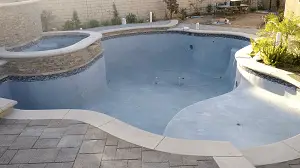
Acid washing works partly by dissolving material from the cement-based surface. That is why the treatment can expose a brighter layer, but also why repeating it unnecessarily can shorten the useful life of the finish.
Plaster that has already been etched, weakened, or heavily treated may not tolerate another wash.
National Plasterers Council research explains how aggressive chemical conditions can dissolve cementitious material and deteriorate the surface.
There is no universal rule that every plaster pool should be acid washed two or three times over its life. A sound decision requires knowing the finish’s age, thickness, previous treatments, and current condition.
One pool service company’s September 2026 treatment guide emphasizes that an acid wash permanently consumes part of the remaining surface. It recommends considering that tradeoff before approving the service.
If plaster is flaking, deeply pitted, or otherwise failing, resurfacing may be more appropriate than stripping another layer.
A professional should assess whether the finish can safely tolerate treatment before making a price recommendation.
Draining the Pool Safely
Draining an inground pool requires more judgment than simply placing a pump at the bottom.
High groundwater can exert upward pressure against the shell. When the pool is emptied, the loss of water weight can contribute to lifting, cracking, or displacement if pressure is not properly relieved.
Soil conditions, recent rainfall, drainage, construction type, and local groundwater levels all matter. Improper draining can cause damage far more expensive than the original acid wash.
A pool contractor should evaluate the drain procedure, local discharge requirements, available hydrostatic relief measures, and any manufacturer restrictions before emptying the pool.
Acid also presents serious chemical hazards.
The CDC’s pool chemical safety recommendations call for trained personnel, appropriate protective equipment, proper ventilation, and strict separation of incompatible chemicals.
In particular, mixing chlorine products with acid can release toxic gases. The older article’s suggestion that homeowners use increasingly concentrated acid mixtures is not a safe substitute for professional procedures.
Acidic wastewater also requires appropriate management. Discharging it into a storm drain, yard, or sanitary sewer without considering local requirements can create environmental or regulatory problems.
For these reasons, this is a job better handled by a properly trained pool-service professional rather than treated as a routine DIY cleaning project.
How Long Will the Pool Be Unavailable?
The actual surface treatment may take only part of a day, but the complete job also involves draining, preparing the surface, handling wastewater, refilling, circulating water, and adjusting its chemistry.
Industry provider PoolDial estimates that complete acid-washing projects often require approximately two days, although refill conditions and the amount of cleaning can change the schedule.
Larger pools, slow water supply, difficult drainage, and additional surface work can extend the interruption.
Reopening the pool should depend on measured water conditions and completion of necessary circulation and chemical treatment, not just a fixed number of hours after the acid wash.
The CDC recommends routinely maintaining pool water pH in the 7.0 to 7.8 range and appropriate sanitizer levels.
Regular maintenance can help reduce the conditions that lead to surface problems. Seasonal work, such as the services described in ThePricer’s pool closing cost guide, addresses a different set of issues and should not be confused with acid washing.
How to Compare Pool Service Quotes
Ask each contractor whether the quote covers the complete project or only the chemical treatment. The distinction can be worth hundreds of dollars.
Makes sense if
- The pool has stubborn staining on a suitable plaster finish.
- The contractor has identified the likely source of discoloration.
- The plaster is healthy enough to tolerate treatment.
- Draining conditions and local wastewater rules have been checked.
- The estimate identifies refill and chemical-startup responsibilities.
Does not make sense if
- The pool only needs ordinary cleaning or water rebalancing.
- The finish is already badly etched, flaking, or worn.
- The contractor recommends acid treatment without examining the staining.
- Groundwater conditions make draining unsafe.
- The quote omits substantial water and startup costs.
For a standard pool, get a written scope covering draining, surface cleaning, treatment, wastewater handling, refilling, and startup work.
Property owners considering larger renovations should compare acid-washing costs with the broader swimming pool installation cost and the long-term expense of maintaining the existing finish. An acid wash is a surface treatment, not a substitute for rebuilding a failed pool shell.
What We Verified
- Angi’s September 2026 figures and published Arizona provider prices establish a broad $250 to $1,200+ market for acid-washing work.
- Some contractors exclude the water and chemical startup from the headline service price.
- Municipal water can cost substantially less than delivery by truck.
- The National Plasterers Council warns against treating plaster before identifying the cause of surface problems.
- CDC guidance confirms that routine water sanitation depends on disinfectant and pH maintenance, not regular acid washing.
- Pool chemicals and improper draining create safety and structural risks.
- The worked total and refill comparisons use identified source ranges and explicit assumptions.
Answers to Common Questions
How much does it cost to acid wash a 15,000-gallon pool?
A standard residential treatment commonly costs around $300 to $800. Refill water and separately billed chemical startup may increase the complete budget to approximately $500 to $1,200 or more.
How often should a pool be acid washed?
There is no universal schedule. Acid washing should be considered only when an appropriate plaster surface has staining that cannot be resolved with less aggressive treatment. Repeated unnecessary washing removes usable finish material.
Can you acid wash a fiberglass or vinyl pool?
Conventional plaster acid-washing procedures are not appropriate for vinyl liners and may damage fiberglass finishes. Use products and methods specifically approved for the pool’s interior material.
Does acid washing remove all pool stains?
No. Results depend on the source of the staining and the condition of the finish. Metal staining, deep deterioration, and certain embedded discolorations may require other treatment or resurfacing.
Does the acid-washing price include refilling?
Not always. Some providers include the draining and refill process but bill the replacement water and startup chemicals separately. The full scope should be confirmed before booking.
Disclosure: Educational content, not financial advice. Prices reflect public information as of the dates cited and can change. Confirm current rates, fees, taxes, and terms with official sources before purchasing. See our methodology and corrections policy.