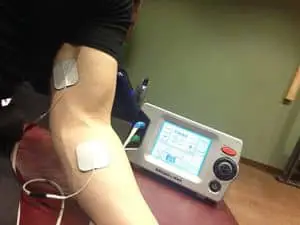
How Much Does an ARP Wave Machine Cost?
Updated on | Written by Alec Pow
This article was researched using 13 sources. See our methodology and corrections policy.
An ARPwave machine currently costs from $2,999 for the portable FlexDoctor to about $15,000 to $20,000 for an RxBlack system. Renting is also available. ARPwave currently lists the FlexDoctor at $299 per month and Rx device rentals at approximately $749 to $1,333 per month.
Patients who do not want a machine can instead buy ARPwave therapy. Current company pricing starts at $999 for therapy plans, while a separately listed 20-treatment package costs $4,000. That works out to $200 per treatment. Add-on therapy sessions currently start at $149.
ARPwave is a neuromuscular electrical-stimulation system, but one regulatory distinction matters before discussing what it can treat. ARPwave describes its current products as FDA-cleared. The FDA’s public record for the ARP RX100 classifies it as a Class II powered muscle stimulator cleared through the 510(k) pathway. That is different from FDA Premarket Approval, and the cleared indications are substantially narrower than some of the condition-specific uses advertised by ARPwave.
Article Highlights
Jump to sections
- The portable ARPwave FlexDoctor currently costs $2,999 (at $30 per hour, earning that amount would take about 2.5 full-time workweeks, before taxes).
- RxBlack purchase options currently run approximately $15,000 to $20,000.
- A commercial RxBlack system is listed at $17,500, while the Enterprise system is $18,995.
- FlexDoctor rental currently costs $299 per month.
- Monthly Rx rentals currently run $749 to $1,333.
- A 20-treatment ARPwave therapy package costs $4,000, or $200 per treatment.
- The FDA record for the ARP RX100 is a 510(k) clearance for a Class II powered muscle stimulator, not a PMA approval for treating every condition advertised by the company.

How Much Does an ARPwave Machine Cost?
There is no longer one ARPwave-machine price. ARPwave sells a smaller home-oriented FlexDoctor as well as the more powerful RxBlack family, and both purchase and rental plans are offered.
| ARPwave option | Current price | What the price represents |
|---|---|---|
| FlexDoctor purchase | $2,999 (about 2.5 full-time workweeks at $30 per hour) | Portable personal ARPwave device |
| FlexDoctor rental | $299/month | Current monthly rental price |
| RxBlack purchase | $15,000 to $20,000 | Current RxBlack purchase range |
| Rx monthly rental | $749 to $1,333/month | Current rental options vary by plan |
| RxBlack Commercial | $17,500 | Commercial neuromuscular therapy system |
| RxBlack Enterprise | $18,995 | Enterprise commercial configuration |
| RxBlack try-before-you-buy | $995 | Current trial offer listed by ARPwave |
| Therapy plans | $999 to $4,299 | ARPwave treatment plans |
The FlexDoctor is currently listed for $2,999 on the official ARPwave store. The package includes the device, charger, lead cable, electrodes, sponges, disposable pads, elastic wraps, application guidance, and an orientation session.
ARPwave’s current RxBlack store listings show purchase pricing between $15,000 and $20,000. Its commercial listings separately price the Commercial RxBlack at $17,500 and Enterprise system at $18,995.
FlexDoctor vs RxBlack
The FlexDoctor is the lower-cost personal option. ARPwave says it operates at a fixed 245 pulses per second, uses one channel, runs on a rechargeable battery, and is intended to be portable. Its current product page says no prescription is required.
The RxBlack is ARPwave’s higher-end system. ARPwave lists a much wider frequency range of 10 to 999 pulses per second and describes it as its more powerful and customizable device. It is marketed to individuals, athletes, clinicians, and commercial practices through the company’s current RxBlack page.
The price difference is substantial. Using $17,500 (about 3.4 months of full-time work at $30 per hour) for the current commercial RxBlack and $2,999 for the FlexDoctor gives a difference of $14,501. The RxBlack costs about 5.8 times as much.
That does not mean one is automatically a better purchase. The cheaper device has fewer controls and substantially less stated power. Someone considering ARPwave for home use should compare the functions actually needed rather than assuming the highest-priced system produces a better outcome for a particular injury.
How Much Does ARPwave Therapy Cost?
Buying a machine is not required to receive ARPwave therapy. The company sells treatment plans and also works through participating clinicians and providers.
Current ARPwave therapy pricing lists plans from $999 to $4,299. Add-on therapy sessions begin at $149, although packages and treatment formats vary.
ARPwave separately lists a $4,000 20-treatment package in its current store. Dividing the total gives:
$4,000 ÷ 20 treatments = $200 per treatment.
This makes a current planning range of roughly $149 to $200 per session useful for some ARPwave treatment options, although the actual effective price depends on the purchased plan and what services are included.
A therapy session and owning a machine are not equivalent purchases. Professional treatment can include evaluation, guidance, exercise, electrode placement, and adjustments that are not automatically included merely because someone owns a stimulation device.
Renting vs Buying ARPwave
Renting can make sense when the expected period of use is short. Current ARPwave rental prices are $299 per month for FlexDoctor and $749 to $1,333 per month for Rx units.
The FlexDoctor provides an unusually simple comparison. Ten months at $299 costs $2,990. Buying it costs $2,999. Ignoring taxes, shipping, rental terms, included services, and resale value, the gross rental spending reaches the purchase price at almost exactly 10 months.
For Rx rentals, 12 months at the current endpoints would cost:
- $749 × 12 = $8,988
- $1,333 × 12 = $15,996
That means long-term Rx rental can consume a large part of the $15,000 to $20,000 purchase price within one year. The plans are not necessarily identical in equipment, services, commitment, or terms, so the arithmetic should be used as a comparison point rather than a true break-even guarantee.
Is ARPwave FDA Approved?
The more accurate term is FDA cleared, not FDA approved.
The FDA’s public 510(k) record for the ARP RX100 identifies it as a Class II powered muscle stimulator and records a December 17, 2009 decision of “substantially equivalent.”
A 510(k) clearance and Premarket Approval are different regulatory pathways. The FDA explains in its device clearance and approval guidance that a 510(k) is based on demonstrating substantial equivalence to an appropriate legally marketed device. PMA is a separate, more stringent pathway requiring sufficient scientific evidence to provide reasonable assurance of safety and effectiveness for the device’s intended use.
Calling ARPwave simply “FDA approved” can therefore give readers the wrong impression about what the regulatory decision established.
What the FDA Clearance Covers
The FDA documentation for the ARP RX100 lists five intended applications:
- relaxation of muscle spasms;
- prevention or retardation of disuse atrophy;
- increasing local blood circulation;
- muscle re-education;
- maintaining or increasing range of motion.
Those are taken from the FDA’s published ARP RX100 510(k) summary. The record identifies the RX100 as a prescription-use device.
ARPwave’s current FAQ repeats essentially the same five applications when describing what its devices and therapy are used for. Its current FAQ also says both FlexDoctor and RxBlack are available for home use.
Claims That Go Beyond Indications
ARPwave’s marketing currently discusses use with a much broader range of problems, including back and knee pain, tendon complaints, sprains and strains, carpal tunnel syndrome, torn ligaments and tendons, pre- and post-surgical rehabilitation, neurological disorders, spinal-cord injuries, and other conditions.
These are company treatment and marketing claims. They should not be confused with the narrower applications listed in the FDA clearance.
In particular, FDA clearance for muscle stimulation does not establish that ARPwave can repair a torn ACL or MCL, reverse structural cartilage damage, treat multiple sclerosis, repair a herniated disc, or eliminate the need for surgery when surgery is medically indicated.
Someone with a torn ligament, progressive neurological symptoms, weakness, severe back pain, or another diagnosed injury should base the medical decision on an appropriate clinician’s evaluation rather than using the cost of ARPwave as a substitute for determining which treatment is clinically appropriate.
The Hidden Five-Year Cost

The old idea that every ARPwave owner pays a mandatory $100 to $200 monthly maintenance fee is not supported by the current company pricing.
There is a different cost consideration for the Rx system. ARPwave’s current RxBlack and Rx100 terms state that Rx units have a five-year warranty for qualifying defects. The terms also define a five-year service life for the unit’s proprietary software and firmware.
After that service life, ARPwave says it has no obligation to provide additional runtime, reactivation, or software extensions. Continued activation may be offered at the company’s discretion and may require an upgrade or relicensing fee. No universal post-five-year price is currently published.
The FlexDoctor has a shorter one-year warranty. Current replacement-accessory prices include approximately $10 to $16 for electrode products, $17 to $23 for a FlexDoctor lead cable, and $80 for a replacement FlexDoctor charger in the company’s accessories store.
Three ARPwave Cost Scenarios
Scenario 1, short-term home use: Someone expects to use a FlexDoctor for three months. At $299 per month, rental totals $897. That is $2,102 less than paying $2,999 to own the device, before any differences in rental terms or included support.
Scenario 2, long-term FlexDoctor use: Ten rental payments total $2,990, only $9 less than the current purchase price. A person expecting substantially more than 10 months of use should compare the rental agreement with buying rather than assuming monthly rental remains cheaper.
Scenario 3, clinician purchasing RxBlack: The Commercial system costs $17,500. ARPwave’s commercial training form says the first attendee is included with a new commercial license and prices each additional attendee at $2,500. A system plus one additional trained attendee would therefore reach $20,000 before any other practice costs.
Insurance and Financing
Insurance should not be assumed simply because the equipment is a medical device. Coverage depends on the insurer, diagnosis, prescribed treatment, provider status, benefits, deductible, prior authorization, and the billing codes involved.
ARPwave currently provides a detailed insurance benefits-check process that asks insurers about therapy codes, durable-medical-equipment benefits, deductible status, authorization, and coverage for neuromuscular electrical-stimulation equipment.
The existence of that process does not guarantee reimbursement. A patient considering a $2,999 FlexDoctor, a $15,000+ RxBlack, or a multi-thousand-dollar treatment package should obtain plan-specific confirmation before calculating insurance into the final out-of-pocket cost.
ARPwave also advertises consumer and commercial financing for its current products. Financing can reduce the immediate cash requirement but increases the importance of checking the term, interest rate, total financed cost, and what happens if treatment ends before the financing contract does.
Related injury treatment costs
ARPwave should be compared with other treatment costs only after a clinician determines which options are appropriate for the actual injury. Readers researching ligament and orthopedic treatment can compare the cost of torn MCL surgery, Tommy John surgery, and meniscus tear surgery. Those procedures treat specific structural injuries and should not be presented as automatically interchangeable with electrical stimulation therapy.
What We Verified
- Checked: ARPwave’s current store lists FlexDoctor at $2,999 and current RxBlack purchase options at $15,000 to $20,000.
- Confirmed: Current monthly rental pricing is $299 for FlexDoctor and $749 to $1,333 for Rx equipment.
- Cross-referenced: The FDA’s K093259 record classifies the ARP RX100 as a Class II powered muscle stimulator cleared through the 510(k) substantial-equivalence process.
- Verified: The FDA-listed indications are muscle-spasm relaxation, disuse-atrophy prevention or retardation, increased local circulation, muscle re-education, and maintaining or increasing range of motion.
- Checked: Current ARPwave terms give RxBlack a five-year warranty and defined five-year service life, while FlexDoctor carries a one-year warranty.
Answers to Common Questions
How much does an ARPwave machine cost?
The current FlexDoctor price is $2,999. RxBlack options currently cost about $15,000 to $20,000, depending on the system.
How much does it cost to rent an ARPwave machine?
FlexDoctor currently rents for $299 per month. Monthly Rx rentals run from about $749 to $1,333. ARPwave also lists other weekly and longer-term plans.
How much does ARPwave therapy cost per session?
Current add-on therapy pricing begins at $149. A $4,000 package containing 20 treatments works out to $200 per treatment.
Is ARPwave FDA approved?
The more accurate regulatory term is FDA cleared. The FDA’s ARP RX100 record is a Class II 510(k) clearance based on substantial equivalence to a legally marketed powered muscle stimulator. That is different from FDA Premarket Approval.
Can ARPwave replace ACL, MCL, meniscus, or other surgery?
FDA clearance does not establish ARPwave as a replacement for surgery to repair structural ligament, tendon, cartilage, or other injuries. Whether surgery, physical therapy, electrical stimulation, or another treatment is appropriate depends on the specific diagnosis and should be decided with a qualified clinician.
Disclosure: Educational content, not medical advice. Pricing varies by provider, location, and insurance. Confirm eligibility, coverage, and out-of-pocket costs with a licensed clinician and your insurer. See our methodology and corrections policy.