
How Much Does Bucket Truck Rental Cost?
Updated on | Written by Alec Pow
This article was researched using 12 sources. See our methodology and corrections policy.
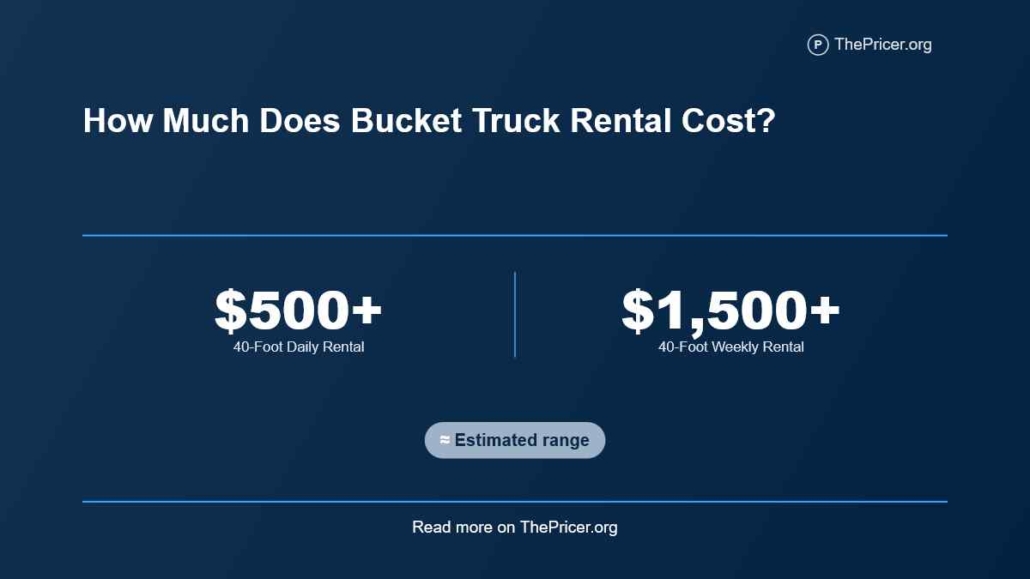
Bucket truck rental commonly costs around $500 per day, $1,500 per week, or $4,500 per month for a road-going 40-foot-class truck when a supplier publishes transparent rates. Specialized tracked, high-reach, heavy-material-handling, or utility configurations can cost much more, with current listings reaching about $1,700 per day, $3,950 per week, and $10,500 per month.
The headline rate is only part of the budget. Delivery, pickup, fuel, insurance requirements, refueling charges, taxes, extra rental days, working-height requirements, 4×4 capability, insulation, and material-handling equipment can all move the final invoice.
A bucket truck is a vehicle-mounted aerial device that carries one or more workers in an elevated platform. Unlike a towable or self-propelled boom lift, the lift is mounted directly to a road vehicle, making bucket trucks especially useful for utilities, telecom work, tree care, signs, lighting, and roadside maintenance.
Article Highlights
Jump to sections
- A currently listed 40-foot insulated bucket truck rents for about $500 (at $30 per hour, earning that amount would take about 2.1 full-time workdays, before taxes) per day, $1,500 per week, or $4,500 per month.
- Specialized tracked bucket equipment can reach roughly $1,700 per day or $10,500 per month.
- Large national specialty fleets often quote bucket trucks by the week or month rather than advertising a universal daily rate.
- Delivery, pickup, fuel, insurance, taxes, and damage responsibility can materially increase the final rental cost.
- Working height is not the same thing as platform height. A 33-foot platform can provide roughly 38–39 feet of working height.
- OSHA requires operators to be trained and authorized, but there is no universal federal $75 “bucket truck certification” charge.
How Much Does Bucket Truck Rental Cost?
Current public rental listings show a much wider market than the old $200–$500 (about 0.8 to 2.1 full-time workdays at $30 per hour) daily estimate suggested.
For example, current bucket-truck listings show a 2026 40-foot Palfinger at $500 per day, $1,500 per week, and $4,500 per month. The same marketplace shows a specialized tracked Dur-A-Lift bucket unit at $1,700 per day, $3,950 per week, and $10,500 per month.
| Rental type | Current planning range |
|---|---|
| Standard road-going bucket truck | About $500+ per day |
| Standard weekly rental | About $1,500+ |
| Standard monthly rental | About $4,500+ |
| Specialty tracked/high-capability unit | Up to $1,700+ per day |
| Specialty monthly rental | $10,000+ possible |
These figures are budgeting anchors, not a national tariff. Local supply, working height, insulation class, chassis, 4×4 capability, material handling, and rental duration all affect the quote.
Large specialty providers may not publish simple walk-up daily pricing at all. one major North American bucket-truck rental fleet says it offers both weekly and monthly agreements and carries telecom, distribution, forestry, construction, and transmission configurations with working heights extending well beyond ordinary sign or lighting trucks.
Daily vs Weekly
The biggest price lesson is that longer rentals can dramatically reduce the effective daily cost.
Using the current $500 (about 2.1 full-time workdays at $30 per hour)/$1,500/$4,500 Palfinger example:
- One day costs $500.
- A seven-day week at $1,500 works out to about $214 per calendar day.
- A 30-day month at $4,500 works out to about $150 per calendar day.
If you need the truck for four separate $500 rental days in one week, the headline rental charge would be $2,000. The published $1,500 weekly rate would save $500, or 25%, even before considering repeated delivery and pickup.
This same rate pattern appears throughout the aerial-equipment market. Our guide to boom lift rental costs shows how weekly pricing can undercut the cost of stacking several individual daily rentals.
Truck Type
Calling every machine a “bucket truck” hides important differences.
A small telecom unit can have a platform roughly 30 to 33 feet above the ground and a one-person basket. Larger utility trucks may provide 50, 60, 100, or even 125 feet of working height, larger platforms, insulated booms, material-handling jibs, and heavier chassis.
For example, a current 33-foot telecom rental configuration has a 300-pound platform capacity, 33-foot platform height, 29-foot side reach, AWD, and a working height of 39 feet.
By comparison, a 55-foot-class material-handling Versalift provides almost 60 feet of working height, roughly 30 feet of horizontal reach, a 500-pound platform rating, and material-handling capability.
The lesson is simple: renting “more truck” than the job requires can waste money, but choosing only by height can leave you without enough side reach or platform capacity.
Height and Reach
Platform height and working height are not interchangeable.
The worker’s hands extend above the basket floor, so manufacturers normally publish a working height greater than platform height. A truck described as having a 33-foot platform may therefore provide roughly 38 or 39 feet of working height.
Horizontal reach matters just as much. Altec’s equipment-selection guidance explains that a job requiring work 50 feet above ground may need a unit rated higher than 50 feet when the truck cannot park directly beneath the work.
This becomes important beside buildings, fences, ditches, trees, traffic lanes, landscaping, and overhead obstacles.
The Hidden Price
The published rental rate can be only the first line of the invoice.
Delivery and pickup may be billed separately. United Rentals’ current U.S. rental terms state that pickup and delivery are subject to a separate service charge disclosed on the rental agreement. They also make clear that rental charges continue until equipment is properly returned or called off rent and picked up under the contract terms.
Those current rental terms also explain that taxes are separate and that the renter remains responsible for equipment condition and certain damage or loss.
Fuel can create another line item. The old article said fuel was generally covered by the rental company on short rentals. That should not be assumed. one current specialty-fleet rental agreement requires equipment to be returned with a full fuel tank and imposes an $85 labor charge plus fuel cost when it is returned short.
Insurance can be substantial. The same specialty provider requires commercial general liability, automobile coverage, physical-damage coverage, and other insurance documentation before certain rentals. This is quite different from assuming every customer simply buys a 10% to 20% counter damage waiver.
Before comparing two quotes, ask whether each includes:
- delivery;
- pickup;
- fuel or refueling;
- taxes;
- damage protection;
- required insurance;
- extra-hour charges;
- cleaning;
- accessories and fall protection;
- weekend or after-hours service.
A $2,405 Example
Suppose a contractor needs a 40-foot-class bucket truck for one week. Using the current publicly listed $1,500 weekly rate as the base, an illustrative project budget might look like this:
| Item | Example cost |
|---|---|
| One-week bucket truck rental | $1,500 |
| Delivery and pickup allowance | $500 |
| Fuel allowance | $250 |
| Miscellaneous fees/taxes allowance | $155 |
| Illustrative total | $2,405 |
The non-rental lines add $905 to a $1,500 headline rate. In this example, the final project budget is about 60% higher than the advertised equipment rate alone.
This is not a quote from a single rental company. Delivery, fuel, insurance, taxes, and local fees need to be priced for the specific rental.
At a $30 hourly wage, $2,405 represents about 80 hours of gross earnings, or approximately two 40-hour workweeks before taxes.
Bucket Truck vs Boom Lift
A self-propelled boom lift may be cheaper or easier when the work stays on one site and you do not need a road-going truck underneath the platform.
A bucket truck becomes especially useful when crews must travel between utility poles, signs, trees, lights, or other distributed work locations. The vehicle carries the aerial device, tools, and sometimes substantial equipment storage from site to site.
If mobility around one construction site matters more than road travel, compare the quote with our boom lift rental pricing before automatically choosing a bucket truck.
Bucket Truck vs Crane
A bucket truck is primarily a personnel access machine. Some models also have material-handling systems, but that does not turn the work platform into a general-purpose crane.
For example, a 55-foot Versalift can carry a 500-pound platform load while offering separate material-handling capability. Larger utility machines can be rated for much heavier loads, but only through the manufacturer’s specified material-handling system.
If the actual job is lifting heavy materials rather than positioning workers, our guide to crane rental costs is the more relevant comparison.
Training and Safety
There is no single federal $75 bucket-truck certification fee.
OSHA’s aerial-lift guidance requires trained and authorized operators. Training should cover electrical hazards, falls, falling objects, unsafe conditions, correct operation, maximum load, inspections, and manufacturer requirements.
Federal rules also require workers in an aerial lift to use appropriate fall arrest or travel-restraint equipment and prohibit exceeding the manufacturer’s boom and basket load limits. OSHA’s vehicle-mounted aerial-platform standard also addresses brakes, outriggers, controls, and operating precautions.
A rental company’s familiarization process is not automatically a substitute for an employer’s training responsibilities. Anyone budgeting a rental should confirm what training is required for the employees and job involved.
Do You Need a CDL?
Not every bucket truck requires the same driver’s license.
Truck weight and configuration matter. FMCSA guidance uses the 26,001-pound threshold in its federal CDL framework, although the specific vehicle, towing configuration, commercial use, and state rules must be checked.
This matters because bucket trucks span very different chassis classes. A current Altec 52-foot truck built on an F-550 is listed at 19,500 pounds GVWR, while a 60-foot utility rental configuration uses a 33,000-pound-GVWR chassis.
Do not reserve a heavy truck and assume every employee who can drive the company’s pickup is legally qualified to drive it.
Tree Work
Tree trimming and removal are common bucket-truck applications, but access determines whether a truck is practical. The vehicle needs sufficient ground conditions, clearance, setup space, and boom geometry.
A difficult backyard may require climbing or crane-assisted work instead. Our updated guide to tree removal costs explains how bucket trucks, climbers, chippers, rigging, and cranes can enter the same project depending on access and tree position.
That comparison also helps explain why renting a truck yourself does not necessarily make a tree project inexpensive. The equipment is only one part of trained aerial work.
Buying vs Renting
For occasional use, rental avoids tying up capital in a highly specialized truck.
Purchase prices can be substantial. For perspective, Altec recently listed a 52-foot F-550-mounted bucket truck at roughly $196,000, while an electric utility configuration with more than 60 feet of working height was listed near $598,000.
A company renting a $4,500-per-month truck for three isolated months spends $13,500 in headline rent. Even before financing, insurance, inspections, maintenance, depreciation, registration, storage, and downtime are considered, that is far below the acquisition cost of a new specialized utility truck.
Frequent year-round users have a different calculation. Fleet utilization, maintenance capacity, financing, resale value, and the exact type of work can make ownership more attractive.
Choosing a Rental
Start with the job rather than a price list.
Determine the required vertical working height, side reach, platform capacity, insulation requirement, material-handling needs, chassis weight, drive type, and terrain before requesting quotes.
A current Versalift telescopic specification, for example, shows how two superficially similar models can provide working heights around 36 and 40 feet with different horizontal reach. Those few feet can determine whether the crew can actually position the bucket where it is needed.
Ask each vendor for the same information:
- daily, weekly, and four-week/monthly rate;
- included operating hours or mileage;
- delivery and pickup;
- fuel policy;
- insurance requirements;
- damage-waiver options;
- taxes and environmental charges;
- working height and side reach;
- platform and material-handling capacity;
- insulated or non-insulated boom;
- CDL implications;
- cancellation and off-rent procedure.

Lowering the Cost
The most effective saving is usually matching the rental term to the schedule.
Using the current $500 daily and $1,500 weekly example, the weekly price equals only three individual rental days. If a job could reasonably run four days, reserving by the week may already be cheaper.
The next savings come from avoiding unnecessary capability. A telecom or lighting crew that needs 35 feet of working height may not benefit from paying for a 60-foot material-handling utility truck.
Other useful steps include:
- schedule delivery after the site is ready;
- confirm access before the truck arrives;
- avoid repeated short rentals when one weekly booking is cheaper;
- return or call the unit off rent promptly;
- understand the fuel-return requirement;
- check insurance before reserving;
- select only the reach and material capacity the work requires;
- compare at least two specialty rental fleets.
For projects that also require earthmoving, our guide to mini excavator costs can help separate the aerial-access budget from excavation equipment rather than blending unrelated machinery into one estimate.
What We Verified
We checked current 2026 rental listings, specialty-fleet policies, manufacturer specifications, and federal safety and vehicle guidance rather than carrying forward the older article’s generic rate estimates.
Current transparent listings support about $500 per day, $1,500 per week, and $4,500 per month for one 40-foot road-going bucket-truck configuration, while specialized tracked equipment can cost several times more. Large specialist fleets also confirm that weekly and monthly contracts are common, so there is no basis for describing a seven-day minimum as a universal industry rule.
We also removed or corrected claims about Home Depot, Lowe’s, local utility rental pools, fuel being automatically included, a standard percentage-based insurance charge, and a universal $75 OSHA training fee. OSHA regulates operator training and safe use, while individual rental companies set their own commercial terms, insurance requirements, delivery charges, and fuel policies.
Answers to Common Questions
How much is a bucket truck rental per day?
A current 40-foot road-going bucket-truck listing is approximately $500 per day. Specialized tracked or high-capability equipment can reach roughly $1,700 per day, so the required truck class matters considerably.
How much does a bucket truck cost to rent for a week?
A current 40-foot example is about $1,500 per week. Specialized equipment can approach $4,000 per week or more.
How much does a bucket truck cost per month?
A road-going 40-foot example is currently listed around $4,500 per month, while specialized tracked equipment can exceed $10,000 per month.
Does bucket truck rental include delivery?
Do not assume so. Rental companies may bill delivery and pickup separately. Ask for both charges before comparing quotes.
Does the rental company pay for fuel?
Policies vary. Some contracts require the renter to return the truck full, and refueling charges can apply when it comes back short.
Do you need training to operate a bucket truck?
Yes for workplace use. OSHA requires aerial-lift operators to be trained and authorized. The required training covers hazards, proper operation, load capacity, inspection, and manufacturer requirements.
Do you need a CDL to rent a bucket truck?
Not automatically. It depends partly on the truck’s GVWR and configuration as well as applicable state and federal requirements. Some bucket trucks sit below the federal 26,001-pound CDL threshold, while large utility models exceed it.
How much weight can a bucket truck hold?
There is no universal 200–500-pound limit. Current equipment ranges widely. Smaller telecom platforms may carry roughly 300–440 pounds, while large utility platforms can be rated for 700 pounds or substantially more. Always use the exact manufacturer’s platform rating.
Can you lift materials with a bucket truck?
Only when the specific aerial device includes approved material-handling equipment and the load remains within its ratings. The worker platform itself should not be treated like an improvised crane.
Is a bucket truck cheaper than a boom lift?
It depends on the job. A boom lift can make more sense on one fixed construction site, while a road-going bucket truck can be more productive when crews must travel between poles, trees, lights, signs, or multiple work locations.
Prices are budgeting estimates based on publicly available U.S. rental listings and provider information current in 2026. Actual rates, taxes, delivery, insurance, availability, and rental terms vary by location, equipment, customer account, and project.
Disclosure: Educational content, not financial advice. Prices reflect public information as of the dates cited and can change. Confirm current rates, fees, taxes, and terms with official sources before purchasing. See our methodology and corrections policy.