
How Much Do Cambria Countertops Cost?
Updated on | Written by Alec Pow
This article was researched using 9 sources. See our methodology and corrections policy.
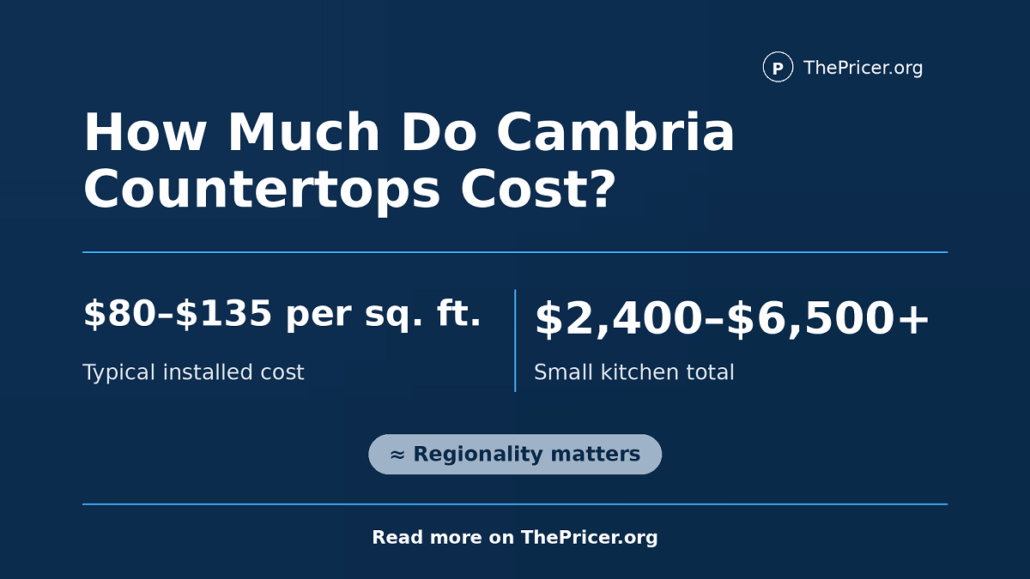
Cambria quartz countertops typically cost about $80 to $135 per square foot installed, although a simple project may fall near $60 per square foot and a complex premium installation can exceed $150 per square foot. Cambria currently estimates $2,400 to $6,500+ for a small kitchen with 30 to 50 square feet of surface and $4,000 to $13,500+ for a medium kitchen with 50 to 100 square feet.
A 40-square-foot kitchen usually lands near $3,200 to $5,400 at the common installed range. The price can reach $6,000 to $8,000+ when the layout needs a second slab, a waterfall end, elaborate edge work, several cutouts, old-counter removal, plumbing changes, or careful vein matching.
Cambria is normally purchased as a measured, fabricated, delivered, and installed countertop rather than as a loose slab sold directly to the homeowner. The quote is established by the dealer, fabricator, or installer, which is why two homeowners choosing the same design may receive different prices.
Article Highlights
Jump to sections
- Cambria countertops commonly cost $80 to $135 (at $30 per hour, earning that amount would take about 2.7 to 4.5 hours of work, before taxes) per square foot installed.
- A small 30- to 50-square-foot kitchen may cost $2,400 to $6,500+.
- A medium 50- to 100-square-foot kitchen may cost $4,000 to $13,500+.
- Needing one additional slab can add thousands of dollars even when only a few extra finished square feet are needed.
- Waterfall ends, mitered edges, cooktop cutouts, sinks, backsplashes, and vein matching raise fabrication costs.
- Cambria does not need routine sealing, but it can still be scratched, chipped, scorched, or damaged by direct heat.
- Residential Cambria installations carry a transferable Full Lifetime Warranty when warranty conditions are met.
How Much Do Cambria Countertops Cost?
| Cambria project | Surface area | Current installed range |
|---|---|---|
| Bathroom vanity | 10 to 15 sq. ft. | $800 to $2,025+ (about 0.7 to 1.7 full-time workweeks at $30 per hour) |
| Small kitchen island | 8 to 12 sq. ft. | $640 to $1,560+ |
| Medium kitchen island | 14 to 20 sq. ft. | $1,120 to $2,600+ |
| Small kitchen | 30 to 50 sq. ft. | $2,400 to $6,500+ |
| Medium kitchen | 50 to 100 sq. ft. | $4,000 to $13,500+ |
| Large kitchen | 100 to 150 sq. ft. | $8,000 to $19,500+ |
Cambria publishes these project ranges through its current quartz countertop pricing guide. The numbers imply a broad installed rate near $80 to $130 per square foot, although the exact figure changes with the project’s shape, design series, slab use, fabrication, and local labor.
Independent pricing is somewhat wider. HomeGuide places Cambria near $60 to $125 per square foot installed, while Angi’s 2026 quartz data places the wider engineered-quartz market at $50 to $200 per square foot. Cambria usually sits in the premium half of that market rather than competing with entry-level imported quartz.
A price below $60 per square foot may apply to a remnant, promotion, builder package, limited color, or quote with fewer included services. A price above $150 per square foot can be reasonable when premium fabrication, difficult access, bookmatched veining, multiple trips, or expensive local labor is involved.
What Cambria Quartz Is

Cambria is an American-made engineered quartz surface used for kitchen countertops, bathroom vanities, backsplashes, shower walls, fireplace surrounds, wet bars, desks, and other interior applications. Quartz particles are combined with binders and pigments to create slabs with controlled patterns and colors.
It is not the same material as quartzite. Quartzite is a natural stone cut from a quarry, while Cambria is manufactured into designed slabs. It also differs from solid-surface products such as Corian, which use a different mineral and resin composition and can be repaired or refinished in ways quartz cannot.
Cambria is nonabsorbent and does not require periodic sealing. Granite and other natural stones may need sealing depending on the stone and finish. Homeowners comparing these materials can review the cost and ownership differences between Corian and granite countertops before narrowing the choice to one surface category.
The Slab-Yield Price Trap
Countertop quotes are often discussed by finished square foot, but the fabricator must buy enough slab material to cut every piece. The number of slabs needed can matter more than the final measured countertop area.
Cambria’s standard slab is approximately 122 by 55.5 inches and contains a nominal 47 square feet. Its jumbo slab measures approximately 132 by 65.5 inches and contains a nominal 60 square feet, according to the company’s current slab sizing chart.
Those nominal areas are not fully usable countertop areas. Saw cuts, damaged edges, pattern direction, sink openings, cooktop openings, seam positions, slab defects, and the shapes of cabinets create waste. A 47-square-foot slab does not guarantee 47 finished square feet.
A 42-square-foot kitchen might fit on one jumbo slab when its pieces nest efficiently. The same 42 square feet may require two slabs when the kitchen has a long island, a full-height backsplash, strong directional veining, or pieces too wide to share the remaining slab area.
This explains why two kitchens with nearly identical measured areas can differ by several thousand dollars. One uses most of a single slab. The other crosses the line into a second slab and pays for material that may not appear in the finished countertop.
ThePricer Slab-Yield Calculation
Consider a kitchen with 48 finished square feet of countertops. At an installed rate of $105 (about 3.5 hours of work at $30 per hour) per square foot, a simple area calculation gives a starting price of $5,040.
Suppose the design and piece layout cannot be cut from one 60-square-foot jumbo slab because the island must remain seamless and its veining must run in one direction. A second slab is required even though the finished project uses only eight square feet more than the first slab’s practical yield.
If that second-slab requirement adds $1,900 in material, handling, and fabrication, the revised total becomes $6,940. The effective project rate rises from $105 to about $144.58 per finished square foot.
ThePricer calculation: the additional slab increases the original estimate by 37.7%, although the measured countertop area did not change. This slab-yield penalty is one of the largest hidden costs in a Cambria quote and cannot be found by multiplying cabinet measurements by an advertised square-foot rate.
Fabrication and Installation
Cambria does not set one retail price for homeowners. Its trade partners, dealers, fabricators, and contractors establish project pricing, as Cambria explains in its current purchasing FAQ.
The fabricator visits the home after cabinets are installed and level, creates a digital or physical template, prepares a cutting plan, fabricates the pieces, finishes the edges, makes sink and appliance cutouts, transports the slabs, and installs them. The crew may also set seams, attach an undermount sink, drill faucet holes, add brackets, and apply joint adhesive.
A simple galley kitchen with straight runs and one sink costs less to fabricate than a U-shaped kitchen with angled corners, curved pieces, several seams, and a large island. Walls that are bowed or out of square require scribing and careful fitting.
Cambria states that its approved fabricators cut the chosen slab, produce the selected edge, and make openings for sinks, faucets, and cooktops during the countertop installation process. The quote should say which of those services are included.
Edges, Islands, and Waterfalls
A basic eased or straight edge is often included in the installed rate. Rounded, beveled, ogee, mitered, laminated, or built-up edges require more machining, polishing, material, adhesive, and shop labor.
A mitered edge creates the look of a thicker countertop by joining a vertical quartz strip to the horizontal surface. The material may still be 2 or 3 centimeters thick, but the finished edge can appear much deeper. Poorly aligned veining makes the joint noticeable, so premium designs demand careful fabrication.
A waterfall end extends the countertop vertically down one or both sides of an island. The added surface may cost $800 to $2,000+ per end after material, mitering, pattern alignment, installation, and floor fitting. One current quartz pricing guide notes that a complex waterfall treatment can add $1,000 or more.
A 10-foot island can also force a second slab or a seam, depending on the design, available slab size, finished overhang, and piece orientation. A jumbo slab is nominally 132 inches long, but the largest safe fabricated piece may be smaller than the slab’s published dimensions.
Sinks and Appliance Cutouts
A standard sink cutout may be included, while polished undermount openings, farmhouse sinks, drain grooves, cooktop openings, pop-up outlets, faucet holes, and unusual appliance shapes can add separate charges.
An undermount sink requires a finished opening because the cut edge remains visible. A drop-in sink covers the opening and may require less polishing. Farmhouse sinks also need cabinet preparation and support before templating.
Cooktop cutouts create narrow strips of material at the front and rear of the opening. Those strips can crack during transport or installation when the design leaves too little quartz around the appliance. The fabricator may add reinforcement, adjust seam placement, or require cabinetry changes.
Plumbing work is normally separate from countertop fabrication. A plumber may charge for disconnecting and reconnecting the sink, faucet, garbage disposal, dishwasher, and water filter. Changing the sink style or drain location can add piping and cabinet modifications.
Tear-Out and Wall Repairs
Removing old countertops may add $5 to $15 per square foot, depending on the material, weight, access, disposal charges, and risk of cabinet damage. Tile and concrete surfaces take longer to remove than laminate.
The old backsplash may be damaged during demolition. Walls can need drywall repair, paint, tile replacement, or a new full-height Cambria backsplash. If the new countertop is thinner than the old one, an exposed strip may remain below the existing tile.
Cabinets must be structurally sound, fixed in place, and level before templating. Repairing or shimming cabinets after the countertop has been measured can change dimensions and delay installation.
A kitchen renovation may pair Cambria with a less expensive surface in a pantry, laundry room, or rental unit. Current Formica countertop costs show how much can be saved when premium quartz is reserved for the main work area rather than installed throughout the property.
Three Cambria Project Scenarios
Small bathroom vanity: A 12-square-foot vanity made from a suitable remnant could cost $900 to $1,800. One sink opening, a basic edge, and nearby installation support the lower end. A premium design, full-height backsplash, vessel-sink drilling, or minimum fabrication charge can push the project higher.
Forty-square-foot kitchen: At $100 per square foot, the basic installed cost is $4,000. Add $450 for removal and disposal, $300 for plumbing, and $500 for upgraded edges and cutouts. The realistic total becomes $5,250.
Large island with two waterfall ends: A 20-square-foot island surface priced at $120 per square foot starts at $2,400. Two waterfall panels, mitered edges, vein matching, floor fitting, and extra slab material can raise the island package to $5,000 to $8,000+.
These projects show why “price per square foot” works best as a screening number. It becomes less reliable once the design requires remnants, complete slabs, vertical surfaces, miters, or complex pattern placement.
Cambria vs Other Countertops
Cambria usually costs more than entry-level quartz and laminate. It can overlap with premium quartz brands, granite, quartzite, porcelain, solid surface, and some marble installations.
Granite offers natural variation and can cost less when a common domestic or imported stone is chosen. It may require periodic sealing, depending on porosity and finish. Cambria does not require routine sealing and gives the buyer a more controlled pattern.
Quartzite is natural stone and may offer stronger heat resistance, but it often costs more to fabricate and may need sealing. It can also be confused with quartz in retail conversations, despite being a different material.
Solid-surface countertops can be repaired, sanded, and joined with less visible seams. They scratch more readily and do not have the same mineral appearance. Laminate is far cheaper but is more vulnerable to heat, water intrusion at seams, and surface damage.
Rare natural stones can exceed Cambria pricing by a wide margin. A premium labradorite countertop, for instance, is purchased for unique mineral color and movement rather than predictable slab consistency or low maintenance.
Care and Heat Limits
Cambria can be cleaned with warm water, mild soap, and a soft cloth. The surface does not need sealing, polishing, or stone conditioner.
Stain resistance does not make it immune to every chemical or residue. Grease, food, cosmetics, metal marks, and dried spills should be removed using products and methods allowed by Cambria. Abrasive pads and harsh chemical exposure can damage the finish.
Cambria warns that no stone surface is scratch-proof. Cutting directly on the countertop can dull knives and may mark the surface. A cutting board protects both the knife and the quartz.
Direct heat is another limit. Cambria states that the surface may not withstand heat transferred directly from pots, pans, electric frying pans, griddles, slow cookers, roaster ovens, and heat lamps in its official product care instructions. Use a trivet or heat barrier rather than placing hot cookware or countertop appliances directly on the quartz.
Seams, Chips, and Repairs
Cambria is not a seamless product. Seam location depends on slab size, access, piece weight, cabinet layout, pattern, installation safety, and the fabricator’s cutting plan.
Solid and finely patterned designs may make a well-built seam less noticeable. Broad marble-style veining can draw attention to a seam when the pattern changes abruptly. Slab layout and vein matching should be reviewed before fabrication when appearance matters.
Small edge chips may be repaired using color-matched resin, but the repair can remain visible. Cracks near sink rails, cooktop openings, unsupported overhangs, seams, or corners require professional evaluation.
Do not fill a structural crack or failed seam with household clear caulk. A home repair can hide movement, stain the joint, complicate a professional repair, or affect a warranty claim. Contact the installer or Cambria before altering the damaged area.
What the Warranty Covers
Cambria provides a transferable Full Lifetime Warranty for qualifying installations. The warranty remains with the property after the homeowner moves, according to Cambria’s current warranty terms.
The existence of a lifetime warranty does not mean every chip, seam, crack, burn, installation defect, or misuse claim is covered. Coverage depends on the product, application, fabrication, installation, registration, care, and listed exclusions.
Damage from direct or sustained heat, thermal shock, outdoor exposure, chemical exposure, misuse, excessive loading, improper support, and some installation problems may fall outside product coverage. Labor, plumbing, cabinetry, appliances, and third-party work should be checked separately.
Keep the purchase invoice, fabricator details, design name, installation date, photographs, and warranty registration. These records are useful when the property is sold or a claim is reviewed years later.
When Cambria Is Worth Paying For
Makes sense when:
- You want premium quartz designs with controlled color and pattern.
- You prefer a nonabsorbent countertop that does not need routine sealing.
- The transferable warranty matters for long-term ownership or resale.
- Your project can use the slab efficiently without costly leftover material.
- You have an experienced fabricator who can plan seams and vein direction well.
May not justify the premium when:
- A builder-grade quartz design gives you the same desired appearance for less.
- The kitchen layout wastes most of a second slab.
- You need a surface that can be sanded or refinished after damage.
- The countertop will receive frequent direct heat or outdoor sunlight exposure.
- Your budget leaves no room for plumbing, tear-out, backsplashes, or cabinet repairs.
ThePricer All-In Kitchen Example
Consider a 52-square-foot kitchen using a premium Cambria design. The fabricator quotes the standard measured, fabricated, and installed countertop at $110 per square foot, creating a starting price of $5,720.
- Cambria countertop package: $5,720
- Old countertop removal and disposal: $520
- Upgraded edge on island: $475
- Undermount sink and cooktop cutouts: $450
- Plumbing disconnect and reconnection: $375
- Wall repair and touch-up after demolition: $260
The complete project reaches $7,800, equal to $150 per finished square foot. The base countertop package accounts for about 73.3% of the total.
ThePricer calculation: removal, fabrication upgrades, plumbing, and repairs add $2,080, or 36.4% above the initial countertop quote. A homeowner budgeting only from the $110-per-square-foot advertised rate would be short by more than $2,000.
What We Verified
- Checked Cambria’s current kitchen and island price ranges against its published project guide.
- Confirmed standard and jumbo slab dimensions through Cambria’s current technical sizing sheet.
- Cross-referenced the wider installed quartz market using 2026 independent cost data.
- Verified that Cambria’s trade partners establish the final homeowner price.
- Confirmed the company’s instructions on heat, scratches, sealing, and surface care.
- Checked the transferable Full Lifetime Warranty and the need to follow its conditions and exclusions.
Answers to Common Questions
How much does 40 square feet of Cambria cost?
Forty square feet commonly costs about $3,200 to $5,400 installed. A second slab, waterfall end, premium edge, tear-out, or plumbing work can raise the total to $6,000 to $8,000+.
Is Cambria more expensive than regular quartz?
Cambria usually costs more than builder-grade quartz. Its price overlaps with other premium quartz brands and many granite or natural-stone installations.
Can homeowners buy Cambria slabs directly?
Cambria is normally purchased through an approved dealer, fabricator, contractor, or installer. The trade partner sets the project price and handles measurement, fabrication, and installation.
Does Cambria need to be sealed?
No. Cambria is nonabsorbent and does not require routine sealing, polishing, or reconditioning.
Can hot pans be placed on Cambria?
No. Cambria recommends using trivets or heat barriers because direct heat and thermal shock can damage the surface.
Are Cambria seams invisible?
No. Cambria is not seamless. A skilled fabricator can make seams neat and reduce their visibility, but pattern direction, lighting, slab size, and layout affect the result.
Disclosure: Educational content, not financial advice. Prices reflect public information as of the dates cited and can change. Confirm current rates, fees, taxes, and terms with official sources before purchasing. See our methodology and corrections policy.