
How Much Do Labradorite Countertops Cost?
Updated on | Written by Alec Pow
This article was researched using 9 sources. See our methodology and corrections policy.
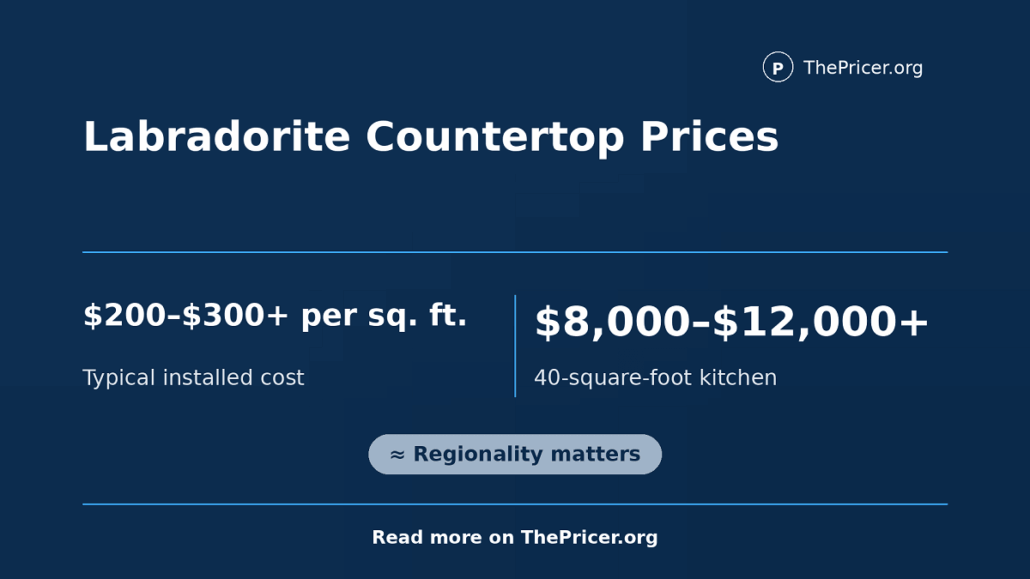
Labradorite countertops typically cost $200 to $300+ per square foot installed. A 30-square-foot kitchen may cost $6,000 to $9,000+, while a 40-square-foot project commonly costs $8,000 to $12,000+.
A large island with premium blue-green flash, waterfall panels, bookmatched sections, complex edges, or multiple cutouts can cost $12,000 to $20,000+. Highly desirable slabs may also require buying more material than the countertop’s measured square footage because of defects, layout priorities, seams, and slab yield.
The slab alone may cost about $60 to $180+ per square foot. Templating, fabrication, polishing, sink and cooktop cutouts, reinforcement, freight, installation, and waste create the difference between the raw stone price and the finished countertop bill.
Article Highlights
Jump to sections
- Labradorite countertops commonly cost $200 to $300+ (at $30 per hour, earning that amount would take about 0.8 to 1.3 full-time workdays, before taxes) per square foot installed.
- A typical kitchen may cost $6,000 to $12,000+.
- A premium island can cost $10,000 to $20,000+.
- The slab alone may cost $60 to $180+ per square foot.
- Waterfall ends, bookmatching, cutouts, freight, and reinforcement increase the total.
- Slabs should be viewed in person under lighting similar to the finished room.
- Sealing requirements depend on the exact slab rather than a fixed annual schedule.
- Wholesale marketplace prices should not be compared directly with a finished U.S. installation.
Labradorite Countertop Prices
| Project | Typical installed cost | Common scope |
|---|---|---|
| Small bathroom vanity | $2,500 to $6,000+ (about 2.1 to 5 full-time workweeks at $30 per hour) | One slab section, sink cutout, finished edges, and installation |
| 30-square-foot kitchen | $6,000 to $9,000+ | Standard perimeter counters with basic edges and cutouts |
| 40-square-foot kitchen | $8,000 to $12,000+ | Larger layout with seams, sink, cooktop, and backsplash options |
| Large kitchen island | $7,000 to $15,000+ | Premium slab selection, wide overhang, and minimal seams |
| Island with waterfall panels | $12,000 to $20,000+ | Additional slab area, mitered edges, pattern matching, and support |
| Full luxury kitchen | $15,000 to $30,000+ | Several slabs, detailed fabrication, backsplash, and complex installation |
HomeGuide currently estimates that labradorite countertops cost $200 to $300+ per square foot installed, or $6,000 to $12,000+ for an average kitchen. Its slab-only estimate is $60 to $180+ per square foot.
These figures are planning ranges rather than a fixed national price. The available slab, grade, distributor, fabricator, project location, and installation difficulty can move the quote considerably.
What Labradorite Stone Is

Labradorite is a calcium-rich plagioclase feldspar mineral. Its defining visual property is labradorescence, an optical effect that creates blue, green, gold, and turquoise flashes as the light source or viewing angle changes.
Mindat classifies labradorite as an intermediate member of the albite-anorthite feldspar series in its mineral reference entry.
Countertop slabs marketed as Labradorite, Lemurian Blue, Blue Australe, Madagascar Blue, or Labradorite Blue are not necessarily uniform blocks of jewelry-grade labradorite. They are natural architectural stones containing large feldspar crystals that produce the desired optical effect.
Suppliers may classify the same or similar commercial material as granite, exotic granite, labradorite stone, or luxury stone. The exact geological classification matters less to the project than the slab’s performance, treatment, condition, and fabrication requirements.
Lemurian Blue and Madagascar Stone
Many of the dramatic countertop slabs sold as Lemurian Blue come from Madagascar. Ziche Marmi describes Lemurian Blue as an African labradorite quarried in Madagascar, with blue reflections that appear and fade as the viewer moves.
Acemar Stone similarly describes its 2-centimeter Lemurian Blue slab as a Madagascar stone with blue, green, black, and turquoise iridescence on its current slab listing.
Trade names are not standardized grading systems. One distributor’s “Extra,” “Ultra,” or “Premium” grade may not match another supplier’s definition.
Buyers should compare the actual slabs rather than relying only on the commercial name or a small showroom sample.
Slab Price vs Installed Price
A raw slab quote does not cover a completed countertop. The installed price can include:
- Slab purchase
- Freight to the distributor or fabricator
- Site measurement and digital templating
- Slab layout and cutting
- Edge fabrication and polishing
- Sink, faucet, and cooktop cutouts
- Seam preparation
- Reinforcement around openings
- Delivery to the home
- Installation and final adjustment
- Sealer or surface treatment when required
An online wholesale offer may exclude crating, ocean freight, customs charges, domestic delivery, breakage risk, inspection, fabrication, and installation. It may also require a large minimum order.
For that reason, low overseas marketplace figures such as $10 to $20 (about 20 to 40 minutes at $30 per hour) per square foot should not be presented as a realistic consumer countertop price.
Slab Yield Changes the Budget
A project may measure 35 square feet but require far more than 35 square feet of slab material. Sections must be placed around natural fissures, repaired areas, edge damage, sink cutouts, grain direction, and the strongest blue flashes.
Fabricators also need cutting space between pieces. A waterfall edge or bookmatched installation may require using specific adjacent areas of the slab instead of maximizing raw yield.
Some suppliers sell only complete slabs. A homeowner needing a 24-square-foot island may therefore pay for a 50- or 60-square-foot slab.
Any usable remnant remains valuable, but its resale value is uncertain. Ask whether the homeowner owns the remaining material and who will store it.
ThePricer 35-Square-Foot Example
Consider a 35-square-foot kitchen island using one premium slab:
- Labradorite slab: $5,800
- Freight and handling: $650
- Digital template and slab layout: $450
- Fabrication and polishing: $2,400
- Sink and faucet cutouts: $550
- Delivery and installation: $1,350
- Steel support for the overhang: $700
The total is $11,900, equal to $340 per measured square foot.
ThePricer calculation: the $5,800 slab represents only 48.7% of the finished total. Fabrication, transportation, cutouts, support, and installation add another $6,100.
A quote based only on the slab would understate the completed project by approximately 105%.
Large Island Cost
A 10-foot-long island does not have one standard square footage. A 10-by-3-foot top measures 30 square feet, while a 10-by-4-foot island measures 40 square feet before edge buildup or waterfall panels.
At $200 to $300 per square foot, a basic 30-square-foot island costs about $6,000 to $9,000. A 40-square-foot version costs $8,000 to $12,000.
A pair of waterfall ends measuring four by three feet each adds another 24 square feet of visible stone. The full stone area could then reach 64 square feet, creating a planning range of $12,800 to $19,200+.
Fabrication Complexity
Labradorite-bearing slabs can contain natural fissures, resin-filled areas, mesh reinforcement, pits, and large mineral crystals. The fabricator must decide where to place seams and cutouts without weakening or visually disrupting the best parts of the slab.
Natural Stone Institute guidance notes that many granite slabs receive factory resin treatment to fill microfissures and minor surface characteristics. Its stone-treatment guidance explains that resin treatment and field-applied sealer are different processes.
Common fabrication upgrades include:
- Waterfall panels
- Bookmatched seams
- Mitered built-up edges
- Curved sections
- Drain grooves
- Undermount sink polishing
- Cooktop and outlet cutouts
- Steel rodding or reinforcement
Each opening reduces the continuous stone surrounding it. Sink and cooktop placement should be planned with the fabricator before the slab is cut.
Lighting and Slab Orientation
Labradorescence changes with direction and light. A slab that flashes brightly under vertical showroom lighting may appear darker when installed beside a window or beneath warm pendant lights.
View the entire slab while standing at several angles. Ask the fabricator to photograph or digitally map the planned cut locations before production.
Rotating one section can change the visible color even when both pieces came from the same slab. This is especially noticeable at seams and waterfall corners.
Lighting should therefore be considered during layout, not only after installation.
Seams and Bookmatching
Large islands may require more than one slab. The seam position affects both appearance and structural performance.
A conventional seam may interrupt the blue flash or dark background. Bookmatching uses adjacent slab faces to create a mirrored pattern, but it requires compatible slabs and can increase material waste.
Ask to approve a digital slab layout showing the sink, cooktop, seams, edges, and waterfall sections. Verbal promises about “matching the pattern” are difficult to evaluate after the material has been cut.
Cabinet and Overhang Support
Natural stone is heavy. Existing cabinets must be level, properly secured, and capable of supporting the slab, appliances, overhangs, and normal loads.
Wide islands and long overhangs may need steel plates, brackets, corbels, or another engineered support system. Natural Stone Institute countertop resources address cabinet conditions, allowable spans, cantilevers, sink mounting, reinforcement, and other countertop installation requirements.
The support plan should be established before the slab is fabricated. Decorative knee space does not eliminate structural requirements.
Floor framing may also need evaluation for an unusually large island, especially when thick built-up edges, waterfall panels, stone backsplashes, or heavy appliances are combined.
Delivery and Access
A large slab section can be difficult to move through narrow doors, stairways, elevators, and finished rooms. Restricted access can require additional labor, special lifting equipment, temporary railing removal, or dividing the countertop into more pieces.
Installers should inspect:
- Door and hallway width
- Stairs and turns
- Elevator size and capacity
- Driveway and loading access
- Finished floor protection
- Cabinet readiness
- Space for lifting and rotating the slab
Damage during transport is particularly costly when a replacement slab has different coloring or labradorescence.
Care and Sealing
Clean labradorite countertops with warm water, mild dish detergent, stone soap, or a pH-neutral natural-stone cleaner. Use a soft cloth and wipe spills promptly.
The Natural Stone Institute advises against acidic cleaners, abrasive powders, and products containing lemon, vinegar, or similar acids in its current natural-stone care guidance.
Sealing does not make stone stain-proof. It can make an absorbent stone more stain resistant. Some stones need sealing, while others do not.
Do not automatically reseal once every year. Ask the fabricator whether the exact slab has been resin treated, how absorbent it is, which sealer is compatible, and how to test whether resealing is needed.
Use cutting boards and trivets. These practices protect the polish, seams, resin-filled areas, and surrounding finishes even when the stone itself tolerates heat or scratching reasonably well.
Potential Slab Problems
Natural fissures are different from impact cracks, but the distinction may be difficult for a consumer to judge. Examine the slab for repaired fissures, mesh backing, filled pits, resin, edge damage, warping, and color inconsistencies.
Ask whether any repaired area will fall near:
- The sink opening
- The cooktop opening
- A narrow bridge of stone
- An exposed overhang
- A mitered waterfall corner
- A heavily used preparation area
The contract should explain responsibility if the slab breaks during fabrication or installation and whether an acceptable replacement is available.
Labradorite vs Other Countertops
| Material | Typical installed price | Main difference |
|---|---|---|
| Labradorite | $200 to $300+ | Strong iridescence, limited availability, and complex slab selection |
| Granite | $43 to $140 | Broader availability and lower average price |
| Quartzite | $65 to $150 | Natural stone with marble-like patterns and wider sourcing |
| Quartz | $50 to $200 | Engineered consistency and no routine sealing |
Home Depot currently places installed granite around $43 to $140 per square foot. Standard granite is therefore usually far less expensive than premium labradorite.
HomeGuide estimates quartzite at $65 to $150 per square foot installed. Quartzite can offer dramatic natural movement without the same degree of blue-green iridescence.
Homeowners comparing branded engineered stone can review current Cambria countertop costs, while a lower-cost renovation may use Formica countertops.
Is Labradorite Worth It?
Labradorite can be worthwhile when the homeowner values the exact slab as a functional art piece and has enough budget for careful fabrication.
It is less suitable when the project requires strict color consistency, easy slab replacement, a low price, or minimal involvement in layout and maintenance.
The material should not be purchased on the assumption that it will return its full cost at resale. Its dramatic appearance can attract some buyers and discourage others.
For many projects, using labradorite only on an island or bar creates the desired focal point while less expensive stone covers the perimeter counters.
How to Compare Quotes
Each quote should identify the actual slab, total slab quantity, measured countertop area, thickness, finish, edge profile, cutouts, seams, reinforcement, freight, installation, sealer, tax, and warranty.
Ask whether:
- The quoted slab has already been reserved
- The price is for a full slab or measured square footage
- Unused remnants belong to the homeowner
- The fabricator has worked with similar material
- Slab layout approval is included
- Breakage responsibility is written into the contract
- Cabinet or steel support is included
Compare the same scope between fabricators. A lower quote may exclude freight, reinforcement, installation, or the premium slab shown during selection.
What We Verified
- Checked current installed and slab-only labradorite price ranges.
- Confirmed the mineral identity and labradorescence of labradorite.
- Verified Madagascar as a source of Lemurian Blue architectural stone.
- Distinguished trade names from standardized stone grades.
- Reviewed resin treatment, sealing, and cleaning guidance.
- Checked structural-support and countertop-installation resources.
- Compared current granite, quartzite, and quartz pricing.
- Removed misleading wholesale marketplace pricing from the main estimate.
Answers to Common Questions
How much does a labradorite countertop cost?
Most projects cost $200 to $300+ per square foot installed. A typical kitchen may cost $6,000 to $12,000+.
How much does a labradorite slab cost?
A slab may cost approximately $60 to $180+ per square foot before freight, fabrication, cutouts, delivery, and installation.
Is Lemurian Blue the same as labradorite?
Lemurian Blue is a commercial name commonly used for Madagascar stone containing large iridescent labradorite crystals. Suppliers may also classify it as an exotic granite.
Does labradorite need sealing?
Possibly. The need depends on the exact slab, absorption, resin treatment, and finish. Follow the fabricator’s testing and product recommendations rather than sealing automatically every year.
Can labradorite be used in a kitchen?
Yes, when the selected slab is suitable, correctly fabricated, supported, installed, and maintained. Inspect repaired fissures and plan sink, cooktop, seams, and overhangs carefully.
Why is labradorite so expensive?
The price reflects limited premium slab supply, high visual grading, freight, material waste, fabrication risk, layout complexity, and specialized installation.
Disclosure: Educational content, not financial advice. Prices reflect public information as of the dates cited and can change. Confirm current rates, fees, taxes, and terms with official sources before purchasing. See our methodology and corrections policy.