
How Much Does a Carefree Boat Club Membership Cost?
Updated on | Written by Alec Pow
This article was researched using 8 sources. See our methodology and corrections policy.
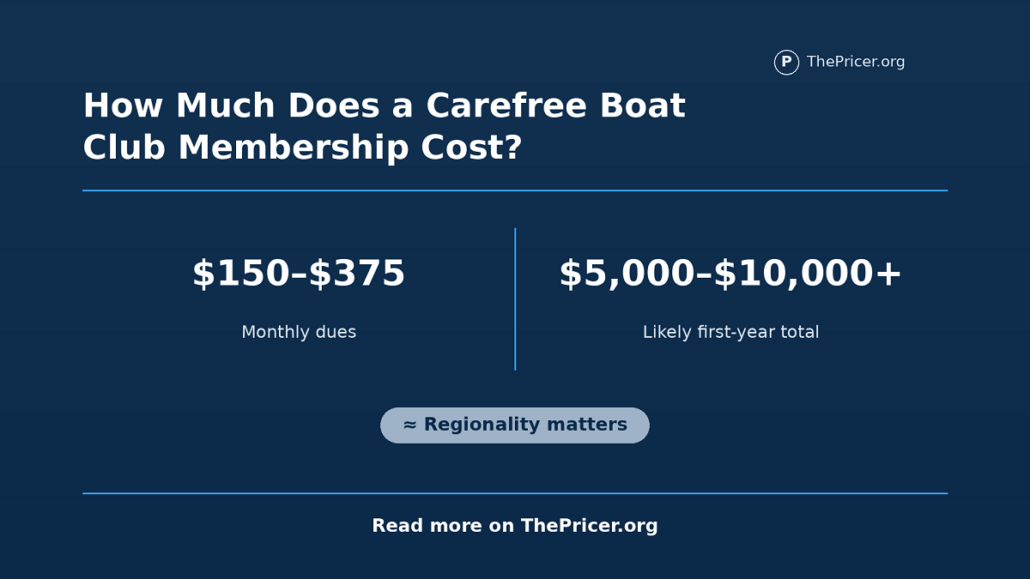
Carefree Boat Club membership commonly costs a one-time initiation fee plus about $150 to $375 per month, although every franchise sets its own plans and prices. A realistic first-year total is often $5,000 to $10,000+ after the joining fee, dues, fuel, taxes, and any local charges. Some locations use annual membership plans instead of a large initiation fee, so two Carefree clubs may quote very different payment structures.
The membership covers access to a local boat fleet, routine maintenance, cleaning, storage, insurance on club boats, dock operations, and initial on-water training. It does not give the member ownership of a boat. Fuel remains an added usage cost, and a member who damages a boat may owe a deductible or location-specific repair charges.
Carefree Boat Club is a franchise network, not one nationally priced membership. Fleet size, boating season, local marina costs, membership tier, reciprocal privileges, reservation rules, and contract length all affect what a member pays.
Article Highlights
Jump to sections
- Monthly dues commonly run about $150 to $375.
- Most locations also charge a one-time initiation fee, commonly reported around $3,000 to $6,000.
- A likely first-year total is $5,000 to $10,000+ before heavy fuel use or damage.
- Fuel is normally charged after each outing based on what the member used.
- Damage deductibles can reach several thousand dollars under local agreements.
- Reservations can generally be made up to six months ahead, subject to plan and fleet availability.
- Reciprocal boating is useful but may have half-day limits, training requirements, and separate local rules.
How Much Does a Carefree Boat Club Membership Cost?
| Membership cost | Expected amount | How it is charged |
|---|---|---|
| Initiation fee | $3,000 to $6,000+ | One-time joining payment at many locations |
| Monthly dues | $150 to $375 | Recurring dues based on plan and market |
| Annual-plan membership | $4,000 to $7,000+ | Used by some franchises instead of a large initiation fee |
| Fuel | $50 to $250+ per outing | Depends on boat, engine, speed, trip length, and fuel price |
| Damage deductible | Up to $2,500 to $5,000 at some clubs | Applies when the member is responsible for damage |
| Optional damage protection | About $275 per year in one published club example | May reduce the deductible, subject to exclusions |
| No-show or service charges | $25 to $250+ | Location-specific handbook charges |
Carefree Boat Club Eastern Connecticut currently places its monthly dues between $150 and $375, depending on membership level and seasonal promotions. The national Carefree Boat Club FAQ confirms that most locations charge a one-time initiation fee and an annual membership fee that may be paid monthly, but it directs buyers to their nearest club for an exact quote.
The joining fee is harder to verify nationally because most franchises do not publish it. Reported current and recent quotes commonly fall around $3,000 to $6,000, but a high-cost boating market, premium fleet, discounted promotion, weekday plan, or annual-only structure can move outside that range. The quote should identify whether the initiation fee is refundable, transferable, financed, discounted, or waived under a temporary promotion.
First-Year and Multi-Year Totals
A member paying a $4,000 initiation fee and $300 per month spends $7,600 during the first year before fuel. In year two, the same dues total $3,600, assuming the rate does not change. Four years of membership would cost $18,400 before fuel, taxes, protection plans, and contract-specific charges.
Usage changes the real cost. Twelve outings using $100 of fuel each add $1,200 per year, raising the first-year example to $8,800. Twenty-four outings using the same amount add $2,400, for a total of $10,000. The club price is fixed enough to plan, but the boating pattern controls the final amount.
ThePricer calculates the effective membership cost per outing at different usage levels. The $7,600 first-year membership equals $633 per trip when used 12 times, $317 per trip at 24 outings, and $158 per trip at 48 outings. Fuel must still be added. Members who boat frequently receive more value from the fixed dues than people who use the club only several times each summer.
What Membership Includes
Carefree provides the boat, slip or marina arrangement, routine maintenance, cleaning, winterization where required, insurance on club vessels, and dock support. Members reserve a boat, complete the checkout process, use it for the approved session, and return it to staff. The club handles cleaning and refueling after the trip, while the member pays for the fuel consumed.
The company advertises unlimited boating, but unlimited does not mean that every boat is available on demand. Access depends on the membership plan, weather, operating season, reservation inventory, boat downtime, local hours, and how many members want the same model during peak weekends. The national Carefree membership overview describes unlimited usage through its online reservation system rather than guaranteed access to a particular boat at every requested time.
One membership may cover a member and co-member at some locations. Guest rules, passenger limits, age requirements, and who may operate the boat are controlled by the local agreement. Ask whether both adults can reserve and operate boats independently or whether one must remain the primary member.
Training Has Real Value
Carefree says new members begin with an approved boating-safety course and receive one-on-one on-water instruction. Training covers club procedures, navigation, docking, anchoring, local hazards, and operation of different boats in the fleet. Additional instruction may be available without an added fee, though local rules control scheduling and required retraining.
The Los Angeles club FAQ states that members receive training with a National Safe Boating Council-certified instructor and may request further instruction at no extra cost. This can be valuable for a new boater who would otherwise pay separately for lessons before safely handling a larger pontoon, center console, bowrider, or wake boat.
Training does not remove the member’s responsibility once the boat leaves the dock. The operator remains responsible for passengers, navigation, weather decisions, fuel management, safe speed, grounding risk, and damage that occurs during the outing.
Fuel Is the Main Usage Cost
Carefree’s national FAQ says the normal added cost per trip is the fuel used. The boat is provided ready for the outing, dock staff refuel it after return, and the member pays the marina. There is no ordinary hourly rental fee on top of membership dues.
Fuel use varies sharply by boat and behavior. A slow pontoon cruise may consume much less than watersports, offshore running, or operating a twin-engine boat at high speed. Suppose a boat burns 8 gallons per hour and the member runs it for four hours. At $5 per gallon for marina fuel, the outing costs $160. A boat burning 18 gallons per hour over the same run costs $360.
Members who choose larger vessels because the membership price appears fixed can be surprised by the fuel bill. Ask the dock staff for the normal gallons-per-hour range of each boat and whether the club charges the marina pump price, a posted club rate, sales tax, or another refueling amount.
Damage Is Not Fully Covered
The club pays for routine maintenance and mechanical failures that arise through normal use. That does not mean a member can damage a boat without financial exposure. Carefree’s national FAQ says members are generally responsible for the insurance deductible when they damage a vessel.
The network’s published membership rights and responsibilities allows responsibility for a deductible up to $3,500 under that agreement and authorizes charges for fuel, repairs, service fees, dues, and damage to the payment card on file. Individual franchises can use different deductibles and rules.
A Southern Connecticut member handbook uses a maximum damage exposure of $5,000 in several situations. It also lists example charges such as $250 for an aluminum propeller, $850 for a stainless-steel propeller, $350 for a skeg, and as much as $5,000 for a lower unit. Its optional $275-per-year supplemental coverage can reduce the deductible under qualifying circumstances, but exclusions apply.
These local terms should not be treated as universal Carefree pricing. They show why the damage section of the contract matters. Ask about grounding, propeller damage, towing, gelcoat scratches, missed inspection findings, guest-caused damage, theft of equipment, deductibles at reciprocal clubs, and loss-of-use charges.
Reservation Limits Matter
Carefree allows reservations through ResNet up to six months in advance. Some plans permit members to hold as many as four future reservations at one time. Once an outing is completed, another reservation slot becomes available. Short-notice boats may also be offered by the dockmaster without using an advanced reservation slot.
The DMV-area Carefree FAQ describes up to four advanced reservations depending on plan type and allows spur-of-the-moment bookings when boats are open. This is not the same as having four boats booked for every Saturday of the season, since local rules may restrict peak-period reservations, consecutive sessions, boat categories, or holiday use.
Availability should be tested before joining. Ask the salesperson to show real reservation inventory for several warm Saturdays, not only weekday availability during the sales visit. Also ask how many boats serve the club, how many members share them, what happens when a vessel is out for repair, and whether weather cancellations preserve the reservation slot.
Reciprocal Access Has Conditions
 Carefree advertises access to roughly 145 locations across North America, Central America, and the Caribbean. The current club location directory is more reliable than reproducing a long list that quickly becomes outdated.
Reciprocal boating is not necessarily identical to using the home club. Published handbook rules require members to complete an approved boating certificate, record at least five incident-free home-club outings, and make reciprocal reservations through ResNet. Reciprocal trips may be limited to half-day sessions and may not be available as spur-of-the-moment outings.
The hosting club can apply its own fleet, seasonal, training, fuel, deductible, and reservation rules. A member planning vacations around reciprocity should ask how many visits are included each year, whether the limit applies per club or across the network, what boats are excluded, and how early visitors may reserve.
Membership vs Boat Ownership
Carefree removes the purchase price, loan, marina slip, trailer, registration, routine maintenance, storage, winterization, cleaning, and much of the scheduling work connected with ownership. Those avoided costs can be substantial. Owners who keep a vessel at a marina can compare club dues with current boat storage costs, especially in coastal markets where seasonal slips and winter storage can consume thousands of dollars each year.
Ownership provides control that membership does not. The owner can leave personal gear aboard, modify electronics, fish before club opening hours, stay overnight, travel for several days, tow to new waterways, and use the boat whenever weather permits. The owner also builds resale value, though depreciation and selling expenses reduce the recovery.
Repairs are the largest ownership wildcard. A fiberglass collision, wet core, engine failure, upholstery replacement, or electronics problem can create a large unexpected invoice. Current fiberglass boat repair prices show why transferring routine maintenance and most vessel repair work to the club appeals to occasional boaters.
Membership vs Boat Rental
Renting can cost less for someone who boats only a few times per year. Suppose a suitable rental costs $600 per day. Four outings cost $2,400, while eight outings cost $4,800. A first-year Carefree bill of $7,600 does not beat those totals before fuel.
At 16 rental days, the same rental rate reaches $9,600. The membership may then cost less, while also providing training, several boat types, and easier repeat reservations. Rental prices, deposits, insurance options, delivery, and hourly limits still need to be compared with the club’s actual contract.
A club is usually strongest for a household that expects frequent day trips but does not need one specific vessel. Rental can be better for occasional outings. Ownership may suit someone who wants unrestricted access, overnight trips, extensive fishing equipment, or a customized boat.
Contract Terms Before Signing
The sales presentation should be followed by a complete written agreement. Read the initial term, automatic renewal, cancellation deadline, transfer rights, suspension rules, late fees, financing terms, dues increases, initiation-fee treatment, and what happens if the member moves away or becomes medically unable to boat.
Carefree’s published rights and responsibilities permit late charges, suspension of reservations for unpaid balances, automatic card charges, and acceleration of some remaining amounts after default under the applicable agreement. Those provisions make the membership more than a month-to-month recreation subscription.
Ask for the total owed through the end of the initial term rather than focusing only on monthly dues. A $300 monthly payment tied to a 36-month commitment represents $10,800 in dues, plus the initiation fee. The ability to cancel after several months cannot be assumed unless the contract states it.
Three Member Scenarios
Occasional summer boater: A member pays $4,000 to join and $300 per month, then takes 10 trips using $100 of fuel each. The first-year total is $8,600, or $860 per outing. Renting may be cheaper at that usage level.
Frequent local member: The same plan is used 36 times, with average fuel of $85 per outing. Membership costs $7,600, fuel costs $3,060, and the total is $10,660. The effective cost is about $296 per boating day.
Long-term family member: A household keeps the membership for five years. The initiation fee is $4,000, and unchanged dues of $300 per month total $18,000. The five-year membership cost is $22,000 before fuel. At 30 outings per year, the fixed membership portion averages about $147 per outing.
When Carefree Makes Sense
Makes sense if:
- The household expects to boat at least once or twice per month during the operating season.
- Members value access to several boat types rather than one personally configured vessel.
- Marina storage, winterization, cleaning, and routine repairs are unwanted burdens.
- The local fleet has enough availability during the days the member actually wants to boat.
- The member accepts the damage deductible and reservation rules.
Does not make sense if:
- The household expects only a few outings each year.
- The member needs overnight trips, unrestricted departure times, or permanent gear storage.
- The initiation fee requires financing while the long-term dues strain the budget.
- The local fleet lacks the desired fishing, wake, pontoon, or offshore boats.
- The contract term, cancellation language, or damage exposure is unclear.
What We Verified
- Checked current monthly pricing against the named Eastern Connecticut Carefree membership guide.
- Confirmed that the normal added trip cost is fuel through Carefree’s national FAQ.
- Cross-referenced reservation timing and plan-based limits through the DMV club FAQ.
- Verified deductible and member-charge exposure through Carefree’s published rights and responsibilities.
- Checked reciprocal-access prerequisites and half-day limits against the current member handbook.
Answers to Common Questions
How much is Carefree Boat Club per month?
Published current dues commonly run $150 to $375 per month. The initiation fee, membership tier, location, and promotions change the final quote.
Does Carefree Boat Club charge an initiation fee?
Most clubs charge a one-time initiation fee in addition to annual dues. A planning range is about $3,000 to $6,000, but the local franchise must provide the current amount.
Is fuel included in Carefree membership?
No. The club normally refuels the boat after the outing and charges the member for the fuel consumed.
What happens if a member damages a boat?
The member may owe repair costs up to the insurance deductible and can face suspension or retraining. Published deductibles vary by franchise and agreement.
Can members use Carefree boats while traveling?
Yes, through the reciprocal network, but outside-club reservations can have training, outing-history, half-day, availability, and local-rule restrictions.
Disclosure: Educational content, not financial advice. Prices reflect public information as of the dates cited and can change. Confirm current rates, fees, taxes, and terms with official sources before purchasing. See our methodology and corrections policy.