
How Much Does CarShield Cost?
Updated on | Written by Alec Pow
This article was researched using 10 sources. See our methodology and corrections policy.
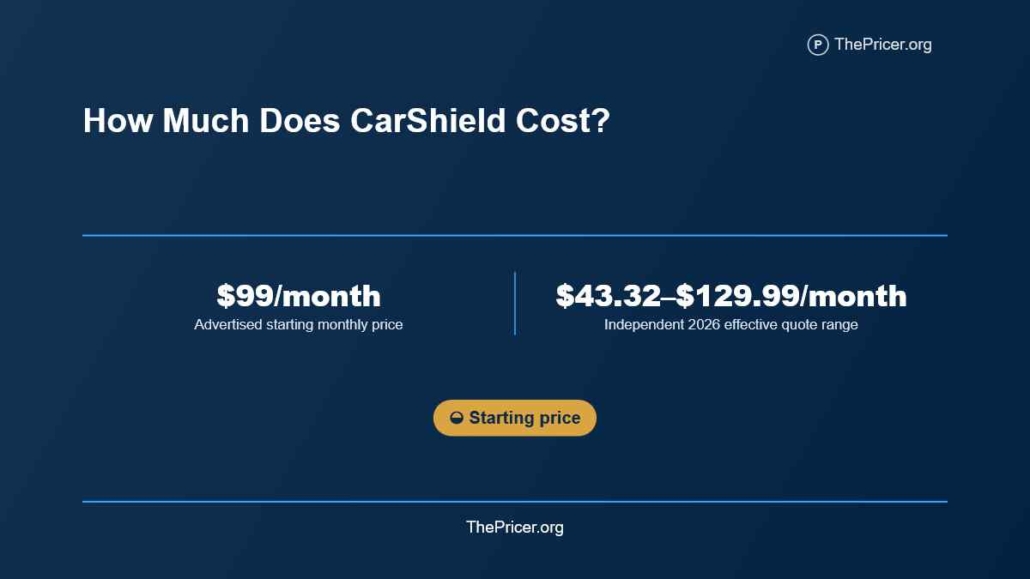
CarShield currently advertises vehicle service plans starting at $99 per month, but there is no single CarShield price for every vehicle. Your quote depends on the vehicle’s year, make, model, mileage, coverage level, payment structure, and deductible. Independent 2026 research found effective CarShield quotes ranging from about $43.32 to $129.99 per month in three mystery-shop examples after accounting for quoted down payments and likely contract terms.
At the advertised $99 monthly starting point, one year of coverage costs $1,188 before any deductible. If your contract carries a $250 deductible, a year with one covered repair could involve at least $1,438 in premiums and deductible before considering excluded items or other charges.
CarShield coverage is a vehicle service contract, not ordinary auto insurance and not the original manufacturer’s warranty. CarShield markets and sells contracts, while American Auto Shield administers many of the contracts and claims and is currently identified by CarShield as a CarShield company.
Article Highlights
Jump to sections
- CarShield currently advertises plans starting at $99 (at $30 per hour, earning that amount would take about 3.3 hours of work, before taxes) per month.
- At that price, 12 months costs $1,188 before deductibles.
- Independent 2026 research found effective quotes of $43.32, $51.65, and $129.99 per month for three different vehicles.
- Quoted deductibles in those examples ranged from $250 to $1,000 depending on the vehicle, repair, and timing.
- Current plans include Diamond, Platinum, Gold Select, Silver, Aluminum, Motorcycle/ATV, and Electric Vehicle coverage.
- Mechanical-breakdown coverage may have a waiting period. One current sample term contract specifies 30 days + 1,000 miles OR 90 days + 200 miles.
- Repairs normally require authorization before work begins.
- CarShield and American Auto Shield agreed to pay $10 million in 2024 to settle FTC allegations involving deceptive vehicle-service-contract advertising.
How Much Does CarShield Cost?
| CarShield pricing example | Effective monthly cost | 12-month equivalent | Quoted deductible |
|---|---|---|---|
| CarShield advertised starting price | $99.00 (about 3.3 hours of work at $30 per hour) | $1,188.00 | Contract-specific |
| 2025 Toyota SUV, 5,000 miles | $43.32 | $519.84 | $250, or $500 for engine/transmission replacement |
| 2025 Audi sedan, 7,000 miles | $51.65 | $619.80 | $500 |
| 2017 Honda sedan, 80,000 miles | $129.99 | $1,559.88 | $1,000 initially, then $250 under the quoted terms |
CarShield’s current pricing page says monthly cost is based on the vehicle’s year, make, model, and mileage and advertises prices starting as low as $99 per month.
NerdWallet’s August 2026 CarShield review and mystery shopping found much more variation. Its adjusted Diamond-plan examples were $43.32 per month for a 2025 Toyota SUV, $51.65 for a 2025 Audi sedan, and $129.99 for a 2017 Honda sedan with 80,000 miles.
Those figures should not be treated as menu prices. They demonstrate why a CarShield article based on old anonymous quotes such as “$145 for a Silverado” becomes stale quickly. Two people asking for the same coverage level can receive very different pricing because the expected repair risk differs.
Current Plan Options

CarShield’s current sample-contract library uses a different plan lineup from the older New Car, Power Train, Power Train+, and Comprehensive categories.
Diamond is the broadest conventional option. It is structured more like exclusionary coverage, meaning the contract describes covered vehicle systems broadly while listing items and situations that are excluded. CarShield describes it as its closest option to a new-car manufacturer’s warranty.
Platinum is a stated-component plan aimed particularly at higher-mileage vehicles. Covered systems can include the engine, transmission, air conditioning, electrical system, starter, water pump, and fuel pump, subject to the contract.
Gold Select adds several systems beyond basic powertrain protection and is marketed toward vehicles with more than 100,000 miles.
Silver is the more basic powertrain plan, focused mainly on engine, transmission, drive components, and other listed mechanical parts.
Aluminum focuses more heavily on electrical and computer-related components, including items such as control modules, navigation electronics, and other listed systems.
Separate contracts are offered for motorcycles and ATVs as well as electric vehicles. Current EV options can include the electric drive unit, electrical systems, and, under certain contracts, the high-voltage battery pack.
CarShield currently advertises potential eligibility for vehicles with up to 300,000 miles. Its current protection-plan disclosures also state that coverage is not offered directly in California, although consumers there may be referred to a licensed California mechanical-breakdown insurer.
Break-Even Math
A service contract should not be judged by whether it eventually pays for one repair. Compare what you pay into the contract with the covered repair costs it actually pays.
Case 1: advertised $99 (about 3.3 hours of work at $30 per hour) plan. Twelve monthly payments total $1,188. Add a hypothetical $250 deductible on one approved repair and the customer has spent $1,438. A covered repair would need to exceed that amount before this simple one-year comparison starts favoring the contract.
Case 2: newer Toyota quote. The published effective quote of $43.32 per month equals $519.84 per year. Add the quoted $250 deductible and the simple first-repair threshold becomes $769.84. An engine or transmission replacement carried a higher quoted $500 deductible, putting that calculation at $1,019.84.
Case 3: older Honda quote. At $129.99 per month, 12 months totals $1,559.88. Using the normal quoted $250 deductible gives $1,809.88. During the period when the quote carried a $1,000 deductible, the same premium-plus-deductible comparison reaches $2,559.88.
The repair numbers matter because a single mechanical failure can cross those thresholds. For comparison, a current starter replacement commonly costs $500 to $850, while a major transmission replacement can exceed $6,000.
A $700 starter repair would not make a $1,188 annual premium financially profitable by itself. An approved $6,000 transmission failure could. The complication is that the actual covered amount depends on your contract, deductible, exclusions, authorization, repair cost limits, and the cause of failure.
Deductibles and Waiting Periods
The monthly premium is only the visible price. A deductible can materially change the cost of using the contract.
NerdWallet’s mystery-shopping quotes included deductibles of $250 for a Toyota, $500 for an Audi, and an initial $1,000 deductible on an older Honda. That is why two CarShield plans with similar monthly payments may still have very different economics when a breakdown occurs.
Coverage also may not begin immediately. One current American Auto Shield Diamond term sample contract states that mechanical-breakdown coverage begins after either 30 days and 1,000 miles or 90 days and 200 miles from the effective date. That sample separately states that roadside protection has no waiting period.
Waiting periods vary by contract, so the numbers printed on the customer’s declarations page control. A breakdown caused by a condition that existed before coverage became effective may also be excluded.
Other costs can remain with the owner even after a claim is approved. CarShield states that exclusions and deductibles apply, and that replacement parts may include parts of like kind and quality, including remanufactured parts.
This makes the contract particularly important for repairs involving expensive parts such as the transmission, air conditioning, starter, electrical modules, or fuel-system components. A component appearing in a marketing list does not mean every possible failure involving that component is automatically payable.
How Claims Work
A vehicle service contract is most useful when the owner understands the claim process before the car breaks down.
CarShield’s current claim instructions tell customers to take the vehicle to a repair facility for diagnosis and have the repair facility contact the claims department before repair work is performed. Covered claims are then paid to the repair facility, while the customer remains responsible for the deductible and any amount that is not authorized or covered.
CarShield currently operates a Shield Repair Network with more than 15,000 facilities. Customers may also seek help coordinating with an out-of-network facility.
The company’s current consumer guidance says customers can use an ASE-certified repair facility that accepts CarShield. The words “that accepts CarShield” matter. A repair shop is not required to participate simply because it is licensed or ASE-certified.
Rental-car benefits also are not the same as receiving an automatically free rental whenever the vehicle breaks down. CarShield says rental eligibility depends on the specific contract and an eligible claim. Customers may obtain a rental and then receive reimbursement for expenses covered by the contract.
Some sample contracts tie rental eligibility to at least four authorized labor hours, cap the amount paid per day, and restrict the number of covered rental days. The declarations page and endorsements establish the actual limits.
Do not authorize a shop to perform thousands of dollars of repairs first and expect reimbursement afterward. Sample CarShield-administered contracts state that claims require prior authorization.
The FTC Settlement Matters
Consumers evaluating CarShield should know about its recent regulatory history rather than relying only on testimonials and advertising.
In July 2024, the Federal Trade Commission announced that CarShield and American Auto Shield had agreed to pay $10 million to settle FTC allegations that vehicle-service-contract advertising and telemarketing were deceptive or misleading.
The FTC alleged, among other things, that advertisements created misleading impressions about whether repairs would be covered, whether customers could use the repair facility of their choice, and whether customers would receive rental cars at no cost. The settlement also imposed requirements intended to prevent deceptive claims and require truthful endorsements.
The matter did not disappear after the settlement. In December 2025, the FTC announced that it was sending more than $9.6 million to 168,179 consumers who had purchased qualifying CarShield contracts between September 2019 and September 2024 and had a claim denied.
This history does not mean that every current CarShield claim will be denied or that every contract is a bad purchase. It does mean buyers have a strong reason to rely on the written contract rather than advertising language when deciding what is actually covered.
When This Cost Makes Sense
Makes sense if:
- Your vehicle is outside its manufacturer warranty and a major covered breakdown would be difficult to pay for from savings.
- Your specific quote has a premium and deductible that compare favorably with the repair risk of your vehicle.
- You have read the actual sample contract and understand which parts and failure causes are excluded.
- You are comfortable following the prior-authorization process before repairs begin.
- A repair facility you would realistically use accepts the contract.
- You value roadside assistance and eligible rental or rideshare reimbursement in addition to repair coverage.
Does not make sense if:
- Your vehicle still has substantial manufacturer or certified-pre-owned warranty coverage.
- You can comfortably self-fund repairs and prefer to keep the monthly premium in your own repair reserve.
- Your quote carries a high deductible that pushes the break-even repair well above the failures you are most likely to encounter.
- The systems you are most worried about are excluded or only partly covered.
- You expect routine maintenance, brake pads, tires, and other wear items to be paid like mechanical breakdowns.
A simple alternative is to create your own repair fund. Saving the advertised $99 per month produces $1,188 after one year, $2,376 after two years, and $3,564 after three years, assuming the money is not spent elsewhere. CarShield transfers some large-repair risk away from the owner, while self-funding keeps the money available for repairs whether or not a failure meets a service-contract definition.
What We Verified
- Checked: CarShield currently advertises monthly vehicle protection starting at $99, with pricing based on year, make, model, and mileage.
- Confirmed: the current plan lineup includes Diamond, Platinum, Gold Select, Silver, Aluminum, Motorcycle/ATV, and Electric Vehicle contracts.
- Cross-referenced: current claim instructions require diagnosis and coordination with the administrator before repair work is performed for a normal covered claim.
- Verified: current CarShield-administered sample contracts can contain waiting periods, deductibles, exclusions, rental limits, and prior-authorization requirements.
- Checked: the FTC’s December 2025 refund program sent more than $9.6 million to 168,179 consumers following the 2024 CarShield/American Auto Shield settlement.
Related Car Costs
Roadside benefits are one piece of the contract, so compare them with the standalone cost of AAA roadside assistance before paying for overlapping coverage. Major mechanical repairs deserve the same comparison. A starter replacement can remain below one year’s CarShield cost, while a transmission replacement can run several times higher.
Answers to Common Questions
How much is CarShield per month?
CarShield currently advertises coverage starting at $99 per month. Actual quotes vary by vehicle and contract. Independent 2026 research found effective monthly examples from $43.32 to $129.99.
How much does CarShield cost per year?
At the advertised $99 monthly starting price, 12 months costs $1,188. A quote of $129.99 per month costs $1,559.88 per year before deductibles.
Does CarShield have a deductible?
It can. The deductible is contract-specific. Recent mystery-shopping examples included $250, $500, and $1,000 deductibles under different circumstances, so check the declarations page rather than assuming a $100 or $250 standard deductible.
Does CarShield cover every repair?
No. Coverage is determined by the vehicle service contract. Exclusions, preexisting conditions, maintenance requirements, covered-component definitions, deductibles, and authorization rules can all affect whether a repair is payable.
Can I use any mechanic with CarShield?
CarShield says customers can use ASE-certified repair shops that accept CarShield, and it operates a large repair network. An out-of-network shop may also be possible with coordination, but do not assume every mechanic is willing to process the contract.
Is there a waiting period?
There can be. One current Diamond term sample contract uses either 30 days plus 1,000 miles or 90 days plus 200 miles before mechanical-breakdown coverage begins. Your own declarations page controls your waiting period.
Can a CarShield contract be canceled?
Yes, subject to the contract and state rules. A sample monthly-contract cancellation endorsement provides a full initial-term refund in certain circumstances when canceled during the first month and no claim has been made, while later refunds can be prorated and reduced by claims or a stated cancellation fee. Read the cancellation language in the specific contract you are offered.
Disclosure: Educational content, not financial advice. Prices reflect public information as of the dates cited and can change. Confirm current rates, fees, taxes, and terms with official sources before purchasing. See our methodology and corrections policy.