
How Much Does Fuel Injector Cleaning Cost?
Updated on | Written by Alec Pow
This article was researched using 11 sources. See our methodology and corrections policy.
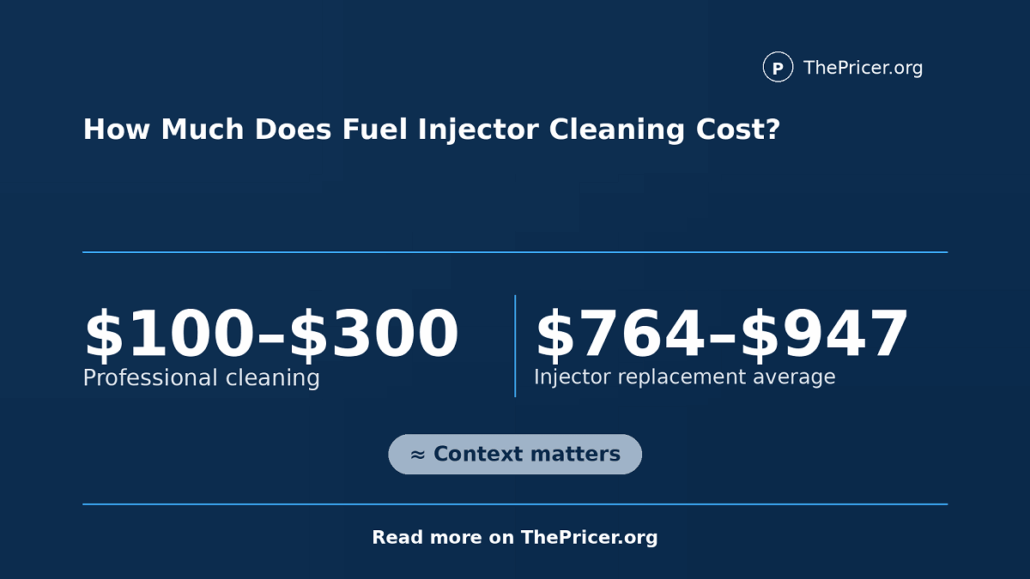
Fuel injector cleaning typically costs about $100 to $300 at a repair shop in 2026. A basic professional cleaning can run around $100, while a more involved pressurized fuel-rail service with throttle-body cleaning commonly costs about $150 to $300. If you only need a pour-in fuel injector cleaner, bottles generally cost $5 to $15.
There is also a fourth option that many price guides miss: removing the injectors and sending them for ultrasonic cleaning, spray-pattern testing, and flow testing. Fuel Injector Clinic currently charges $25 per port injector before removal, reinstallation, and shipping costs through its current injector cleaning service.
The right service depends on whether the injector is actually dirty. Cleaning will not repair a failed electrical coil, leaking injector body, damaged nozzle, or other mechanical failure. Current national fuel-injector replacement costs average $764 to $947, making diagnosis the key step before spending money on either cleaning or replacement.
Article Highlights
Jump to sections
- Professional fuel injector cleaning generally costs about $100 to $300 (at $30 per hour, earning that amount would take about 0.4 to 1.3 full-time workdays, before taxes).
- Pour-in fuel injector cleaner costs about $5 to $15 per bottle.
- Professional pressurized cleaning commonly runs $150 to $300 when throttle-body work is included.
- Removed port injectors can be ultrasonically cleaned and flow-tested for about $25 each before removal and installation labor.
- There is no universal 30,000- or 60,000-mile cleaning interval for every vehicle.
- A failed injector may need replacement rather than cleaning, currently averaging $764 to $947 nationally.
How Much Does Fuel Injector Cleaning Cost?
The phrase “fuel injector cleaning” can describe several very different services. Ask what the shop is doing before comparing prices.
| Cleaning method | Current price | What you get |
|---|---|---|
| Pour-in fuel injector cleaner | $5 to $15 (about 10 to 30 minutes at $30 per hour) | Chemical additive mixed with gasoline in the fuel tank |
| Basic professional injector cleaning | About $100 | Shop-level cleaning aimed at deposits in the fuel system or injectors |
| Pressurized on-car cleaning | $150 to $300 | Concentrated cleaner fed through the fuel rail, often with throttle-body service |
| Ultrasonic cleaning and flow testing | About $25 per port injector | Injector removed, cleaned, tested for spray pattern and flow, then retested |
| Injector replacement | $764 to $947 average | New injector parts plus professional replacement labor |
CARFAX currently puts a typical injector cleaning at around $100 in its fuel injector cost guidance. Cars.com gives a broader $150 to $300 estimate for an on-car cleaning procedure that can include throttle-body cleaning in its injector cleaning analysis.
Jiffy Lube no longer publishes a single nationwide price. Its current fuel system cleaning page asks customers to enter vehicle and location information for pricing and says its service uses multistep cleaners on the fuel system, injectors, and combustion chamber.
What You’re Actually Paying For
A bottle poured into the fuel tank and a professional pressurized cleaning are not cheaper and more expensive versions of exactly the same procedure.
The $5 to $15 (about 10 to 30 minutes at $30 per hour) option is a detergent additive. Cars.com says these products are normally poured into the tank before refueling so they mix with the gasoline. The cleaner travels through the normal fuel system during subsequent driving. Owners should follow the specific product label because concentration and recommended frequency vary.
A professional fuel-rail service uses much more concentrated cleaner. Valvoline’s professional fuel-rail procedure, for example, calls for the vehicle’s fuel pump and return to be disabled or rerouted while shop air pushes cleaner directly through the fuel system at controlled pressure.
Removed-injector service goes further. Fuel Injector Clinic initially tests each injector for leakage, electrical resistance, spray pattern, pulse operation, and flow. The injector is then ultrasonically cleaned while being pulsed and back-flushed before a second flow test. That allows the owner to see whether cleaning actually changed injector performance.
When Cleaning Is Worth Paying For
Professional cleaning makes the most sense when symptoms and diagnosis point toward restricted or dirty injectors rather than a broken component.
Possible signs include rough idle, hesitation, sputtering, poor acceleration, hard starting, misfires, unstable idle speed, or declining fuel economy. CARFAX lists those among the symptoms associated with injector problems, but none is unique to a dirty injector.
A bad ignition coil, worn spark plug, vacuum leak, failing fuel pump, low compression, sensor fault, or electrical injector problem can produce similar behavior. A check-engine light should therefore be scanned and diagnosed before buying a cleaning service.
Injector deposits can have real effects when they are present. Research cataloged by the EPA found that deposits on gasoline direct injectors can change fuel flow and spray characteristics and can increase some emissions. That does not mean every rough-running engine has dirty injectors or that cleaning automatically restores lost fuel economy.
When the Service Is Unnecessary
Kelley Blue Book’s January 2026 guidance is unusually direct: if the vehicle is running normally and the check-engine light is off, the odds are that it does not need a fuel-injector flush. Its current injector flush guidance notes that modern injection systems and detergent gasoline have reduced the need for routine cleaning.
Cars.com reaches a similar conclusion. Routine injector cleaning is generally not listed in manufacturer maintenance schedules, so there is no universal rule requiring the service every 30,000, 50,000, or 60,000 miles.
That makes a mileage-only recommendation a weak reason to spend $150 to $300. Check the vehicle’s maintenance schedule first. If the manufacturer does not specify injector cleaning and the engine has no related symptoms, asking the shop what evidence shows the service is needed can prevent an unnecessary bill.
The same rule applies to Jiffy Lube. Its current national page says fuel-system cleaning is performed on customer request and recommends following manufacturer maintenance recommendations where applicable rather than publishing one mandatory interval for every car.
GDI Engines
Modern gasoline direct injection, or GDI, complicates the subject because “fuel injector cleaning” and “intake valve cleaning” are not the same job.
In a port-injected engine, gasoline is sprayed upstream of the intake valve, so detergent-containing fuel passes over that valve. A GDI engine injects gasoline directly into the combustion chamber. The fuel therefore does not continually wash the intake valves.
AAA’s Car Doctor explains that this design can allow carbon buildup on GDI intake valves and that substantial deposits may require removing the intake manifold and using walnut-shell blasting to clean them.
A $10 bottle poured into the fuel tank cannot clean a GDI intake valve through the gasoline path if the gasoline never passes over that valve. A fuel-rail cleaning can address injector deposits while a separate induction or intake-valve service may be needed for valve carbon.
This is why a shop estimate should identify exactly what is being cleaned: the injectors, throttle body, intake tract, intake valves, combustion chambers, or several of those components.
Cleaning vs Testing vs Replacement
Cleaning is useful only when contamination is preventing an otherwise functional injector from operating properly. Testing becomes more valuable when the mechanic needs to know whether one injector flows differently from the others or has a poor spray pattern.
At the current $25-per-injector Fuel Injector Clinic price, bench-cleaning four port injectors costs $100, six cost $150, and eight cost $200. Those figures exclude the labor needed to remove and reinstall the injectors and return shipping.
If testing finds an electrical or mechanical failure, another cleaning is unlikely to solve the problem. RepairPal’s June 2026 national estimate puts fuel injector replacement at $764 to $947, including about $294 to $432 in labor and $470 to $515 in parts.
Vehicle-specific totals vary sharply. Four-cylinder vehicles with accessible injectors can cost far less than high-pressure direct-injection systems or engines where multiple components have to be removed for access.
Three Fuel Injector Cost Scenarios
Scenario 1, car runs normally: No warning light, no misfire, no hesitation, and no manufacturer-required injector service. The most defensible fuel-injector cleaning budget is $0. Routine use of suitable detergent gasoline may be all the car needs.
Scenario 2, mild deposit-related symptoms: Diagnosis does not find a failed ignition or mechanical component, and the shop suspects fuel-system deposits. A $5 to $15 additive may be tried where the vehicle manufacturer permits it, or professional cleaning can run roughly $100 to $300 depending on procedure.
Scenario 3, one or more injectors test poorly: The injectors are removed for testing. Four port injectors cost about $100 for Fuel Injector Clinic’s cleaning and flow-testing service before removal, installation, and shipping. If the test finds a failed injector rather than contamination, replacement can move the repair toward the current $764 to $947 national average.
How Much Can Cleaning Save?

Using the midpoint of the current professional on-car range gives a cleaning cost of $225. The midpoint of RepairPal’s national replacement estimate is about $856.
If cleaning successfully restores a dirty but functional injector, the difference between those two midpoints is approximately $631. That makes diagnosis valuable: paying $225 to clean an injector that is actually dirty can be much cheaper than replacement, while paying the same $225 to clean an electrically failed injector simply adds another bill before the inevitable repair.
Fuel choice can also affect deposit accumulation. AAA laboratory testing found that non-TOP TIER gasoline created 19 times more engine deposits than the TOP TIER fuels it tested after 4,000 simulated miles. The results are summarized in AAA’s fuel quality research.
The TOP TIER program has also introduced a newer standard aimed specifically at modern GDI engines. Its 2026 TOP TIER+ rollout adds a GDI injector-cleanliness test to the existing detergent requirements. Using fuel that meets the vehicle manufacturer’s recommendations is a less expensive prevention strategy than buying an unnecessary cleaning solely because the odometer crossed a round number.
What We Verified
- Checked: Current professional pricing sources support about $100 for basic injector cleaning and roughly $150 to $300 for a more involved on-car service.
- Confirmed: Fuel Injector Clinic currently charges $25 per top-feed port injector for ultrasonic cleaning, flow testing, spray-pattern testing, and related service.
- Cross-referenced: KBB and Cars.com do not support a universal periodic fuel-injector flush for normally operating modern vehicles.
- Verified: Firestone currently describes its fuel system cleaning as a broader service involving the throttle body, fuel tank additive, and intake system rather than merely pouring cleaner into the tank.
Related fuel-system costs
If cleaning reveals that fuel delivery problems come from somewhere else in the system, compare the price with a fuel pump replacement. Rough running can also involve services covered in our guides to throttle body service and valve cover gasket replacement.
Answers to Common Questions
How much should fuel injector cleaning cost?
Budget about $100 to $300 for professional fuel injector or fuel-system cleaning. Basic cleaning can sit close to $100, while a pressurized cleaning with related throttle-body work can reach $150 to $300.
Is a $10 fuel injector cleaner the same as professional cleaning?
No. A $5 to $15 bottle mixes with gasoline and passes through the normal fuel system. Professional service can feed concentrated cleaner directly through the fuel rail, while removed-injector cleaning can add ultrasonic cleaning and measured flow testing.
How often should fuel injectors be cleaned?
There is no universal mileage interval. Follow the vehicle manufacturer’s maintenance schedule. If the vehicle runs normally and the manufacturer does not call for periodic cleaning, buying a flush solely at 30,000 or 60,000 miles may not be necessary.
Will fuel injector cleaner fix a misfire?
It can help when deposits are genuinely restricting injector flow, but misfires also come from spark plugs, coils, vacuum leaks, electrical injector failures, fuel-pressure problems, and mechanical faults. Diagnose the misfire before assuming cleaner will solve it.
Is cleaning cheaper than replacing fuel injectors?
Yes, when deposits are the problem. Professional cleaning generally costs $100 to $300, while current national fuel-injector replacement averages $764 to $947. Cleaning cannot repair an injector that has failed mechanically or electrically.
Disclosure: Educational content, not financial advice. Prices reflect public information as of the dates cited and can change. Confirm current rates, fees, taxes, and terms with official sources before purchasing. See our methodology and corrections policy.