
How Much Does Chevy Tahoe Engine Replacement Cost?
Updated on | Written by Alec Pow
This article was researched using 12 sources. See our methodology and corrections policy.
Replacing a Chevy Tahoe engine typically costs $5,000 to $11,000 at a U.S. repair shop when using a compatible used or remanufactured V8. An older Tahoe with an affordable salvage engine may cost closer to $4,000 to $6,000, while a newer model, expensive GM replacement engine, or dealership installation can push the bill to $12,000 to $15,000 or more. These are planning estimates, not fixed national prices.
The Tahoe’s model year, engine code, replacement-engine condition, and labor charges determine the actual cost. Owners of certain 2021–2024 Tahoes with the 6.2-liter V8 should also check for an applicable engine recall before approving a paid replacement. That check could eliminate an otherwise substantial repair expense.
Article Highlights
Jump to sections
- $4,000–$7,000 is a plausible budget for a straightforward older-Tahoe installation using a used engine.
- $6,000–$11,000 is a practical planning range for many professionally installed remanufactured V8 replacements.
- $2,799–$4,999 covers several advertised GM 5.3-liter remanufactured engines from one independent supplier, before installation and selected extras.
- GM lists a compatible remanufactured engine for 2015–2020 Tahoes at $6,775.05 MSRP, plus a refundable $5,000 core charge.
- Labor and extra parts can change a seemingly affordable engine purchase into a much larger project.
- Engine diagnosis, warranty eligibility, and the vehicle’s remaining value should be checked before ordering a replacement.
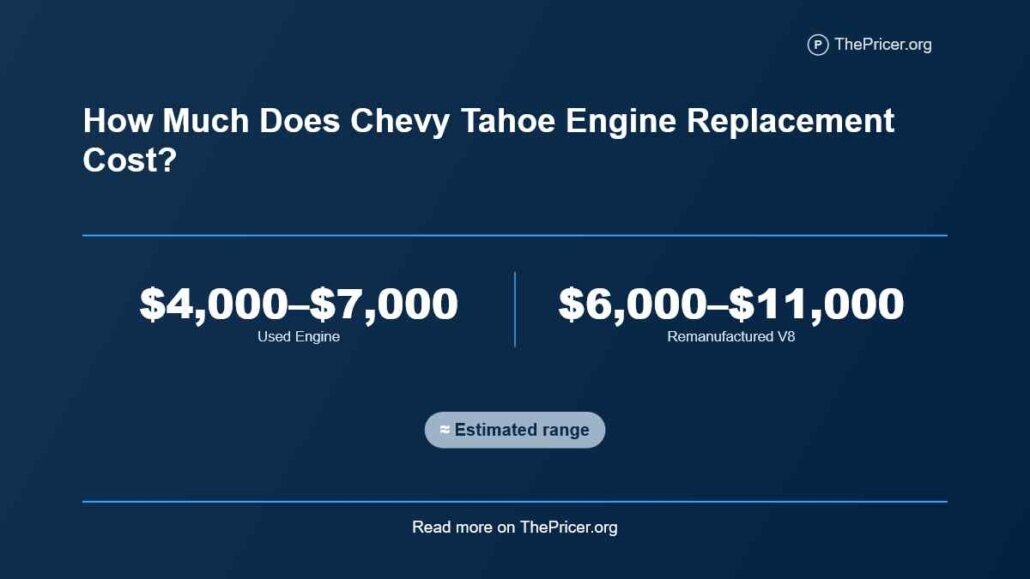
How Much Does Chevy Tahoe Engine Replacement Cost?
A replacement engine is not a standardized repair product. A salvage-yard assembly may include accessories that a remanufactured long block does not, while a dealership’s installed price includes labor and may incorporate additional factory-required procedures.
The following figures combine advertised replacement-engine prices, salvage-market listings, and illustrative installation allowances. The installed ranges are budgeting estimates rather than published nationwide Tahoe averages.
| Replacement option | Engine or parts price | Estimated installed total |
|---|---|---|
| Older Tahoe, used V8 | $1,500–$3,500 | $4,000–$7,000 |
| 2015–2020 Tahoe, used 5.3L | $2,000–$4,000 | $4,500–$8,000 |
| 5.3L aftermarket remanufactured | $3,000–$5,500 | $6,000–$10,000 |
| GM remanufactured V8 | $6,000–$9,000 | $9,000–$15,000+ |
These categories overlap and depend on engine generation. For example, Powertrain Products’ GM 5.3-liter listings show several older remanufactured engines advertised at $2,799, a 2014–2019 L83 at $3,999, and an L84 at $4,999. These are engine prices, not complete repairs.
The salvage market provides another reference. A 2017 Tahoe salvage-price comparison reports a $3,000 median asking price among 39 priced listings, with an overall spread from $700 to $3,861. Condition, mileage, seller grading, and included components explain part of that difference.
A general engine swap can involve considerably different expenses when the replacement requires custom mounts, electronics, or drivetrain changes. The figures here assume a compatible factory-type Tahoe engine.
Prices by Engine and Model Year
Two Tahoes carrying the same Chevrolet badge can need substantially different replacement engines. GM engine families, fuel injection, valve-train systems, electronics, and block specifications changed across generations.
Older 5.3-liter Tahoes
Many older Tahoes are attractive repair candidates because compatible used and remanufactured V8 engines remain available. For certain late-1990s and 2000s 5.3-liter applications, advertised remanufactured engine prices start below $3,000. Engine identifiers and VIN details still require verification before ordering.
An older vehicle may cost less to repair mechanically but can introduce additional expenses from corroded exhaust fasteners, deteriorated hoses, damaged mounts, or aging cooling components.
2015–2020 Tahoe 5.3-liter V8
GM’s remanufactured engine part 19434265 lists compatibility with 2015–2020 Chevrolet Tahoes and an MSRP of $6,775.05. The listing also specifies a refundable $5,000 core deposit.
This is an important distinction when comparing a GM dealer quote with a lower-priced aftermarket remanufactured engine. The advertised price of an engine alone does not disclose labor, accessories, extra procedures, or the final dealer selling price.
2021 and newer Tahoe V8 engines
The newer 5.3-liter L84 generation also has remanufactured options. One L84 replacement-engine listing advertises $4,999, subject to the specified engine configuration and order selections.
Meanwhile, AutoZone’s 2024 Tahoe engine catalog includes remanufactured long blocks listed at $3,503.99 and $4,628.99, each with an additional refundable $570 core deposit. Vehicle-specific fitment must be checked.
The 6.2-liter V8 requires separate pricing. A GM 6.2-liter remanufactured assembly is advertised at $3,917.95 MSRP for a listed 2021 Tahoe application, but carries a substantial $7,000 refundable core charge. An inexpensive-looking GM part listing therefore does not necessarily indicate an inexpensive checkout transaction.
Labor and an Installed Example
Engine replacement generally involves disconnecting the electrical, fuel, cooling, exhaust, and drivetrain connections, removing the existing engine, transferring eligible accessories, installing the replacement, refilling fluids, and testing the vehicle.
AAA’s 2026 labor-rate analysis reports that nearly half of surveyed general repair shops charge between $120 and $159 per hour, based on industry survey findings. Individual dealerships and specialist shops can charge considerably more.
For budgeting, an assumed 12–20 billable labor hours at $120–$200 per hour produces a broad labor allowance of $1,440–$4,000. These hours are illustrative rather than a verified factory labor standard for every Tahoe generation.
Worked example for a 2017 Tahoe
Consider an independent shop replacing a failed 2017 Tahoe 5.3-liter engine with a compatible used assembly. Use the observed $3,000 salvage median as the engine input and assume a shop charges $145 per hour for 16 billable hours.
| Expense | Amount |
|---|---|
| Used engine | $3,000 |
| Installation, 16 × $145 | $2,320 |
| Fluids and sealing materials, assumed | $250 |
| Hoses, belts, and related parts, assumed | $200 |
| Diagnostics and final testing, assumed | $180 |
| Illustrative total | $5,950 |
This example excludes sales tax, towing, unexpected engine damage, and any additional warranty requirements. The non-engine amounts are explicit planning assumptions, not a published customer invoice.
If the same shop charges $200 per hour, labor becomes $3,200 and the modeled total rises to $6,830. That $880 difference arises without changing the replacement engine.
A documented 2017 Tahoe owner’s dealership quote reached $11,000 for an engine replacement with warranty in 2023. It is a useful example of a higher-end reported quote, not evidence that every dealership currently charges that amount.
Hidden Costs
The replacement engine’s advertised price is only one part of the transaction. Several expenses can be overlooked when comparing online engine prices against an installed repair estimate.
Refundable core deposits
Remanufacturers often require the buyer to return the damaged engine for rebuilding. Chevrolet’s core-return policy explains that refunds depend on returning an acceptable component under the seller’s specified conditions.
For the GM 2015–2020 engine priced at $6,775.05 with a $5,000 core charge, the combined temporary amount is $11,775.05 before other costs. Once an eligible core refund is completed, the effective engine price returns to $6,775.05.
The deposit is not automatically a permanent expense. However, the buyer may need to finance or temporarily cover it, and a damaged or unacceptable core may prevent a full refund.
Other overlooked charges
- Additional parts. Water pumps, engine mounts, belts, hoses, ignition parts, and failed accessories may require replacement.
- Diagnostics. Testing is necessary to establish whether the engine has suffered internal damage or only a repairable component failure.
- Programming and calibration. Electronic setup requirements depend on the particular engine and components replaced.
- Cooling-system cleaning. Contamination or an overheating-related failure can require repairs beyond the engine assembly.
- Freight and core returns. Shipping, unloading, packaging, and return deadlines can affect the net price.
- Taxes and transportation. Sales tax, towing, and alternative transportation may remain outside the written repair estimate.
Ask for two figures before authorizing work. The first is the complete out-the-door invoice. The second is the expected net cost after any eligible core refund. That comparison prevents a temporary deposit from being confused with a permanent engine expense.
Can a Tahoe Engine Be Repaired?
Engine replacement is not always necessary when a Tahoe develops a misfire, tapping noise, oil consumption, or loss of power. A failed lifter, camshaft component, cylinder head, gasket, or oil-system component can sometimes be repaired while retaining the original engine.
AutoZone’s replacement-cost guidance places complete engine replacement in a broad multi-thousand-dollar category and explains why replacement-engine type and labor significantly influence the outcome. The precise repair-versus-replacement decision requires diagnosis.
For example, assume a technician establishes that a localized valve-train repair will cost $3,000, while a complete replacement estimate is $8,000. The immediate savings from repairing the existing engine would be $5,000. Those are illustrative quote amounts, and the comparison is worthwhile only if the lower-cost repair addresses the underlying damage reliably.
If an engine block or cylinder is damaged, machining may be another option. The cost of reboring an engine covers machining operations, but removing, rebuilding, and reinstalling the engine adds substantial additional expense. A rebore price alone should never be compared with a fully installed replacement quote.
Before approving replacement, request compression or leak-down testing where appropriate, inspection for metal contamination, and a written explanation of the failed component. A second diagnostic opinion may be especially valuable when the first recommendation involves replacing the entire engine.
Recall and Warranty Coverage
This is particularly important for owners of newer 6.2-liter Tahoes.
Federal safety recall 25V274 covers certain 2021–2024 Chevrolet Tahoes equipped with the 6.2-liter L87 V8. The NHTSA recall report identifies 44,814 potentially affected Tahoes, with the relevant suspect engine-production window spanning March 2021 through May 2024.
Owners should have a Chevrolet dealer check the VIN for open recalls, applicable inspection procedures, and the authorized remedy. An eligible recall repair is performed without the owner paying the recall repair charge. This does not mean every 2021–2024 Tahoe needs a free engine replacement, nor does it apply to every engine configuration.
Separate from recalls, Chevrolet’s powertrain warranty information describes typical coverage of five years or 60,000 miles, whichever comes first, subject to the applicable vehicle terms. Certain components and defects are covered, while misuse and insufficient maintenance can affect eligibility.
Replacement-engine warranties are different. Some GM remanufactured-engine listings specify a limited 36-month/100,000-mile parts warranty, with labor coverage conditioned on installation by a GM dealer. Confirm the exact contract, installation requirements, and covered labor reimbursement before comparing warranties.
When Replacement Makes Sense
A Tahoe’s age alone does not determine whether replacing its engine is a sound financial choice. The condition of the transmission, frame, suspension, electrical system, and four-wheel-drive hardware matters just as much.
Consider a Tahoe worth $14,000 in running condition and a complete engine replacement quote of $7,000. The repair consumes half its estimated post-repair value. That does not automatically make replacement a poor decision because buying another reliable SUV may require considerably more money.
A more useful test compares the total replacement expense with the expected remaining service life and the cost of obtaining an alternative vehicle.
If the $7,000 repair provides another three years of useful service, its equivalent engine-repair burden is approximately $194 per month. If the Tahoe instead needs another $4,000 in foreseeable major repairs during that period, the combined $11,000 amounts to roughly $306 per month, before ordinary ownership costs.
That calculation helps expose the cost of repairing an engine in an otherwise deteriorating vehicle. A separate transmission replacement could materially change the decision if the drivetrain is already showing problems.
Makes sense if
- The Tahoe has a sound transmission, frame, and electrical system.
- A compatible replacement engine has a credible warranty.
- The installed cost is substantially below the expense of obtaining a suitable replacement vehicle.
- The owner expects to retain and use the SUV for several more years.
Does not make sense if
- The transmission or other major systems are near failure.
- The engine quote approaches the vehicle’s running-condition value while other expensive repairs remain.
- The shop cannot clearly identify engine compatibility or warranty coverage.
- The vehicle qualifies for a no-charge recall remedy that has not yet been evaluated.
Choosing an Engine and Repair Shop

A used engine is often the least expensive practical solution, particularly for an older Tahoe. Ask the supplier for documented donor mileage, VIN or interchange information, available running-test records, the exact parts included, and written warranty terms.
A remanufactured engine may be preferable when the owner wants a longer service life and clearer component coverage. However, confirm whether the price is for a short block, long block, or more complete assembly. The installer may need to transfer substantial equipment from the damaged engine.
Ask competing repair shops to quote the same engine condition, scope, and warranty. Compare included fluids, seals, accessory transfers, programming, testing, and responsibility for warranty labor. An inexpensive installation with missing items is not necessarily the lowest total cost.
DIY replacement may save labor for someone experienced in V8 engine installation, but lifting equipment, torque procedures, compatible electronics, and safe handling of heavy assemblies are essential. The risk of installation errors and warranty disputes makes professional installation the more practical route for most owners.
Answers to Common Questions
How much is a new Chevy Tahoe engine from a dealership?
GM remanufactured-engine listings include Tahoe-compatible assemblies priced at several thousand dollars before installation. Some listed assemblies approach or exceed $7,000–$9,000. A genuinely new factory assembly may differ in price and availability. Request a VIN-specific parts and installation quote rather than assuming a remanufactured listing represents a brand-new engine.
Is it cheaper to rebuild or replace a Tahoe engine?
A localized repair can be considerably cheaper than replacement. A complete rebuild involving extensive machining and internal components may approach the price of a remanufactured engine, especially after removal and reinstallation labor. The extent of damage determines the better option.
How long does a Chevy Tahoe engine replacement take?
A shop may bill roughly 12–20 hours for an illustrative replacement estimate, but actual labor time varies by vehicle and procedure. Calendar downtime can last longer because of diagnosis, parts delivery, scheduling, programming, and post-installation testing. Request both the estimated billable hours and the expected completion date.
Can I install a used 5.3-liter engine from another Chevrolet truck?
Potentially, but sharing the 5.3-liter displacement does not guarantee compatibility. Engine generation, VIN code, fuel system, electronics, sensors, cylinder heads, and accessory connections must be checked. Have the installer confirm interchange details before purchasing.
Will replacing the engine increase my Tahoe’s resale value?
A documented replacement may improve buyer confidence compared with a vehicle suffering from engine failure. However, sellers should not assume the full repair invoice will be recovered at resale. The vehicle’s overall condition, replacement-engine documentation, and remaining warranty matter.
Can a 2021–2024 Tahoe get a free replacement engine?
Some 6.2-liter L87 vehicles are covered by a safety recall. Whether an individual Tahoe qualifies for an engine replacement depends on its VIN, the applicable recall procedures, and inspection findings. A Chevrolet dealer can confirm the appropriate no-charge remedy for an eligible vehicle.
Disclosure: Educational content, not financial advice. Prices reflect public information as of the dates cited and can change. Confirm current rates, fees, taxes, and terms with official sources before purchasing. See our methodology and corrections policy.