
How Much Does a Conch Piercing Cost?
Updated on | Written by Alec Pow
This article was researched using 14 sources. See our methodology and corrections policy.
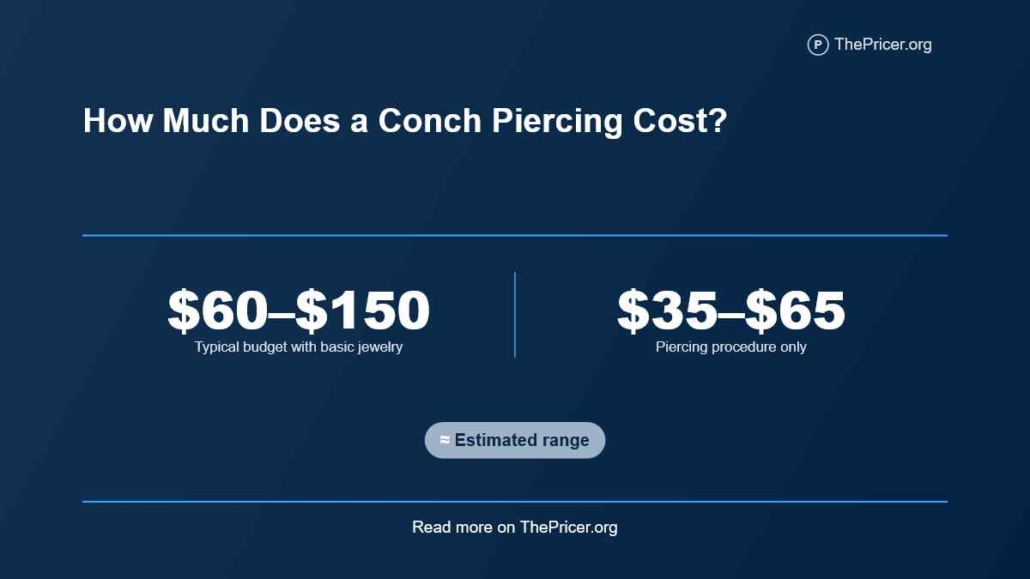
A conch piercing generally costs $60 to $150 for one ear at a professional U.S. piercing studio when basic jewelry is included. The piercing procedure alone often costs $35 to $65, while premium titanium jewelry, decorative gemstones, or solid gold can push the initial appointment above $200.
The advertised piercing fee is not necessarily the final bill. Jewelry, aftercare supplies, sales tax, and a later jewelry adjustment can change what you spend. Published studio prices also vary substantially, making it useful to compare complete packages rather than the procedure fee alone.
Article Highlights
Jump to sections
- A practical budget for one conch piercing with basic jewelry is approximately $60 to $150 (at $30 per hour, earning that amount would take about 2 to 5 hours of work, before taxes).
- Published U.S. piercing-only fees include $55 and $60 offers.
- Premium gold jewelry can bring the initial total to $150 to $250+.
- A separate jewelry downsize may be necessary after the initial swelling subsides.
- Conch cartilage commonly needs six to twelve months to heal fully.
- Implant-grade titanium offers a suitable initial jewelry option without the expense of solid gold.
How Much Does a Conch Piercing Cost?
Published prices show why the commonly quoted $45 to $100 (about 1.5 to 3.3 hours of work at $30 per hour) range does not describe every conch piercing purchase. Some studios advertise only the professional service, while others publish a complete package that includes jewelry and aftercare.
Booksy’s U.S. ear-piercing price listings place conch procedures around $35 to $65, generally before separately charged jewelry. This provides a useful service-fee reference, rather than a guaranteed national average for the complete appointment.
| Studio or provider | Published conch price | What the price covers |
|---|---|---|
| Faythe In Needles | $55 | Piercing service only. Basic titanium posts start at $16.99. |
| Studio Sashiko | $60 | Piercing service, with jewelry charged separately. |
| Aperture Piercing | $120 to $250+ | 2026 estimates including jewelry, aftercare, and tax. Jewelry selection determines the total. |
| Sireal Headquarters | $35 | Standard jewelry included, with a separate walk-in charge when applicable. |
Faythe In Needles publishes its conch piercing service fee separately from jewelry. Studio Sashiko similarly lists a conch procedure at sixty dollars plus jewelry.
At the higher end, Aperture Piercing’s 2026 piercing price estimates put a basic bead-style conch at $120, decorative gemstone versions around $130 to $155+, and gold options at $250+. These estimates include aftercare and tax, so they should not be compared directly with service-only rates.
A lower published example comes from Pittsburgh-based Sireal Headquarters, whose conch service listing advertises $35 with jewelry included. It also lists a $10 walk-in fee. That illustrates how booking arrangements can change even a seemingly inclusive offer.
Inner vs. Outer Conch Prices
A conch piercing passes through the bowl-shaped cartilage of the external ear. The exact location depends on the anatomy and the intended jewelry appearance. Inner conch placement is closer to the ear canal, while outer conch placement is farther toward the ear’s outer bowl.
Although some piercing guides assign higher prices to inner conch placements, a universal surcharge is not supported by the published studio schedules reviewed. Several studios simply list one conch piercing category.
The more meaningful distinction is whether your anatomy requires a different jewelry size, placement, or design. A larger decorative end or future ring may affect the jewelry bill even when the piercing labor fee remains unchanged.
These anatomical considerations also apply to other cartilage services, including helix piercings. The two procedures have different placements, so their jewelry requirements and healing experiences should not automatically be treated as identical.
How Jewelry Changes the Bill
Jewelry can cost as much as, or considerably more than, the procedure. Initial jewelry must accommodate swelling, suit the placement, and use a material appropriate for a fresh piercing.
The Association of Professional Piercers’ jewelry standards identify suitable materials and specifications, including implant-certified titanium meeting recognized ASTM or ISO standards, certain implant-grade steels, and appropriately alloyed solid gold.
Implant-grade titanium is an attractive practical choice for many customers. It is lightweight, suitable for people concerned about nickel sensitivity, and available in simple designs. Solid gold is an optional aesthetic upgrade, not a requirement for safe healing.
Gold jewelry used in fresh piercings should meet appropriate material standards. Gold-plated and gold-filled jewelry are not equivalent to solid, biocompatible gold and are unsuitable for initial piercings under APP guidance.
Ouro Fine Jewellery and Piercings publishes an especially useful service-and-jewelry price breakdown. Its conch piercing fee is $50 (about 1.7 hours of work at $30 per hour), implant-grade titanium or niobium jewelry starts at $50, and gold jewelry starts at $100. That produces an initial minimum of $100 with titanium or $150 with gold, before any additional applicable charges.
The difference matters. Choosing the advertised starting gold option instead of the starting titanium option adds $50 to this particular studio’s initial total, a 50% increase over its basic titanium combination.
What Is the Real Total?
For budgeting, the useful number includes the procedure, initial jewelry, cleaning supplies, and any follow-up appointment that requires payment. Not every studio charges each component separately.
Consider an illustrative customer purchasing a titanium conch piercing at the published Ouro minimum, then choosing a separate aftercare product and allowing for a possible paid adjustment.
Itemized Budget Example
- Piercing service: $50
- Entry-level titanium jewelry: $50
- Illustrative sterile saline allowance: $10
- Illustrative follow-up allowance: $20
- Calculated total: $130, before applicable tax
The first two figures are published prices from Ouro. The final two are planning allowances, not quoted Ouro charges. The calculation assumes one saline purchase and one paid follow-up, without adding a separate jewelry replacement charge.
Under those assumptions, the follow-up and saline allowances increase the initial $100 studio purchase by $30, or 30%. If both are included or provided without charge, the modeled total falls back to $100.
Jewelry choices can have an even greater effect. Using Aperture’s published estimates, upgrading from its $120 basic bead package to the starting $250 gold package adds at least $130. The gold option costs more than twice the basic package, without purchasing a second piercing.
These examples establish different budget outcomes, not a statistical average of what U.S. customers actually spend.
Hidden Costs During Healing
The most easily overlooked expense is a possible jewelry downsize. Initial posts often provide extra room for swelling. Once swelling settles, a shorter post may reduce unnecessary movement or catching.
The APP’s professional piercing FAQ explains why appropriately timed downsizing matters. Your piercer should determine whether a change is needed and whether the appointment, replacement post, or both carry a charge.
Another potential expense is replacing jewelry that proves unsuitable. Purchasing an inexpensive decorative piece before healing is complete can become wasteful if the material, diameter, or shape cannot be used safely.
Hoops and chain-connected styles deserve particular attention. The desired finished appearance may not be suitable as the initial setup. A later decorative change can create a second jewelry purchase, although the size and timing must be assessed by the piercer.
The same concern applies to more elaborate ear projects, such as industrial piercings, where jewelry geometry and anatomy can affect what is practical.
Aftercare and Healing Time

A conch piercing requires more healing time than a standard earlobe piercing. The Cleveland Clinic’s ear-piercing guidance estimates approximately six to twelve months for conch and several other cartilage piercings.
The surface can appear settled before the channel is fully healed. Pressure from headphones, sleeping directly on the piercing, and unnecessary jewelry movement may aggravate the area.
The APP’s body-piercing aftercare recommendations favor sterile saline wound wash containing 0.9% sodium chloride, without additional ingredients. Mixing sea salt at home is no longer recommended because the concentration can be difficult to control.
Avoid unnecessary rotation, harsh cleaning products, and repeated touching. Sterile saline does not need to be supplemented with multiple specialized cleaning products unless a qualified healthcare professional identifies a separate medical need.
Cartilage complications can be more serious than ordinary irritation. The Cleveland Clinic’s explanation of perichondritis describes infection involving tissue around the ear cartilage, including cases associated with cartilage piercings.
Seek medical assessment for worsening pain, spreading redness, heat, pus, fever, or increasing swelling. The NHS infection guidance advises prompt medical attention when piercing infection is suspected. Do not remove jewelry from a suspected infected piercing without medical advice.
Choosing a Piercing Studio
Price alone cannot establish whether a studio uses suitable jewelry, effective sterilization procedures, or appropriate placement techniques.
The APP’s piercer selection checklist recommends checking training, sterile equipment, jewelry quality, and the studio’s infection-control practices. Professional piercers use sterile, single-use piercing needles rather than piercing guns.
Ask for a complete quote covering labor, jewelry, taxes, aftercare, and any recommended follow-up. Confirm whether the studio offers downsizing and whether that service has a separate charge.
A consultation may be included in the appointment. A universal additional consultation fee should not be assumed. Ask the piercer to explain the proposed placement and show how the initial jewelry will fit your anatomy.
Makes sense if
- You are prepared for several months of cartilage healing.
- You can afford appropriate initial jewelry rather than relying on an unsuitable cheap alternative.
- Your chosen studio can explain sterilization, placement, and follow-up arrangements.
Does not make sense if
- You need to change decorative jewelry frequently during the first several months.
- Your work or daily activities regularly apply unavoidable pressure to the ear.
- You are choosing a studio mainly because its price is unusually low, without checking its safety practices.
For anyone primarily interested in a larger or stretched ear-jewelry appearance, ear stretching costs involve a different process and budget from a standard conch piercing.
Answers to Common Questions
How painful is a conch piercing?
Pain varies by individual and cartilage anatomy. Many people experience a brief sharp sensation followed by tenderness. A professional procedure may be quick, but discomfort does not provide a reliable measure of placement quality or healing progress.
How long does a conch piercing take to heal?
Allow approximately six to twelve months for complete cartilage healing. Your piercer can assess whether jewelry adjustments are appropriate before that period ends.
Can a conch piercing reduce anxiety?
There is no reliable clinical evidence that conch piercings treat anxiety. The medical review of conch piercings describes anxiety-relief claims as anecdotal rather than established. A conch piercing should be considered decorative body modification, not anxiety treatment.
Can I wear a hoop immediately?
The initial jewelry should be selected for your anatomy and healing needs. A ring may be unsuitable for some placements or sizes. Ask your piercer whether a flat-back stud is preferable initially and when a hoop could be fitted.
Is a more expensive piercing always safer?
No. A higher price can reflect jewelry materials, studio overhead, or decorative upgrades. Safety depends on the piercer’s practices, appropriate jewelry specifications, sterilization, and aftercare guidance rather than price alone.
Disclosure: Educational content, not financial advice. Prices reflect public information as of the dates cited and can change. Confirm current rates, fees, taxes, and terms with official sources before purchasing. See our methodology and corrections policy.