
How Much Do Braces Cost?
Updated on | Written by Alec Pow
This article was researched using 15 sources. See our methodology and corrections policy.
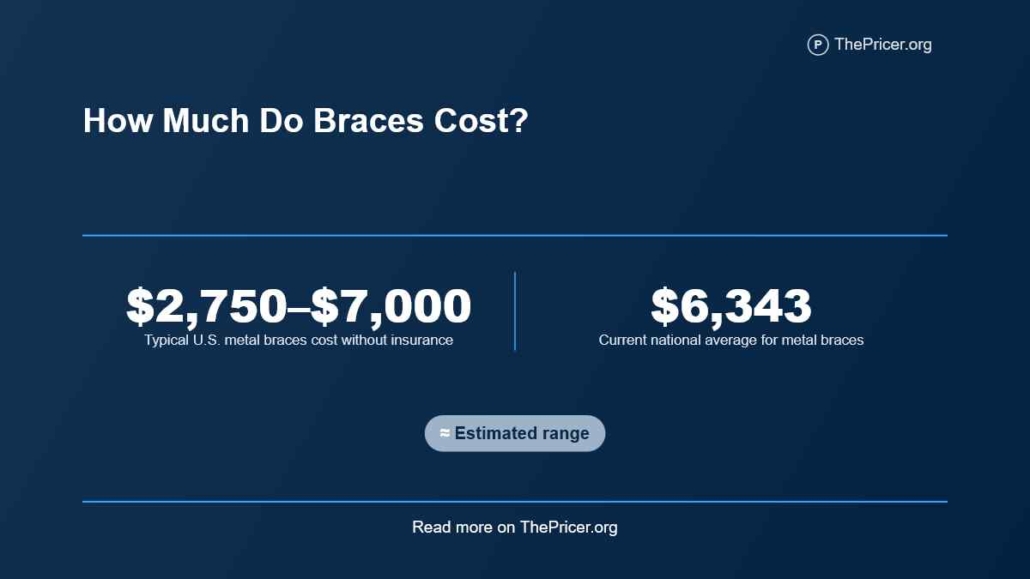
Traditional metal braces in the United States usually cost about $2,750 to $7,000 without insurance, and a June 2026 cost study puts the whole-treatment average at $5,991. Current braces pricing data also shows that ceramic braces, lingual braces, and clear aligners can push the bill higher.
Your own quote can sit outside that range because braces are priced as a treatment plan, not as a box of brackets. Case complexity, appliance type, treatment length, location, insurance rules, included retainers, and extra dental work can all change the amount you pay. A written quote matters because two offices can advertise similar braces prices while including different services.
Article Highlights
Jump to sections
- Metal braces commonly fall near $2,750 to $7,000 (at $30 per hour, earning that amount would take about 2.3 to 5.8 full-time workweeks, before taxes), while wider national data extends from $2,500 to $10,000.
- Current national data places the average metal-braces charge near $6,343.
- Ceramic braces can reach $11,312, while lingual braces can reach $17,411 in one national cost study.
- Orthodontic insurance often uses a lifetime benefit limit, so a plan that pays a percentage may stop paying after the cap is reached.
- The first set of retainers may be included in treatment, while replacement retainers can become a later out-of-pocket expense.
How Much Do Braces Cost?
A national study published by CareCredit, based on research across all 50 states and the District of Columbia, found a metal-braces average of $6,343 (about 5.3 full-time workweeks at $30 per hour) with a range of $2,500 to $10,000. Its U.S. braces cost study also reports separate figures for ceramic, lingual, and clear-aligner treatment. The data comes from Synchrony procedural cost research conducted in 2023 and 2024, so it is useful as a current national benchmark rather than a guaranteed quote.
| Treatment type | Average cost | Observed price range |
|---|---|---|
| Traditional metal braces | $6,343 | $2,500 to $10,000 |
| Ceramic braces | $5,834 | $4,480 to $11,312 |
| Lingual braces | $9,221 | $7,321 to $17,411 |
| Clear aligners | $5,108 | $1,800 to $8,100 |
Those ranges overlap because appliance type is only one part of the final written quote. A short, straightforward metal-braces case can cost less than a complicated ceramic case, while a difficult metal case can move toward the upper end of the market. If appearance matters, separate pages on ceramic braces and lingual braces go deeper into those two systems.
What the Quote Buys
Braces are fixed orthodontic appliances that use brackets and wires to move teeth and correct bite problems over time. The American Association of Orthodontists says most people wear braces for about 12 to 24 months and return for adjustments every four to 12 weeks, although treatment length depends on the bite problem and the planned movements. Its braces treatment overview also places a retention phase after active treatment.
A quote may bundle the initial records, appliance placement, routine adjustment visits, removal, and the first retainers. Another office may charge separately for one or more of those items. The AAO notes that some practices use all-inclusive pricing that covers braces, appointments, emergency visits, and post-treatment retainers, which is why the items included in a braces quote deserve as much attention as the headline number.
 Ask for a written treatment fee and a written list of exclusions. Check whether the price includes diagnostic records, all planned visits, repairs, appliance removal, and the first retainers. This also makes a low quote easier to compare with a higher quote that includes more care. The separate cost of braces removal matters most when removal is not part of the original package.
Insurance and Your Share
Orthodontic insurance does not work like a simple coupon off the sticker price. Delta Dental explains that orthodontic benefits often have a lifetime maximum rather than an annual maximum that resets every plan year. Once that lifetime orthodontic benefit is exhausted, the plan does not keep paying for later orthodontic charges. That distinction is spelled out in Delta Dental’s orthodontic maximum explanation.
A current Cigna individual plan shows how a cap can work in practice. Cigna Dental 1500 advertises a $1,000 (about 4.2 full-time workdays at $30 per hour) lifetime maximum for orthodontia such as braces and Invisalign treatment. The plan’s published orthodontia benefit is a concrete reminder that a plan can cover orthodontics and still leave most of a multi-thousand-dollar bill with the patient. Other plans may have different age limits, networks, coinsurance, waiting periods, or benefit caps.
One large OrthoFi dataset cited by Invisalign covered 112,243 U.S. patients with dental insurance in calendar year 2021. Average orthodontic coverage in that sample was $1,772, while many patients qualified for benefits capped at $2,000 or $3,000. The insurance coverage data is older than the price figures used elsewhere here, so it should be read as a benefit benchmark, not a 2026 promise.
Hidden Braces Costs
The most useful question is not only how much braces cost, but what happens outside the quoted package. Retainers are the clearest example. The AAO says the first set is often part of the orthodontic treatment fee while replacements may carry a separate charge in its retainer cost guidance. The University of Iowa currently lists clear retainers at $200 per arch and Hawley retainers at $330 per arch in its orthodontic clinic fee information.
That makes a two-arch replacement set $400 for clear retainers or $660 for Hawley retainers at that clinic. Those amounts are not national averages. They show how a post-treatment item that seems small beside the braces fee can still add hundreds of dollars later. A full guide to retainer costs is useful when comparing lifetime orthodontic spending rather than only the active-treatment price.
Repairs, replacement appliances, missed visits, records, extractions, periodontal treatment, or dental work needed before braces can also change the bill when they are outside the orthodontic package. Location can move the starting quote too. In the CareCredit state data used earlier, Nevada’s metal-braces average is $8,350 and Indiana’s is $4,767. The gap is $3,583, which means the higher state average is about 75% above the lower one. That is a pricing spread, not a prediction for any individual office.
Braces vs Clear Aligners
Clear aligners should not be treated as a separate low-cost category by default. Invisalign states that its treatment cost is often comparable to braces and that the doctor sets the fee based on case complexity and the number of aligners needed. Its current cost information also shows real patient examples with different doctor fees, insurance contributions, down payments, and financing schedules. The broader CareCredit data used earlier places clear aligners at an average of $5,108, but the observed range overlaps metal braces.
The practical comparison is treatment scope plus the written fee. A lower aligner quote does not automatically buy the same service as a higher braces quote. One package may include refinements or retainers while the other does not. The number and complexity of movements can differ too. Readers weighing removable treatment can use the separate Invisalign cost guide for the aligner-specific side of that decision.
Self-ligating systems such as Damon braces also should not be chosen on an assumption that they will shorten the full treatment enough to save money. A 2021 systematic review and network meta-analysis found that most claimed efficiency differences between conventional and self-ligating brackets were not substantiated, including no meaningful difference in full treatment duration. The self-ligating bracket evidence supports comparing the actual quoted fee and treatment plan rather than paying a premium for a speed claim alone.
Three Cost Scenarios
A no-insurance metal-braces case can start with the national average of $6,343 from the price study used earlier. If that written quote includes records, placement, adjustments, removal, and first retainers, the active-treatment budget stays close to $6,343. If retainers or preparatory dental work are excluded, the true cash requirement will be higher. This is why a complete inclusions list is part of the price comparison.
Now apply the $1,772 average orthodontic insurance benefit from the OrthoFi sample to that same $6,343 benchmark. The arithmetic is $6,343 – $1,772 = $4,571. In that illustrative case, insurance covers about 28% of the starting charge and the patient remains responsible for $4,571 before any deductible, negotiated network price, plan exclusions, or separate dental work. The calculation shows why a percentage headline can mislead if the plan has a dollar cap.
A real clinic example gives a different view. The University of Iowa lists resident-clinic orthodontic treatment at $5,250 with $800 due before treatment and the remainder spread across 24 months. That leaves $4,450, or about $185.42 per month. Its faculty clinic lists a base fee of $6,875 with 25% down. The down payment is $1,718.75, leaving $5,156.25, or about $214.84 per month over 24 months. The resident price is $1,625 lower, about 24% below the faculty base fee, before any extra charges for ceramic brackets or branded Invisalign treatment.
Paying for Treatment
Dental-school orthodontic clinics can provide a lower published fee in some markets, as the Iowa example shows, but access, referral rules, appointment availability, treatment length, and case acceptance can differ from a private office. A lower fee is useful only if the clinic can treat the case and the patient can keep the required appointment schedule. Comparing two or three written quotes with matched inclusions is more informative than comparing a single advertised starting price.
Health Savings Accounts and Flexible Spending Accounts can also matter. IRS Publication 502 lists braces among dental treatments that qualify as medical expenses for federal tax purposes. The IRS dental-expense rules establish braces as an eligible medical expense. HSA or FSA reimbursement still depends on the account’s rules.
Payment plans can spread a large balance across the treatment period, but compare the total amount financed rather than the monthly installment alone. Ask for the down payment, number of installments, interest or financing charges, and late-payment fees before signing the agreement.
Choosing a Budget Fit
The lowest advertised quote is not always the lowest payable total. A cheaper offer that excludes retainers, records, or certain repairs can finish above a larger package that includes them. Insurance can create the same problem when a percentage benefit is limited by a lifetime cap. Compare a written treatment fee beside a written benefits estimate from the insurer.
Appliance choice belongs in the same comparison. Metal braces often sit toward the lower end of published ranges, ceramic brackets trade visibility for a different fee structure, lingual braces can cost much more, and clear aligners overlap fixed braces across a wide band. The treatment plan has to work clinically before price differences become useful. Cost alone cannot show which appliance can perform the movements a patient needs.
Makes sense if
- The written quote lists the services included in the treatment fee.
- The insurance benefit has been checked for lifetime limits, age rules, network status, and waiting periods.
- The payment schedule fits the household budget without hiding financing charges.
- The selected appliance matches the orthodontic plan rather than only the preferred appearance.
Does not make sense if
- The decision is based only on the lowest advertised starting price.
- A percentage insurance benefit is treated as unlimited coverage.
- A premium bracket system is chosen only because of an unsupported promise of faster full treatment.
- Retainers and post-treatment costs are left out of the budget.
Answers to Common Questions
How much do braces cost without insurance?
Metal braces commonly cost about $2,750 to $7,000, while broader national cost data shows an observed range from $2,500 to $10,000. Complex treatment, local pricing, and the items bundled into the quote can push the cost higher.
How much are braces with insurance?
There is no single insured price. A plan may pay a percentage or a fixed benefit, then stop at a lifetime orthodontic maximum. In the OrthoFi sample discussed earlier, the average orthodontic benefit was $1,772, but a current Cigna plan provides a $1,000 lifetime orthodontia maximum.
Are retainers included in the cost of braces?
The first retainers are often included, but that is not universal. Replacement retainers may be billed separately, so the quote should state what happens after the braces come off.
Are ceramic braces more expensive than metal braces?
They can be. Current national data places ceramic braces from $4,480 to $11,312 and metal braces from $2,500 to $10,000. Individual quotes overlap because complexity and provider pricing still matter.
Can an HSA or FSA pay for braces?
Braces are listed by the IRS as qualifying dental treatment for medical-expense purposes. HSA or FSA reimbursement still has to follow the rules of the specific account and plan.
Disclosure: Educational content, not medical advice. Pricing varies by provider, location, and insurance. Confirm eligibility, coverage, and out-of-pocket costs with a licensed clinician and your insurer. See our methodology and corrections policy.