
How Much Does It Cost to Build a Castle?
Updated on | Researched and reviewed by Alec Pow, Founder & Pricing Investigator
Prices, claims, and calculations checked against 14 cited sources. See our research methodology and corrections policy.
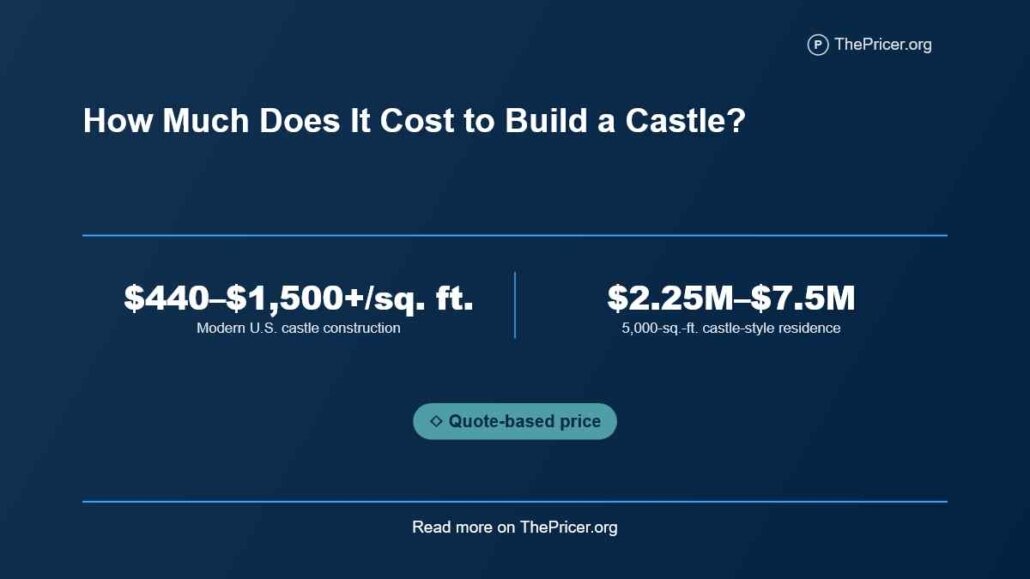
A modern castle in the United States can cost roughly $440 to $1,500+ per square foot to build, depending on whether the project is a specialist solid-stone residence, a castle-inspired luxury estate, or an ultra-luxury custom home with extensive stonework and bespoke interiors.
CastleMagic currently publishes $440 to $615 per square foot in its finished-castle benchmark for 2025, while a 2026 luxury custom-home guide places U.S. projects around $450 to $1,500+ per square foot. Prime ultra-luxury projects can exceed $2,500 per square foot. Land, major site work, professional fees, furnishings, walls, gates, and estate grounds work can sit outside the building figure.
Article Highlights
Jump to sections
- Current published construction benchmarks span roughly $440 to $1,500+ per square foot, depending on project type and finish level.
- A 5,000-square-foot luxury castle-style residence can model at about $2.25 million to $7.5 million in building cost before land and many non-building expenses.
- A 10,000-square-foot project can reach roughly $4.5 million to $15 million on the same 2026 luxury construction inputs.
- Architecture alone can add 10% to 15% of construction cost in some high-cost U.S. markets.
- Stone veneer can deliver a castle appearance for far less than a wall system built around heavy traditional masonry.
- A historically authentic castle cannot be responsibly priced from an ordinary luxury-home rate alone.
How Much Does It Cost to Build a Castle?
Project-level pricing shows the same scope problem. CastleMagic currently lists residential solid-stone castles at $1.5 million to $4.5 million and courtyard castles with perimeter walls at $4.5 million to $15 million. Those are specialist-builder figures, not national averages, but they show how walls and site scope can change the total before size alone explains it.
A modern framed estate with stone veneer can sit near luxury-home pricing. A highly customized property in a costly market can move much higher because finish level, labor, logistics, and site work can dominate. A solid-stone specialist project can land in another band because its construction system and specification differ. One national average would hide those differences.
| Project type | Useful construction benchmark | What changes the number |
|---|---|---|
| Castle-style luxury residence | $450 to $1,500+ per sq. ft. | Custom interiors, masonry, towers, roof complexity, local labor |
| Specialist solid-stone castle | $440 to $615 per sq. ft. | Stone source, site access, wall system, labor, local approvals |
| Prime ultra-luxury estate | Can exceed $2,500 per sq. ft. | Signature design, imported finishes, complex engineering, market |
| Historical-method reconstruction | No reliable national rate | Traditional labor, research, craft methods, very long schedule |
A castle belongs closer to high-end custom construction than to a production house. Current house construction costs provide a baseline before castle-specific architecture and masonry are added.
Three Different Castle Projects
The word castle can describe three very different construction scopes. A castle-style luxury residence uses modern framing, concrete, insulation, windows, mechanical systems, and current residential interiors while borrowing features such as turrets, steep roofs, stone arches, battlements, great-room proportions, and heavy exterior masonry. A second type pushes much closer to a true stone castle through thick masonry assemblies, reinforced concrete cores, timber work, and extensive hand-built details.
The third category is a historically authentic reconstruction that tries to reproduce old construction methods and materials. That is not merely a more expensive version of a custom house. It can involve hand quarrying, stone cutting, traditional timber framing, lime mortar, period tools, and a labor schedule measured in decades rather than normal residential construction cycles.
Modern comfort changes the design too. A private residence still needs insulation, plumbing, electrical service, HVAC, drainage, fire protection where required, modern kitchens and bathrooms, safe stairs, code-compliant glazing, and structural engineering. Those systems have to fit around towers, masonry, vaulted rooms, large fireplaces, and unusual roof geometry.
That distinction changes the budget. A house with castle styling should not be priced as if every exterior wall is structural stone, and a historically researched reconstruction should not be modeled as if it were a conventional luxury home with decorative turrets.
What Size Does to the Budget
Square footage turns a broad rate into a real capital requirement. Using the 2026 luxury construction band of $450 to $1,500 per square foot, a 5,000-square-foot castle-style residence models at $2.25 million to $7.5 million for the building. A 10,000-square-foot project produces $4.5 million to $15 million. At 20,000 square feet, the same calculation becomes $9 million to $30 million.
Those are construction scenarios, not quotes. They exclude land and can omit major site development, furnishings, financing, perimeter walls, gatehouses, pools, and other estate work. Prime-market construction above $2,500 per square foot would put a 10,000-square-foot residence above $25 million before excluded costs.
Castle geometry can make square footage less efficient. Round towers, thick walls, double-height halls, large stairs, and vaulted rooms can consume substantial building area without adding the same amount of ordinary living space. Two 10,000-square-foot homes can deliver very different usable layouts.
Size is still one of the strongest first-pass inputs. The old claim that a small castle costs about $3 million can be plausible, but only after defining what “small” means. At 5,000 square feet, $3 million equals $600 per square foot, which sits inside both current luxury and specialist-castle evidence.
Stone, Towers
One of the largest design choices is whether stone is primarily a finish or part of the wall system. Current stone veneer installation pricing runs about $10 to $45 per square foot, with natural thin stone around $15 to $45 per square foot installed. That is a facade cost, not a castle-building rate. It shows why a modern framed structure with stone veneer can create a heavy masonry appearance without reproducing a traditional castle wall.
True castle construction can use much heavier assemblies. Stone, reinforced concrete, structural steel, deep foundations, timber framing, arches, and masonry cores can all appear in the same project. Towers add curved formwork, custom windows, nonstandard roofing, spiral stairs, and more exterior wall area per square foot of usable floor space.
The same issue appears with a great hall. A double-height room may require longer structural spans, tall glazing, large fireplaces, acoustic treatment, oversized HVAC zones, and decorative timber or stone work. Those features add cost without creating another full floor of usable space.
Material choice also changes the comparison with a conventional masonry house. A buyer using brick as the baseline can compare current brick-house construction costs, but hand-laid stone arches, carved surrounds, battlements, and tower geometry should be priced as specialty work rather than treated as an ordinary masonry upgrade.
Design, Engineering
The contractor’s building figure is not the full project budget. Full-service residential architect fees in San Francisco and Marin currently run about 10% to 15% of construction cost. Castle geometry can also demand structural, mechanical, electrical, plumbing, civil, geotechnical, lighting, security, and grounds-design specialists.
Current Los Angeles luxury-home guidance places 1.0% to 2.5% of construction cost in structural engineering fees and 0.8% to 2.0% in MEP engineering, with soft costs for complex luxury work running much higher once permits and other professional services are included. Those percentages are market-specific evidence, not a national castle fee schedule.
A separate 2026 custom-home guide for coastal San Diego estimates soft costs at 15% to 25% on top of construction. Apply 20% only as an illustrative midpoint to a $3.25 million hard-cost project and the added soft-cost allowance is $650,000, bringing the modeled subtotal to $3.9 million before land and several estate categories.
Permits are local. A castle does not receive one universal “castle permit.” Height, grading, utilities, fire access, septic or sewer work, retaining structures, zoning, environmental review, and neighborhood or design controls can all affect approval. A lawyer may be useful on a difficult land-use case, but legal counsel is not an automatic castle-construction requirement.
Land, Site Work
Land can change the project before the first wall is built. Current 2026 guidance for Pacific Palisades and Bel Air says hillside lots can add 15% to 35% to construction cost compared with the guide’s flatter-site assumptions. That is regional evidence, not a national castle surcharge, but it shows how slope and access can overwhelm a neat square-foot estimate.
Apply that regional 15% to 35% premium to an illustrative $3 million comparable flat-site construction budget and the added amount is about $450,000 to $1.05 million. The calculation does not include the land purchase, long private roads, distant utilities, blasting, retaining walls beyond the benchmark scope, wells, septic systems, or major grounds work.
Estate features need separate budgets too. Perimeter stone walls, gatehouses, bridges, water features, formal courtyards, pools designed as moats, detached garages, guest houses, and extensive gardens can sit outside a house contractor’s square-foot allowance. Treating them as automatic parts of a $600-per-square-foot estimate can leave a large amount of capital unmodeled.
The same budgeting discipline appears in other large properties. Current hotel construction costs show why the building itself is only one part of a complete site budget.
Construction Time
A modern castle can use current equipment and still look medieval. A historically authentic project is different. Guédelon Castle in France began laying stone in 1997 and is being built with late-13th-century techniques, tools, and craft practices.
The project’s builders told NPR that completion could still be another 10, 15, or 20 years away, and that they do not know the final modern cost. The Guédelon construction project is experimental archaeology, not a normal private-home contract.
That makes it a useful boundary. A historically researched reconstruction should not be priced by taking a luxury-house rate and adding a small masonry premium. Traditional stone cutting, timber work, hand-forged hardware, period finishes, and educational or archaeological goals can radically alter the schedule and labor model.
Modern specialist work can be much faster. A current castle schedule review reports one to two years for small or medium builds and about five years for large castles with curtain walls. Those are planning figures, not a national guarantee.
Stretching a job over more years does not automatically make it cheaper. Longer projects can carry more supervision, insurance, temporary protection, financing, remobilization, and price-escalation exposure. The economical schedule is the one that fits the design, procurement plan, financing, weather, and craft availability.
Ownership Decision
Assume a 5,000-square-foot castle-style residence at $650 per square foot. Construction is $3.25 million. Add an illustrative 20% soft-cost allowance from the current 15% to 25% evidence, and soft costs add about $650,000. The modeled subtotal is $3.9 million.
That $3.9 million excludes land, major utility extensions, perimeter walls, a gatehouse, grounds work, furniture, artwork, and financing. A $500,000 minimum does not fit current evidence for a multi-thousand-square-foot new castle.
Ownership needs a maintenance reserve too. Historic Warwick Castle reports more than £25 million in major restoration work since 1978 for stone masonry and roofing. That is an ancient public heritage property, not an annual proxy for a new residence. It shows how masonry, roofs, drainage, windows, and specialty fabric can create large long-run obligations.
Makes sense if
- The budget separates building cost from land, soft costs, and estate work.
- The desired castle type is defined before design pricing begins.
- The site can support the mass, height, access, and utilities.
- The maintenance plan matches the building and grounds.
Does not make sense if
- The budget uses a generic house rate without castle-specific scope.
- Decorative stone is priced like full structural masonry.
- Land, professional fees, walls, gates, and grounds are omitted.
- The project assumes a slower schedule must cost less.
Answers to Common Questions
How much does it cost to build a castle?
Current evidence supports roughly $440 to $1,500+ per square foot for modern U.S. castle and luxury-estate construction, with prime ultra-luxury work potentially above $2,500 per square foot.
How much would a 5,000-square-foot castle cost?
At $450 to $1,500 per square foot, a 5,000-square-foot building models at roughly $2.25 million to $7.5 million before land and many soft or estate costs.
Is it cheaper to use stone veneer?
Yes, compared with a heavy traditional masonry wall system. Current stone veneer installation runs about $10 to $45 per square foot, but veneer is a finish rather than complete castle construction.
How long does it take to build a castle?
Current published guidance puts small and medium castle projects at roughly one to two years and large projects with curtain walls at about five years. Historical-method projects can take decades.
Does the construction price include the land?
Not in the planning figures used here. Land, major site work, some professional fees, furnishings, financing, perimeter structures, and large grounds work programs may sit outside the quoted building cost.
Disclosure: Educational content, not financial advice. Prices reflect public information as of the dates cited and can change. Confirm current rates, fees, taxes, and terms with official sources before purchasing. See our methodology and corrections policy.