
How Much Does It Cost To Replace a Toilet Wax Ring?
Updated on | Written by Alec Pow
This article was researched using 12 sources. See our methodology and corrections policy.
A professional toilet wax ring replacement usually costs about $150 to $300 in 2026 for a straightforward toilet removal, new seal, and reset. Current market guides put the wax-ring repair itself around $50 to $200, while a complete toilet reseat averages about $230. The wax ring usually costs only about $4 to $16, so most of the bill pays for the service call, lifting the toilet, cleaning the old seal, checking the flange, resetting the fixture, and testing for leaks.
A damaged flange, a flange sitting too low after new flooring, a rocking toilet, or water-damaged subfloor can push the repair above $300 to $500. Those are separate problems discovered after the toilet is lifted, not evidence that the wax ring itself is expensive.
Wax rings are not scheduled maintenance parts. A correctly installed ring can last many years, sometimes for the life of the toilet. Replace it when the seal fails or whenever a traditionally wax-sealed toilet is removed and reinstalled.
Article Highlights
Jump to sections
- A straightforward professional wax-ring replacement commonly costs about $150 to $300 (at $30 per hour, earning that amount would take about 0.6 to 1.3 full-time workdays, before taxes).
- Angi’s 2026 toilet-repair data put wax-ring replacement at $50 to $200.
- HomeGuide lists about $230 to remove, reseal, and reseat a toilet.
- Current basic wax rings sell for roughly $4 to $10, with wax-free seals around $10 to $16.
- A bad toilet flange can raise the repair by another $85 to $350 or more when replacement is needed.
- A wax ring does not normally cause a running toilet or higher water bill because it seals the waste outlet, not the tank’s water-supply mechanism.
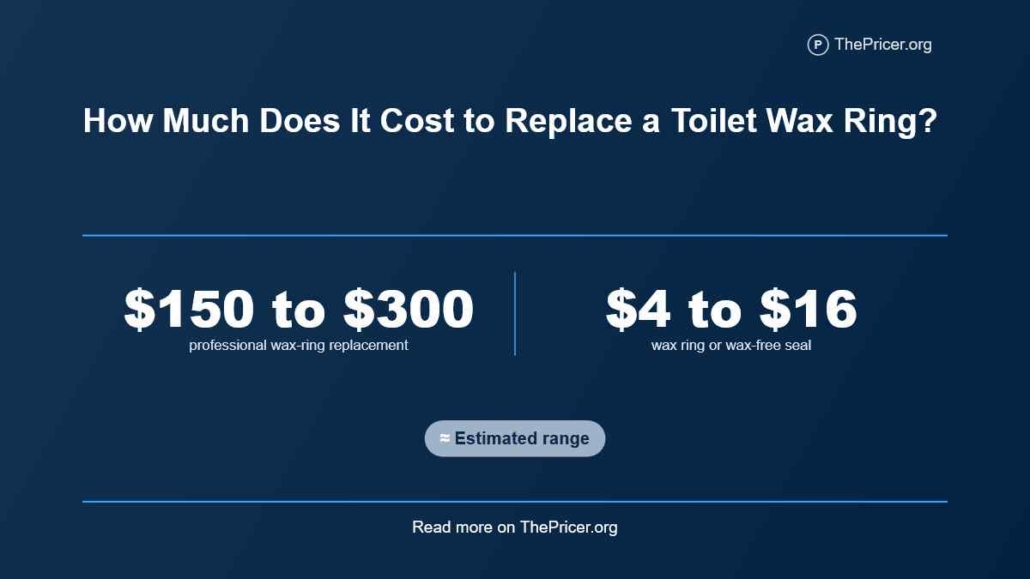
How Much Does It Cost to Replace a Toilet Wax Ring?
Angi’s July 2026 toilet-repair pricing puts wax-ring replacement at $50 to $200 (about 1.7 to 6.7 hours of work at $30 per hour). HomeGuide currently lists about $230 for a toilet reseat, which includes removing the toilet, replacing the wax seal, and setting the fixture back in place.
| Repair or part | Current price signal | What it covers |
|---|---|---|
| Basic professional wax-ring repair | $50-$200 | Angi 2026 repair range |
| Full toilet reseat | About $230 | HomeGuide remove, reseal, and reset benchmark |
| Basic wax ring | $3.98-$6.40 | Current Home Depot wax examples |
| Extra-thick reinforced wax ring | $9.99 | Used when the installation geometry calls for more thickness |
| Wax-free seal | About $10-$16 | Reusable-style alternative depending on product and installation |
| Toilet flange replacement | $85-$350 | Separate repair if the flange is damaged or unsuitable |
Home Depot’s current wax-ring listings include a wax ring and bolt kit at $5.70, an Oatey ring with horn and bolts at $6.40, a jumbo wax ring at $3.98, and an extra-thick reinforced ring at $9.99.
What You’re Paying For
The wax ring is a compressed gasket between the toilet outlet and the floor flange. It keeps flush water and sewer gas inside the drain connection. Once the toilet is lifted, the old wax must be scraped away, the flange inspected, a new seal positioned, and the toilet lowered squarely so the new wax compresses evenly.
Oatey’s current 2026 wax-ring installation guide rates the project as intermediate and says the repair can take under two hours. It also warns that toilets are heavy and recommends help when lifting one.
The plumber’s charge pays mostly for labor, travel, setup, handling the toilet, diagnosing the flange condition, and standing behind the reset. The seal itself is a very small part of the invoice.
Why a $5.70 Ring Becomes a $230 Repair
Use the current Home Depot wax-ring-and-bolt kit at $5.70 and HomeGuide’s $230 (about 7.7 hours of work at $30 per hour) toilet-reseat benchmark. The difference is $230 – $5.70 = $224.30.
The physical seal represents only $5.70 ÷ $230 = 2.5% of that modeled professional repair. The remaining 97.5% reflects the service and work around the part rather than the wax itself.
This also explains why bringing your own $6 ring rarely changes a professional quote. Even if the plumber charged no markup at all on the part, the large portion of the bill would remain.
DIY economics look very different. Angi’s current do-it-yourself guide puts the project supplies at up to $25. A homeowner who already has the necessary tools and can safely lift and reset the toilet can avoid most of the professional labor charge.
Choosing the Right Wax Ring
Paying more does not automatically buy a better seal. The correct ring depends on flange height, floor level, toilet design, and the condition of the mounting surface.
Oatey says a standard wax ring is appropriate when the flange sits at or slightly above the finished floor. If the flange is below the finished floor, an extra-thick ring or flange extender may be needed. Its current product guidance also says not to stack two wax rings as a substitute for correcting flange height.
Wax-free seals are another option. They can be cleaner to handle and some products can be repositioned or reused, but they are not automatically superior in every installation. The flange geometry still has to match the seal design.
If tile or another floor covering has raised the finished floor around an older flange, solving the height problem can matter more than buying a premium ring.
Hidden Price

The toilet flange anchors the fixture and provides the surface that the seal works against. A cracked flange, corroded bolt slots, loose anchoring, or the wrong height can prevent a new wax ring from sealing correctly.
HomeGuide currently puts toilet flange replacement at $85 to $350, including roughly $75 to $300 in labor for a simple job. Angi’s 2026 estimate is tighter at $145 to $165 on average for straightforward replacement.
Complete replacement is not always required. Oatey’s flange repair guidance shows separate repair-ring, extender, and replacement approaches depending on whether the flange is broken, too low, or otherwise unsuitable.
A simple $230 reseat plus a modeled $150 flange repair would become $380. If a long-running leak has damaged flooring or the drain connection, the final bill can move well beyond that amount.
Signs the Wax Ring May Have Failed
Water appearing at the toilet base after flushing is the classic warning sign. Other clues include a sewer odor near the fixture, water staining on the ceiling below an upstairs bathroom, soft or damaged flooring around the toilet, or a bowl that rocks because its mounting is unstable.
Oatey’s current wax-ring failure guidance lists pooling water, sewer odors, floor damage, rocking, and ceiling stains among the signs that warrant inspection.
A running toilet is different. Water that repeatedly refills the tank usually points to the flapper, fill valve, flush valve, or another tank-side problem. A failed wax ring sits below the bowl on the waste side and does not normally cause the fill valve to keep running.
Water at the base is not absolute proof of a wax-ring failure either. Supply-line leaks, tank-to-bowl leaks, condensation, or a cracked fixture can send water toward the same area. Drying the floor and watching when the leak appears can help distinguish a flush-related base leak from a supply-side drip.
DIY vs Professional Replacement
The repair is within reach for a mechanically capable homeowner, but the awkward part is handling the toilet without damaging it, the floor, or the new seal. The basic sequence is to shut off the water, drain and disconnect the toilet, remove the closet bolts, lift the toilet, scrape off the old wax, inspect the flange, install the new seal, reset the toilet, reconnect the supply, and test.
A wax ring cannot be reused after the toilet has compressed it. Oatey specifically instructs installers to use a new seal whenever the toilet is removed. That applies even when the original ring was not leaking before removal.
Professional help makes more sense when the toilet is unusually heavy, the flange is damaged, the fixture rocks because of floor problems, the bathroom is on an upper floor with evidence of hidden leakage, or the homeowner cannot safely lift and reset the bowl.
For broader labor context, see current plumber costs. A small fixture job can still trigger the plumber’s minimum service charge even when the physical repair takes little time.
Three Wax Ring Repair Budgets
Simple DIY reset. Use a current $5.70 ring-and-bolt kit plus a few dollars for cleanup and caulk. A homeowner with suitable tools can finish near $10 to $25 in new supplies if the flange is sound.
Straightforward professional reset. HomeGuide’s current benchmark is about $230. A local quote near $150 to $300 is a reasonable planning target when no secondary repair appears.
Wax ring plus flange problem. Start with the $230 reseat benchmark and add a modeled $150 straightforward flange repair. The result is $380. Water-damaged subfloor, cast-iron drain work, or a flange set in concrete can take the project higher.
Who This Cost Makes Sense For
Makes sense if:
- Water appears at the base during or shortly after flushing and the source has been narrowed to the toilet connection.
- The toilet has already been removed for another repair and needs a new seal before resetting.
- The flange has been checked for height, damage, and secure anchoring before the new ring is compressed.
- The professional quote includes removing, resetting, reconnecting, and leak-testing the toilet.
Does not make sense if:
- You are replacing the wax ring every five or ten years even though the toilet has not been removed and the seal has no symptoms.
- A running toilet or high water bill is being blamed on the wax ring without checking the tank components.
- An extra-thick ring is being used to hide a broken or badly positioned flange.
- The toilet rocks after installation and the movement is ignored instead of correcting the mounting problem.
What We Verified and Related Costs
- Checked the difficulty and supply cost against Angi’s April 2026 wax-ring replacement guide, which rates the DIY job as intermediate, about two hours, and up to $25 in supplies.
- Confirmed the expected service life through Oatey’s current wax-ring guidance, which says a properly installed seal can last many years and that a new ring should be installed whenever the toilet is removed.
- Cross-referenced current Oatey retail pricing with Home Depot’s Oatey wax-ring listings, where standard products currently sit around $4.45 to $6.40.
- Verified the repair-versus-extender decision against Oatey’s toilet reset and flange guide, which uses repair rings for damaged flanges and extenders when the flange sits below the finished floor.
If the flange is cracked, badly corroded, or too low, compare the repair with current toilet flange replacement costs. If the fixture itself is cracked or inefficient, the cost of a new toilet installation may be more useful than repeatedly repairing an old unit.
Water that turns out to come from the supply line, shutoff valve, or another plumbing joint belongs in a different repair category. Current water leak repair costs show how access and leak location change that bill.
Answers to Common Questions
How much does a plumber charge to replace a toilet wax ring?
A straightforward professional replacement commonly costs about $150 to $300. Angi’s 2026 wax-ring range is $50 to $200, while HomeGuide uses about $230 for removing, resealing, and resetting the toilet.
How much does the wax ring itself cost?
Current basic wax rings are commonly around $4 to $10. Home Depot currently lists examples from $3.98 to $9.99, while wax-free seals can cost roughly $10 to $16.
How often should a toilet wax ring be replaced?
There is no five-year or ten-year replacement schedule. A correctly installed wax ring can last many years, often as long as the toilet remains undisturbed. Install a new ring whenever the toilet is removed or when the seal fails.
Can you reuse a wax ring after removing the toilet?
No. Traditional wax rings compress when the toilet is installed and should be replaced after the toilet is lifted. A new ring is inexpensive compared with the cost of repeating the entire reset because an old seal leaked.
How do I know whether the wax ring or flange is bad?
A wax-ring leak can cause flush water or sewer odor at the base. A loose or damaged flange can also make the toilet rock and prevent the seal from staying compressed correctly. The flange should be inspected after the toilet is lifted before assuming a new ring alone solves the problem.
Price note: Toilet wax-ring replacement costs vary with local service minimums, toilet size and weight, flange condition, floor damage, access, and whether another plumbing problem caused the leak. Have the flange inspected before the toilet is reset and confirm what the professional quote includes.
Disclosure: Educational content, not financial advice. Prices reflect public information as of the dates cited and can change. Confirm current rates, fees, taxes, and terms with official sources before purchasing. See our methodology and corrections policy.