
How Much Does it Cost to Open a Laundromat?
Updated on | Written by Alec Pow
This article was researched using 8 sources. See our methodology and corrections policy.
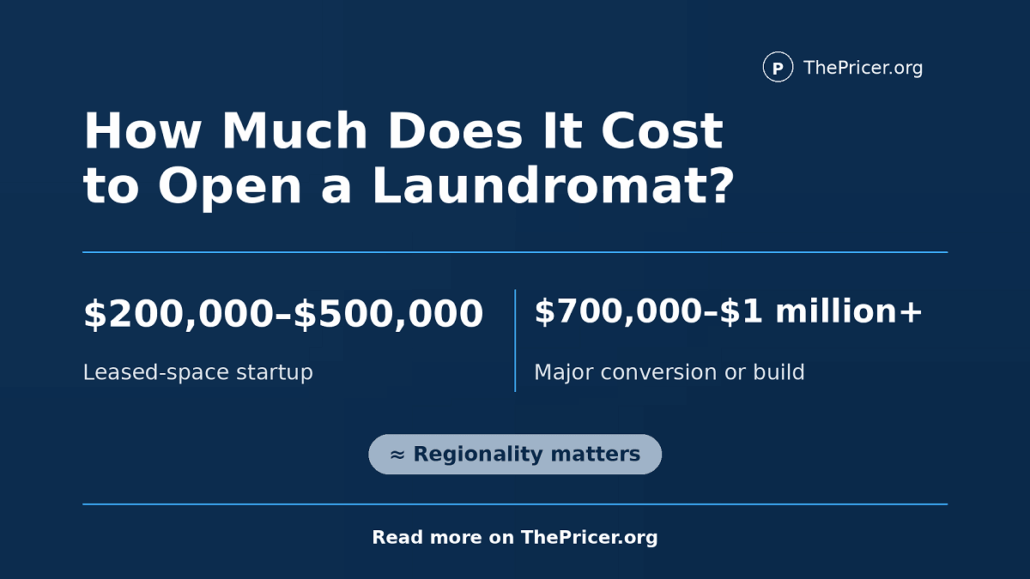
Opening a laundromat commonly costs $200,000 to $500,000 when leasing a commercial space and installing a modern mix of washers and dryers. Retooling an existing laundromat may cost about $100,000 to $300,000, while converting an unfinished retail shell, constructing a new building, or buying the real estate can push the investment from $700,000 to more than $1 million.
The machines are only part of the budget. A new operator may also pay for water and sewer connections, gas lines, electrical service, dryer exhaust, water heating, concrete pads, permits, architectural plans, payment systems, signage, security, lease deposits, insurance, professional fees, opening inventory, and several months of working capital.
The cheapest path is usually taking over a former laundry with usable utility infrastructure. The most expensive path is converting ordinary retail space that lacks the water, sewer, gas, power, venting, and floor capacity needed for dozens of commercial machines.
Article Highlights
Jump to sections
- A leased-space laundromat commonly requires $200,000 to $500,000 (at $30 per hour, earning that amount would take about 3.2 to 8 years of full-time work, before taxes).
- Retooling a former laundromat may cost $100,000 to $300,000.
- A raw-shell conversion or ground-up project can cost $700,000 to $1 million+.
- Commercial laundry equipment may consume 35% to 55% of the startup budget.
- Plumbing, sewer, gas, electrical, and venting upgrades can add $75,000 to $300,000+.
- Working capital should cover at least three to six months of operating expenses.
- Buying an existing store requires verified utility bills, machine records, lease terms, and tax returns.
Laundromat Startup Costs
| Startup path | Planning range | What the investment usually covers |
|---|---|---|
| Small existing laundromat acquisition | $100,000 to $300,000 (about 1.6 to 4.8 years of full-time work at $30 per hour) | Operating business, older equipment, lease rights, and customer base |
| Retool a former laundromat | $150,000 to $350,000 | New machines, repairs, payment system, cosmetics, and limited utility work |
| New store in fitted commercial space | $200,000 to $500,000 | Equipment, moderate build-out, permits, deposits, and working capital |
| Raw retail shell conversion | $400,000 to $900,000+ | Equipment plus major water, sewer, gas, electrical, structural, and venting work |
| Ground-up building or real-estate purchase | $700,000 to $3 million+ | Land or property, construction, site work, equipment, financing, and reserves |
Current business-cost estimates place many mid-sized laundromat launches near $200,000 to $500,000. Nav publishes a much wider 2026 range of $50,000 to more than $3 million because it includes small acquisitions, major renovations, property purchases, and new construction.
The wide range is not a contradiction. A buyer taking over a functioning 1,500-square-foot neighborhood store faces a different project from an owner developing a 5,000-square-foot laundry with new real estate, large-capacity machines, wash-dry-fold service, pickup vehicles, and extensive utility work.
What You Are Actually Opening

A laundromat is a utility-intensive retail business built around commercial washers, tumble dryers, customer payment systems, water heating, drainage, ventilation, and repeated daily equipment use. Some stores remain unattended and focus on self-service laundry. Others employ attendants and add wash-dry-fold, commercial accounts, pickup and delivery, vending, dry-cleaning drop-off, or alteration services.
The store is not priced like an ordinary retail shop. A former clothing store may have enough floor area but still lack the sewer capacity, hot-water production, gas supply, electrical panels, roof penetrations, make-up air, and reinforced machine bases needed for laundry equipment.
Each washer has a specific capacity, water requirement, drain connection, electrical load, and mounting method. Dryers require gas or electric service, exhaust ducts, combustion air, and lint management. Payment equipment can range from coin drops to centralized card systems and mobile apps.
Commercial Washer Costs
Commercial washers can cost from about $1,500 to $15,000+ (about 1.3 to 12.5 full-time workweeks at $30 per hour) each before freight and installation. Price rises with drum capacity, extraction speed, control system, mounting type, water efficiency, brand, warranty, and included payment hardware.
Small top-load units may begin near $1,000 to $2,500. Front-load machines in the 20- to 30-pound range often cost about $3,000 to $7,000. Larger 40-, 60-, and 80-pound washer-extractors may cost $7,000 to $15,000+ per machine.
A current laundromat equipment guide places stacked commercial dryers near $6,000 per unit and notes that front-load washers can cost several thousand dollars each in its 2026 startup estimate.
High-capacity machines cost more but can improve revenue per square foot. Customers use them for comforters, household loads, rugs, and several baskets of clothing. A store filled only with small machines may have a lower equipment invoice but miss demand for larger loads.
Machine prices should be compared after adding freight, lift-gate service, bases, anchoring, plumbing, drains, electrical work, gas connections, dryer venting, programming, commissioning, and payment hardware. A $6,000 washer can become a $7,500 to $9,000 installed line item.
Equipment Mix for a Mid-Sized Store
A 2,500- to 3,500-square-foot laundromat might contain 25 to 40 washers and dryers, depending on machine sizes and whether stacked dryers are used. The equipment package may include several small washers, a larger group of 30- and 40-pound units, a few 60- to 80-pound machines, and enough dryer capacity to keep customers from waiting.
One possible package could include:
- Eight 20-pound washers at $4,000 each: $32,000
- Eight 30-pound washers at $6,000 each: $48,000
- Six 40-pound washers at $8,000 each: $48,000
- Four 60-pound washers at $11,000 each: $44,000
- Eight stacked dryer units at $7,000 each: $56,000
The machine-only total is $228,000. Payment systems, freight, bases, installation, commissioning, spare parts, and tax could raise that equipment package to about $250,000 to $285,000.
This example also shows why the old article’s claim that a 20-machine store might need only $100,000 in equipment can be misleading. It may be possible with small used machines, but it is not a dependable budget for a modern mix of new commercial equipment.
The Utility Build-Out Trap
The largest budget surprise often appears behind the walls and beneath the floor. A laundromat needs high-volume water supply, large drains, adequate sewer capacity, substantial hot-water production, gas piping, dryer exhaust, make-up air, and enough electrical service for dozens of machines.
Converting a former laundry may require only repairs and new connections. Converting an ordinary store can require trenching the concrete slab, installing new floor drains, replacing the water service, increasing the sewer line, upgrading the gas meter, adding roof penetrations, and rebuilding electrical panels.
A basic build-out may cost $75,000 to $150,000. A raw-shell conversion can reach $150,000 to $300,000+ before equipment. Sewer tap fees, municipal impact fees, transformer upgrades, concrete repairs, roof work, and difficult utility access can increase the total.
The old article’s $20,000 to $50,000 build-out allowance would cover only limited cosmetic and connection work in many markets. It is not enough for a full utility conversion.
This same infrastructure problem appears in other water-heavy businesses. A new laundry can require an investment closer to building a self-service car-care site than opening a simple neighborhood shop because plumbing, drainage, power, and equipment drive the design.
Water, Sewer, Gas, and Power
Utility rates can decide whether a location works financially. Two stores with the same customer volume can produce very different profits when one municipality charges substantially more for water and sewer.
Request at least 12 to 24 months of utility bills for an existing store. Compare gallons used, sewer charges, gas consumption, electricity, seasonal changes, operating hours, equipment age, and any landlord reimbursements.
ENERGY STAR reports that certified commercial washers use about 45% less water and are about 9% more energy efficient than standard models on average. Those percentages do not predict one store’s bill, but they show why machine selection can affect long-run operating cost.
Water heating also matters. A store may use gas-fired storage heaters, boilers, tankless systems, or equipment designed to reduce hot-water demand. The system must recover fast enough during peak periods when many washers start close together.
Dryers consume gas or electricity and need clean exhaust ducts. Restricted airflow lengthens drying time, increases energy consumption, and reduces the number of customers each dryer can serve during busy hours.
Lease Costs and Site Deposits
A leased laundromat may require the first month’s rent, last month’s rent, a security deposit, utility deposits, insurance, legal review, and several months of rent before the store opens. Construction delays can create rent expense while the machines are not producing revenue.
A tenant leasing a space for $7,500 per month and paying a three-month deposit commits $22,500 before construction. Six months of rent during design, permits, and construction adds another $45,000.
The lease must be long enough to recover the build-out and equipment investment. A short initial term or weak renewal options can leave the owner with expensive machines and plumbing improvements in a property they no longer control.
Check whether the landlord permits roof penetrations, utility upgrades, floor trenching, exterior vents, large signage, late hours, parking demand, delivery vehicles, and assignment of the lease to a future buyer.
Common-area maintenance, property-tax pass-throughs, insurance charges, rent escalations, trash service, water allocation, and repair obligations should be included when calculating occupancy cost.
Permits and Professional Fees
Architects, engineers, contractors, lawyers, accountants, and permit agencies can add $20,000 to $75,000+ to a new project. A raw-shell conversion or property development can cost more.
Possible approvals include building, plumbing, electrical, mechanical, fire, signage, accessibility, health, sewer, backflow, gas, and business permits. Plans may require architectural drawings, equipment schedules, utility calculations, ventilation details, structural information, and accessibility layouts.
The budget may also include entity formation, lease negotiation, environmental review, lender reports, appraisals, equipment inspections, franchise or distributor consulting, and contractor bonds.
The IRS allows qualifying businesses to elect a deduction of up to $5,000 for certain startup costs and another $5,000 for organizational costs, with the deduction reduced when qualifying costs exceed $50,000, according to Publication 583. Equipment, building improvements, and other capital assets follow different tax treatment, so an accountant should classify each expense.
Payment and Security Systems
A basic coin-operated store may spend $5,000 to $15,000 on change machines, coin boxes, locks, counters, and related hardware. A centralized card or mobile payment system can cost $15,000 to $50,000+, depending on machine count and features.
Modern systems may support variable pricing, loyalty programs, remote refunds, machine monitoring, app payments, customer messages, revenue reports, and equipment-status alerts. They can also create ongoing processing, software, cellular, or support fees.
Security cameras, alarms, access control, lighting, mirrors, panic buttons, safes, and reinforced cash-handling areas may add $5,000 to $20,000. A 24-hour unattended operation usually needs a stronger security plan than an attended daytime store.
Card processing fees must be included in pricing decisions. A store can collect more conveniently through cards and apps, but a percentage of those sales may go to processing and platform fees.
Opening Inventory and Amenities
Folding tables, carts, seating, trash cans, signs, cleaning supplies, vending machines, televisions, Wi-Fi equipment, soap inventory, laundry bags, office equipment, and attendant stations can add $10,000 to $40,000.
Wash-dry-fold service requires scales, sorting tables, racks, bins, bags, labels, shelving, point-of-sale software, and a defined customer-storage area. Pickup and delivery can add a vehicle, commercial auto insurance, routing software, drivers, and fuel.
A vending machine may create extra revenue, but detergent, softener, dryer sheets, drinks, snacks, and bags tie up cash and require restocking. The store must also decide whether vending machines are purchased, leased, or supplied by an outside operator.
Working Capital Before Break-Even
A new laundromat should not open with every available dollar tied up in machines and construction. The store may need months to build traffic while rent, utilities, payroll, insurance, loan payments, repairs, marketing, and software bills continue.
A working-capital reserve of $30,000 to $100,000+ is reasonable for many projects. A large attended store or wash-dry-fold operation may need more because payroll begins before recurring service volume is established.
Three months of operating expenses at $25,000 per month equals $75,000. Six months equals $150,000. A lender may require part of this cash reserve as a condition of financing.
Unexpected expenses can arrive early. A new owner may face sewer backups, card-system problems, water-heater repairs, equipment warranty delays, weak opening traffic, increased insurance, or construction invoices that exceed allowances.
Buying an Existing Laundromat
An existing laundromat can reduce construction risk because the location already has drains, water lines, gas, exhaust ducts, electrical service, and operating approvals. It may also come with customers and immediate revenue.
The asking price should not be based only on gross sales. Review tax returns, bank deposits, payment-system reports, coin collections, utility bills, payroll, lease statements, machine age, repair logs, insurance, vending income, wash-dry-fold records, and owner expenses.
Cash-heavy businesses require extra verification. Compare reported washer revenue with water usage, machine counts, vend prices, and estimated turns per day. A seller claiming strong cash sales without matching utility usage or deposits creates a major diligence problem.
The lease may be more valuable than the machines. Review the remaining term, renewal options, scheduled rent increases, transfer rights, personal guarantees, common-area charges, repair duties, and any landlord consent needed for a sale.
Used machines can lower the purchase price but create deferred replacement cost. A buyer acquiring a $250,000 store that soon needs $150,000 in new equipment is effectively making a $400,000 investment.
Financing a Laundromat
Laundromat projects may be financed with owner cash, equipment loans, conventional bank financing, seller financing, investors, SBA-backed loans, or a combination of sources.
The SBA 7(a) program can support business acquisitions, working capital, real estate, equipment, furniture, fixtures, supplies, refinancing, and changes of ownership under its approved uses of proceeds.
SBA 504 loans provide long-term fixed-rate financing for major fixed assets such as owner-occupied real estate and heavy equipment. They are not designed as general working-capital loans, according to the 504 loan program.
Equipment manufacturers and distributors may also offer financing. Huebsch, for instance, advertises financing and periodic equipment promotions through authorized distributors on its commercial finance page.
Loan approval can depend on credit, cash injection, collateral, management experience, projections, lease length, equipment value, and debt-service coverage. The fact that a program permits a use does not mean every applicant or project will qualify.
ThePricer Startup Budget
Consider a 3,000-square-foot leased laundromat opening in a former retail space. The owner plans a 34-machine equipment mix, card payments, an attended counter, and a modest wash-dry-fold operation.
- Washers and dryers: $225,000
- Freight and machine installation: $28,000
- Plumbing, drains, gas, electrical, and venting: $145,000
- Architectural plans, engineering, and permits: $28,000
- Card payment system: $22,000
- Water heating: $18,000
- Flooring, paint, lighting, counters, and signs: $36,000
- Security, Wi-Fi, carts, tables, and vending: $21,000
- Lease and utility deposits: $24,000
- Insurance, legal, accounting, and opening marketing: $13,000
- Working-capital reserve: $60,000
The total startup budget is $620,000. The equipment itself represents 36.3% of the investment. Utility infrastructure and installation total $191,000, equal to another 30.8%.
ThePricer calculation: the machines, freight, installation, and utility work together cost $398,000. That is 64.2% of the entire startup budget. The remaining $222,000 pays for the location, approvals, customer systems, furnishings, professional work, and enough cash to survive the opening period.
Revenue by Machine Turns
Laundromat revenue is often modeled through turns per day, meaning the average number of paid cycles completed by each washer. The number must be estimated separately for each machine size because vend prices and customer demand differ.
Assume a 26-washer store averages three paid washer turns per day at an average vend price of $6. Daily washer revenue equals 26 machines multiplied by three turns and $6, producing $468.
Across 30 days, washer revenue is $14,040. If dryer revenue equals 45% of washer revenue, dryers add about $6,318. The combined self-service revenue becomes $20,358 per month.
Adding $8,000 in wash-dry-fold sales and $1,000 from vending produces total monthly revenue of $29,358, or about $352,296 per year.
This is scenario math, not a promised result. A store averaging 1.5 turns per day would produce about half as much washer revenue. A strong urban store with high demand, good parking, modern machines, and long hours may perform better.
Monthly Operating Costs
Operating expenses should be modeled line by line rather than assumed to equal a fixed percentage of revenue. A laundromat may pay for rent, water, sewer, gas, electricity, labor, payroll taxes, repairs, cleaning, insurance, payment processing, software, trash, marketing, supplies, security, accounting, and debt service.
A sample monthly budget for the $29,358 revenue scenario might include:
- Rent and occupancy charges: $7,500
- Water and sewer: $3,600
- Gas and electricity: $2,700
- Payroll and payroll costs: $5,000
- Repairs and maintenance: $1,400
- Insurance, software, security, and accounting: $1,000
- Payment processing and supplies: $1,200
- Marketing, cleaning, and trash: $800
Operating expenses total $23,200 before debt payments, depreciation, income tax, and owner compensation. Operating cash flow is $6,158 per month, or $73,896 per year.
If loan payments total $4,500 per month, cash remaining before tax and owner distributions falls to $1,658 per month. This is why a store can appear profitable before financing yet produce little owner cash after debt service.
Profit Is Not Guaranteed
The old article stated that owners could expect to break even within one to two years and earn $50,000 to $150,000 annually. Those results are possible, but they should not be presented as standard outcomes.
Profit depends on store traffic, turns per day, vend pricing, rent, utility rates, payroll, loan payments, machine downtime, equipment age, repair costs, and whether the owner works in the business.
A debt-free existing store with modest rent may produce strong cash flow at moderate revenue. A newly built store with a large loan can generate much higher sales yet leave less cash after debt payments.
Wash-dry-fold can raise revenue but also adds labor, supplies, customer claims, storage, rewash risk, and management. Pickup and delivery can expand the service area while adding vehicles, drivers, software, fuel, and route inefficiency.
Other capital-intensive businesses show the same divide between revenue and owner earnings. A food business such as an 85 Degrees Bakery franchise may report substantial sales while occupancy, labor, equipment, supplies, and financing determine the amount retained by the operator.
When the Investment Makes Sense
Makes sense when:
- The trade area has enough renters, multifamily housing, students, or households without in-unit laundry.
- The lease provides enough time and renewal control to recover the build-out.
- Utility capacity and rates have been verified before signing.
- The machine mix matches local household size and customer demand.
- The project retains enough working capital after construction.
Does not make sense when:
- The financial model depends on unverified cash sales or unrealistic turns per day.
- The landlord offers only a short lease after the tenant pays for major plumbing.
- The sewer, gas, water, electrical, or venting scope remains unknown.
- The owner uses every available dollar for equipment and has no reserve.
- The acquisition price ignores old machines and near-term replacement costs.
Before Signing a Lease
Obtain written confirmation of water pressure, sewer capacity, gas volume, electrical service, roof access, drainage, parking, hours, signage, and permitted use. A landlord’s verbal statement that a laundry should be possible is not enough.
Have an equipment distributor, plumber, electrician, mechanical contractor, architect, and local permit office review the proposed site. Their early feedback can expose a $200,000 utility problem before the lease becomes binding.
Request a construction period with free or reduced rent. Negotiate renewal options, assignment rights, exclusivity, utility responsibilities, restoration duties, and approval for vents, roof penetrations, signage, equipment delivery, and floor cutting.
Build a contingency of at least 10% to 15% into the construction budget. A $250,000 build-out with a 12% contingency carries another $30,000 for concealed conditions, price changes, and permit revisions.
What We Verified
- Checked current laundromat startup ranges against 2025 and 2026 business-financing estimates.
- Confirmed that SBA 7(a) financing can support equipment, acquisitions, real estate, and working capital.
- Cross-referenced SBA 504 financing with its permitted use for major fixed assets.
- Verified ENERGY STAR’s published water and efficiency comparison for certified commercial washers.
- Confirmed current IRS treatment for qualifying startup and organizational cost deductions.
Answers to Common Questions
How much money do you need to open a laundromat?
Many leased-space laundromats require $200,000 to $500,000. A major conversion, property purchase, or ground-up project can cost $700,000 to more than $1 million.
How much does laundromat equipment cost?
A complete washer and dryer package commonly costs $100,000 to $300,000+. Store size, machine capacity, brand, payment system, freight, and installation affect the total.
Is it cheaper to buy an existing laundromat?
It can be. Existing plumbing, drains, gas, venting, electrical service, and customers may reduce startup risk. Old machines, a poor lease, weak sales, and deferred repairs can erase the saving.
How much working capital should a laundromat have?
Plan for at least three to six months of rent, utilities, payroll, insurance, repairs, marketing, and loan payments. Many projects need $30,000 to $100,000+ in reserves.
How long does it take for a laundromat to become profitable?
There is no fixed timeline. A store can produce operating profit soon after opening, but recovering the original construction and equipment investment may take several years.
Disclosure: Educational content, not financial advice. Prices reflect public information as of the dates cited and can change. Confirm current rates, fees, taxes, and terms with official sources before purchasing. See our methodology and corrections policy.