
How Much Does a Netherland Dwarf Bunny Cost?
Updated on | Written by Alec Pow
This article was researched using 14 sources. See our methodology and corrections policy.
A Netherland Dwarf rabbit currently costs about $199 to $599+ from the specialty U.S. breeders with public prices that we found, while rescue adoption can be around $70 to $100. Adorabunny currently publishes $250 to $500 pricing depending on color, parents, individual characteristics, and show potential on its Netherland Dwarf pricing chart.
The rabbit itself is often one of the smaller first-year expenses. CBA Rabbitry currently prices its companion-grade Netherland Dwarfs at $199 to $349, premium rabbits at $399 to $549, and its highest Signature grade at $599+. The same breeder pricing and transport page lists shared ground transportation at another $130 to $190 depending on destination.
Purchase price is only the acquisition line. Housing, hay, pellets, greens, litter, spay or neuter surgery when not already completed, routine veterinary care, and an emergency reserve can make the first year cost several times more than the rabbit.
Article Highlights
Jump to sections
- Current specialty-breeder examples run from about $199 to $599+ (at $30 per hour, earning that amount would take about 0.8 to 2.5 full-time workdays, before taxes).
- A current rescue example charges $70, rising to $100 after a second vaccine, and includes neuter, vaccination work, and a microchip.
- Ground transport alone can add $130 to $190 to a breeder purchase.
- Rabbit spay or neuter surgery commonly costs about $200 to $300 and can exceed $500.
- A three-item starter basket using current retail prices already reaches about $69.50 before a carrier, flooring, bowls, hides, toys, and bunny-proofing.
- A simple recurring hay, pellet, and litter shopping scenario comes to about $506.96 per year before fresh greens.
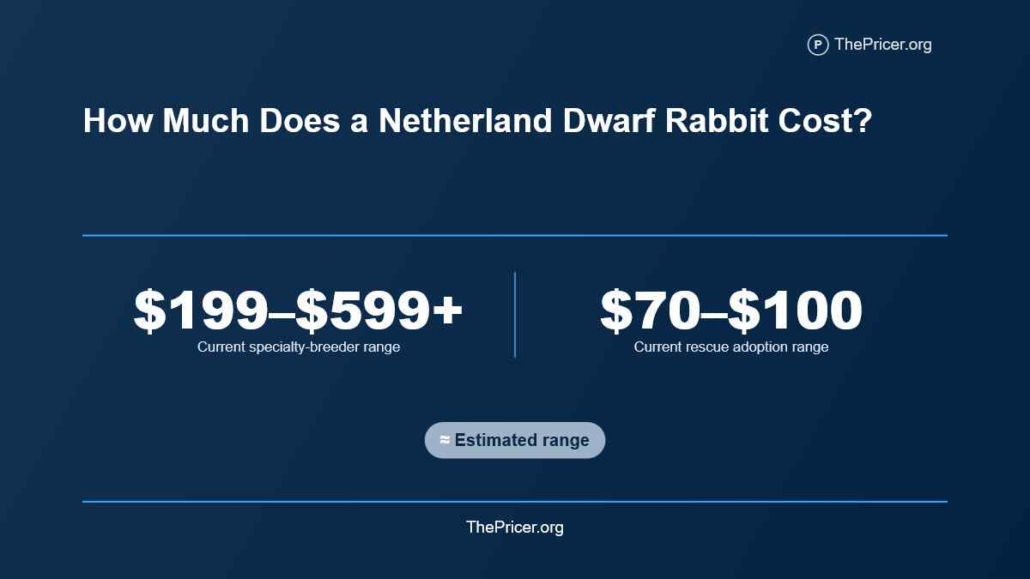
How Much Does a Netherland Dwarf Rabbit Cost?
| Current cost example | Price | What the number covers |
|---|---|---|
| Adorabunny | $250 to $500 (about 1 to 2.1 full-time workdays at $30 per hour) | Published pricing varies by color, parents, individual characteristics, and show potential. |
| CBA Rabbitry Grade A | $199 to $349 | Companion rabbits with some conformation variation. |
| CBA Rabbitry Premium | $399 to $549 | Higher conformation grade with a show-line parent. |
| CBA Rabbitry Signature | $599+ | Highest published grade, including show-line traits or rarer coat colors. |
| Current rescue example | $70 to $100 | Neuter, vaccination work, and microchip are included in the cited listing. |
| Breeder ground transport | $130 to $190 | CBA’s published shared-ride estimate, depending on U.S. region. |
| Rabbit spay or neuter | $200 to $300 common, $500+ possible | Procedure price varies with sex, clinic, health, and included services. |
A rescue can look more expensive than an old $25 classified-ad rabbit, but the comparison fails once medical work is counted. A live 2026 Petfinder listing for a Netherland Dwarf named Beans states a $70 adoption donation including neuter, first RHDV vaccine, and microchip, with the fee moving to $100 after his second vaccine. That current Netherland Dwarf rescue listing is much more useful than an old generic shelter estimate.
What You’re Actually Buying
The Netherland Dwarf is a very small domestic rabbit with a compact body, short upright ears, a round head, and short coat. Its size does not turn it into a cage pet. It still needs room to run, stand upright, forage, hide, chew, rest, and interact on its own terms. The breed can be energetic and initially shy or skittish, and its small body can be injured by rough handling. That makes calm adult handling and a secure living area a better fit than frequent carrying by young children.
Pedigree and show potential also describe a different purchase from a companion rabbit. A higher breeder grade may reflect conformation, bloodline, coat color, or traits valued in showing. None of those labels removes the normal cost of food, veterinary care, housing, litter, or enrichment. A pet buyer who does not intend to show or breed the rabbit has little financial reason to pay a premium only for show traits. Another compact breed can carry a different grooming burden, which is worth checking against current Lionhead rabbit costs.

The $70 Rescue Advantage
The hidden value in adoption is medical work that may already be included. PetMD currently puts rabbit spay or neuter surgery around $200 to $300 (about 0.8 to 1.3 full-time workdays at $30 per hour) in the U.S., with some cases rising above $500, according to its rabbit surgery cost guidance. The same acquisition-versus-medical-cost issue appears when comparing Holland Lop prices.
Compare that with the $100 rescue example after the second vaccine. A breeder rabbit bought for $250 plus a $200 to $300 surgery already reaches $450 to $550 before counting vaccination or microchipping. Against the $100 rescue case, that is a difference of $350 to $450 using only the rabbit and surgery lines.
The gap becomes larger at the top of the breeder market. A $599 rabbit plus $150 to $190 in cross-country transport produces a delivered acquisition figure of $749 to $789 before veterinary work. Add a $200 to $300 spay or neuter and the subtotal reaches $949 to $1,089. A higher pedigree may be worth paying for a show or breeding program, but it does not make routine pet ownership cheaper.
Small Rabbit, Big Housing
Netherland Dwarfs are tiny, but buying a tiny cage to match the rabbit is false economy. Rabbits need a living area that lets them hop, run, stretch, stand upright, hide, and exercise. Space also needs to accommodate litter, hay, water, resting spots, and enrichment rather than leaving the rabbit surrounded by equipment.
Current retail pricing shows how quickly even the basic hardware starts to stack up. A MidWest small-pet exercise pen is currently $53.51 in Chewy’s rabbit playpen listings. An Oxbow rectangular litter pan is $15.99 on the retailer’s rabbit litter-pan page. Those two pieces alone total $69.50.
That $69.50 is not a complete enclosure budget. It excludes a carrier, floor protection, hiding places, bowls, hay storage, toys, cord covers, gates, and any larger pen or room modifications. Buying a small cage because the breed weighs only a few pounds can save money at checkout while failing to provide the usable exercise area a rabbit needs.
Food Is a Recurring Bill
Adult rabbits need unlimited grass hay as the main part of the diet, with fresh greens and a smaller amount of pellets. Rabbit.org describes hay as about 80% of a suitable rabbit diet and explains its role in gut and dental health in its rabbit hay guidance.
Current retail prices give a better budget signal than the old claim that all food costs only $10 to $20 per month. Chewy currently lists a 6-pound Kaytee Timothy hay bag at $17.95 on its rabbit hay page. A 9.5-pound Kaytee Timothy Complete pellet bag is $15.95 on the current pellet listing, while a 20-liter package of Fresh News paper litter costs $18.98 on the paper litter product page.
Here is a ThePricer shopping scenario, not a feeding prescription. If a household buys one $17.95 hay bag each month, one $18.98 litter package each month, and one $15.95 pellet bag every three months, the annual total is $506.96. The arithmetic is $215.40 for hay, $227.76 for litter, and $63.80 for pellets. Fresh greens, treats, replacement toys, cleaning supplies, and waste sit outside that number.
Three First-Year Budgets
Case 1: Current rescue route. Start with the later $100 rescue fee from the Beans example, add the $69.50 pen-and-litter-pan starter hardware, then add the $506.96 recurring hay, pellet, and litter shopping scenario. The documented-cost floor is $676.46 before fresh greens, a carrier, extra housing pieces, routine veterinary visits, and emergencies. The rescue listing already includes neuter, vaccination work, and microchipping.
Case 2: A $250 breeder rabbit. Add $200 to $300 for spay or neuter, $69.50 for the two starter hardware items, and $506.96 for the same consumables scenario. That produces $1,026.46 to $1,126.46 before greens, vaccination, microchipping, a carrier, routine veterinary visits, and emergencies.
Case 3: Transported Signature-grade rabbit. Take the published $599+ rabbit price, add $150 to $190 eastern U.S. transport, $200 to $300 surgery, $69.50 in starter hardware, and $506.96 in recurring consumables. The resulting first-year floor is $1,525.46 to $1,665.46+ before the same omitted costs.
Worked example: compare the $100 rescue route with the $250 breeder route. Using the same hardware and consumables, the rescue floor is $676.46. The breeder floor with a $250 surgery is $1,076.46. The difference is $400, and it comes entirely from the purchase and surgery lines. The cage size and food bill do not shrink because one rabbit came from a breeder.
Netherland Dwarfs are also a long commitment. Using a 10-year ownership window and repeating only the $506.96 consumables basket produces $5,069.60 in hay, pellets, and litter. At 12 years, the same shelf-price scenario reaches $6,083.52. Neither figure includes greens, veterinary care, housing replacement, boarding, or emergencies, so it is a floor rather than a lifetime forecast.
When This Breed Fits
Makes sense if:
- You can provide a large, safe indoor living and exercise area despite the rabbit’s small body size.
- You are comfortable with a rabbit that may need time before accepting handling and close contact.
- You can budget for rabbit-experienced veterinary care rather than treating the breed as a low-cost pocket pet.
- You can provide daily feeding, cleaning, exercise, health observation, and social contact.
Does not make sense if:
- The purchase plan depends on keeping the rabbit permanently in a small cage.
- The budget stops after the breeder or adoption fee.
- Young children are expected to carry the rabbit frequently without close adult supervision.
- No rabbit-experienced veterinary clinic is accessible for routine and urgent care.
What We Verified
- Checked: veterinary-reviewed breed information lists Netherland Dwarfs at about 2 to 2.5 pounds and gives a 10-to-12-year lifespan on the PetMD Netherland Dwarf profile.
- Confirmed: rabbit housing should allow running, hopping, standing upright, hiding, and constant access to exercise space, while compatible rabbit companionship is recommended in the RSPCA housing guidance.
- Cross-referenced: breed-specific welfare guidance describes Netherland Dwarfs as potentially timid and easily frightened and says rabbits are poorly suited to small children who may pick them up, according to the PDSA breed profile.
Related Rabbit Costs
Rabbits with very different coats can carry different care workloads, which is easy to see in Angora rabbit costs. Wild or restricted animals belong to a completely different ownership category, as the cost of a pet otter shows.
Answers to Common Questions
How much is a Netherland Dwarf rabbit?
Current specialty-breeder examples support about $199 to $599+. Rescue adoption can be around $70 to $100, and may include medical work that a breeder price does not.
How much does a Netherland Dwarf cost in the first year?
Using current documented prices, a rescue-based floor can start around $676.46, while the breeder scenarios above begin around $1,026.46 and can exceed $1,600. These floors still exclude fresh greens, full housing, routine vet visits, and emergencies.
How long do Netherland Dwarf rabbits live?
Veterinary-reviewed breed guidance gives an average lifespan of about 10 to 12 years, so even a low purchase price leads to a long ownership commitment.
Can I leave a Netherland Dwarf rabbit alone for two days?
Do not plan on a rabbit going 48 hours without a responsible person checking it. Rabbits need daily feeding, fresh water, cleaning, interaction, and health observation, and the RSPCA calls for daily health checks in its rabbit health guidance.
Are Netherland Dwarf rabbits good pets for children?
They can live successfully in a family, but their tiny bodies and often cautious temperament make them a poor choice for frequent handling by very young children. Adults should remain responsible for care and supervise handling.
Disclosure: Educational content, not medical advice. Pricing varies by provider, location, and insurance. Confirm eligibility, coverage, and out-of-pocket costs with a licensed clinician and your insurer. See our methodology and corrections policy.