
How Much Does the Exogen Bone Stimulator Cost?
Updated on | Written by Alec Pow
This article was researched using 13 sources. See our methodology and corrections policy.
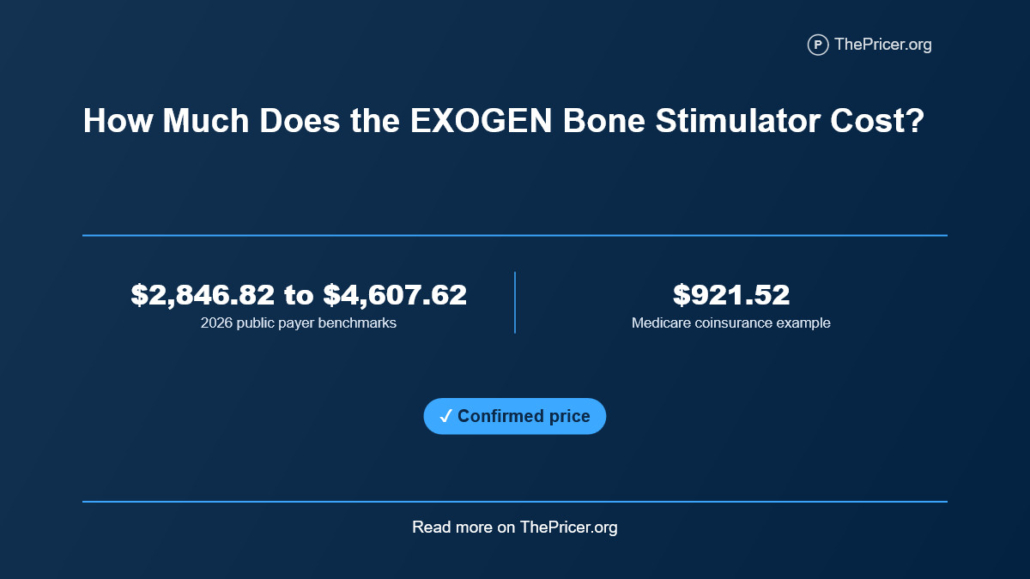
The EXOGEN bone stimulator is a several-thousand-dollar prescription device, but the amount a patient actually pays can be far lower. In 2026, public payer schedules for HCPCS E0760 show useful benchmarks from $2,846.82 in the Illinois Medicaid durable medical equipment schedule to $4,607.62 in Medicare’s second-quarter Jurisdiction B fee schedule for a new low-intensity ultrasound osteogenesis stimulator.
Those figures are reimbursement benchmarks, not universal cash prices. A covered patient may owe only deductible and coinsurance, while an uninsured or denied patient should request a written patient-pay estimate before delivery.
EXOGEN is a low-intensity pulsed ultrasound, or LIPUS, bone-healing system made by Bioventus. It is used at home for prescribed fracture indications, normally for one 20-minute treatment each day. Device price and patient responsibility are separate numbers.
Article Highlights
Jump to sections
- Public 2026 payer benchmarks for E0760 span at least $2,846.82 to $4,607.62 (at $30 per hour, earning that amount would take about 2.4 to 3.8 full-time workweeks, before taxes) in the examples reviewed here.
- Medicare can cover ultrasonic osteogenesis stimulation for qualifying nonunion fractures, but fresh fractures and delayed unions remain nationally non-covered.
- After the Part B deductible, a covered Medicare DME item usually leaves the beneficiary with 20% of the Medicare-approved amount when the supplier accepts assignment.
- EXOGEN Rewards can reimburse eligible U.S. patients up to $500 of actual out-of-pocket device cost, but government-program patients are excluded.
- The U.S. device is prescription-only and intended for the individual for whom it was prescribed, so a cheap secondhand unit is not comparable with a normally supplied new prescription device.
- FDA reclassified non-invasive bone growth stimulators from Class III to Class II effective May 18, 2026, but CMS said in July that it was not changing the E0760 fee schedule at that time.
How Much Does the EXOGEN Bone Stimulator Cost?
There is no single national retail sticker price published by Bioventus for every U.S. patient. The clearest current price signals come from public payer schedules and the patient’s insurance benefit investigation.
| 2026 price signal | Amount | What the number means |
|---|---|---|
| Medicare DMEPOS E0760, new equipment | $4,607.62 (about 3.8 full-time workweeks at $30 per hour) | Second-quarter Jurisdiction B fee-schedule amount, not a universal cash quote |
| Medicare DMEPOS E0760, rental line | $460.76 | Fee-schedule rental amount, not proof that EXOGEN is routinely offered as a consumer rental |
| Illinois Medicaid E0760 purchase amount | $2,846.82 | State Medicaid reimbursement benchmark, not the patient’s bill |
| EXOGEN Rewards | Up to $500 | Potential reimbursement of eligible patient out-of-pocket device cost |
The second-quarter 2026 Medicare DMEPOS schedule lists E0760 at $4,607.62 for new equipment and $460.76 on its rental line across the Jurisdiction B states shown. Illinois Medicaid separately lists a $2,846.82 E0760 purchase amount.
Those two public schedules differ by $4,607.62 – $2,846.82 = $1,760.80. The Illinois figure is about 38.2% below the Medicare example. That difference is a good warning against treating one reimbursement schedule as the market price every patient will see.
What You’re Actually Buying
EXOGEN is a portable low-intensity pulsed ultrasound system placed over the prescribed fracture site with coupling gel. Bioventus’ current U.S. prescribing information identifies established nonunions, excluding skull and vertebrae, as a principal indication. It also includes narrowly defined fresh distal-radius and tibial fractures when the labeling conditions are met.
The manufacturer instructs patients to use the system for 20 minutes daily or as prescribed. It is not an implant and does not require a clinic visit for each treatment. Follow-up imaging, braces, therapy, or surgery are separate fracture-care costs, not routine EXOGEN accessories.
The old idea of EXOGEN “Mini” and “Classic” models with different national price bands should not be used. Current U.S. manufacturer material refers to the EXOGEN Ultrasound Bone Healing System rather than a Mini-versus-Classic retail lineup.
Allowed Price vs Patient Cost
The most useful EXOGEN calculation starts with the allowed amount, not the provider’s gross charge.
Medicare says beneficiaries usually pay 20% of the Medicare-approved amount for covered durable medical equipment after meeting the Part B deductible when the supplier accepts assignment. Using the published $4,607.62 (about 3.8 full-time workweeks at $30 per hour) E0760 fee-schedule amount only as a planning example, $4,607.62 × 20% = $921.52.
A qualifying beneficiary who already met the deductible could face about $921.52 in coinsurance in that example before secondary coverage or claim-specific adjustments. It is not a universal Medicare bill.
The Medicare DME cost rule also makes assignment important. A non-participating supplier that does not accept assignment can change what the patient must pay upfront.
Commercial insurance adds another layer. Bioventus’ current EXOGEN Rewards page describes an eligible-patient reimbursement program. If a commercial plan left a hypothetical $900 responsibility and the patient qualified for the full $500 reimbursement, the effective cost would be $400.
The $900 figure in that example is hypothetical. The $500 program cap is current, and actual reimbursement cannot exceed the patient’s eligible out-of-pocket payment.
Insurance, Medicare
Medicare coverage is narrower than the manufacturer’s U.S. indications. CMS covers ultrasonic osteogenesis stimulators for qualifying nonunion fractures when required radiographic documentation shows no clinically significant healing across two sets of images separated by at least 90 days. Skull, vertebral, and tumor-related nonunions are excluded.
CMS also states that ultrasonic stimulation for fresh fractures and delayed unions is nationally non-covered. The current national coverage determination is the better reference than a blanket statement that Medicare simply pays 80% for EXOGEN.
Commercial insurers write their own medical-necessity rules. UnitedHealthcare maintains a current 2026 policy for electrical and ultrasonic bone growth stimulators. Actual coverage still depends on plan terms and documentation.
FDA records show that EXOGEN and the broader non-invasive bone-growth-stimulator category were reclassified to Class II effective May 18, 2026. The FDA EXOGEN device record carries that date.
CMS initially planned related billing and fee changes, then said on July 2 that it was not changing the E0760 fee schedule at that time and directed suppliers to continue using the KF modifier. For patients, the practical lesson is simple: the 2026 FDA class change did not instantly create a lower national patient price.
Used, Rental, and Accessory Traps

A secondhand listing may look much cheaper than a DME supplier quote, but it is not comparable. A U.S. EXOGEN user guide states that federal law restricts the device to prescription use and labels the system for the prescribed individual and single-patient use.
Advice to buy, sanitize, and resell a used unit should be removed. Current patient-support programs also tie eligibility to a valid prescription and normal Bioventus distribution.
The published Medicare schedule includes both purchase and rental modifiers for E0760. That coding fact does not establish that a particular EXOGEN supplier will offer a one-month consumer rental. Ask the supplier whether the order is purchase or rental before treating a fee-schedule rental line as an available shopping option.
The old accessory list is misleading too. Charger, strap, transducer, and coupling gel are elements of the normal system rather than a predictable extra $500 to $1,000 accessory bill. Additional orthopedic visits and x-rays may still cost money, but they are fracture-care expenses, not routine EXOGEN maintenance fees.
Evidence and the 38% Healing Claim
Older EXOGEN marketing and clinical summaries often cite about 38% faster healing. That number came from specific earlier fresh-fracture trials and should not be presented as an average benefit for every fracture or every EXOGEN patient.
Evidence differs by fracture type. A 2017 BMJ systematic review of randomized LIPUS trials found that the most trustworthy evidence in fresh fractures did not show better patient-important outcomes or faster radiographic healing. Applicability to nonunion fractures remained uncertain.
EXOGEN still has FDA-authorized indications and payer coverage for some defined nonunion cases. The article should separate device indication, insurance coverage, and evidence for the patient’s fracture.
Price should not be justified by claiming that EXOGEN universally avoids surgery, gets every patient back to work sooner, or heals 65% to 90% of all nonunions. Those outcomes depend on patient selection, fracture biology, stability, treatment adherence, and the evidence being applied.
Three EXOGEN Cost Scenarios
Qualifying Medicare nonunion. Use the $4,607.62 published E0760 amount as the pricing benchmark. If the item is covered, the Part B deductible has already been met, and the supplier accepts assignment, a 20% coinsurance illustration is about $921.52. Supplemental insurance could reduce the patient’s final share.
Commercial insurance with Rewards eligibility. Suppose a plan’s benefits investigation leaves the patient with $900 to pay. If the patient meets the current EXOGEN Rewards requirements and receives the full $500 reimbursement, the modeled net cost becomes $400. The program excludes Medicare, Medicaid, TRICARE, VA, and other government coverage.
Non-covered indication. A patient can have an FDA-labeled or clinician-recommended use that does not meet a payer’s rule. Medicare, for example, does not cover fresh fractures or delayed unions even though U.S. labeling includes certain defined fresh fractures. Request a written self-pay amount if coverage is denied.
Worked price comparison
Consider two public reimbursement benchmarks for the same E0760 code. Medicare’s reviewed schedule shows $4,607.62, while Illinois Medicaid lists $2,846.82. The difference is $1,760.80. If someone incorrectly called either figure “the retail price,” two readers could receive estimates that differ by more than $1,700 before either one checks actual coverage.
Who This Cost Makes Sense For
Makes sense if:
- The prescribing clinician has identified a fracture that fits the device’s intended use and can document the treatment site.
- The supplier has completed a benefits investigation and provided an estimated patient responsibility before shipment.
- A Medicare patient has documentation that meets the nonunion coverage criteria.
- The patient understands that the device is one part of fracture care and that follow-up imaging and orthopedic visits may continue.
Does not make sense if:
- A cheap secondhand device is being treated as equivalent to a prescribed single-patient unit.
- A supplier quotes only a gross charge and will not disclose the expected allowed amount or patient share.
- Someone assumes FDA labeling guarantees insurance coverage.
- The purchase is justified with a universal promise that EXOGEN will shorten healing by 38%.
What We Verified and Related Costs
What we verified
- Checked the current Medicare DME MAC coverage criteria, which require documented nonunion and deny E0760 for fresh fractures and delayed unions.
- Confirmed that commercial coverage remains policy-specific through Cigna’s 2026 medical policy index, which lists its Bone Growth Stimulators policy with a May 15, 2026 effective date.
- Cross-referenced the 2026 Class II change with CMS billing instructions rather than assuming FDA reclassification automatically changed the patient’s price.
Related fracture costs
EXOGEN is one type of bone-growth technology. Readers comparing it with electrical stimulation can review bone growth stimulator costs and Orthofix bone stimulator pricing. These devices use different technologies and can fall under different HCPCS codes.
When a fracture needs operative fixation, the financial comparison changes completely. Current ankle ORIF costs illustrate the separate surgeon, facility, anesthesia, imaging, implant, and rehabilitation charges that can accompany fracture surgery.
For a less complex fracture example, broken wrist treatment costs show how imaging, casting, follow-up, and possible surgery can outweigh the price of any single recovery device.
Answers to Common Questions
How much does EXOGEN cost without insurance?
Bioventus does not publish one universal U.S. cash price on its patient site. Public 2026 payer schedules put the E0760 device in the several-thousand-dollar range, including $2,846.82 in one state Medicaid schedule and $4,607.62 in the Medicare example reviewed here. An uninsured patient should request a written self-pay quote from the authorized supplier.
Does Medicare cover EXOGEN?
Medicare covers qualifying ultrasonic osteogenesis stimulation for documented nonunion fractures when its criteria are met. Fresh fractures, delayed unions, skull or vertebral nonunions, and tumor-related nonunions are not covered under the national policy.
How much could a Medicare patient pay?
For covered DME, Medicare says the beneficiary usually owes 20% of the Medicare-approved amount after the Part B deductible when the supplier accepts assignment. Using $4,607.62 only as the fee-schedule illustration gives about $921.52 of coinsurance before secondary coverage.
Can I buy a used EXOGEN bone stimulator?
Secondhand devices may appear for sale, but the U.S. manufacturer instructions describe EXOGEN as prescription-only, intended for the prescribed individual, and for single-patient use. A used listing should not be treated as a medically equivalent substitute for a normally prescribed and supplied unit.
How long is EXOGEN used each day?
The manufacturer instructs patients to use EXOGEN for 20 minutes per day or as prescribed. There is no universal four-to-six-month course because the treating clinician decides when the fracture has healed and how long treatment should continue.
Medical and price note: EXOGEN coverage, allowed amounts, patient responsibility, and clinical use depend on the fracture, insurance plan, documentation, supplier, and current payer rules. Confirm the device order and expected out-of-pocket amount with the prescribing clinician, insurer, and authorized supplier before delivery.
Disclosure: Educational content, not medical advice. Pricing varies by provider, location, and insurance. Confirm eligibility, coverage, and out-of-pocket costs with a licensed clinician and your insurer. See our methodology and corrections policy.
Bought an Exogen unit from eBay – did not work – unit displayed “No Remaining Treatments”. Do not buy used Exogen units from there as they have both a usage count and a 180 day time limit. Once they are over either of those, it will not work & cannot be reset.