
How Much Does a Goat Cost?
Updated on | Written by Alec Pow
This article was researched using 9 sources. See our methodology and corrections policy.
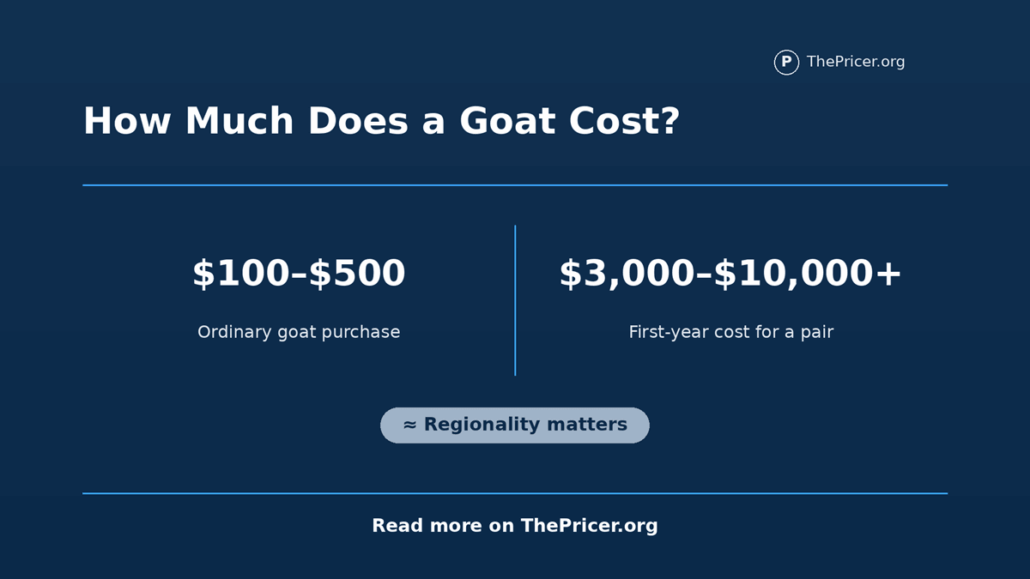
A goat generally costs $100 to $500 for an ordinary pet wether, mixed-breed animal, or commercial meat goat. Registered dairy, breeding, and show goats commonly cost $400 to $1,500+, while exceptional animals with proven milk production, show records, or elite genetics can cost $2,500 or more.
The purchase price is only a small part of the expense. Because goats are social animals, a new owner should normally budget for at least two compatible goats. Building safe fencing, shelter, feeding stations, and water systems can push the first-year cost for a pair to approximately $3,000 to $10,000+.
After the property is equipped, ongoing care commonly costs $600 to $1,500+ per goat annually. Hay prices, pasture quality, reproductive status, veterinary emergencies, bedding, minerals, and local climate can move the total well outside that range.
Article Highlights
Jump to sections
- Ordinary goats generally cost $100 to $500 (at $30 per hour, earning that amount would take about 0.4 to 2.1 full-time workdays, before taxes) each.
- Registered breeding or dairy goats often cost $400 to $1,500+.
- Goats should usually be budgeted in pairs rather than individually.
- A two-goat first-year setup can cost $3,000 to $10,000+.
- Secure fencing may cost more than the goats themselves.
- Ongoing care commonly costs $600 to $1,500+ per goat per year.
- Milk, meat, and kid sales may offset expenses, but profit is not guaranteed.
How Much Does a Goat Cost?
| Type of goat | Typical 2026 price | What affects the price |
|---|---|---|
| Pet wether or mixed-breed goat | $100 to $350 (about 0.4 to 1.5 full-time workdays at $30 per hour) | Age, temperament, size, health |
| Commercial meat kid | $150 to $500 | Live weight, season, market demand |
| Registered dairy doeling | $400 to $1,000+ | Pedigree, testing, milk lines |
| Proven dairy doe | $500 to $1,500+ | Milk records, age, pregnancy status |
| Breeding buck | $500 to $2,000+ | Genetics, registration, offspring records |
| Show or elite breeding prospect | $750 to $2,500+ | Conformation, awards, pedigree |
| Unregistered auction goat | $75 to $400+ | Weight, condition, sale type, demand |
Current 2026 breeder listings demonstrate how registration and intended use affect the price. Giggling Goat currently lists base prices of approximately $400 to $500 for registered Nigerian Dwarf doe kids. Another dairy breeder, Naomi Lane Dairy, has advertised a registered producing doe for $350.
Those are individual breeder examples rather than national averages. A goat with proven production, championship ancestry, valuable color genetics, pregnancy confirmation, or offspring records may cost considerably more.
Commercial market goats are priced differently. USDA’s goat market reports track auction prices by weight, class, condition, and location. A slaughter kid sold by the pound should not be compared directly with a registered dairy goat sold according to pedigree and production potential.
Budget for Two Goats
Goats are social herd animals. A solitary goat may become stressed, vocal, destructive, difficult to contain, or excessively dependent on people and other animals.
A dog, horse, sheep, or human attention does not always replace another compatible goat. Species differ in behavior, diet, parasite exposure, communication, and social structure.
For a first-time owner who wants pets or brush control, two healthy wethers of similar size and temperament are often simpler than starting with breeding does, intact bucks, bottle babies, or a mixed-sex herd.
Keeping two goats does not double every expense. Both can share shelter, perimeter fencing, tools, and water equipment. Feed, veterinary care, bedding, transport capacity, and emergency exposure still increase with each animal.
First-Year Cost for Two Goats
A realistic beginner budget must include the property as well as the animals. A pair of inexpensive goats can become a costly purchase when the land has no livestock fencing, shelter, water connection, hay storage, or safe loading area.
A typical two-goat setup may include:
- Two goats: $300 to $1,500 (about 0.3 to 1.3 full-time workweeks at $30 per hour)
- Basic shelter: $800 to $4,000+
- Secure fencing and gates: $1,500 to $6,000+
- Feeders and water equipment: $150 to $700
- Hay, forage, and minerals: $400 to $1,200
- Testing and veterinary reserve: $300 to $1,000+
- Bedding, tools, transport, and supplies: $250 to $800
The resulting first-year total is approximately $3,700 to $15,200+. A prepared farm with existing livestock infrastructure may spend much less, while a property requiring extensive grading, electricity, water lines, predator fencing, or a permanent barn may spend far more.
Goat Fencing Costs
Fencing is one of the most important and frequently underestimated goat expenses. Goats push, rub, climb, squeeze through gaps, and reach across barriers for desirable plants.
A small paddock using woven wire, posts, bracing, gates, and an electric offset may cost $1,500 to $6,000+. A larger rotational-grazing system can reach tens of thousands of dollars.
Penn State Extension’s meat-goat enterprise example allocates approximately $13,000 to $15,000 for fencing ten acres. It also allocates another $7,500 to $8,500 for gates, handling equipment, feeders, waterers, and related infrastructure.
A small homestead would not necessarily spend that much, but the example shows why a complete goat operation cannot be budgeted at only a few hundred dollars per animal.
Fencing cost depends on perimeter length rather than acreage alone. A long narrow property needs more fencing than a square property of the same area. Rocky soil, slopes, wooded lines, road exposure, and multiple gates increase labor and material costs.
Predator pressure must also be considered. Domestic dogs and coyotes can injure or kill goats. Electric strands, secure night pens, guardian animals, and frequent fence maintenance may be needed.
Shelter and Barn Costs
Goats need a dry, well-ventilated area that protects them from rain, wind, extreme heat, snow, and deep mud. The shelter should not be airtight or damp.
A simple three-sided field shelter may cost $500 to $2,000 when constructed with basic materials. A durable goat shed with secure doors, drainage, electricity, storage, and separate pens can cost $2,000 to $8,000+.
A larger barn conversion or new livestock building may cost $5,000 to $20,000+. Breeding herds may need kidding pens, quarantine space, a separate buck enclosure, milking space, and safe areas for sick or injured animals.
Locate the structure on well-drained ground. A cheap shelter placed in a muddy low area can lead to bedding waste, hoof problems, odors, parasites, and expensive site repairs.
How Much Feed Does a Goat Need?
Forage should make up most of a goat’s diet. The amount required depends on body weight, forage quality, pasture availability, pregnancy, lactation, growth, weather, and hay waste.
A 100-pound goat consuming dry matter equal to 2.5% of body weight needs:
100 pounds × 2.5% = 2.5 pounds of dry matter per day
Over one year:
2.5 pounds × 365 days = 912.5 pounds of dry matter
Hay contains moisture, and some will be wasted. A fully hay-fed 100-pound goat may therefore require more than 1,000 pounds of purchased hay annually.
If hay costs $250 per ton, 1,000 pounds has a raw value of:
1,000 ÷ 2,000 × $250 = $125
At $500 per ton, the same amount costs $250. Small bales, premium alfalfa, delivery, storage loss, and regional shortages can raise the price considerably.
USDA publishes current regional hay market reports because national averages do not reflect local forage type, bale size, weather, or transport conditions.
Pasture and Stocking Rates
The old claim that every goat needs two to four acres is not a reliable national rule. Productive pasture may support several goats per acre, while dry, overgrazed, wooded, or poor-quality land may support far fewer.
University of Georgia stocking guidance uses an animal-unit equivalent of approximately 0.17 for a goat. Its stocking-rate explanation demonstrates how forage production and grazing management determine carrying capacity.
Another Georgia Extension example says some productive small farms may support approximately four goats per acre, while winter hay may still be necessary. This is a regional illustration, not a guarantee for every property.
Goats also prefer more browse than cattle. University of Minnesota Extension estimates that goats may select approximately 60% browse, 30% grass, and 10% forbs, although the mix changes with management and available plants.
Ask a local Extension agent to estimate forage production, identify toxic plants, and create a stocking plan. Land should include a sacrifice area or dry lot for periods when pasture is wet, dormant, or overgrazed.
Grain, Minerals, and Supplements
Not every goat needs grain. Healthy adult pet wethers on suitable forage may need hay, clean water, and an appropriate loose goat mineral rather than a daily grain ration.
Growing kids, late-pregnant does, lactating dairy goats, underweight animals, and some meat-production goats may require concentrated feed. The amount must be matched to forage quality and production level.
Penn State’s dairy goat guidance warns that excessive grain combined with low fiber can cause rumen problems such as indigestion and acidosis.
Mineral products should be formulated for goats and local deficiencies. Sheep minerals may contain insufficient copper for goats, while cattle products may not be correctly balanced for a small goat herd.
Do not assume baking soda, generic salt blocks, or multiple supplements are universally required. Work with a veterinarian, nutritionist, or Extension specialist when designing a feeding plan.
Veterinary and Health Care Costs
A healthy pet goat may have an inexpensive year, but livestock veterinary bills are irregular. One difficult kidding, urinary blockage, pneumonia case, severe parasite burden, injury, or surgery can exceed several years of routine expenses.
Routine vaccines, supplies, and basic herd-health work may cost $25 to $100 per goat annually. Disease testing may add $30 to $150+ per animal, depending on the laboratory and number of tests.
A farm-call charge is usually separate from examination, medication, imaging, surgery, or laboratory work. Keep an emergency reserve of at least $500 to $2,000+ per herd.
Our guide to the cost of a farm veterinary visit explains why travel and minimum-call charges can make even a minor livestock appointment expensive.
Parasite Control Costs
Routine calendar deworming is no longer considered a dependable parasite-control strategy. Widespread resistance has developed to available dewormer classes.
University of Minnesota Extension recommends targeted treatment using clinical condition, fecal testing, FAMACHA assessment where appropriate, and testing whether a chosen dewormer still works on the farm. Its barber-pole worm guidance specifically advises against relying on routine whole-herd deworming.
A parasite budget may include fecal egg counts, FAMACHA training, veterinary advice, targeted medication, pasture rotation, quarantine, and follow-up testing. A simple bottle of dewormer is not a complete management plan.
Overstocking, grazing too close to the ground, wet conditions, and repeatedly using the same paddock can increase parasite exposure. Better fencing and more land divisions may therefore reduce medical costs.
Hoof Care and Routine Supplies

Basic hoof shears commonly cost $20 to $50 as a one-time tool purchase. Owners who learn proper trimming may spend little in later years beyond replacement tools and disinfectant.
Professional trimming may be charged per goat or subject to a farm-call minimum. Hoof rot, injury, overgrowth, and structural problems require additional treatment.
Other supplies can include collars, buckets, mineral feeders, hay racks, bedding forks, thermometers, syringes, kidding supplies, disinfectants, clippers, scales, storage containers, and transport crates.
A realistic initial supply budget is $200 to $700, followed by approximately $50 to $300+ annually for replacement and consumable items.
Disease Testing and Quarantine
First-time buyers should ask about the source herd’s history and testing for caprine arthritis encephalitis, caseous lymphadenitis, Johne’s disease, and other locally relevant conditions.
A negative result reduces uncertainty but does not guarantee that an animal will remain disease-free. Test timing, age, laboratory method, herd exposure, and sampling quality matter.
New goats should be quarantined from the existing herd while their health, fecal condition, feet, body condition, and records are evaluated. Quarantine requires separate fencing, feeding equipment, shelter, and cleaning procedures.
A cheap untested goat can become extremely expensive if it introduces a chronic disease into a valuable breeding or dairy herd.
Three Goat Ownership Budgets
Two pet wethers on a new property. The two goats cost $500. A small shelter costs $1,500, fencing and gates cost $3,000, and feeders and waterers cost $300. Hay and minerals add $700, the veterinary and testing reserve is $500, and bedding, tools, and transport add $400.
Estimated first-year total: $6,900
Three registered dairy does on an equipped farm. The does cost $2,400, fence improvements cost $1,500, and milking equipment costs $800. Feed and hay total $2,100, testing and veterinary care cost $750, and bedding and supplies add $450.
Estimated first-year incremental total: $8,000
Small meat-goat startup. Five commercial does at $350 each cost $1,750, and a breeding buck costs $700. Fencing, handling equipment, shelter, and water systems add $8,000. Feed, testing, transport, and veterinary reserves add another $2,500.
Estimated startup total: $12,950
These are ThePricer planning calculations rather than quotes from named farms. Actual costs depend heavily on what infrastructure is already available.
Annual Cost of Keeping Goats
After fencing and shelter are established, an ordinary pet goat may cost approximately $600 to $1,200 annually. Dairy, breeding, show, elderly, or medically complicated goats may cost $1,000 to $2,500+ each.
A yearly pet-goat budget might include:
- Hay and forage: $150 to $500+
- Minerals and supplemental feed: $50 to $250
- Bedding: $75 to $300+
- Vaccines and routine supplies: $25 to $100
- Testing and parasite monitoring: $50 to $200+
- Fence and shelter repairs: $100 to $400+
- Veterinary reserve: $200 to $1,000+
A two-goat household may therefore spend approximately $1,200 to $3,000+ in a typical year after infrastructure is built.
Can Goats Pay for Themselves?
Milk, meat, breeding stock, brush-control services, show animals, fiber, and manure may generate revenue. That does not mean the goats will automatically produce a profit.
Revenue must be reduced by feed, breeding, veterinary care, registration, testing, fencing, equipment depreciation, processing, transport, advertising, losses, permits, insurance, and labor.
Penn State’s goat-business resources emphasize that livestock enterprises require a production plan and a market. A goat that produces $800 of gross sales has not generated $800 of profit when it costs hundreds of dollars to maintain.
Meat and Breeding Income
Market goats are commonly sold according to weight, condition, grade, season, and local demand. A fixed claim that every meat goat sells for $150 to $300 does not reflect changing auction markets.
USDA goat reports can be used to review current regional prices before buying breeding stock or projecting sales. Holiday demand may raise prices for certain weights and classes, but future results are not guaranteed.
Registered kids may sell for hundreds or thousands of dollars when the breeder has strong genetics, records, health testing, marketing, and an established customer base. Unsold kids still consume feed and occupy space.
Offering buck service also creates biosecurity, fencing, handling, injury, and liability risks. It should not be treated as effortless side income.
Lifetime Cost of Two Pet Goats
Assume two pet goats cost $6,000 to purchase and establish. Their combined ongoing care averages $1,800 per year over a 12-year period.
$1,800 × 12 years = $21,600
Adding the startup cost gives:
$21,600 + $6,000 = $27,600
This calculation excludes a major medical emergency, complete fence replacement, property improvements, boarding, paid labor, or lost income. A pair of goats can therefore represent a commitment of $20,000 to $40,000+ over their lives.
What to Ask Before Buying
Ask why the goat is being sold, its exact age, registration status, health history, diet, temperament, hoof condition, horn status, vaccination history, and whether it has lived with other goats.
For breeding or dairy animals, request pedigree documents, kidding records, milk records, pregnancy information, teat and udder history, and disease-testing results.
Observe the animal walking, eating, breathing, and interacting with the herd. Check body condition, eyes, coat, feet, jaw alignment, manure consistency, skin, and signs of coughing or nasal discharge.
Confirm transportation before paying a deposit. A goat should not be placed loose in an open pickup bed. Use an appropriately ventilated and secure trailer, crate, or livestock compartment.
What We Verified
We checked current 2026 breeder listings showing registered dairy kids and producing does priced in the hundreds of dollars. USDA auction resources were used to distinguish live-weight market goats from registered breeding animals.
Penn State Extension data was used for commercial fencing, equipment, dairy production, and goat-enterprise planning. University of Georgia and University of Minnesota Extension sources were used to correct the stocking-rate, browsing, forage, and parasite-control sections.
The old universal $50 to $300 purchase range, $500 to $800 first-year estimate, $400 to $500 annual-care figure, two-to-four-acre rule, routine deworming assumption, automatic milk income, and claim that goat sales cancel care expenses were removed.
Related Goat Costs
Miniature goats have their own purchase and care considerations. Compare the cost of a pygmy goat before assuming that a smaller animal will be inexpensive.
For another distinctive small breed, see the cost of a fainting goat.
Veterinary travel charges can substantially affect a small herd’s medical expenses. Our guide explains the cost of a farm veterinary visit.
Answers to Common Questions
Do goats need grain?
Not all goats need grain. The requirement depends on age, body condition, forage quality, growth, pregnancy, and milk production.
How much does goat fencing cost?
A small secure paddock may cost $1,500 to $6,000+. Larger perimeter and rotational systems can cost tens of thousands of dollars.
How much does a goat shelter cost?
A basic field shelter may cost $500 to $2,000, while a permanent shed or barn setup can cost $2,000 to $20,000+.
Should goats be dewormed routinely?
No fixed calendar works for every herd. Targeted treatment based on clinical condition, testing, and veterinary guidance helps slow drug resistance.
Can selling goat milk cover the costs?
It may offset some expenses, but legal milk sales can require permits, inspections, approved equipment, refrigeration, testing, processing, and insurance.
Are goats profitable?
They can be under a well-managed business plan with a reliable market. Revenue does not guarantee profit once feed, infrastructure, health care, labor, and losses are included.
Disclosure: Educational content, not medical advice. Pricing varies by provider, location, and insurance. Confirm eligibility, coverage, and out-of-pocket costs with a licensed clinician and your insurer. See our methodology and corrections policy.