
How Much Does Horse and Carriage Rental Cost?
Updated on | Researched and reviewed by Alec Pow, Founder & Pricing Investigator
Prices, claims, and calculations checked against 13 cited sources. See our research methodology and corrections policy.
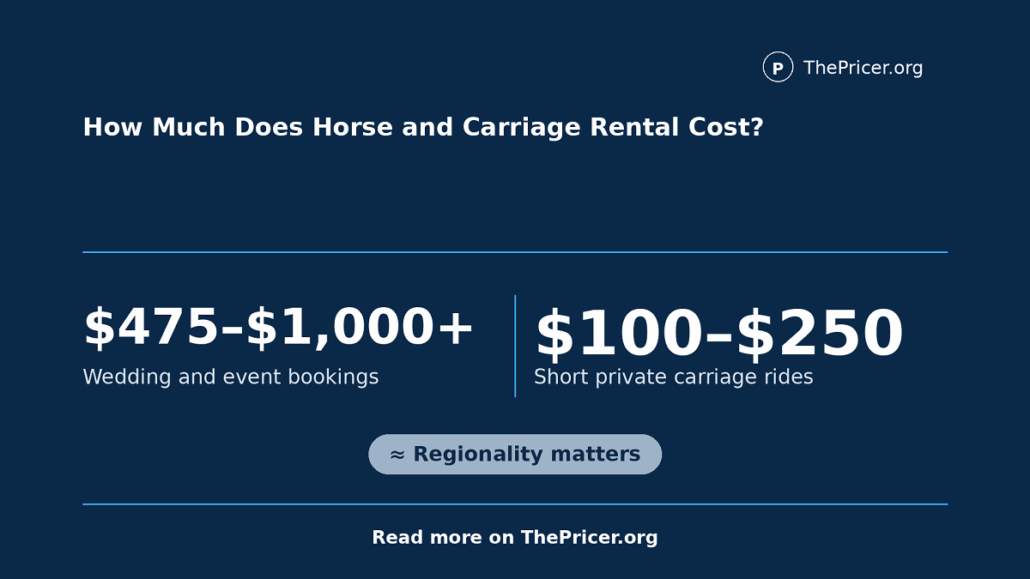
A horse and carriage rental currently costs about $475 to $1,000+ for many U.S. wedding and private-event bookings with published prices, while short tourist carriage rides can cost about $100 to $250 per carriage. A current St. Augustine wedding package lists a private 30-minute wedding carriage at $475 plus tax, while a current farm wedding carriage add-on is $750.
The event quote can rise when the booking needs two horses, a specialty Cinderella carriage, several hours of standby time, transport from the stable, custom decoration, or multiple guest rides. Current U.S. venue pricing shows why a short ride and a mobile event booking should not be compared as the same product.
Private horse-drawn carriage service is usually quoted by event, route, carriage style, horse count, and time commitment. Wedding carriages, tourist rides, funeral hearses, parade wagons, and guest-transport wagons use different equipment and staffing, so combining them into one hourly average produces a poor budget number.
Article Highlights
Jump to sections
- Published U.S. wedding and event examples currently run from about $475 to $1,000+ before some taxes, gratuities, travel charges, or upgrades.
- Short tourist rides are a different market, with current private-carriage examples around $100 to $250.
- Adding a second horse can raise a wedding-carriage package by several hundred dollars.
- Transporting the horses and carriage to an off-site venue can matter more than the distance traveled during the actual ride.
- Some wedding packages include decoration and gratuity, while others add tax and gratuity to the posted carriage price.
- Horse-drawn funeral service should be quoted separately rather than priced from wedding or tourist-ride rates.
How Much Does Horse and Carriage Rental Cost?
Current public pricing varies sharply because each listing buys a different amount of carriage time, equipment, staffing, and event access. The examples below are useful benchmarks, not a national rate card.
| Current booking example | Published price | What the price covers |
|---|---|---|
| St. Augustine wedding ride | $475 + tax | A private 30-minute wedding carriage for the couple, with formal driver, decoration, and tip included. |
| Valley View Farm wedding add-on | $750 | A romantic carriage ride with a pair of Belgian geldings and a white vis-a-vis Cinderella carriage. |
| Live Oak wedding options | $500 single horse $800 two horses |
On-site wedding arrival using an elegant carriage or western wagon. |
| Central Park private rides | $99.99 short ride $159.99 50 minutes $189.99 60 minutes |
Tourist rides priced per carriage rather than per passenger. |
| St. Augustine holiday rides | $200 to $250 | A 45-minute private carriage during the 2025-2026 Nights of Lights season, depending on carriage size. |
A table like this is useful only when the scope stays attached to the price. A couple booking horses, a carriage, a formal driver, transport, setup, waiting time, and a wedding exit is buying a mobile event service. A tourist stepping into a carriage already stationed at a city pickup point is buying ride time.
Horse-drawn funeral transport belongs in another quote category. The current carriage operator directory specifically lists funeral vehicles alongside weddings, proms, parades, and parties, but it does not publish a national funeral rate. That makes a local written quote more useful than carrying forward an old flat estimate.
What You’re Actually Renting
A private carriage booking pays for more than a vehicle with a driver. The operator has to select and prepare the horse or team, groom the animals and fit the working tack, prepare the carriage, load equipment when the event is off-site, transport the setup, arrive early enough to unload and hitch safely, follow the event timeline, and return the horses and carriage afterward. The carriage itself may be a Victoria, vis-a-vis, Cinderella coach, wagon, sleigh, or funeral hearse.
The professional carriage trade group describes member businesses ranging from one-horse owner-operators to larger fleets with multiple carriages and motorized transport. That range explains why two quotes for the same wedding can represent very different operations. Passenger capacity, route surface, horse count, event duration, trailer access, and the amount of waiting built into the booking all shape the service.
Wedding Carriage Prices
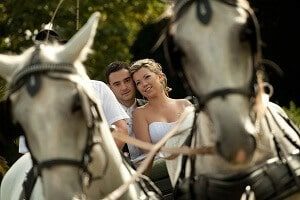
The number of horses is one of the clearest price signals. A current Montana venue lists a single-horse wedding carriage at one price and a two-horse team at a higher price, showing that the upgrade is not merely decorative. Another horse means another trained animal, another tack setup, more handling, and a larger team arrangement.
A current Scottsdale-area listing makes the add-on visible in dollar terms. Its three-hour carriage package lists a four-passenger white vis-a-vis at $900 and an extra horse or mule at $200. Adding one animal would take that example to $1,100, a rise of about 22%, before any other change to the booking.
Carriage style can create another premium. A Cinderella coach is usually larger and chosen for visual impact, while a smaller Victoria or vis-a-vis may be enough for a couple’s arrival and exit. The useful question is not whether the larger carriage looks better in a brochure. It is whether the extra horse count, capacity, and appearance add something the event will actually use.
A $500 Carriage Can Become $1,000
The hidden cost is the gap between the carriage price and the finished event invoice. Travel to the venue, trailer access, waiting time, overtime, a second horse, decorations, special driver attire, extra passenger rides, tax, gratuity, and route changes can all sit outside a low starting figure.
Forrest Hills provides a clean worked example in its current wedding upgrade menu. The venue lists a single-horse carriage at $750++ and a two-horse Cinderella carriage at $1,000++. The same page defines the double-plus notation as 8% tax and 20% gratuity. Using those published inputs, the single-horse option becomes $960, while the Cinderella option becomes $1,280. The larger setup adds $320 to the finished carriage line after those stated charges.
That arithmetic also shows why two advertised prices should not be compared before checking inclusions. One operator may quote a package with gratuity and decoration already included. Another may show only the carriage service and add percentage charges later. Written quotes should spell out horse count, carriage, hours, travel radius, setup time, waiting time, route, decorations, tax, gratuity, weather cancellation, and overtime.
Tourist Ride Prices
City carriage rides can look much cheaper because the horses, carriage, and driver are already positioned where customers board. The operator is selling a defined route rather than moving an entire carriage operation to a private venue. That removes much of the trailering, setup, and standby burden found in event work.
The same distinction applies when comparing a carriage with a limousine. WeddingWire’s current wedding transport benchmark says U.S. couples spend about $750 on wedding-day transportation, but that figure spans limousines, buses, vans, trolleys, and other vehicles. A carriage package priced near that number is not automatically expensive or cheap because passenger capacity, hours, route speed, and event role are different.
A carriage is strongest as ceremonial transport, a photo feature, a short arrival, or a staged exit. It is a poor substitute for moving a large wedding party across long highway distances. That difference should shape the budget before the couple compares hourly rates.
Three Realistic Carriage Rental Scenarios
Short private ride: A couple booking a carriage already operating in a tourist district can stay near the low hundreds because the route, boarding point, horse, carriage, and driver are already in place. This is the closest match to a Valentine’s Day ride, proposal, anniversary outing, or sightseeing booking.
Wedding arrival and exit: A private venue booking can move into the mid hundreds or low four figures once the operator commits horses, a carriage, transport, setup, waiting time, and formal presentation to one event. A pair of horses or specialty coach pushes the price upward faster than simply adding a few minutes to the ride.
Large or specialty event: A multi-hour carriage booking, large wagon, Cinderella coach, parade appearance, or event that requires substantial travel should be treated as a custom quote. The carriage may spend only a short period moving passengers even though the horses, crew, tow vehicle, trailer, and equipment are committed for much of the day.
When the Extra Cost Makes Sense
A carriage is usually purchased for its ceremonial role rather than transportation efficiency. That makes the value highly dependent on the route and the amount of the event built around it.
Makes sense if:
- The carriage will be part of the ceremony entrance, exit, or planned photography.
- The venue has safe access, room for loading and unloading, and a practical route.
- The couple wants a short ceremonial trip rather than long-distance transportation.
- The quote identifies the horses, carriage, time window, travel charge, and weather terms.
May not make sense if:
- The main goal is moving many guests quickly between distant venues.
- The property has steep, unsuitable, or restricted routes for the planned turnout.
- The carriage will be used for only a few minutes but requires a large transport surcharge.
- A low quote omits waiting time, return transport, tax, gratuity, or weather cancellation terms.
Local operating rules can also affect availability. A private event may face city, park, venue, road, weather, or animal-use restrictions that differ from another location. Confirm the planned route and property access with the operator and venue before treating the reservation as settled.
What We Verified
- Checked: A current wedding carriage package page caps some carriage travel at three miles, lists an additional horse at $150, and prices extra time at $150 per hour, showing how route length and time can create separate charges.
- Confirmed: A current Florida carriage operator page lists weddings, funerals, parades, theme parks, special events, and quinceañeras as separate carriage-service uses rather than one standardized rental product.
- Cross-referenced: New York City’s 2026 carriage legislation record shows a proposal to prohibit horse-drawn cabs was laid over in committee, illustrating why local rules and availability should be checked close to the booking date.
Related Event Costs
The carriage is only one part of the event budget. Couples comparing ceremony and transportation choices can also look at the cost of a Perona Farms wedding, the price of wedding draping, and the ongoing expense behind owning a horse when they want context for why professional carriage service carries substantial equipment and animal-care overhead.
Answers to Common Questions
How much is a horse and carriage for a wedding?
Current published U.S. examples place many wedding carriage bookings around $475 to $1,000+. A two-horse team, Cinderella coach, long event window, or off-site transport can push the final quote higher.
How much is a short private carriage ride?
Current tourist-market examples run around $100 to $250 per carriage for short private rides. These rates are not comparable with a mobile wedding service that has to trailer horses and equipment to the event.
Does a second horse cost more?
Yes. Current published wedding examples show a second horse can add several hundred dollars because the operator is supplying and handling another trained animal and a different turnout.
Is gratuity included in horse carriage rental?
Sometimes. Some current packages include tip, while others add gratuity to the advertised price. Check the written quote before adding a separate percentage.
Can a horse carriage travel from the ceremony to a distant reception?
That depends on the route, distance, surface, local rules, horse team, and operator. Long-distance guest transport is usually better handled by a motor vehicle, while the carriage serves the ceremonial portion of the event.
Disclosure: Educational content, not financial advice. Prices reflect public information as of the dates cited and can change. Confirm current rates, fees, taxes, and terms with official sources before purchasing. See our methodology and corrections policy.