
How Much Do Blue Lacy Puppies Cost?
Updated on | Written by Alec Pow
This article was researched using 16 sources. See our methodology and corrections policy.
Current 2026 price evidence puts many Blue Lacy puppies around $500-$600. Good Dog’s current buyer guide places the breed at $500-$600 nationally. Marketplace ads can run higher, but the old $800-$1,500 headline range looks too high as a default. A buyer should still budget far beyond the puppy itself. Veterinary care, food, training, gear, insurance, boarding, and emergency treatment can make the first year several times more expensive than the purchase price.
The Blue Lacy, also called the Lacy Dog, is a Texas-developed working breed built for ranch, hunting, trailing, and other high-energy jobs. Price matters, but working temperament, pedigree documentation, breeder practices, and whether the household can meet the dog’s activity needs matter just as much.
Article Highlights
Jump to sections
- Current Blue Lacy puppy evidence clusters around $500-$650 (at $30 per hour, earning that amount would take about 2.1 to 2.7 full-time workdays, before taxes), not $1,500+ as a normal starting price.
- A current Texas Good Dog breeder lists a total puppy price of $500-$600.
- A realistic first-year planning scenario reaches about $3,350 before insurance, boarding, daycare, licensing, or emergency care.
- The Blue Lacy became the official State Dog Breed of Texas in 2005, and its documented roots go back to the Lacy family arriving in Texas in 1858.
- LGDR’s current standard places adult weight at about 30-55 pounds and recognizes blue, red, and tri-colored Lacys.
- Adoption can cost less, but a shelter breed label is not the same as verified Blue Lacy pedigree documentation.
How Much Does a Blue Lacy Puppy Cost?
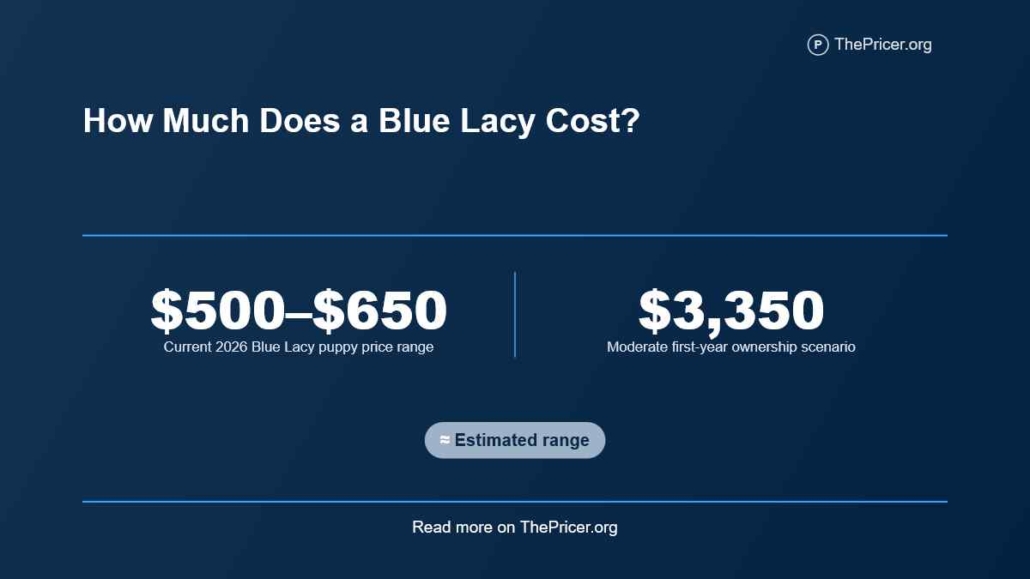
A practical 2026 purchase budget is about $500-$650 (about 2.1 to 2.7 full-time workdays at $30 per hour) for many advertised Blue Lacy puppies. Good Dog’s current breed guide gives a $500-$600 national range, and a Texas breeder on the same platform lists a $100 deposit plus $400-$500 final payment. That totals $500-$600 before taxes and platform fees. The breeder states that the price includes registry papers and that puppies must go to working homes.
Current Ranch World Ads results also show working Lacy puppies around $550, $600, and $650. These are individual advertised prices rather than a scientific national sample, but they support the same lower price band. The current Blue Lacy listings are far more useful than old claims that East or West Coast puppies automatically cost twice as much. I found no solid current basis for regional tiers such as $1,500-$1,800+ merely because a breeder is outside Texas.
| 2026 price evidence | Published or advertised price | Scope |
|---|---|---|
| Good Dog buyer guide | $500-$600 | Current national breed guide |
| Red River Blue Lacys, Texas | $500-$600 | Current breeder listing |
| Ranch World Ads listings | $550-$650 | Current working-dog advertisements |
What Drives the Price
Blue Lacy pricing is tied more closely to working ability, pedigree records, breeder practices, and individual puppy quality than to a show-dog hierarchy. The Texas Lacy Game Dog Association currently lists litters and puppies from member breeders in Texas and other states, and its available-puppies page shows active 2026 breeder postings. That geographic spread is another reason to avoid a rigid Texas-versus-coasts price chart.
Registry status can add documentary value, but the paperwork itself is inexpensive. The Lacy Game Dog Registry currently charges current LGDR fees of $20 (about 40 minutes at $30 per hour) for a whole-litter application and $25 for registration and pedigree. Those fees show that “registered” should not be treated as a justification for hundreds of dollars of unexplained markup. The stronger value questions concern the sire and dam, working history, temperament, health records, puppy socialization, vaccines, deworming, and the breeder’s willingness to take responsibility for the dog after sale.
Color should not be the main pricing argument either. Blue Lacys can be blue, red, or tri-colored. Buyers paying extra for a fashionable shade should ask what the premium represents beyond appearance. Working suitability comes first. A dog bred for cattle, blood trailing, hog work, or another task may also be matched to a buyer based on drive and temperament rather than sold to the first person offering the highest amount.
Texas Working-Dog Roots
The breed did not begin in the 1950s. Texas House Concurrent Resolution 108 records that George, Ewin, Frank, and Harry Lacy moved from Kentucky to Texas in 1858 and settled near Burnet County. The family raised cattle and hogs and developed dogs to help with that work. The same resolution describes Lacys as ranch, droving, and hunting dogs and notes that preservation work became necessary after working dogs declined on ranches.
Texas formally designated the Blue Lacy as the official State Dog Breed in 2005. That history helps explain why current breeders still emphasize usefulness rather than decorative traits. The Lacy Game Dog Registry’s current breed standard describes an athletic medium-sized dog built for endurance and speed, with an adult weight around 30-55 pounds and height around 18-23 inches. Recognized colors are blue, red, and tri-color, and all are still called Blue Lacys.
The working background also affects household costs. A high-drive dog that needs structured exercise, training, scent work, livestock work, or another job can require more paid training, travel, equipment, or dog-care support than a low-energy companion. Someone comparing a Blue Lacy with a smaller herding breed can also review the cost of a Corgi, but puppy prices alone do not capture the difference in daily workload.
What a Breeder Provides

The safest starting point is a breeder recognized by the breed organizations rather than a random classified seller. The LGDR breeder list identifies breeders known to LGDR and TLGDA and directs buyers to current litter information. The organizations focus on preserving working ability, structure, coat, health, and temperament. A breeder should be able to explain why a particular sire and dam were paired and what type of home or work the litter suits.
The LGDR breeder code also gives buyers concrete items to ask for. It requires breeders to give puppies their first series of shots and worming before departure, provide registration and health records, represent quality honestly, and avoid sending puppies away too young. The current breeder ethics code also says puppy prices should reflect individual quality. That is stronger guidance than assuming a higher price automatically means a better dog.
Ask to see the puppy’s registration paperwork, vaccination and deworming records, parent information, contract terms, and any health information the breeder has collected. Ask what work the parents actually perform. A buyer seeking a household companion should also ask how the litter has been exposed to people, other dogs, surfaces, noises, crates, vehicles, and routine handling. The paperwork matters. The breeder’s behavior matters more.
First-Year Blue Lacy Budget
The old advice to reserve only $500 beyond the puppy price is too low for 2026. Rover’s current puppy-cost research puts total first-year puppy spending at about $1,460-$6,745. Its published component ranges include $300-$800 for spay or neuter, $30-$80 for microchip and ID, $80-$180 for an initial exam, $180-$300 for vaccinations, $75-$175 for initial preventatives, $260-$1,125 for essential supplies, and $575-$4,775 for annual food. Group puppy training can run about $300 for a course.
A moderate Blue Lacy scenario shows why the purchase price is only one line. Start with a $550 puppy. Add an illustrative $550 sterilization cost, $55 for microchip and ID, $130 for an initial exam, $240 for vaccines, $125 for preventatives, $500 for supplies, an assumed $900 food budget within Rover’s published range, and $300 for group training. The itemized first-year total is $3,350.
In that scenario, the $550 puppy is only about 16% of first-year spending. The remaining 84% comes after the dog is already home. The scenario excludes pet insurance, boarding, daycare, licensing, dog walking, working equipment, fencing changes, travel to the breeder, and emergencies. The separate pet insurance cost and dog training cost guides can help price two of those optional lines.
Annual and Lifetime
Once the puppy setup period passes, the budget shifts toward food, preventive veterinary care, training refreshers, toys, replacement gear, boarding, and unexpected treatment. Rover’s 2026 dog-cost research places adult dog care at $1,930-$5,305 per year. For a medium dog, it gives a modeled lifetime range of $35,415-$43,285. That is not a Blue Lacy-specific lifetime average, but the breed’s 30-55-pound size makes it a useful planning comparison.
Using the current Blue Lacy puppy band of $500-$650, the purchase price equals only about 1.2%-1.8% of that medium-dog lifetime model. The lower percentage uses a $500 puppy against the $43,285 high lifetime figure. The upper percentage uses a $650 puppy against the $35,415 low lifetime figure. That calculation explains why saving a few hundred dollars on the puppy matters less than choosing a dog whose care and activity demands fit the household for years.
Food can move the annual number because a hard-working 40- or 50-pound dog may eat differently from a sedentary pet. The dog food cost guide gives a separate framework for dry, wet, premium, and specialty diets. Health can shift spending too. PetMD describes the Blue Lacy as a healthy breed with limited population data, while noting that allergic skin disease can occur. Do not turn that into a prediction for an individual puppy. Use it as a reason to maintain a medical reserve.
Adoption and Rescue
Adoption is a real option, but the available dogs may be adults, mixes, or dogs identified by appearance rather than registry records. Adopt a Pet currently shows current Texas Blue Lacy listings, including dogs in several cities. A shelter listing can be useful for finding a suitable active dog, but it should not be treated as proof that the dog descends from LGDR-recorded lines.
The exact adoption fee belongs to the shelter or rescue caring for the individual dog, so there is no defensible single Blue Lacy adoption price of $300. Some adoption fees include sterilization, microchipping, vaccinations, or other veterinary work. Others include less. Ask what has already been completed before comparing an adoption fee with a breeder price.
Adoption also does not make a Blue Lacy unsuitable for a first-time owner by definition. The better questions concern that dog’s prey drive, training history, comfort with children or other animals, exercise needs, and behavior in the home. A well-evaluated adult may be easier for some households than an intense working-bred puppy. A poorly matched dog can be difficult regardless of where it came from.
Does the Budget Fit?
A Blue Lacy can be inexpensive to buy compared with many purebred dogs, yet the breed is not a low-effort purchase. The household needs enough time and money for training, exercise, preventive care, food, secure containment, and backup care when work or travel interrupts the normal routine. A current puppy around $500-$650 can still lead to a first year near $3,350 under the moderate scenario above.
Makes sense if
- You want an active working-type dog and can provide daily physical and mental work.
- You can budget several thousand dollars for the first year rather than only the puppy fee.
- You are willing to verify registry records, breeder practices, and parent temperament.
- You have a plan for training, containment, travel, and emergency veterinary care.
Does not make sense if
- You are choosing the breed mainly because the puppy price is low.
- Your schedule leaves little time for exercise, training, or structured activity.
- You need a low-energy dog that is content with minimal daily engagement.
- A surprise four-figure veterinary or boarding bill would destabilize the household budget.
Verification checks
- Checked the current TLGDA breeder roster for active breeder coverage beyond one Texas location.
- Confirmed the AKC 2026 breed list does not list the Blue Lacy as an AKC-recognized breed.
- Cross-referenced the LGDR forms and guidelines for current registration workflow and breeder documentation.
Answers to Common Questions
How much does a Blue Lacy puppy cost?
Current 2026 evidence places many Blue Lacy puppies around $500-$650. Good Dog’s breed guide is narrower at $500-$600, while current working-dog classifieds extend into the mid-$600s.
Are Blue Lacys expensive to own?
The puppy itself is relatively affordable, but first-year ownership can cost several thousand dollars. The worked scenario above totals about $3,350 before insurance, boarding, daycare, licensing, travel, or emergencies.
Is the Blue Lacy really the Texas state dog?
Yes. Texas designated the Blue Lacy as its official State Dog Breed in 2005. The breed’s documented Texas roots go back to the Lacy family’s arrival in 1858.
Can I adopt a Blue Lacy?
Yes. Texas shelters and rescues currently list dogs identified as Blue Lacys and Blue Lacy mixes. The actual adoption fee and included veterinary work are set by each organization.
What should I ask a Blue Lacy breeder?
Ask for pedigree and registration records, vaccine and deworming records, information about the parents’ work and temperament, contract terms, health history, and details about how the puppies are raised and matched to homes.
Disclosure: Educational content, not medical advice. Pricing varies by provider, location, and insurance. Confirm eligibility, coverage, and out-of-pocket costs with a licensed clinician and your insurer. See our methodology and corrections policy.