
How Much do Breast Implants Cost?
Updated on | Written by Alec Pow
This article was researched using 8 sources. See our methodology and corrections policy.
Breast augmentation with implants commonly costs $6,000 to $12,000 all-in in the United States. Lower-cost saline packages may start near $5,000 to $7,000, while silicone augmentation commonly lands between $7,000 and $12,000. An experienced surgeon in a high-cost city, complex breast asymmetry, premium implants, hospital-based surgery, or a combined breast lift can raise the total to $12,000 to $20,000 or more.
The American Society of Plastic Surgeons reports an average implant-augmentation cost of $4,875, but that number is the surgeon’s fee rather than the complete checkout price. It excludes anesthesia, the operating facility, implants, medical testing, prescriptions, postoperative garments, and other related expenses. A written clinic quote must identify whether the implant pair, routine follow-up, and possible sizing changes during surgery are already included.
Breast augmentation places saline-filled or silicone-gel implants beneath breast tissue or chest muscle to increase volume or change shape. It differs from a breast lift, breast reconstruction after mastectomy, fat-transfer augmentation, implant exchange, and implant removal, each of which has its own medical purpose and price structure.
Article Highlights
Jump to sections
- Breast augmentation with implants commonly costs $6,000 to $12,000 (at $30 per hour, earning that amount would take about 5 to 10 full-time workweeks, before taxes) all-in.
- The current ASPS figure of $4,875 is a surgeon fee, not the full patient bill.
- Published 2026 all-inclusive packages begin near $6,975 for saline and $8,175 for silicone.
- A breast lift can move a combined operation into the $12,000 to $20,000+ range.
- Silicone implants may require periodic ultrasound or MRI surveillance that insurance may not cover.
- Implant removal has a current average surgeon fee of $3,979 before anesthesia and facility costs.
- A modeled $9,825 augmentation can become a $20,825 lifecycle expense after imaging and later exchange.
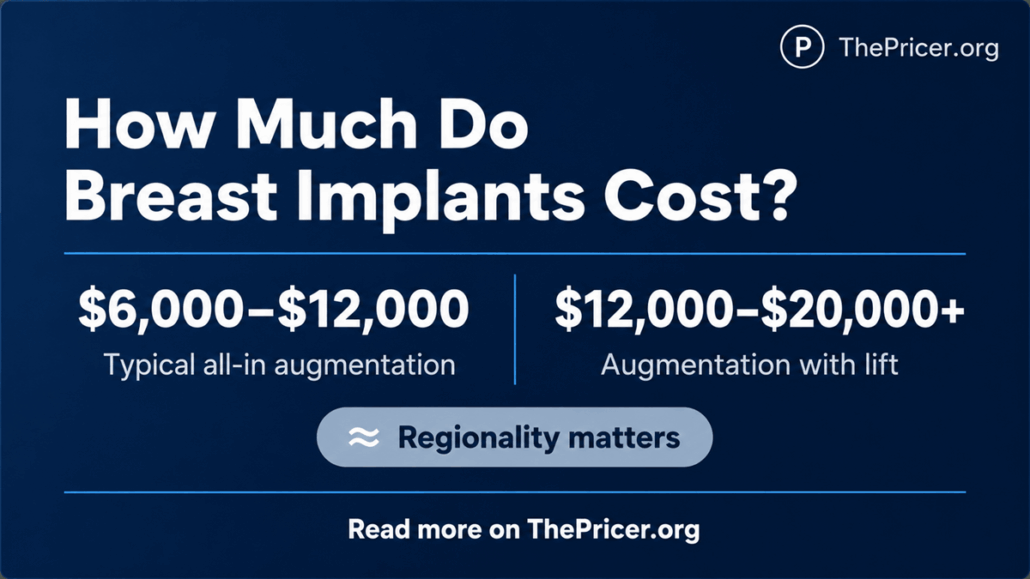
How Much Do Breast Implants Cost?
| Breast Procedure | Planning Cost | What Commonly Drives the Price |
|---|---|---|
| Saline implant augmentation | $5,000 to $9,000 (about 4.2 to 7.5 full-time workweeks at $30 per hour) | Surgeon, implant pair, facility, anesthesia, and location |
| Silicone implant augmentation | $7,000 to $12,000 | Implant type, surgeon demand, facility, and operative plan |
| Premium-market augmentation | $12,000 to $20,000+ | High-cost city, complex anatomy, surgeon demand, or extra procedures |
| Augmentation with breast lift | $12,000 to $20,000+ | Longer surgery, skin removal, nipple repositioning, implants, and scars |
| Fat-transfer augmentation | $8,000 to $15,000+ | Liposuction, fat processing, injection, and possible staged treatment |
| Implant exchange or revision | $8,000 to $15,000+ | Old implant removal, capsule work, new devices, and correction |
| Implant removal | $5,000 to $12,000+ | Removal, capsulectomy, lift, pathology, anesthesia, and facility |
The current ASPS figure for implant augmentation is $4,875, while augmentation with fat grafting carries an average surgeon fee of $5,719. The society states that neither amount includes anesthesia, operating-room facilities, or related expenses. That exclusion matters because a clinic advertising an all-inclusive package and a national surgeon-fee statistic are not describing the same purchase.
Current published clinic prices show how the complete invoice starts higher. Little Rock Plastic Surgery lists 2026 all-in breast augmentation from $6,975 for saline implants and $8,175 for Motiva silicone implants. A Scottsdale practice advertised a 2026 all-inclusive saline package starting at $6,950. These are practice-specific prices rather than national promises, but they support a realistic U.S. starting point above the old $3,000 headline.
What the Quote Includes
A breast augmentation quote may combine the surgeon’s work, implant pair, surgical facility, anesthesia professional, operating-room supplies, routine appointments, postoperative bra, and prescriptions. Another quote may list each component separately. A third may call itself a package while excluding laboratory work, consultation, medication, garments, implant upgrades, difficult anatomy, or extra operating time.
The implant pair is a common source of confusion. Some surgeons include standard saline or silicone devices inside the procedure price, then charge only for an upgrade. Others present the implants as a separate line. Adding a standalone implant estimate to an already all-inclusive clinic package can double count the devices. Ask whether the written total covers both implants, the named manufacturer and model, warranty registration, and any implants opened for intraoperative sizing.
The estimate should also state how much routine care is included after surgery. Many practices include scheduled postoperative visits for a defined period. Unplanned evaluation, additional imaging, treatment by another physician, emergency care, revision surgery, or follow-up after the included window may produce a separate bill. The phrase “all-inclusive” needs a list, not an assumption.
Saline or Silicone
Saline implants use a silicone shell filled with sterile saline after insertion. Silicone implants arrive prefilled with silicone gel. Saline packages commonly cost less, partly because the device price can be lower. Silicone products vary in gel cohesivity, profile, shell, shape, and manufacturer, so “silicone” is not one fixed upgrade.
Little Rock Plastic Surgery’s current menu creates a $1,200 (about 1 full-time workweek at $30 per hour) difference between its $6,975 saline starting price and $8,175 Motiva silicone starting price. The silicone package costs 17.2% more than the saline package at that practice. This is a better comparison than claiming that silicone always adds exactly $1,000 per pair because it measures two complete packages with the same clinic context.
Price should not determine implant type by itself. Tissue coverage, chest dimensions, implant placement, desired volume, rippling risk, future surveillance, rupture behavior, and the surgeon’s operative plan all matter. Silicone implants may produce a different feel or visible edge profile for some patients, but no implant guarantees a particular look or outcome.
When a Lift Is Added
Implants increase volume. They do not reliably correct every degree of skin laxity, nipple position, or breast sagging. A breast lift removes and reshapes skin, repositions breast tissue, and may move the nipple and areola. Combining the procedures increases operating time, incision work, anesthesia, facility use, postoperative care, and revision complexity.
The ASPS reports a current average breast-lift surgeon fee of $6,816, excluding anesthesia, operating-room charges, and related expenses. That figure should not simply be added to the $4,875 augmentation fee because combined surgery can share facility and anesthesia time. It does show why an augmentation-and-lift quote near $15,000 is not directly comparable with an $8,000 augmentation-only quote.
A patient deciding between implants alone and combined mastopexy can review current breast lift costs alongside the augmentation estimate. The written surgical plan should identify whether the quote covers augmentation only, lift only, or both procedures, plus any correction of asymmetry, enlarged areolas, tuberous anatomy, or previous scars.
Three Surgical Totals
Lower-cost saline package: Use the published all-inclusive starting price of $6,975. Add a modeled $250 for preoperative testing and prescriptions and $125 for travel, parking, and recovery supplies. The immediate cash total becomes $7,350. The clinic package represents 94.9% of the first-stage spending, making this much closer to a true checkout price than a surgeon-fee-only figure.
Silicone augmentation: Begin with the current published $8,175 all-inclusive starting price. Add modeled preoperative and recovery expenses of $400, plus $1,250 for lost income or unpaid time away from work. The practical short-run cost reaches $9,825. Lost income is not a medical invoice, but it remains a real household cost that cosmetic-package advertisements omit.
Augmentation with lift: Start with a modeled combined surgical package of $15,000. Add $500 for testing, garments, prescriptions, transport, and recovery supplies, plus $2,000 in modeled lost income. The complete household impact reaches $17,500. A low augmentation-only advertisement cannot be used to predict this procedure because the patient is purchasing skin reshaping, nipple repositioning, a longer operation, and implants.
ThePricer Lifetime Total

Breast implants are not lifetime devices. The FDA states that the longer a person has implants, the greater the chance of a complication and another operation. Possible issues include capsular contracture, rupture, infection, asymmetry, pain, implant displacement, and implant removal. The agency also tracks breast implant-associated anaplastic large cell lymphoma and reports concerning symptoms that require medical evaluation.
ThePricer’s lifecycle scenario begins with the modeled $9,825 silicone-augmentation total. Add two later surveillance ultrasounds at a modeled $400 each, producing $800. Add one MRI at a modeled $1,200 and a future implant exchange package at $9,000. The modeled lifecycle spending becomes $20,825. The initial augmentation represents 47.2% of that amount.
This calculation does not predict when or whether one patient will need exchange surgery. It shows why the opening quote is not a lifetime ceiling. Current MRI pricing can range widely by facility, region, insurance, and scan type, which makes surveillance budgeting uncertain. The FDA also notes that imaging recommended for silicone implants may not be covered by insurance.
Removal and Revision
Implant removal can involve taking out the device alone, removing part or all of the surrounding capsule, replacing the implant, correcting position, treating infection, submitting tissue for pathology, or adding a breast lift. The amount paid depends on the reason for surgery and the work found during the operation.
The ASPS reports an average implant-removal surgeon fee of $3,979. Anesthesia, operating facility, tests, garments, prescriptions, and related charges sit outside that figure. A complete removal can land around $5,000 to $12,000 or more, while removal with capsulectomy, replacement, or a lift can exceed that range.
Implant warranties may provide replacement devices or limited financial support under named conditions. They do not automatically pay the surgeon, anesthesia, facility, travel, lost income, capsule removal, or lift. The ASPS notes that a warranty may cover part of revision expenses in some cases. The implant card, serial numbers, manufacturer warranty, and original operative report should be kept where they can be found years later.
Insurance Is Not One Rule
Elective cosmetic breast augmentation is commonly self-pay. A policy normally does not cover surgery performed only to increase breast size or change appearance. Medical reconstruction connected with mastectomy belongs to a different category and should not be described as a rare cosmetic exception.
The Women’s Health and Cancer Rights Act requires applicable plans that provide mastectomy benefits to cover specified reconstruction benefits. CMS states that these include reconstruction of the breast on which the mastectomy occurred, surgery and reconstruction of the other breast to produce symmetry, prostheses, and treatment of physical complications of mastectomy. The current WHCRA fact sheet also explains that the law does not require every plan to cover mastectomy in the first place.
Coverage for congenital conditions, trauma, severe asymmetry, implant complications, gender-affirming care, or medically necessary removal depends on the plan, diagnosis, documentation, network, exclusions, and prior authorization. A patient comparing augmentation with breast reduction surgery should know that reduction may qualify for insurance under documented medical criteria while cosmetic augmentation usually does not.
Financing Raises the Price
A monthly payment does not make the procedure less expensive. It changes when the cost is paid and may add interest, fees, or deferred-interest risk. Cosmetic financing can involve medical credit cards, personal loans, clinic payment plans, or standard credit cards. The written agreement should identify the annual percentage rate, origination fee, promotional deadline, late-payment terms, and whether unpaid promotional interest is charged retroactively.
In a modeled example, financing $9,000 for 36 months at 15% APR creates a payment near $312 per month. The borrower repays about $11,232, adding roughly $2,232 to the surgery price. The financing charge raises the cash price by 24.8%. A later imaging or revision bill could arrive before the first loan is repaid.
Medical tourism also needs landed-cost math rather than a low procedure advertisement. Flights, hotel, companion travel, meals, local transportation, time away from work, extended stays, treatment after returning home, and a second international trip for revision can erase the price advantage. A foreign clinic quote should identify surgeon credentials, facility accreditation, implant manufacturer, records, emergency plan, and who pays when complications develop after departure.
Who This Cost Fits
Makes sense if:
- The patient understands the full written price rather than only the surgeon fee.
- The implant choice and surgical plan match the patient’s anatomy and goals.
- The budget includes imaging, possible revision, and time away from work.
- The surgeon’s certification, license, facility, and follow-up process are verified.
- The patient accepts that implants may lead to later operations.
Does not make sense if:
- The procedure requires high-interest debt with no room for complication costs.
- The lowest quote excludes implants, anesthesia, facility, or follow-up.
- A lift is needed but the price comparison uses augmentation alone.
- The clinic cannot provide implant identification and warranty terms.
- The decision relies on a promotion rather than a complete medical consultation.
The American Board of Plastic Surgery provides a public surgeon certification search. Certification does not guarantee an outcome, but it verifies that the physician has met the board’s plastic-surgery training and examination requirements. State license status and disciplinary history should also be checked through the relevant medical board.
What We Verified
- Checked: ASPS currently reports an implant-augmentation surgeon fee of $4,875, excluding facility and anesthesia.
- Confirmed: A current 2026 clinic menu lists all-in saline augmentation from $5,300 in its 2025 published guide, while its updated 2026 standard pricing starts at $6,975.
- Cross-referenced: The FDA states that breast implants are not lifetime devices and may require additional surgery.
- Verified: FDA patient guidance says silicone implants may require periodic MRI or ultrasound exams that insurance may not cover.
- Checked: Current ASPS figures place the breast-lift surgeon fee at $6,816 and implant-removal surgeon fee at $3,979.
- Confirmed: Federal WHCRA protections apply to qualifying reconstruction connected with mastectomy when the health plan covers mastectomy benefits.
Answers to Common Questions
How much do breast implants cost in total?
Breast augmentation with implants commonly costs $6,000 to $12,000 all-in. High-cost markets, complex anatomy, premium implants, or a breast lift can raise the total above $15,000.
Does the ASPS average include the full surgery?
No. The current $4,875 figure is a surgeon fee and excludes anesthesia, facility costs, implants, tests, medication, and related expenses.
Are silicone implants more expensive than saline?
Silicone packages commonly cost more. One current 2026 clinic menu shows a $1,200 difference between saline and silicone starting prices.
Does insurance pay for breast implants?
Insurance usually does not cover elective cosmetic augmentation. Reconstruction after mastectomy and some medically necessary procedures follow different coverage rules.
Do breast implants need to be replaced every ten years?
There is no automatic replacement date for every patient. Implants are not lifetime devices, and removal or exchange may be needed if rupture, contracture, pain, position changes, infection, or another complication occurs.
Disclosure: Educational content, not medical advice. Pricing varies by provider, location, and insurance. Confirm eligibility, coverage, and out-of-pocket costs with a licensed clinician and your insurer. See our methodology and corrections policy.
I am 52 years old and I have no breasts whatsoever I never did and I always hated them and it did affect my self-esteem it always did I find the rest of my body is fine it’s just that that I’m having a problem with and I always did ever since I was a kid i don’t want big ones I just want them filled in to look normal