
How Much Do Dermal Fillers Cost?
Updated on | Written by Alec Pow
This article was researched using 13 sources. See our methodology and corrections policy.
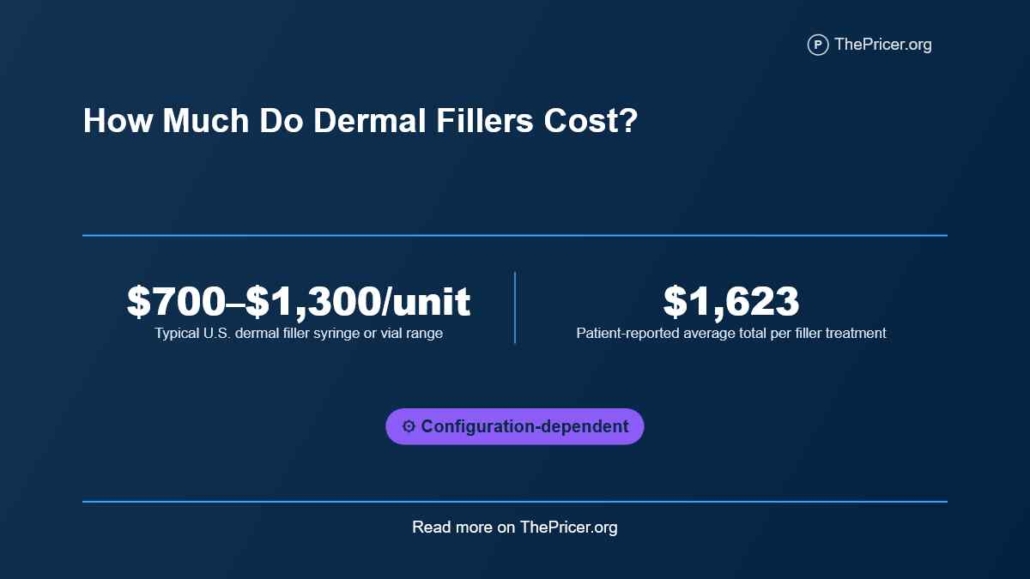
Dermal filler treatment in the United States often costs about $700 to $1,300 per syringe or vial, but the complete appointment can be much higher when several units or treatment areas are involved. The American Society of Plastic Surgeons reports an average of $715 for hyaluronic acid filler and $901 for non-hyaluronic acid filler, while CareCredit reports current per-vial averages from $868 for hyaluronic acid to $1,323 for Sculptra.
The billing unit matters. Juvéderm and Restylane treatments are often discussed by syringe or milliliter, Radiesse has its own product volume, and Sculptra is commonly priced by vial across a multi-session plan. A low single-syringe quote can understate what a multi-area treatment will cost. The useful number is the treatment plan total, not one container in isolation.
Article Highlights
Jump to sections
- ASPS reports $715 (at $30 per hour, earning that amount would take about 3 full-time workdays, before taxes) as the current average cost for hyaluronic acid dermal filler.
- CareCredit reports $868 per vial for HA filler, $1,127 for Radiesse, and $1,323 for Sculptra.
- RealSelf’s patient-reported treatment average is $1,623, with submitted totals from $500 to $5,500.
- A two-unit HA plan modeled from the CareCredit benchmark costs $1,736, while three units reach $2,604.
- Sculptra uses a multi-session treatment model, so one-vial pricing can understate the course cost.
- Correction or removal can create a second bill, and some fillers are difficult or impossible to remove.
How Much Do Dermal Fillers Cost?
The latest ASPS cost data puts hyaluronic acid filler at an average of $715 (about 3 full-time workdays at $30 per hour), non-hyaluronic acid filler at $901, and lip augmentation with dermal filler at $743. Those figures come from physician-reported statistics and are useful as professional-fee benchmarks. They are not a promise that every syringe, product, or full-face visit will cost that amount.
CareCredit uses a different pricing unit. Its current dermal filler data reports $868 per vial for HA filler, $1,127 for calcium hydroxylapatite such as Radiesse, $1,263 for PMMA filler such as Bellafill, and $1,323 for poly-L-lactic acid such as Sculptra. Those numbers should not be averaged with ASPS because the unit and data source differ.
| Filler category | Current benchmark | Common pricing unit | Example products |
|---|---|---|---|
| Hyaluronic acid | $715 ASPS average and $868 CareCredit average | Syringe or vial | Juvéderm, Restylane, Belotero |
| Calcium hydroxylapatite | $1,127 CareCredit average | Syringe or vial | Radiesse |
| Poly-L-lactic acid | $1,323 CareCredit average | Vial | Sculptra |
| PMMA | $1,263 CareCredit average | Syringe or vial | Bellafill |
RealSelf gives a useful appointment-level check. Its patient-reported filler costs average $1,623 per treatment, with submissions from $500 to $5,500. That gap between a single-unit benchmark and the treatment average is why the full plan deserves more attention than the advertised syringe price.
Syringes, Vials
Dermal filler is not sold through one universal container size. Many HA products are supplied in prefilled syringes, and a clinic may price by syringe, treatment area, or total plan. Other products use vial-based pricing. The number of units opened can change the bill far more than the brand name alone.
Full-face treatment can require much more product than a lip or fold treatment. Juvéderm’s current full-face examples show actual patients receiving different amounts across cheeks, chin, lips, jawline, undereyes, temples, and facial folds. One company example totals 8.1 mL across five areas, while another totals 11.7 mL. Those are manufacturer patient examples, not typical-volume claims.
This matters because the old rule that most patients need two or three syringes is too broad. A small lip treatment may use far less product than a full-face plan, while structural cheek, chin, or jawline work can use several milliliters. A reader comparing two quotes should ask which exact product, how many syringes or vials, what volume is in each unit, and which areas are included.
Small jobs can stay small. Large plans scale quickly. The quote should state the unit.
HA Filler Costs
Hyaluronic acid fillers make up a large part of the facial filler market. Current CareCredit data places the national HA average at $868 (about 3.6 full-time workdays at $30 per hour) per vial, while ASPS reports $715 as its professional benchmark. The difference is not an error. The two sources collect and describe costs differently, which is why a single national price should not be manufactured by blending them.
A simple quantity model shows what happens when the provider opens more HA product. Using CareCredit’s $868 benchmark, one unit models to $868, two units to $1,736, and three units to $2,604. This is a ThePricer scenario using equal-price units. It does not assume that every patient needs one, two, or three syringes, and it excludes any clinic-specific discount on later syringes.
Product and area still matter. Juvéderm lists different approved products for cheeks, chin, smile lines, lips, jawline, undereyes, and temples, with product-specific durations that range from about one year to up to two years under the labeled treatment conditions. Restylane also separates products by approved use. Readers focused on the lips can compare current lip filler pricing, where half-syringe versus full-syringe economics create a different buying decision.
The cheapest HA quote is not automatically the cheapest plan. Compare volume, treatment area, product, injector fee structure, and any later maintenance.
Radiesse and Sculptra Costs
Radiesse and Sculptra should not be squeezed into an HA-style price-per-syringe template. CareCredit currently reports $1,127 per vial for calcium hydroxylapatite and $1,323 for poly-L-lactic acid. The higher unit price is only part of the story because the products are used differently and do not share the same treatment schedule.
Sculptra’s current treatment guidance says patients average two to three treatment sessions over a few months, with a typical regimen of three sessions spaced several weeks apart. The manufacturer also shows an actual facial patient treated with three vials over two sessions. Vial count per session varies, so one-vial pricing is not a full-course estimate.
Using that documented three-vial example and CareCredit’s $1,323 national per-vial average creates an illustrative product-cost scenario of $3,969. The arithmetic is three multiplied by $1,323. It is not the bill for that named patient and does not account for clinic-specific discounts or charges outside the product-price benchmark.
That calculation explains why comparing a $868 HA vial with a $1,323 Sculptra vial can mislead. The relevant purchase may be one HA appointment versus a staged Sculptra plan. They are different treatment structures.
Location and Treatment Area
Geography does move prices, but current data is better than broad claims about coastal cities always costing the most. CareCredit’s HA dataset ranges from $683 to $1,567 per vial across states and the District of Columbia. California is listed at $1,125, New York at $963, Texas at $808, and Florida at $863.
The spread from $683 to $1,567 is $884 per vial. A two-unit HA plan would magnify that same benchmark gap to $1,768 if each unit were priced at the state average. That is a modeled comparison, not evidence that every clinic in either state charges those exact figures. It shows why location can matter more as product quantity rises.
Treatment area also changes the amount purchased. Lips may involve a different volume and product than cheeks, chin, temples, or a multi-area facial plan. The Juvéderm treatment-area data cited earlier shows actual full-face examples using several different formulas and multiple milliliters. A consultation for one wrinkle is not comparable with a structural contouring plan across several regions.

Ask for the quote by area and unit. That makes competing estimates easier to compare without assuming that a lower per-syringe number buys the same treatment.
Maintenance and Correction
Most cosmetic fillers are not permanent, so the first appointment may not be the last expense. Juvéderm’s current duration guidance says lip products can last up to one year, VOLUMA in the chin up to one year, VOLLURE around smile lines up to 18 months, and VOLUMA in the cheeks up to two years under the labeled treatment conditions. Product, area, amount, and individual response affect how soon another appointment is purchased.
Correction can create a separate bill. The FDA says reducing or removing filler may require injections, surgery, or other interventions and can be difficult or impossible with permanent fillers or materials other than HA. One current Charlotte practice publishes HA filler dissolving at $250 per treated area, with follow-up dissolving visits for that same area included. That is one clinic price, not a national average.
A simple correction scenario shows why the hidden cost matters. If a patient paid the CareCredit HA benchmark of $868 for one unit and later paid the Charlotte example of $250 for elective dissolving, the combined spend would be $1,118 before any replacement filler. A new HA unit at the same benchmark would raise the modeled cash outlay to $1,986.
Emergency treatment for vascular injury is different from elective dissolving. It is a medical emergency, not a price-shopping event.
FDA Safety and Provider Choice
Dermal fillers are medical devices with product-specific approved uses. The FDA’s current filler safety guidance says accidental injection into a blood vessel can cause tissue necrosis, vision abnormalities including blindness, stroke, and death. Common reactions include bruising, redness, swelling, pain, tenderness, itching, and rash.
The FDA lists several unapproved uses, including injection into the nose and glabella, and stresses that approval is tied to the exact filler and treatment area. That is why a brand name alone does not tell a patient whether a proposed use is FDA-approved.
Provider selection should focus on licensed status, training, anatomy knowledge, product familiarity, and the ability to identify and manage complications. The FDA advises patients to seek a licensed health care provider trained in filler injection and to discuss the patient labeling for the exact product being used. A dermatologist consultation cost may be relevant when a separate medical evaluation is needed, but cosmetic filler itself is usually priced outside ordinary medical coverage.
Seek immediate medical attention for unusual pain, vision changes, white, gray, or blue skin near the injection site, or stroke symptoms during or shortly after treatment.
Insurance, Payment
Cosmetic dermal fillers are normally self-pay. The American Academy of Dermatology states that insurance does not cover treatment used to reduce signs of aging. Financing changes when the bill is paid, not the underlying treatment price. Read the lender terms before comparing a payment plan with the cash quote.
Routine cosmetic filler should not be treated as an automatic FSA or HSA expense. IRS medical expense rules exclude procedures directed only at improving appearance unless they address a qualifying deformity tied to congenital abnormality, trauma, or disfiguring disease. A clinic accepting a card does not establish tax eligibility.
Manufacturer rewards can reduce some out-of-pocket spending, but the terms matter. They should never drive product selection when the approved use or treatment plan points elsewhere. Readers comparing filler with a neuromodulator can use current Botox pricing, but Botox and dermal filler work differently and are not interchangeable treatments.
Makes sense if
- You know the exact product, treatment area, and number of syringes or vials in the quote.
- The provider is licensed and trained in filler injection and complication management.
- You have budgeted for maintenance rather than treating the first appointment as a lifetime cost.
- You understand whether the proposed use is within the product’s FDA-approved indication.
Does not make sense if
- You are choosing a filler because it has the lowest price per syringe.
- You cannot tell how much product is included in the treatment quote.
- You are assuming every filler can be dissolved later.
- You expect ordinary cosmetic treatment to be covered by health insurance or tax-advantaged medical funds.
Answers to Common Questions
How much does one syringe of dermal filler cost?
Current benchmarks vary by product and data source. ASPS reports $715 for HA filler, while CareCredit reports $868 per vial for HA products.
How much do two syringes of filler cost?
Using the CareCredit HA benchmark as an illustrative equal-price model, two units cost $1,736. A clinic may charge more or less and may discount later syringes.
How much does Sculptra cost?
CareCredit reports an average of $1,323 per vial. Sculptra commonly involves two to three treatment sessions, and vial count varies by treatment plan.
Can dermal filler be dissolved?
HA filler can often be reduced with hyaluronidase, but other filler materials can be difficult or impossible to remove. Elective dissolving is a separate paid procedure at many practices.
Does insurance cover cosmetic dermal fillers?
No. Cosmetic dermal fillers are normally self-pay, and ordinary appearance-only treatment should not be assumed eligible for HSA or FSA reimbursement.
Disclosure: Educational content, not medical advice. Pricing varies by provider, location, and insurance. Confirm eligibility, coverage, and out-of-pocket costs with a licensed clinician and your insurer. See our methodology and corrections policy.