
How Much Do Landscape Boulders Cost?
Updated on | Written by Alec Pow
This article was researched using 14 sources. See our methodology and corrections policy.
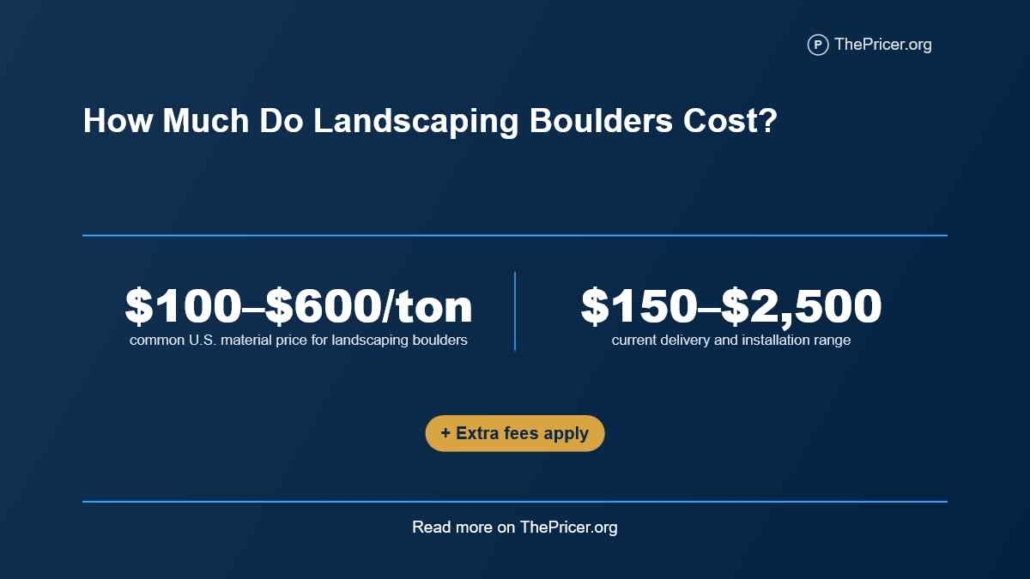
Landscaping boulders commonly cost about $100 to $600 per ton for the stone itself in the United States. Current 2026 boulder cost data also puts delivery and installation around $150 to $2,500, depending on quantity, weight, and access. Installed cost can exceed the material price by a wide margin.
The key budgeting step is to price the entire path from stone yard to final position. Weight controls trucking and machine needs, and a boulder that looks modest can weigh more than a car.
Article Highlights
Jump to sections
- Raw boulders commonly cost $100 to $600 (at $30 per hour, earning that amount would take about 0.4 to 2.5 full-time workdays, before taxes) per ton, with one 2026 source averaging about $250 per ton.
- Current suppliers list many full-size stones around $225 to $625 per ton.
- Delivery and machine placement can add hundreds or thousands of dollars.
- A 36-inch weathered limestone boulder can weigh about 2,000 to 2,400 pounds.
- Site preparation can add $1,000 to $6,000+ when substantial earthwork is required.
- Structural boulder walls need a separate wall budget.
How Much Do Landscaping Boulders Cost?
A second national dataset places raw boulders around $120 to $350 (about 0.5 to 1.5 full-time workdays at $30 per hour) per ton. Its current boulder prices by size put 24-inch stones around $35 to $90, 36-inch stones around $100 to $350, 48-inch stones around $150 to $650, and pieces larger than 48 inches around $600 to $2,300. Those figures show why shopping by individual stone can make more sense than a ton price for a small project.
Retail yards show why local supply matters. One current supplier boulder price list shows Meridian stone at $439 per ton, weathered limestone at $520 per ton, and glacial stone at $625 per ton. The same size can cost very different amounts when color, quarry source, weathering, and freight change.
| Current price example | Published price | What the figure covers |
|---|---|---|
| Broad national material band | $100 to $600 per ton | Material before delivery and placement |
| Second national material band | $120 to $350 per ton | Common boulder material pricing |
| Current supplier range | $439 to $625 per ton | Three current named boulder varieties |
| Delivery and installation | $150 to $2,500 | National range depending on quantity and access |
A cheap ton price is only useful when the supplier is close enough to deliver it economically and the stone can reach the intended spot. Imported or uncommon stone can lose its material-price advantage once trucking and handling enter the quote.
Size and Weight
Boulders are usually sold by ton or by piece, but dimensions matter because weight climbs fast as a rock grows in three directions. A stone estimating guide lists approximate densities of 150 pounds per cubic foot for sandstone, 165 for limestone, and 175 for granite. Those stone density figures make it possible to estimate whether a loader, skid steer, excavator, or crane will be needed before the stone arrives.
A round three-foot sandstone boulder weighs about 2,120 pounds under the same 150-pound density assumption. That is slightly more than one ton. At a sandstone material price near $60 to $300 (about 0.3 to 1.3 full-time workdays at $30 per hour) per ton, the raw stone models to roughly $64 to $318. The equipment needed to move a one-ton object can cost as much as the rock itself, so price by size should never stop at the material line.
A 2026 supplier size guide places a 24-inch boulder around 650 to 700 pounds and a 36-inch boulder around 2,000 to 2,400 pounds. A 50% increase in diameter takes the listed weight to roughly three times as much. Using the current $520 per ton weathered-limestone price cited earlier, the 24-inch stone works out near $169 to $182, while the 36-inch stone works out near $520 to $624.
That is why a tape measure can be a cost tool. Measure length, width, and height, ask the yard for the stone type, and request an estimated weight. The number that matters for placement is pounds, not how small the rock appears from the driveway.
Stone Type
Granite, limestone, sandstone, fieldstone, quartzite, glacial stone, and weathered specialty rock do not share one rate. A current stone pricing guide places local fieldstone around $100 to $250 per ton, granite around $200 to $500, moss rock around $300 to $600+, and limestone or sandstone around $150 to $400. Local quarry availability can move a project toward either edge of those bands.

The better comparison is often within one supplier. The 2026 listings already cited show Meridian stone at $439 per ton and glacial boulders at $625 per ton. The glacial material is $186 per ton higher, a difference of about 42% for the same billing unit. A three-ton order would widen that material gap to $558 before trucking or installation changes.
Color and surface character can also change the quote. Moss-covered, river-worn, unusually colored, or weathered material may carry a premium even when its structural role is purely decorative. Local stone often wins on delivered cost because there is less weight to haul over long distances.
Do not confuse large feature boulders with river rock costs or smaller decorative rock prices. Pebbles and loose rock are bought for area coverage. A boulder is bought as an individual heavy object whose placement logistics can dominate the invoice.
Delivery and Placement
Delivery has two stages. The truck must first get the stone to the property, then machinery may need to move it from the unloading point to its final location. A front-yard placement beside an accessible driveway is very different from setting the same rock behind a house with a narrow gate, mature trees, irrigation lines, or a septic field.
One current supplier delivery policy lists several boulders at $225 per ton, starts delivery and placement at $300, and requires at least eight feet of gate access for that starting service. If the machine does not fit, extra labor, a smaller machine, a dolly, or crane work may replace the low starting charge.
A second contractor publishes an even clearer split. Its boulder delivery charges are $85 for a dump-truck drop of up to three boulders, plus $450 to bring a skid steer and place up to three. That makes the delivery-and-machine portion $535 before the stone purchase itself.
Machine placement is not decorative labor. A large stone can weigh several thousand pounds. A current crane placement guide describes lifting and setting heavy boulders with machinery when walls, fences, or inaccessible yards prevent normal loader access. Damage risk to lawns, paving, utilities, and structures is part of the quote, so the access route should be planned before a stone is purchased.
Site Preparation and Access
A decorative boulder on firm, level soil may need only a prepared setting area. Difficult ground changes the project. Current site preparation pricing puts grading around $1,000 to $3,000, excavation around $1,500 to $5,000, and land clearing around $500 to $2,000 for projects that need those services. These are separate earthwork jobs, not mandatory charges for every boulder.
Good placement usually means setting part of the stone below grade on stable soil rather than sitting the entire rock on top of grass. A current boulder sizing guide describes setting roughly one-third of a decorative stone below grade. That also makes the stone look anchored rather than dropped onto the yard.
Cement is not a standard bedding requirement for ordinary decorative boulders. Soil bearing, compaction, drainage, slope, and the stone’s center of gravity matter more. The installation may use compacted native soil, aggregate, or another prepared base based on site conditions. Structural walls and steep slopes need a different design.
Check the travel path too. Mark irrigation heads, septic areas, buried utilities, soft lawns, gates, overhead wires, and narrow turns. If earthwork is already needed, yard leveling costs can help separate broad grading work from the price of simply setting one stone.
Decorative Stones vs Boulder Walls
A single feature rock is a placement job. A boulder retaining wall is a structural earth-retention project. The wall may need excavation, a stable base, drainage stone, backfill, batter into the slope, equipment access, and engineering or permits depending on height, loads, and local code. Pricing the wall from the same per-ton stone number used for a decorative focal point misses most of the work.
Natural boulder walls can also consume much more stone than the exposed face suggests because large pieces interlock in depth. Drainage behind the wall matters because retained soil can saturate and push against the structure. Vehicle loads, steep grades, fences, buildings, and property lines can change the design.
For comparison, current retaining wall costs for a segmental block system commonly run $25 to $60 per square foot installed, with engineered or difficult work moving above that band. A natural-boulder wall is a different system, but the comparison shows why finished wall pricing cannot be reduced to stone cost per ton.
Decorative groups are simpler. Three stones placed around a planting bed, pond, or driveway entrance may need little excavation beyond stable setting pockets. A long wall holding back a slope should be quoted as a wall project from the beginning.
Worked Boulder Budgets
A simple front-yard scenario can use one supplier’s current pricing. Choose one ton of its $225 per ton grey granite and its published delivery-and-placement service starting at $300. The resulting starting budget is $525. That figure assumes the one-ton quantity fits the supplier’s normal service conditions and the site meets the required access. Extra preparation, longer hauling, or harder placement would raise the invoice.
Now consider a larger decorative group using three tons of the same $225 per ton stone. Material is $675. Adding the same published starting placement charge produces a minimum modeled subtotal of $975. This is a lower-bound scenario because a three-ton order may require more truck or machine time than the minimum service covers.
A different supplier shows how equipment can outweigh inexpensive rock. Its published delivery is $85 and machine placement is another $450 for up to three boulders. For an illustrative case that assumes the three stones themselves cost $600, the itemized budget follows.
- Three assumed boulders $600
- Delivery $85
- Skid steer placement $450
- Modeled subtotal $1,135
The service portion alone is $535, so transport and placement account for about 47% of this modeled subtotal before grading or repairs.
The same logic applies at larger sizes. Once one stone weighs two or three tons, the selected equipment, gate width, crane reach, and soil conditions can matter more than a $100 difference in material price. Price the route before choosing the rock.
DIY or Professional Placement?
Small rocks that two people can move with a cart are reasonable DIY material. Multi-hundred-pound and multi-ton boulders are equipment jobs. Larger stones can require a skid steer, excavator, loader, or crane, depending on weight and reach. Paying for one correct placement is usually cheaper than moving a badly positioned stone twice.
DIY preparation can still lower labor. Mark final positions, clear small vegetation, identify buried utilities, measure every gate and turn, and prepare the route for machinery. Do not plan to roll a one-ton rock across finished paving or soft turf by hand.
Makes sense if
- The supplier can quote stone weight before delivery.
- The machine route is wide enough and firm enough for the planned equipment.
- The stone type is available locally enough to keep freight reasonable.
- The final position has stable support and suitable drainage.
Does not make sense if
- The purchase is based on stone price without a delivery or placement quote.
- The boulder is too heavy for available machinery or access.
- A structural retaining wall is being treated like a decorative rock grouping.
- The planned location conflicts with utilities, septic components, drainage, or unstable slope conditions.
Answers to Common Questions
How much does a one-ton boulder cost?
The stone itself commonly costs $100 to $600. Delivery and machine placement are extra.
How much does a three-foot boulder weigh?
A round three-foot sandstone boulder is about 2,120 pounds. Granite and limestone can weigh more.
How much does boulder delivery cost?
Current guidance puts delivery around $50 to $400+. Delivery plus placement can reach $150 to $2,500.
Should landscaping boulders be buried?
Large decorative stones are often set partly below grade. Roughly one-third burial is common in professional designs.
Can I install a large boulder myself?
Small stones can be DIY projects. Heavy boulders normally need lifting equipment and an experienced operator.
Disclosure: Educational content, not financial advice. Prices reflect public information as of the dates cited and can change. Confirm current rates, fees, taxes, and terms with official sources before purchasing. See our methodology and corrections policy.