
How Much Do Macarons Cost?
Updated on | Written by Alec Pow
This article was researched using 12 sources. See our methodology and corrections policy.
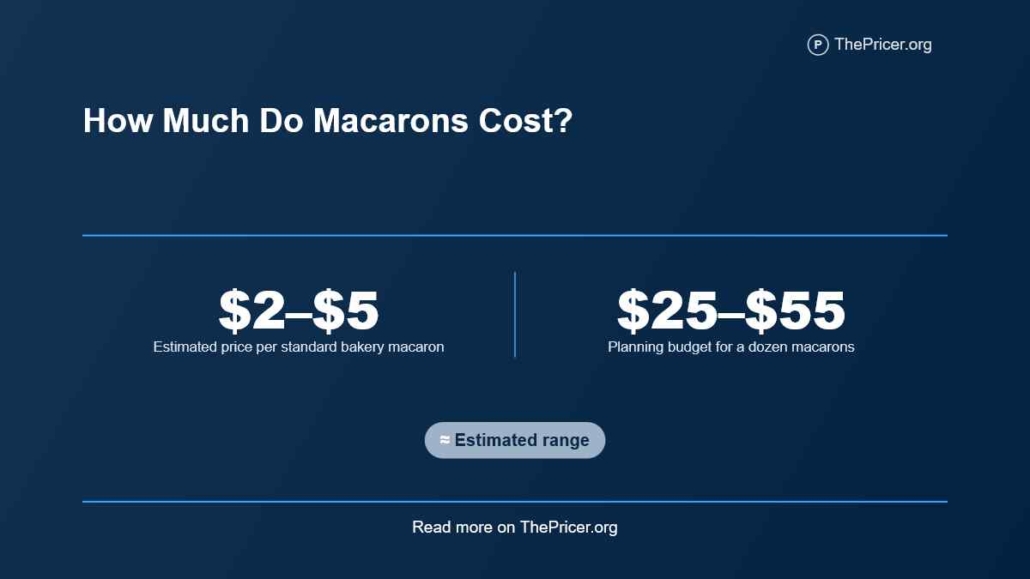
Macarons cost approximately $2 to $5 each at U.S. bakeries and specialty dessert shops in 2026, with premium gift boxes sometimes exceeding $4 per macaron. A dozen typically requires a budget of roughly $25 to $55, depending on the bakery, flavors, packaging, and ordering method. Published examples include a $42 assorted dozen from Pastreez and a $52 box from Ladurée.
French macarons are small sandwich cookies made from almond flour, egg whites, sugar, and a filling such as buttercream, jam, or ganache. Their prices reflect delicate production, specialty ingredients, labor, breakage risk, and presentation. Buying a few from a neighborhood bakery, ordering a luxury gift box, purchasing party favors, and baking them yourself involve different costs. Shipping charges and the number of usable macarons can also change the price per piece considerably.
Article Highlights
Jump to sections
- Individual bakery macarons commonly cost approximately $2 to $5, depending on the seller and size.
- A 12-piece Pastreez assortment costs $42 (at $30 per hour, earning that amount would take about 1.4 hours of work, before taxes), or $3.50 each, with shipping advertised as included.
- Ladurée lists a 12-piece gift box at $52, equivalent to $4.33 per macaron.
- Pastreez offers a 48-piece box at approximately $95, reducing the price to about $1.98 per piece.
- Homemade macarons can cost substantially less in ingredients, but the result depends on batch yield, filling, equipment, and failed shells.
- The widely reported luxury macaron priced at $9,703 included a hotel stay and other benefits, not merely one cookie.
How Much Do Macarons Cost?
Published U.S. macaron prices vary more by bakery and packaging than by flavor alone. The Ladurée U.S. gift catalog lists multiple box sizes, including 8, 12, 15, 18, 20, and 28 macarons. Its 12-piece Intemporel gift box costs $52 (about 1.7 hours of work at $30 per hour), while an 18-piece Napoléon box costs $75.
Pastreez, a California-based bakery offering nationwide delivery, lists a 12-macaron assorted box at $42 and a custom assortment at $45. These are advertised online prices, rather than a representative average across all U.S. bakeries.
| Advertised macaron product | Box price | Price per macaron |
|---|---|---|
| Pastreez, 12-piece assortment | $42 | $3.50 |
| Pastreez, 12-piece custom box | $45 | $3.75 |
| Pastreez, 20-piece gift assortment | $59 | $2.95 |
| Pastreez, 48-piece party box | $95 | $1.98 |
| Ladurée, 8-piece Napoléon box | $38 | $4.75 |
| Ladurée, 12-piece Intemporel box | $52 | $4.33 |
| Ladurée, 18-piece Napoléon box | $75 | $4.17 |
| Ladurée, 20-piece Intemporel box | $80 | $4.00 |
| Ladurée, 28-piece Intemporel box | $109 | $3.89 |
Pastreez’s online box collection also shows a 48-piece offer at $89, while other listings advertise $95. Promotional pricing and product configurations can change, so the table uses the higher listed 48-piece price rather than claiming a permanent discount.
These are sampled advertised products from two sellers, not a national statistical survey. They illustrate the difference between a customizable shipped assortment, an event-size box, and a luxury branded gift.
How Much Is a Dozen Macarons?
A dozen macarons is one of the most useful purchasing units because many bakeries sell six-piece or twelve-piece assortments. For a straightforward purchase, a working budget of $25 to $55 (about 0.8 to 1.8 hours of work at $30 per hour) covers a broad selection of everyday and premium U.S. options, although elaborate packaging and delivery can push the total higher.
The difference between buying by the dozen and purchasing larger boxes is substantial. At Pastreez, the $42 assortment costs $3.50 per piece. Its $95 48-piece box costs about $1.98 each. Four 12-piece assortment boxes would cost $168, while one 48-piece box costs $95, a difference of $73 for the same number of cookies.
That comparison is valid only if the larger assortment meets the buyer’s needs. Four individually wrapped gift boxes provide a different presentation from one bulk order. Those receiving separate presents may value packaging more than the lower unit price.
At Ladurée, a 12-piece box costs $52, while the 20-piece box costs $80. Buying the larger box lowers the price per macaron from about $4.33 to $4. The savings per cookie are relatively modest compared with Pastreez’s larger event-size discount.
Why Are Macarons So Expensive?
Macarons require relatively few ingredients, but producing them consistently is difficult. Their delicate shells are made with an almond-based batter folded into whipped egg whites. The finished cookies need a smooth surface, a characteristic ruffled foot, and an interior that is neither hollow nor overly dense.
The King Arthur French recipe calls for almond flour, egg whites, two types of sugar, cream of tartar, and a buttercream filling. It yields about two dozen finished macarons and has a total preparation time of approximately two hours.
There are several genuine cost drivers.
- Ingredient quality. Finely ground almond flour costs more than ordinary wheat flour, and fillings may contain butter, cream, chocolate, fruit, or nuts.
- Labor. Mixing, piping, baking, matching shells, filling, and packaging require several separate steps.
- Breakage and failed batches. Cracked shells, hollow centers, uneven sizes, and sticking can reduce the number of saleable macarons.
- Flavor complexity. Pistachio, specialty chocolate, fruit preparations, and elaborate decoration add ingredients and handling.
- Packaging and delivery. Protective trays, gift boxes, and temperature management can matter as much as small differences in ingredient costs.
These production steps help explain why a cookie containing inexpensive quantities of sugar and egg whites can command a premium bakery price. The bakery must recover the cost of the full production process, not merely the ingredients inside one successful cookie.
How Much Do Homemade Macarons Cost?
Making macarons at home can reduce the ingredient expense considerably, particularly when baking multiple batches. It also introduces the cost of kitchen tools, time, and potential failures. The older estimate of 31 cents per macaron assumed unusually low ingredient costs and did not account for all of these factors.
A reproducible calculation starts with a specific recipe. King Arthur’s recipe yields about 24 filled macarons using 85 grams of almond flour, 75 grams of egg whites, 75 grams of granulated sugar, 100 grams of confectioners’ sugar, and 200 grams of buttercream filling.
For a retail reference, Walmart almond flour was listed at $7.88 for 16 ounces, or approximately 454 grams. The recipe’s 85 grams would therefore consume approximately $1.48 of almond flour. A dozen large eggs was listed at $1.67, making three eggs approximately $0.42.
The following itemized model uses those two published prices and explicit assumptions for the remaining ingredients. It is an illustrative home-baking calculation, not a verified grocery receipt.
- 85 grams almond flour, $1.48
- Three large eggs, $0.42
- Granulated sugar, $0.20 assumed
- Confectioners’ sugar, $0.30 assumed
- Buttercream and flavoring, $2.50 assumed
- Cream of tartar and incidental ingredients, $0.10 assumed
- Total ingredient cost, $5.00 for 24 macarons
That produces approximately 21 cents per filled macaron in consumed ingredients. It excludes electricity, parchment, equipment, cleanup, and the cost of purchasing full packages of ingredients. Buttercream cost is especially sensitive to the recipe and butter price.
If only 18 of the intended 24 macarons are usable, the same $5 ingredient outlay rises to approximately 28 cents per successful macaron. At 12 usable macarons, it becomes approximately 42 cents each.
The important finding is that baking failures can double the effective ingredient cost per successful cookie, even though the original recipe and grocery purchases remain unchanged.
Equipment, Time, and Hidden Costs
 The ingredient calculation does not answer what a beginner must spend to make macarons for the first time. Macarons require accurate measurements, controlled mixing, careful piping, and consistent baking. A kitchen without appropriate tools may need a digital scale, piping bags, a suitable tip, and baking sheets.
The Italian meringue recipe has a total preparation time of two hours and 50 minutes and yields approximately 20 to 22 macarons. This version requires making hot sugar syrup and adding it to beaten egg whites. The French method avoids the cooked syrup but still involves careful mixing and resting.
For someone making one batch for a special occasion, labor changes the comparison. If a home baker assigns a hypothetical value of $15 per hour to two hours of active and intermittent work, that adds $30 of imputed time to the $5 ingredient model. The resulting economic cost is $35, or approximately $1.46 per macaron across 24 successful pieces.
That is not money paid to an outside worker. It measures the value of the baker’s own time. The same baker could decide the activity is enjoyable and count only cash expenses.
Experienced bakers working efficiently across several trays may achieve better economics. Beginners making one small batch have less opportunity to spread setup, cleanup, and equipment costs across the finished macarons.
Shipping, Gift Boxes
Macarons are fragile and contain perishable fillings. When bought online, the order may include protective trays, insulated materials, express shipping, and decorative packaging. A product with an advertised shipping-inclusive price should be compared with the delivered total of a product that charges freight separately.
Pastreez’s 20-piece gift box costs approximately $59 for an assortment and $62 for a custom selection. The product page advertises free shipping. The difference between the two configurations is $3, or 15 cents per cookie.
Small party favors can carry higher packaging costs per macaron. The bakery’s party favor collection lists a three-piece favor box at $12 and a two-piece version at $10. These work out to $4 and $5 per cookie, respectively, before any customization beyond the displayed offer.
Another custom favor listing advertises printing at an additional 75 cents per macaron. Printing 40 macarons would add $30 to the product order. This optional charge becomes meaningful for weddings and corporate events involving dozens of individually presented favors.
Buyers should confirm the delivery date, shipping temperature, and storage instructions before scheduling an event. A lower price means little if the macarons cannot arrive in suitable condition before they are needed.
Macaron Towers and Large Orders
Large gatherings create another pricing category. Instead of buying individual gift boxes, customers may order bulk macarons or a display tower. A tower includes the dessert quantity and a presentation structure, so its price cannot be compared directly with a plain box of the same cookies.
Pastreez lists a four-tier tower with 36 macarons at approximately $119. A six-tier tower with 84 macarons is listed around $219, while a ten-tier display with 240 macarons costs approximately $599. These are advertised configurations, and prices can change with customization.
The four-tier display works out to approximately $3.31 per macaron, while the 84-piece tower costs about $2.61 each. The 240-piece tower costs about $2.50 each, including the presentation component.
For a wedding with 60 guests, allowing two macarons per person means ordering 120 macarons. Five 24-piece boxes would provide that quantity, while a tower package might offer presentation advantages but require a different quantity. The right comparison is the full cost of 120 suitable cookies plus the desired display, not just the advertised tower price.
The Luxury Macaron Price Myth
The original article described macarons costing $7,000 to $9,000 each. Those figures require substantial qualification. They are associated with unusual luxury packages, not ordinary bakery pricing.
A historical Condé Nast Traveler report described a $9,703 offering at the St. Regis Bal Harbour Resort in Florida. The package involved macarons containing edible gold and white tea, a Lalique crystal box, and an overnight stay in a luxury hotel suite.
Calling that a single $9,703 cookie is misleading. The buyer was purchasing an elaborate hospitality experience with a collectible presentation, accommodations, and service. The amount does not describe the market value of a normal macaron.
Ladurée provides a more useful luxury comparison. Its $52 twelve-piece box places the price at approximately $4.33 per macaron. That is a genuine gourmet confectionery offer, not a luxury hotel package disguised as a dessert price.
Buying or Baking Macarons
Macarons originated as almond-based cookies in Europe, later developing into the filled sandwich confection associated with Parisian pastry shops. Contemporary versions feature chocolate, raspberry, lemon, pistachio, salted caramel, rose, and countless seasonal fillings.
French and Italian macaron methods use different approaches to preparing meringue. A successful macaron has a thin shell, a moist interior, and a filling that complements the almond base. It is different from a coconut macaroon, which is typically made with shredded coconut and has a different texture.
Makes sense if
- You buy individual macarons to sample flavors before purchasing a gift box.
- You choose a larger box when its full quantity will be eaten or shared.
- You pay more for presentation when the gift packaging has genuine value to the recipient.
- You bake regularly and already own the equipment needed for consistent batches.
Does not make sense if
- You purchase a large box solely for its lower price per cookie and expect substantial leftovers.
- You compare delivered macarons against bakery pickup without including shipping.
- You assume a beginner can reproduce professional results at ingredient cost alone.
- You use the price of a luxury hotel package as evidence of normal macaron prices.
For a comparison with other specialty desserts, Crumbl Cookies menu prices cover oversized cookies and discounted boxes, while Cinnabon menu prices illustrate how bakery multipacks affect the price per serving. Macarons occupy a different portion-size and production category, so matching by quantity alone is incomplete.
Answers to Common Questions
How much does one macaron cost?
Budget approximately $2 to $5 for a standard macaron at a U.S. bakery, with gift packaging and specialty orders sometimes costing more per piece.
How much does a dozen macarons cost?
Approximately $25 to $55 is a useful shopping budget. Published premium examples include Pastreez at $42 and Ladurée at $52 for twelve.
Are macarons cheaper to make at home?
They can be. An illustrative 24-piece batch uses about $5 of ingredients, but failed shells, equipment, electricity, and time increase the effective cost.
How long do macarons last?
King Arthur recommends storing filled macarons in an airtight container in the refrigerator for up to one week or freezing them for up to one month. Follow the bakery’s instructions when buying filled products.
Are macarons gluten-free?
Traditional shells use almond flour rather than wheat flour. Fillings, flavorings, decorations, and bakery cross-contact can still introduce gluten, so anyone with celiac disease or a wheat allergy should check the specific product and preparation conditions.
Disclosure: Educational content, not financial advice. Prices reflect public information as of the dates cited and can change. Confirm current rates, fees, taxes, and terms with official sources before purchasing. See our methodology and corrections policy.