
How Much Does a Black Panther Cost?
Updated on | Written by Alec Pow
This article was researched using 9 sources. See our methodology and corrections policy.
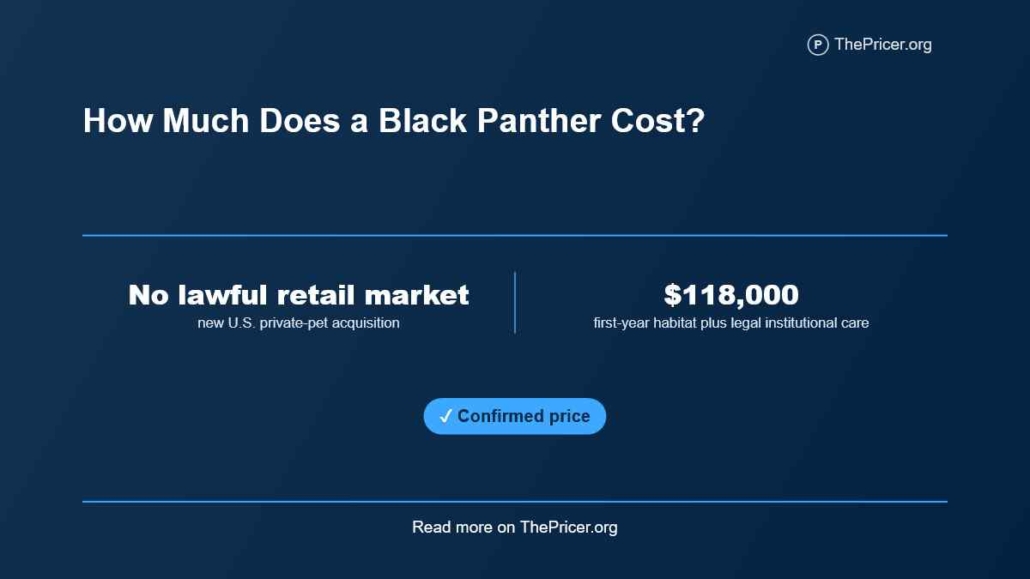
For legal institutional or sanctuary care, a big cat can cost up to about $20,000 per year for daily care, enrichment, and preventive medicine, while a new secure habitat can cost around $98,000, according to current figures published by The Wildcat Sanctuary. For an ordinary private buyer in the United States, though, there is no normal current purchase price for a black panther because federal law now prohibits acquiring a leopard, jaguar, or other covered big cat as a new private pet.
The Big Cat Public Safety Act took effect on December 20, 2022. It restricts possession, breeding, acquisition, sale, transport, and other transactions involving covered big cats. Private owners who already possessed qualifying animals before the law took effect could keep them only under the grandfather provision and had to register them by June 18, 2023. That registration period is closed.
This changes the cost question. A 2026 U.S. reader should not budget for a cub purchase from a breeder. The meaningful numbers now involve legal sanctuary or institutional care, existing grandfathered animals, secure habitats, veterinary care, feeding, regulatory compliance, and the consequences of an unlawful acquisition.
Article Highlights
Jump to sections
- Current sanctuary figures put annual big-cat care at up to $20,000 (at $30 per hour, earning that amount would take about 3.8 months of full-time work, before taxes) per animal.
- A new secure habitat with heated indoor space can cost around $98,000.
- The same sanctuary publishes an annual feeding figure of about $2,400 per big cat.
- An institutional first-year scenario using the habitat and annual-care figures reaches up to $118,000 before costs not included in those two lines.
- Ordinary private buyers in the U.S. generally cannot acquire a new leopard or jaguar as a pet under the Big Cat Public Safety Act.
- Leopards and jaguars are both listed in CITES Appendix I, placing strict controls on international trade.
- A 2025 federal prosecution under the Big Cat Public Safety Act resulted in one defendant receiving a $5,000 fine and five years of probation.
How Much Does a Black Panther Cost?
| Current cost or financial signal | Published amount | What it represents |
|---|---|---|
| New big-cat habitat | $98,000 (about 1.6 years of full-time work at $30 per hour) | Current sanctuary estimate for constructing a new habitat with heated indoor space |
| Annual care | Up to $20,000 per year | Daily care, enrichment, and preventive medicine for one big cat |
| Annual feeding | $2,400 per year | Published sanctuary feeding cost for one big cat |
| Facility heating | $35,000 per year | Heating indoor animal buildings across the sanctuary, not a per-cat cost |
| 2025 BCPSA sentence | $5,000 fine | Actual federal sentence in a post-Act big-cat acquisition case |
These figures should not be read as the price of buying a black panther. They show what legal professional care can cost after the animal already exists within a lawful institutional or grandfathered setting.
What a Black Panther Is
A black panther is not a separate animal species. The name is commonly used for a melanistic, or unusually dark-colored, big cat. In most wildlife discussions, that means a melanistic leopard, Panthera pardus, or a melanistic jaguar, Panthera onca. Their underlying coat patterns do not disappear simply because the coat becomes dark.
The San Diego Zoo jaguar profile describes melanistic jaguars as having black-on-black coloration. Jaguars are native to the Americas, while leopards occur in Africa and Asia. Jaguars are also more heavily built, and their rosettes often contain central spots that typical leopard rosettes lack.
The distinction matters because wildlife laws and trade documents use actual species names. A seller calling an animal a “panther” does not create a separate legal category.
No Normal U.S. Pet Market
The U.S. Fish and Wildlife Service states that the Big Cat Public Safety Act covers lions, tigers, leopards, snow leopards, clouded leopards, jaguars, cheetahs, cougars, and their hybrids. The agency specifically notes that the law also covers animals commonly called panthers.
Without an applicable exception, a person may not breed or possess a covered big cat or import, export, transport, sell, receive, acquire, or purchase one in commerce covered by the Act.
The grandfather provision does not create a new purchasing route. Private people who legally possessed qualifying big cats before December 20, 2022 could retain those specific animals if they completed federal registration by June 18, 2023 and continue to meet the requirements. They cannot use that status to acquire another leopard or jaguar today.
This also overrides the usefulness of old lists claiming that particular states allow unrestricted panther ownership. A permissive state rule does not cancel federal big-cat law.
The $98,000 Habitat Problem
The enclosure can dwarf many recurring expenses. The Wildcat Sanctuary currently publishes a cost of $98,000 (about 1.6 years of full-time work at $30 per hour) to construct a new habitat with heated indoor space.
Compare that with its published $2,400 annual feeding cost for one big cat:
$98,000 ÷ $2,400 = 40.83.
The habitat costs the equivalent of about 40.8 years of the published annual feeding expense. That does not mean a habitat lasts exactly 41 years or that food remains fixed at today’s cost. It shows how badly a purchase-price discussion understates the infrastructure needed for professional big-cat care.
The sanctuary also publishes annual care of up to $20,000 per cat. Divided across 12 months, that is about $1,666.67 per month. Its separate $2,400 feeding figure equals about $200 per month.
The organization does not state on that page whether the $2,400 feeding line is already included inside the broader $20,000 care figure. For that reason, the two annual numbers should not simply be added together and presented as one guaranteed bill.
Five-Year Cost Math
Consider a qualifying institution that has to construct one new habitat and then fund five years of care for one big cat. Using only the two published figures that can be cleanly separated by time:
$98,000 habitat + ($20,000 × 5 years) = up to $198,000.
That is an up to $198,000 five-year scenario for the habitat plus the sanctuary’s stated annual care category. It does not include land acquisition, facility-wide heating allocation, major emergency medical treatment, transportation, insurance, staffing infrastructure outside the stated care figure, or rebuilding the habitat.
Food provides another useful measure. At the separately published $2,400 per year:
$2,400 × 5 = $12,000 of feeding expense across five years.
Again, that $12,000 should be viewed separately because the source does not specify whether food is already included in its up-to-$20,000 annual care figure.
Existing grandfathered animal: a private owner who lawfully registered an animal does not need to buy it again, but recurring care can still run for years.
New qualifying sanctuary habitat: the published habitat and first-year care figures alone produce an up-to-$118,000 first-year scenario.
Ordinary new private buyer: there is no lawful U.S. pet-purchase scenario to calculate under the federal framework unless a statutory exception applies.
Who Can Legally Possess One?
Federal law contains narrow exceptions. The Fish and Wildlife Service identifies qualifying USDA Class C exhibitors, certain federal facilities, state colleges and universities, state agencies, state-licensed veterinarians, qualifying wildlife sanctuaries, and qualifying transporters acting for exempt recipients.
The sanctuary and exhibitor requirements place conditions on those exceptions. Qualifying sanctuaries, for instance, cannot commercially trade in covered big cats, cannot breed them, cannot permit public contact, and cannot transport them offsite for display.
A facility seeking to exhibit regulated animals may also encounter federal Animal Welfare Act licensing requirements. USDA APHIS maintains the current Class C exhibitor application process. A federal license is not a shortcut allowing someone to buy a leopard simply because they want one at home.
International movement adds another obstacle. The current CITES Appendices list both Panthera pardus and Panthera onca in Appendix I. CITES explains that Appendix I trade is subject to particularly strict regulation and may be authorized only in exceptional circumstances.
Breaking the Law
An illegal big-cat purchase can create costs that have nothing to do with feeding or cages. Federal authorities have already prosecuted conduct occurring after the Big Cat Public Safety Act took effect.
In March 2025, the Department of Justice announced that a defendant who had purchased and transported a tiger cub after enactment received five years of probation and a $5,000 fine.
An earlier DOJ announcement in the same prosecution stated that a violation of the Act could carry up to five years in prison and a fine of up to $10,000. Those maximums are penalties, not an alternative licensing fee. Animals involved in prohibited transactions can also be subject to seizure and forfeiture.
That is why an advertised cub price from an informal seller cannot be treated as the true cost of ownership in 2026. The legality of the transaction comes before the sticker price.

When This Cost Makes Sense
Makes sense if:
- You are budgeting for a qualifying sanctuary, zoo, university, veterinary facility, or other entity covered by a lawful exception.
- You are a registered pre-Act private owner estimating the continuing cost of an animal you already legally possessed.
- You are researching the true institutional cost of habitat, feeding, veterinary support, and daily care.
- You are comparing the economics of long-term wildlife rescue and sanctuary capacity.
Does not make sense if:
- You are trying to budget for purchasing a new black panther as an ordinary private U.S. pet.
- A seller claims state law alone makes a new private transaction legal.
- You are treating an overseas breeder as a workaround without accounting for U.S. federal law and CITES controls.
- Your budget covers the animal itself but not secure professional housing and long-term care.
The same federal framework affects other big-cat cost searches. Anyone researching the cost of a lion, tiger, or cheetah should distinguish historical or institutional pricing from what an ordinary private U.S. buyer can legally acquire today.
What We Verified
- Checked: the current federal guidance confirming that leopards, jaguars, and animals referred to as panthers are covered by the Big Cat Public Safety Act.
- Confirmed: private grandfather registration closed on June 18, 2023, and registered pre-Act owners cannot acquire additional big cats.
- Cross-referenced: current sanctuary figures of $98,000 for a new habitat, up to $20,000 per year for care, and $2,400 per year for feeding.
- Verified: the federal penalty provision cited by DOJ allows up to five years’ imprisonment and a fine of up to $10,000 for a BCPSA violation.
- Confirmed: both leopards and jaguars remain listed in CITES Appendix I under the current published appendices.
Answers to Common Questions
How much does a black panther cost in the United States?
There is no normal lawful 2026 private-pet purchase price for an ordinary U.S. buyer. In legal institutional care, current published figures include up to $20,000 per year for care and about $98,000 for a new habitat.
Can I legally buy a black panther as a pet?
An ordinary private U.S. buyer cannot newly acquire a covered big cat as a pet under the Big Cat Public Safety Act. Narrow exceptions exist for qualifying institutions and certain registered pre-Act owners.
Is a black panther a separate species?
No. The term commonly refers to a melanistic big cat, particularly a leopard or jaguar. Federal big-cat guidance also treats “panther” as a descriptive name rather than a separate species.
How much does it cost to feed a big cat?
The Wildcat Sanctuary currently publishes a figure of about $2,400 per year to feed one big cat, or roughly $200 per month. Actual food costs can vary by species, animal size, supplier, location, and diet.
How much can a legal big-cat habitat cost?
One current sanctuary estimate puts construction of a new habitat with heated indoor space at about $98,000. That is an institutional example rather than a universal contractor quote.
Disclosure: Educational content, not medical advice. Pricing varies by provider, location, and insurance. Confirm eligibility, coverage, and out-of-pocket costs with a licensed clinician and your insurer. See our methodology and corrections policy.