
How Much Does A Cargo Ship Cost?
Updated on | Written by Alec Pow
This article was researched using 12 sources. See our methodology and corrections policy.
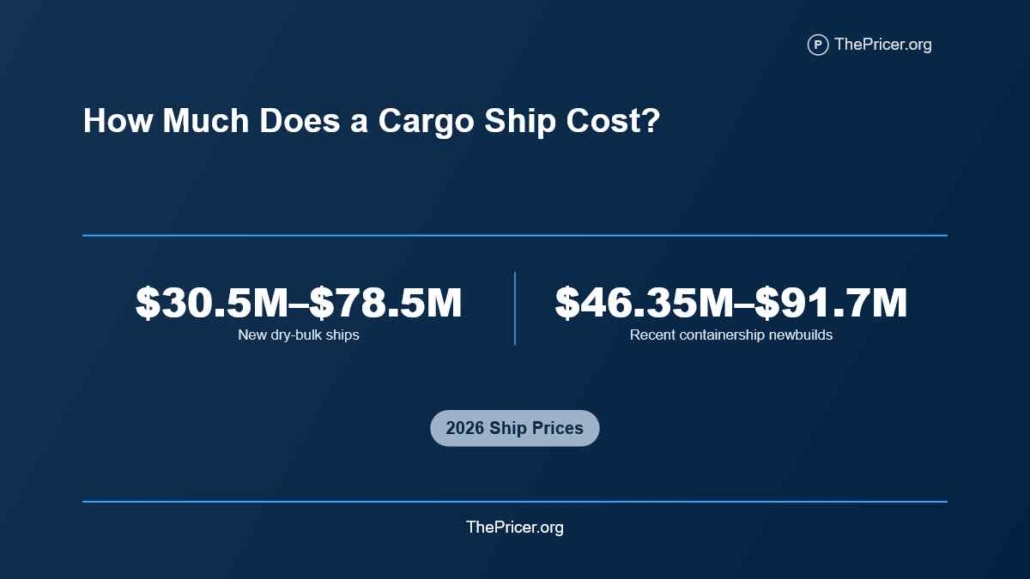
A cargo ship can cost from roughly $3 million to $4 million for an older small general-cargo vessel to about $30.5 million to $78.5 million for a new conventional dry-bulk carrier. Modern container ships can cost more, with recent newbuild contracts ranging from about $46.35 million for a 2,800-TEU feeder ship to roughly $82.6 million to $91.7 million per vessel for some latest-generation mid-size containerships.
There is no meaningful single average price for a cargo ship. A 20-year-old multipurpose vessel, a new 38,000-dwt Handysize bulk carrier, and a highly efficient refrigerated containership are all cargo ships, but their purchase prices, fuel consumption, maintenance needs, and earning potential are completely different.
Article Highlights
Jump to sections
- Older general-cargo ships can sell for roughly $3 million to $4 million (at $30 per hour, earning that amount would take about 48 to 64 years of full-time work, before taxes).
- New dry-bulk ships currently run from about $30.5 million for a Handysize to about $78.5 million for a Newcastlemax.
- Euroseas ordered specialized 2,800-TEU containerships for about $46.35 million each in March 2026.
- Global Ship Lease’s 2026 newbuild programs work out to around $82.6 million to $91.7 million per ship.
- Routine vessel operating costs can reach roughly $2 million to $2.5 million per year before bunker fuel and many voyage expenses.
- One major hidden cost is drydocking. Global Ship Lease reported an average $3.4 million drydock cost plus $1.7 million in lost revenue from off-hire.
How Much Does A Cargo Ship Cost?
The type of cargo ship matters more than almost anything else when estimating the purchase price.
| Cargo ship example | Approximate price | Price basis |
|---|---|---|
| Older general-cargo vessel | $3M–$4M (about 48 to 64 years of full-time work at $30 per hour) | Secondhand broker listings |
| New 38,000-dwt Handysize | $30.5M | June 2026 market benchmark |
| New 63,000-dwt Ultramax | $34.5M | June 2026 market benchmark |
| New 82,000-dwt Kamsarmax | $37.5M | June 2026 market benchmark |
| New 2,800-TEU containership | $46.35M–$46.5M | 2026 Euroseas contracts |
| New 180,000-dwt Capesize | $75.5M | June 2026 market benchmark |
| New 205,000-dwt Newcastlemax | $78.5M | June 2026 market benchmark |
| Latest-generation mid-size containership | $82.6M–$91.7M | 2026 Global Ship Lease orders |
For dry-bulk ships, Intermodal’s June 2026 shipping market report puts indicative newbuilding prices at about $30.5 million for a Handysize, $34.5 million for an Ultramax, $37.5 million for a Kamsarmax, $75.5 million for a Capesize, and $78.5 million for a Newcastlemax.
This is one of the biggest corrections to the old version of this article. A conventional large bulk carrier does not normally cost anything close to $500 million. Current newbuilding benchmarks for these vessels are in the tens of millions.
Container Ships
Container ships have their own pricing market, and capacity alone does not tell the full story. Propulsion technology, refrigeration capacity, efficiency, shipyard, and delivery timing can all change the price.
In March 2026, Euroseas announced contracts for two specialized 2,800-TEU high-reefer containerships at approximately $46.35 million (about 743 years of full-time work at $30 per hour) each. The ships will have more than 1,000 refrigerated-container plugs and are scheduled for delivery in 2028. The price comes directly from the company’s SEC filing announcing the shipbuilding contract.
Euroseas expanded the program in April 2026, ordering another pair of the 2,800-TEU high-reefer design for approximately $46.5 million per ship, according to a second SEC filing.
Larger latest-generation designs can cost considerably more. Global Ship Lease announced 10 new mid-size ultra-high-reefer containerships in June 2026 for approximately $917 million total. That works out to about $91.7 million per vessel. The Global Ship Lease announcement filed with the SEC says deliveries are planned between late 2028 and early 2030.
A few weeks later, Global Ship Lease ordered another five latest-generation vessels for approximately $413 million. Dividing the contract value by five gives about $82.6 million per ship, as reported in its June 24 SEC filing.
Used Ships

Buying used can reduce the entry price dramatically. Current broker listings show that some older multipurpose and general-cargo ships built around the turn of the century can be offered in approximately the $3 million to high-$3-million range.
For example, Ship-Broker’s older multipurpose and general-cargo listings have included vessels built from 1999 to 2003 with asking-price indications around this level.
But the cheapest ship to buy is not necessarily the cheapest ship to own. An older vessel may have an upcoming special survey, major steel renewal, engine work, poor fuel consumption, outdated equipment, or efficiency problems that make a low purchase price much less attractive.
This is also why comparing a $3.5 million used ship directly with a $46.35 million newbuild can be misleading. The older ship costs about 92% less to acquire, but it could be more than two decades older and much closer to expensive survey and repair work.
Operating Costs
The purchase price is only the beginning. Owners also pay for crew, provisions, lubricants, spare parts, repairs, technical management, class inspections, insurance, and administration.
Danaos provides a useful real-world benchmark. Its average vessel operating cost reached $6,969 per vessel per day in 2025, according to the company’s 2025 annual SEC filing.
Multiply $6,969 by 365 days and the result is about $2.54 million per year.
That is still not the ship’s total annual cost. The same Danaos filing distinguishes vessel operating expenses from voyage expenses and notes that voyage expenses can include items such as bunker consumption and port costs.
Our guide to oil tanker costs makes the same distinction between buying the vessel, keeping it operational, and actually sailing it on commercial voyages.
Fuel Costs
Fuel is potentially one of the largest expenses in cargo shipping, and even a small change in daily consumption becomes important when multiplied across hundreds of sailing days.
Singapore VLSFO was quoted at $874 per metric ton on September 24, 2026, according to Ship & Bunker’s Singapore bunker-price data. Prices had been $857 per ton only three days earlier and above $900 earlier in September, showing why a permanent fuel-cost estimate quickly becomes outdated.
| Illustrative fuel use | Cost per sailing day at $874/mt | Cost over 250 sailing days |
|---|---|---|
| 20 mt/day | $17,480 | $4.37M |
| 30 mt/day | $26,220 | $6.56M |
| 50 mt/day | $43,700 | $10.93M |
| 70 mt/day | $61,180 | $15.30M |
These are deliberately illustrative scenarios, not assumed fuel-burn rates for every cargo ship. Actual consumption depends on vessel design, engine, speed, weather, cargo load, hull condition, and route.
Current fuel markets can also move sharply. On September 24, 2026, ENGINE reported large one-day movements in bunker prices across Singapore, Zhoushan, and Fujairah.
The effect of added sailing distance is explored in our analysis of the cost of rerouting a tanker around Africa, where additional sailing days compound fuel and daily vessel expenses.
Hidden Costs
Drydocking is one of the most important expenses missing from many simple cargo-ship cost estimates.
Global Ship Lease reported that the 25 drydockings completed across its fleet between January 2024 and December 2025 cost an average of $3.4 million per vessel. It also estimated an average $1.7 million loss of revenue from off-hire while the vessels were unavailable.
That information comes directly from Global Ship Lease’s annual SEC filing.
Add the two figures together and the average economic impact around those drydockings was about $5.1 million per ship.
This does not mean every ship will cost $5.1 million every time it enters a yard. It does show why the date of the next drydock and special survey should be part of any purchase calculation.
Canal Fees
Route choice can add another substantial expense. Panama Canal tolls, for example, are not one flat charge.
The Panama Canal Authority’s official tariff schedule currently lists a fixed transit component of $25,000 for certain regular passenger, general-cargo, and reefer vessels below 10,000 PC/UMS. The fixed component rises to $60,000 for several larger regular vessel categories and higher still for some larger lock categories.
Those fixed charges are only part of the total transit cost. Capacity-based tolls and maritime services can be added, which is why quoting one universal “Panama Canal cost” for a cargo ship would be misleading.
Port-specific government charges can matter as well. Our analysis of new U.S. port fees and import prices shows how vessel characteristics and port-call patterns can add significant costs to a shipping operation.
Efficiency Rules
Fuel efficiency now affects more than the fuel bill. International environmental requirements can change how older ships are operated and whether upgrades make financial sense.
The International Maritime Organization states that EEXI generally applies to ships of 400 gross tonnage and above, while CII applies to covered ships of 5,000 gross tonnage and above.
The covered categories include containerships, bulk carriers, general-cargo ships, and refrigerated cargo carriers.
An older inefficient ship may therefore require changes such as engine-power limitation, efficiency improvements, or operating-speed adjustments. A lower purchase price has to be weighed against these potential costs and restrictions.
What Changes the Price?
Vessel size: Larger ships generally require more steel, larger machinery, and more expensive systems, but ship prices do not increase at a perfectly fixed rate per ton or per TEU.
Cargo type: Reefer plugs, cargo cranes, reinforced holds, hatch systems, and other specialized equipment add cost.
Age: Older ships usually cost less, but the discount can be offset by maintenance, fuel consumption, drydocking, and shorter remaining economic life.
Efficiency: A modern ship that saves even a few metric tons of fuel per sailing day can save hundreds of thousands or millions of dollars over time.
Shipyard: Yard location, orderbook, reputation, financing, and construction slots all affect newbuilding prices.
Delivery date: A ship that is available immediately can be worth more during a strong freight market than one delivering several years later.
Survey status: A cheap ship approaching a multimillion-dollar drydock can effectively be much more expensive than its asking price suggests.
Price Per Capacity
Another useful way to compare ships is to calculate purchase price against cargo capacity, although it should never be used alone.
A $46.35 million 2,800-TEU Euroseas vessel works out to about:
$46,350,000 ÷ 2,800 = $16,554 per TEU
If two ships of similar age and design have very different prices per TEU, that can flag differences worth investigating, such as reefer capacity, machinery, fuel efficiency, charter attachment, or delivery timing.
For bulk carriers, the same calculation can be done per deadweight ton. A $75.5 million 180,000-dwt Capesize benchmark works out to approximately:
$75,500,000 ÷ 180,000 = $419 per dwt
A $30.5 million 38,000-dwt Handysize works out to around $803 per dwt. The larger ship therefore costs more overall but significantly less for each unit of carrying capacity.
Work-Hour Comparison
The scale of these purchases becomes clearer when compared with ordinary earnings. At $30 per hour, earning the $46.35 million purchase price of one Euroseas feeder containership would require approximately 1.545 million work hours.
At 2,080 working hours per year, that equals about 743 years of gross full-time wages, before taxes and living expenses.
Even a $3.5 million older cargo ship represents about 116,667 hours of work, or roughly 56 years at the same wage.
Before You Buy
A ship should be selected around the intended trade rather than simply around the lowest available purchase price. Cargo type, likely ports, draft restrictions, crane requirements, route length, expected charter income, fuel availability, and crew requirements all affect which vessel makes financial sense.
A pre-purchase survey is particularly important on older ships. Class records, hull condition, engine history, upcoming surveys, drydock timing, fuel consumption, emissions performance, and required capital improvements can expose costs that are invisible in the broker’s asking price.
The buyer also needs working capital beyond the acquisition itself. Insurance, crew mobilization, initial stores, bunker fuel, financing fees, interest, registration, legal work, surveys, and unexpected repairs can materially increase the amount of money required before the vessel completes its first profitable voyage.
Answers to Common Questions
How much does a cargo ship cost?
An older small general-cargo vessel can cost around $3 million to $4 million. New dry-bulk vessels currently have benchmarks from roughly $30.5 million to $78.5 million, while recent modern containership orders range from about $46 million to more than $90 million per ship.
How much does a new container ship cost?
Recent real contracts provide a range of about $46.35 million for a specialized 2,800-TEU feeder to roughly $82.6 million to $91.7 million for newer mid-size designs ordered by Global Ship Lease.
How much does a bulk carrier cost?
June 2026 newbuild benchmarks range from approximately $30.5 million for a 38,000-dwt Handysize to $78.5 million for a 205,000-dwt Newcastlemax. A 180,000-dwt Capesize was approximately $75.5 million.
Disclosure: Educational content, not financial advice. Prices reflect public information as of the dates cited and can change. Confirm current rates, fees, taxes, and terms with official sources before purchasing. See our methodology and corrections policy.