
How Much Does a CBC Blood Test Cost?
Updated on | Written by Alec Pow
This article was researched using 14 sources. See our methodology and corrections policy.
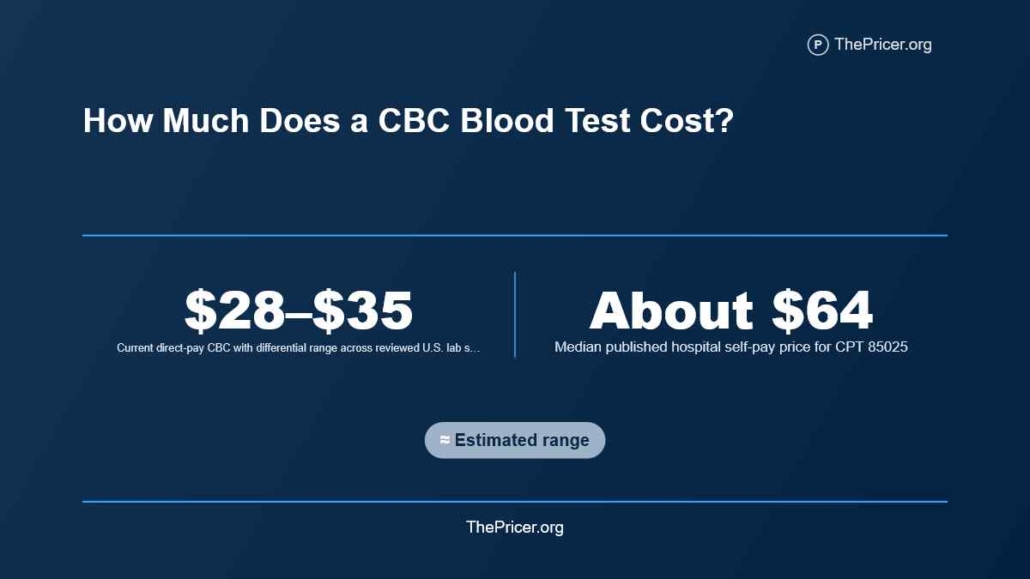
A CBC blood test currently costs about $28 to $35 when ordered directly through several major U.S. lab services reviewed for this update. The lowest published direct-pay example is $28, while two services reach $33 to $35 after their stated physician-order fee is added. Hospital self-pay prices can be higher, and insured patients may owe anything from $0 to their plan’s negotiated patient share.
A complete blood count measures red blood cells, white blood cells, hemoglobin, hematocrit, platelets, and related indices. Many current direct-pay products include a white blood cell differential as well. The key cost distinction is where the test is ordered and billed, not the small amount of blood collected.
Article Highlights
Jump to sections
- Current direct-pay CBC examples reviewed range from $28 to $35 (at $30 per hour, earning that amount would take about 0.9 to 1.2 hours of work, before taxes) after stated order fees.
- The median total across four direct-pay examples is $31.
- A 2026 hospital price dataset puts the median published self-pay price for CPT 85025 at about $64.
- Medicare beneficiaries usually pay $0 for covered medically necessary clinical laboratory tests.
- A CBC alone usually does not require fasting, though another test drawn at the same visit might.
- An abnormal CBC can point toward a problem, but it does not establish a diagnosis by itself.
How Much Does a CBC Blood Test Cost?
For an uninsured person who wants to order a CBC directly, a practical current budget is about $28 to $35 (about 0.9 to 1.2 hours of work at $30 per hour) from the four direct-access services compared below. HealthLabs lists its CBC with differential at $28. Labcorp OnDemand lists CBC with differential at $29 and uses in-person collection at a Labcorp site.
Quest lists its CBC at $29 plus a $6 physician service fee, producing a current stated total of $35 before any optional mobile collection. Walk-In Lab lists CBC with differential at $27 plus a $6 physician fee, or $33 before temporary promotions.
The four total prices are $28, $29, $33, and $35. Their sample median is $31. This is a comparison of four visible direct-pay offers, not a national average. Availability, state rules, age limits, promotions, and collection options can change what a buyer can actually order.
| Direct-pay CBC option | Current listed price | Stated extra fee | Current total used here |
|---|---|---|---|
| HealthLabs CBC with differential | $28 | $0 stated separately | $28 |
| Labcorp OnDemand CBC with differential | $29 | $0 stated separately | $29 |
| Walk-In Lab CBC with differential | $27 | $6 physician fee | $33 |
| Quest CBC with differential | $29 | $6 physician fee | $35 |

Home Collection Costs More
Direct-access testing does not automatically mean a mail-in CBC kit. The services in the price comparison above use a venous blood sample collected at a laboratory or collection site. A CBC needs the cell counts and related measurements produced from that blood sample. A home visit can change where the needle draw happens, but the specimen still goes to a laboratory for analysis.
Quest currently offers in-home sample collection for an additional $79 (about 2.6 hours of work at $30 per hour) in eligible areas. Using the previously established Quest CBC total of $35, adding mobile collection produces an illustrative total of $114. The collection service alone costs more than twice the direct-pay CBC. Someone choosing home collection is paying primarily for convenience rather than a different blood-count test.
This corrects a common pricing error. An online lab ordering service may let you buy the test on a website, but that does not mean the CBC is collected from a mailed finger-prick kit. Check the collection method before comparing two prices. A low advertised test can require travel to a patient service center, while a home phlebotomy option can add a larger convenience charge. For a person who can visit a nearby lab, that $79 difference may be the largest optional cost attached to an otherwise inexpensive CBC.
Hospital Prices Are Different
A hospital laboratory should not be compared with a direct-order lab by looking only at one advertised number. A 2026 dataset built from hospital price-transparency files reports a median hospital cash price of about $64 for CPT 85025, the automated CBC with differential. Its middle 50% of published self-pay prices runs about $35 to $108. The dataset covers thousands of hospitals, but it is still a collection of published facility prices rather than a prediction of one patient’s final bill.
Compared with the $31 median in the four direct-pay examples above, the $64 hospital median is $33 higher and a little more than twice as large. That comparison uses similar CBC-with-differential services, but the purchase channels are different. Hospital prices can reflect facility billing structures that are absent from a direct-access laboratory order.
The setting changes the bill. A CBC drawn during an emergency visit, hospital outpatient appointment, or specialist visit can appear beside other charges that have nothing to do with the laboratory analysis itself. The useful comparison is the laboratory service plus any visit or facility charge you must pay, rather than the CBC line item in isolation. Readers pricing broader testing can compare related blood work costs without assuming every test follows the same price pattern.
Insurance and Medicare
Commercial insurance does not produce one standard CBC copay. Patient responsibility can depend on whether the laboratory is in network, whether the plan applies a deductible, and whether copayment or coinsurance rules apply. HealthCare.gov explains that a health plan deductible is the amount a member can owe for covered services before the plan begins paying its share. Some services are paid before the deductible, so the plan document and lab network still matter.
That means an insured CBC can cost $0 for one patient while another pays the plan’s negotiated amount or a share of it. A test ordered during a medical visit can also be accompanied by an office-visit bill. The safest comparison is to ask the insurer for the expected patient cost for the exact laboratory and, when available, the billing code being ordered.
Medicare is different. The Medicare laboratory benefit says Part B covers medically necessary diagnostic laboratory tests ordered by a healthcare provider and that beneficiaries usually pay $0 for covered tests. That does not make every self-requested or noncovered laboratory service free. A separate visit or another service can still have its own cost rules.
CBC vs CBC With Differential
A standard CBC measures the total number of white blood cells along with red-cell and platelet measurements. A CBC with differential goes one step further by measuring the major white blood cell types separately. The blood differential measures neutrophils, lymphocytes, monocytes, eosinophils, and basophils. Those categories can give a clinician more information about an abnormal total white-cell count.
Several current consumer lab products bundle the differential into the price. The four direct-pay offers used in the price comparison all describe differential testing, so their $28 to $35 totals are not prices for a stripped-down CBC alone. This matters when comparing a doctor’s order or hospital estimate. CPT 85025 is commonly used for an automated CBC with differential, while a CBC without differential can be billed under a different code.
A differential does not turn the test into a diagnosis. High or low neutrophils, lymphocytes, eosinophils, or other cell types can occur for many reasons. The result needs to be read with symptoms, medications, medical history, and other laboratory findings. A person shopping by price should first confirm whether the order is CBC alone or CBC with differential so two unlike tests are not compared as though they were identical.
What the CBC Measures
A CBC provides several measurements from one blood sample. The MedlinePlus CBC guide lists red blood cells, white blood cells, platelets, hemoglobin, hematocrit, and mean corpuscular volume among the core measurements. Many reports also show MCH, MCHC, RDW, and mean platelet volume. A CBC with differential adds the individual white-cell types.
These numbers can support an evaluation for anemia, infection, immune disorders, blood disorders, medication effects, and other conditions. They do not prove the cause. A high white blood cell count can occur with infection, but it can also appear with medication reactions and other conditions. Low red-cell, hemoglobin, or hematocrit values can fit anemia, yet the CBC alone does not identify whether the cause is iron deficiency, blood loss, kidney disease, a vitamin deficiency, or another problem.
Reference ranges also vary. Cleveland Clinic reference ranges show adult WBC values around 4,000 to 10,000 cells per microliter and platelets around 150,000 to 400,000 per microliter, while RBC, hemoglobin, and hematocrit ranges differ by hormone status and other factors. Use the range printed by the laboratory that performed the test.
Extra Costs Around the Test
The CBC can be the cheapest part of the encounter. A doctor or urgent-care visit may be billed separately when testing is ordered to investigate fatigue, fever, bruising, infection symptoms, or another concern. Extra laboratory work can also be added when the CBC points toward a question that the blood count cannot answer. Those additional tests should be priced by name rather than assigned one blanket fee.
A common cost mistake is assuming an advertised test price includes every step. Quest’s current $29 CBC becomes $35 after its stated $6 physician service fee. That fee raises the test’s advertised amount by about 21%. Walk-In Lab’s $27 listed price becomes $33 after its $6 fee, an increase of about 22%. The hidden-cost lesson is small in dollars but meaningful in percentage terms.
Worked scenario. Assume an uninsured person needs one direct-pay CBC now and another three months later for follow-up. Using the four current direct-pay totals, two tests would cost about $56 to $70. That scenario excludes any medical visit and any additional laboratory work. If the reason for testing involves sexual-health screening, CBC pricing should not be substituted for the very different cost of STD testing, which uses different tests and billing codes.
Results, Timing, and Test Decisions
Turnaround is often quick. Labcorp says its direct-pay CBC results are typically available about one day after the sample reaches the lab. Walk-In Lab lists about one to two days, while HealthLabs says most results arrive within one to three business days. A CBC alone usually requires no special preparation, though fasting may still be required when another test is collected at the same appointment.
One abnormal number should not be treated as a diagnosis. MedlinePlus states that results outside a reference range can occur for many reasons, including hydration, medicines, activity, menstruation, and medical conditions. A clinician may repeat the CBC, compare it with earlier results, or order other tests. This distinction matters most when someone buys testing without a regular medical visit and receives a flagged value without clinical context.
Self-ordering can be useful when direct access is permitted and the person wants a known cash price or a previously recommended repeat test. Clinician-ordered testing makes more sense when symptoms need evaluation, a medication is being monitored, or the choice of tests depends on medical history. A CBC also has a different purpose from testing used before a blood transfusion, where blood typing, antibody screening, crossmatching, and other services can enter the bill.
Makes sense if
- You need a CBC that is legally available for direct purchase in your location.
- You want a fixed cash price and do not plan to bill insurance.
- A clinician has previously told you which test to repeat.
- You can follow up on abnormal results with a healthcare professional.
Does not make sense if
- You are using a CBC to diagnose a specific illness on your own.
- Your symptoms need urgent or direct medical evaluation.
- You need several tests and have not compared a bundled order with separate purchases.
- Your insurance may cover an in-network laboratory at a lower out-of-pocket cost.
Answers to Common Questions
How much is a CBC blood test without insurance?
Current direct-pay examples reviewed here cost about $28 to $35 after stated physician-order fees. Hospital cash prices can be higher.
How much does a CBC cost with Medicare?
Medicare says beneficiaries usually pay $0 for covered medically necessary diagnostic laboratory tests ordered by a healthcare provider.
Do I need to fast for a CBC?
No fasting is usually needed for a CBC alone. Another test collected during the same blood draw may require fasting, so follow the instructions for the entire order.
Does a CBC diagnose cancer or infection?
No. A CBC can show blood-cell patterns that may occur with infections, blood cancers, anemia, and many other conditions, but it cannot confirm a specific diagnosis by itself.
How fast do CBC results come back?
Many direct-pay services report results in about one to three days, though timing varies by laboratory, collection time, holidays, and processing delays.
Disclosure: Educational content, not medical advice. Pricing varies by provider, location, and insurance. Confirm eligibility, coverage, and out-of-pocket costs with a licensed clinician and your insurer. See our methodology and corrections policy.