
How Much Does a Chieftain Tank Cost?
Updated on | Researched and reviewed by Alec Pow, Founder & Pricing Investigator
Prices, claims, and calculations checked against 8 cited sources. See our research methodology and corrections policy.
A Chieftain tank does not have a normal new-vehicle price anymore. The British FV4201 Chieftain has been out of production for decades, so surviving examples trade as historic military vehicles, museum pieces, restoration projects, or specialized collector vehicles.
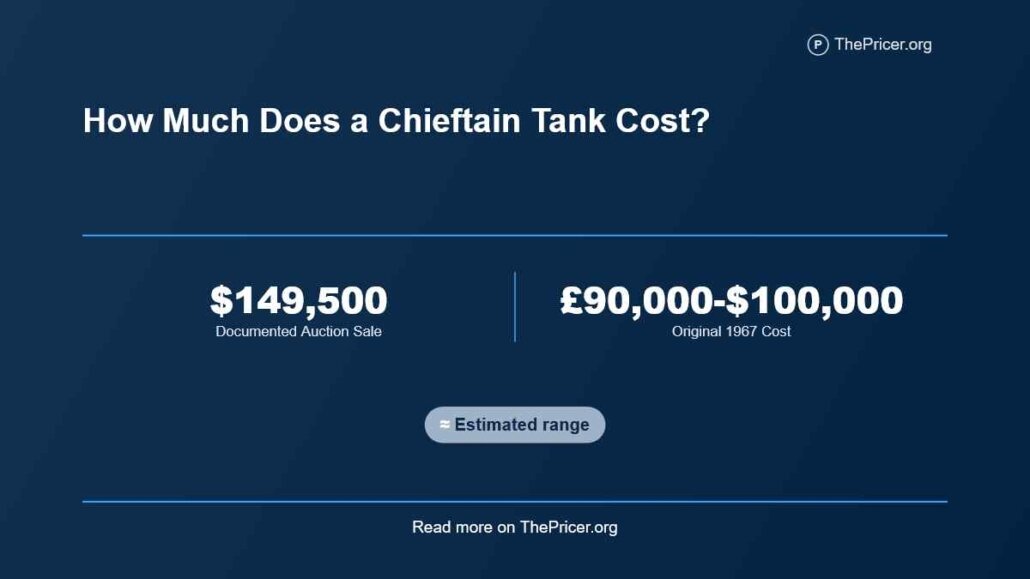
The best documented public-market benchmark we found is $149,500 for a Chieftain Mk 11 with a dozer blade, sold by RM Sotheby’s in 2014. Current Chieftains do occasionally appear on the specialist market, but many are offered without a public asking price, which makes a precise 2026 “average” impossible to defend.
Historically, the British government put the cost of a new Chieftain at £90,000 to £100,000 in 1967. In today’s purchasing power, that would represent roughly £1.8 million to £2 million using a CPI-style inflation comparison, but that is an economic comparison, not what a surviving Chieftain is worth to a collector today.
Article Highlights
Jump to sections
- A documented Chieftain Mk 11 sold for $149,500 at RM Sotheby’s in 2014.
- There is no new Chieftain price today because production ended decades ago.
- The British government estimated a new Chieftain at £90,000-$100,000 in 1967.
- That original price is roughly equivalent to around £1.8 million-$2 million in 2026 purchasing power, depending on the inflation methodology used.
- A Chieftain weighs roughly 55 long tons, so transport, storage, restoration, and maintenance can become major ownership expenses.
- Its approximately 890-liter fuel capacity makes even a single full tank expensive at today’s fuel prices.
- Condition, completeness, provenance, running status, restoration quality, variant, and whether major components are present can matter more to collector value than the Mk number alone.
How Much Does a Chieftain Tank Cost?
For a private collector, a reasonable answer is that a complete Chieftain can be a six-figure historic military vehicle, but there is not enough transparent recent transaction data to claim that every Chieftain is worth $150,000, $300,000, or any other fixed amount.
| Price angle | Documented amount | What it means |
|---|---|---|
| Original British procurement estimate | £90,000-$100,000 in 1967 | Approximate new military acquisition cost |
| 1967 cost in 2026 purchasing power | About £1.8M-£2.0M | Inflation comparison, not collector value |
| Chieftain Mk 11 auction sale | $149,500 in 2014 | Documented collector-market transaction |
| Current private market | Often price on application | Too few public transactions for a reliable average |
The strongest historical evidence comes directly from the UK Parliament. In March 1967, the government told Parliament that the estimated cost of a Chieftain tank was £90,000 to £100,000. A November 1967 answer narrowed the estimate to £90,000-$95,000.
That is far more defensible than assigning invented multimillion-dollar prices to individual Chieftain marks.
Collector Value
The most useful public sale we found is from the Littlefield Collection, one of the best-known military-vehicle collections ever dispersed at auction.
At the July 2014 sale, a Chieftain Mk 11 Main Battle Tank with dozer blade sold for $149,500. It is a real transaction rather than an asking price, making it much more useful than an unsupported online estimate.
That does not mean a Chieftain is worth exactly $149,500 today. Twelve years have passed, and individual military vehicles can differ enormously.
A non-running restoration project with missing equipment may trade for far less than a complete running vehicle. Conversely, an extensively restored tank with good provenance and desirable equipment could justify a much higher price.
Current specialist sellers still advertise Chieftains, but prices are frequently withheld and given only on application. That lack of transparent sales data is why we would not publish the old article’s $500,000-$2 million used range as fact.
Original Cost
The Chieftain’s original price is particularly interesting because we have contemporary government records rather than modern estimates.
In 1967, Parliament was told the tank cost approximately £90,000-$100,000. Around 150 Chieftains were expected to be delivered during that calendar year.
Using long-term UK inflation as a rough comparison, consumer prices are approximately twenty times their 1967 level under one CPI-based methodology. That puts £90,000-$100,000 at approximately:
£90,000 × 20.08 = £1.81 million
£100,000 × 20.08 = £2.01 million
The Bank of England cautions that very long-term inflation comparisons are only approximate because the types of goods and services people buy change over time.
This calculation therefore does not mean that an old Chieftain is currently worth £2 million. It means the government’s original acquisition price represented roughly that scale of purchasing power today.
Export Contracts
Military procurement also shows why dividing a giant defense contract by the number of tanks can produce a misleading “tank price.”
Iran placed a massive order with Britain during the 1970s. A later parliamentary investigation states that the 1976 agreement covered 1,500 Chieftain tanks and 250 repair vehicles, with £650 million paid upfront. Only 185 tanks were ultimately supplied before the Iranian Revolution disrupted the agreement.
The Foreign Affairs Committee documents the resulting decades-long financial dispute.
Another 1979 parliamentary answer put the broader Iranian contract at approximately £1.25 billion, including improved Shir 1 and Shir 2 vehicles and associated material.
Those contract totals should not be presented as simple Chieftain unit prices because military packages can incorporate support equipment, spare parts, training, modifications, repair vehicles, and other items.
Which Chieftain?
 The Chieftain went through repeated upgrades during its service life, which is one reason simple Mk-by-Mk price lists are unreliable today.
The Tank Museum’s Chieftain collection includes both Mk 10 and Mk 11 examples. Its Mk 10 represents one of the substantially upgraded forms of the tank, including Stillbrew additional armor. Its Mk 11 had also received Stillbrew and a Thermal Observation Gunnery Sight.
A Mk 10 is therefore not a “$10 million version” of the tank, as the old article claimed. We found no credible evidence supporting that figure.
Likewise, collector value does not rise according to a simple sequence in which Mk 7 is cheap, Mk 10 expensive, and Mk 11 still more expensive. Rarity, completeness, mechanical condition, history, restoration, and equipment can matter more.
What We Verified
We checked contemporary Parliamentary records for the original procurement price, The Tank Museum for service history and Chieftain variants, RM Sotheby’s for a documented collector-market sale, current specialist-market availability, British historic-vehicle rules, inflation methodology, and current fuel prices.
Several claims from the previous version did not survive that verification.
- There are no newly manufactured Chieftains for sale at $1-$4 million.
- We found no support for a $10 million new Mk 10.
- We found no support for a normal $500,000-$2 million used-market range.
- The Chieftain did not fight in numerous conflicts for the British Army. The Tank Museum says it never fired a shot in anger with British forces.
- We could not substantiate the old article’s claimed University of Cambridge operating-cost study.
The Tank Museum’s Chieftain Matrix describes the type as Britain’s main battle tank for roughly 30 years and provides useful context on the many surviving variants in its collection.
Fuel Cost
A purchase price is only the beginning with a 55-ton tank.
A Chieftain carries approximately 890 liters, or about 234 U.S. gallons, of fuel and has a quoted road range of around 500 km under favorable conditions.
That works out theoretically to:
890 liters ÷ 500 km = 1.78 liters per km
or roughly:
178 liters per 100 km
That is only about 1.3 miles per U.S. gallon.
Real operation can be worse because tanks spend time idling, maneuvering at low speed, operating off-road, and moving through terrain rather than cruising steadily down a road.
UK diesel prices have also reached extraordinary levels in October 2026. The RAC Fuel Watch has tracked national diesel prices around £2 per liter.
At exactly £2 per liter, filling an empty 890-liter fuel system would theoretically cost:
890 × £2 = £1,780
And if the tank achieved its quoted 500-km road range, fuel alone would equal approximately:
£1,780 ÷ 500 = £3.56 per km
That is approximately £5.73 per mile before maintenance, transportation, storage, labor, or repairs.
Ownership Example
Consider a collector buying a Chieftain for the same $149,500 achieved by the Mk 11 at the Littlefield auction.
| Cost | Illustrative amount |
|---|---|
| Purchase price | $149,500 |
| Initial specialist inspection and servicing | $10,000 |
| Initial transport and handling | $7,500 |
| Storage/site preparation | $5,000 |
| Initial repair reserve | $20,000 |
| Illustrative first-year commitment | $192,000 |
The non-purchase figures are illustrative rather than Chieftain quotations because transport distance, mechanical condition, storage arrangements, and the work required can vary dramatically.
The useful insight is the scale: a $149,500 acquisition could become roughly a $190,000 project before any major restoration. A serious engine, transmission, hydraulic, track, or turret-related problem could push the figure much higher.
Hidden Costs
Transport is a major issue. At roughly 55 long tons, a Chieftain cannot simply be loaded onto an ordinary vehicle trailer. Moving one requires specialist heavy-equipment logistics, with costs depending heavily on distance and jurisdiction.
Storage requires space and suitable ground. A normal residential garage is obviously inappropriate for a vehicle of this size and weight. Secure outdoor storage or a suitably engineered building can become part of the ownership budget.
Parts are scarce. The Leyland L60 engine, TN12 transmission, tracks, road wheels, hydraulics, electrical equipment, and other Chieftain-specific components have not been mass-produced for ordinary civilian use in decades.
Labor is specialized. Even when a replacement part can be found, a collector may need technicians familiar with historic tracked military equipment.
Restoration can exceed purchase price. Paint and cosmetic work are minor compared with rebuilding powertrain components or replacing missing military-specific hardware.
Legal status matters. The rules governing historic military vehicles and any former weapon systems depend on the country and the vehicle’s configuration. In Britain, tracked vehicles are exempt from normal vehicle type approval, but vehicles used on public roads must still satisfy applicable registration and roadworthiness rules. The government’s vehicle-approval guidance specifically identifies tracked vehicles as an exemption category.
Collectors should therefore verify the legal status of a particular vehicle and its equipment rather than assuming that buying an historic armored vehicle gives them the same rights that applied when it was in military service.
Buy vs Experience
For someone who primarily wants to experience a Chieftain rather than own one, paying for a tank-driving experience can make much more financial sense.
For context, a UK operator currently charges £999 for a private tank experience that culminates in driving a Chieftain over a car. Even dozens of such experiences would cost less than acquiring, transporting, storing, and maintaining an entire main battle tank.
At £999 per experience, the $149,500 Littlefield auction price alone represents well over 100 comparable experience packages, even before considering ownership expenses.
That illustrates how unusual the economics of tank ownership are: the largest expense is not necessarily gaining access to one, but taking responsibility for 55 tons of obsolete military machinery indefinitely.
Is a Chieftain Expensive?
Compared with other collectible vehicles, absolutely. Compared with the cost of a modern operational main battle tank, however, a surviving Chieftain can appear surprisingly inexpensive.
That distinction is important. An historic, privately owned Chieftain is not economically equivalent to a modern military tank with active weapons, current electronics, logistics support, ammunition, trained crews, and a defense supply chain.
Our broader guide to how much a battle tank costs explains how dramatically modern procurement costs can differ from historic collector values.
You can also compare the economics with other large military systems in our articles on the cost of a submarine and the cost of an F-18.
Answers to Common Questions
How much is a Chieftain tank worth today?
There is no reliable single 2026 market price because transactions are rare and current sellers often do not publish asking prices. A particularly useful documented benchmark is the $149,500 paid for a Chieftain Mk 11 with dozer blade at RM Sotheby’s Littlefield Collection auction in 2014.
How much did a Chieftain cost when new?
The British government told Parliament in 1967 that a Chieftain cost approximately £90,000-$100,000. That represented roughly £1.8 million-$2 million in 2026 purchasing power using one CPI-based long-term comparison.
Can you buy a brand-new Chieftain tank?
No. The Chieftain is an historic design that has been out of production for decades. Any genuine example entering the collector market is a surviving military vehicle, restoration, or converted historic vehicle.
Was a Chieftain Mk 10 worth $10 million?
We found no credible evidence supporting the old $10 million figure. The Mk 10 was an upgraded Chieftain incorporating improvements such as Stillbrew armor, but that does not establish a modern $10 million market value.
How much fuel does a Chieftain use?
Using its approximately 890-liter capacity and quoted 500-km road range produces a theoretical consumption of about 178 liters per 100 km, or roughly 1.3 mpg U.S. Actual use can vary considerably with terrain, speed, idling, and mechanical condition.
What is the biggest hidden Chieftain cost?
There is no single answer, but major mechanical restoration can easily become more important than fuel. Heavy transport, secure storage, specialist labor, scarce parts, and maintaining a decades-old powertrain can all add substantial costs after purchase.
Disclosure: Educational content, not financial advice. Prices reflect public information as of the dates cited and can change. Confirm current rates, fees, taxes, and terms with official sources before purchasing. See our methodology and corrections policy.