
How Much Does a Floating Dock Cost?
Updated on | Written by Alec Pow
This article was researched using 13 sources. See our methodology and corrections policy.
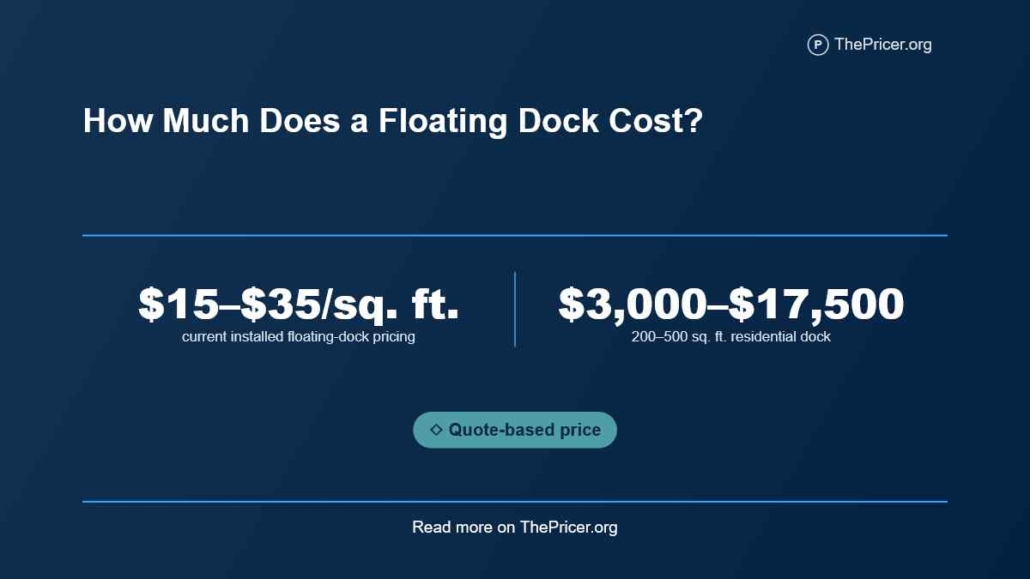
A floating dock costs about $15 to $35 per square foot installed, or roughly $3,000 to $17,500 for a 200- to 500-square-foot residential dock under current U.S. pricing. Current floating dock cost data uses those figures. DIY hardware-and-float kits can cost far less than a contractor-installed system, but their sticker price leaves several project pieces outside the box.
The number that matters is the completed waterfront system, not the platform alone. A floating dock may need decking, flotation, frame hardware, pipe guides or another anchoring method, a gangway, cleats, ladders, seasonal handling, and site-specific approval. Water depth, changing water levels, wave exposure, bottom conditions, and dock size determine which of those pieces are needed.
Article Highlights
Jump to sections
- Current installed floating-dock pricing is about $15 to $35 (at $30 per hour, earning that amount would take about 0.5 to 1.2 hours of work, before taxes) per square foot.
- Current hardware-and-float kits start at $799 for a 4-by-10-foot section before lumber and freight.
- Current modular packages reviewed range from $3,800 for a 24-foot straight dock to $8,950 for larger packages with pipe guides.
- A matching pipe-guide package can add about $1,000 compared with the same dock configuration without the guides.
- A gangway can add $625 to $2,375+ in current retail examples before other site work.
How Much Does a Floating Dock Cost?
DIY component packages sit at the low end. Dock Hardware currently lists floating dock kits with floats at $799 (about 3.3 full-time workdays at $30 per hour) for 4 by 10 feet, $1,259 for 4 by 16 feet, and $2,549 for 8 by 20 feet. These packages supply hardware and flotation, but the buyer still has to price lumber, decking, freight, anchoring, and launch work.
Finished modular systems move into another price band. Tommy Docks currently lists FLEXX floating dock packages at $3,800 for a 24-foot straight package, $4,800 for the same length with pipe guides, $5,950 for a 16-by-8-foot package with pipe guides, $7,450 for a 32-foot platform package, and $8,950 for several larger platform configurations with pipe guides.
| Current floating-dock example | Price | Scope |
|---|---|---|
| 4 x 10 hardware-and-float kit | $799 | Lumber and freight excluded |
| 4 x 16 hardware-and-float kit | $1,259 | Lumber and freight excluded |
| 8 x 20 hardware-and-float kit | $2,549 | Lumber and freight excluded |
| 24-foot straight modular package | $3,800 | Floating package without pipe guides |
| 16 x 8 modular package with guides | $5,950 | Floats, connectors, and pipe-guide kits |
| 32-foot platform modular package | $7,450 | Large floating platform package |
The table compares advertised packages, not equivalent installed docks. A $799 kit and a $7,450 platform can both be valid prices because their included components and dimensions differ. Ask what remains to be purchased before comparing two quotes.
What the Kit Price Excludes
A product-page price can omit major parts of the usable dock. EZ Dock explains that floating-dock quotes vary with configuration, size, location requirements, shipping, accessories, and watercraft needs. That is a better way to frame the budget than treating every floating system as a fixed number per square foot.
For a framed DIY dock, lumber and decking may be missing from the kit. A molded modular system can remove much of that carpentry but still need anchoring, a gangway, cleats, ladders, rails, or a PWC attachment. Freight matters because large floats and dock sections are bulky. Contractors can also charge for mobilization, trailers, work boats, pile-driving equipment, or difficult shoreline access when the site requires them.
The old material table mixed decking prices with complete dock prices. Cedar, aluminum, composite, and plastic are only pieces of the cost story. The flotation system and frame carry the dock, anchoring keeps it in place, and the gangway connects it to shore. A cheaper walking surface does not guarantee a cheaper finished dock if those other components are expensive.
DIY vs Professional Installation
DIY can remove a large labor charge, but a useful floating dock is not a $100 to $200 (about 3.3 to 6.7 hours of work at $30 per hour) project under current component pricing. A 4-by-16-foot Dock Hardware package costs $1,259 for hardware and five floats. The company’s current cost example adds $299 to $659 in residential freight, producing a delivered subtotal of $1,558 to $1,918 before frame lumber and decking.
It also puts a straightforward professionally built and installed floating dock around $3,000 to $6,000 including materials, with dock-builder labor around $40 to $100 per hour.

Those contractor figures are supplier guidance rather than a measured national average. Professional work becomes a different purchase because the builder can be responsible for assembly, launch, alignment, anchoring, and site logistics.
Deep water, difficult equipment access, pilings, long shore connections, or a layout that needs marine equipment can raise a quote beyond the small straightforward project cited above.
ThePricer calculation makes the DIY subtotal easier to compare. The $1,259 4-by-16 kit covers 64 square feet, equal to about $19.67 per square foot before lumber and freight. After the cited freight range, the subtotal becomes about $24.34 to $29.97 per square foot before decking. The old $8 to $13 per square foot DIY estimate no longer works as a sound planning figure.
Anchoring and Shore Access
A floating platform needs an anchoring system that holds it laterally while allowing the dock to move with the water. PolyDock’s anchoring options include pile hoops, pipe brackets, chain anchor plates, stiff arms, and related hardware. The manufacturer says the choice depends on water depth, bottom conditions, water-level movement, wave exposure, dock configuration, and nearby shoreline structures.
Using the two Tommy Docks package pairs cited earlier, pipe guides create a measurable equipment premium. The 24-foot straight package moves from $3,800 to $4,800, and the 16-foot T-shaped package moves from $3,800 to $4,800. In both matched comparisons, the guide-equipped configuration adds $1,000 before separate installation work. The calculation isolates the listed guide package rather than treating every anchoring method as a $1,000 add-on.
The shore connection can be another major line. Tommy Docks currently lists modular aluminum gangways from $625 for a 4-foot cedar-decked version to $2,375 for a 12-foot Titan-decked version. A steep bank or larger water-level swing may require a longer or more specialized ramp. Price the gangway and anchoring before treating the platform quote as the finished dock cost.
Permits and Shoreline Rules
There is no national $1,000 to $5,000 floating-dock permit fee. The U.S. Army Corps of Engineers currently lists a standard permit fee of $10 for noncommercial activity and $100 for commercial or industrial activity. The Corps also states that it does not charge permit fees for general-permit verifications, letters of permission, permit transfers, or permits issued to government agencies.
The filing charge is not the full approval budget. Depending on the property, a dock project can involve state environmental rules, county or municipal approval, a lake authority, an owners association, surveys, engineered drawings, or revisions to the proposed location. The project can cost money even when the federal filing charge is low or absent.
Floating construction is not automatically permit-free. At Table Rock Lake, the Corps says private floating facilities require permits, including private and community boat docks. Rules can also control where a dock is allowed and whether the applicant has qualifying shoreline access. Check the authority governing the actual waterbody before ordering the structure. Approval can alter the design before construction starts.
Three Project Scenarios
A basic DIY section is the lowest-cost case. Using the current 4-by-16 package already cited, hardware and flotation cost $1,259. Residential freight raises the documented subtotal to $1,558 to $1,918. Lumber, decking, anchoring, permits, tools, and launch work remain excluded, so this is a component subtotal rather than a finished-dock quote.
A more complete modular setup can reach several thousand dollars without paid labor. Take the current 16-foot T-shaped package with pipe guides at $4,800 and pair it with an 8-foot cedar-decked gangway at $1,275. The itemized retail subtotal is $4,800 + $1,275 = $6,075. Tax, delivery, local approval costs, extra shoreline hardware, and paid installation remain outside that scenario.
A larger modular platform can become a much broader waterfront project once site work starts. Add a gangway, watercraft attachment, lighting, rails, or a boat lift, and the finished scope can move far beyond the advertised dock package. The same applies when the shoreline needs longer access or heavier anchoring. These scenarios differ because the included work changes. Scope changes the total.
Materials, Maintenance
Floating docks use several construction systems. Wood-framed docks often combine pressure-treated lumber or composite decking with polyethylene floats. Aluminum systems reduce wood framing and resist rot. Molded polyethylene systems use interlocking sections and avoid much of the deck-board maintenance. Stability depends on dock width, flotation distribution, loaded weight, anchoring, waves, and water movement rather than simply using larger pontoons.
Freezing conditions change the ownership plan. PolyDock says winter removal is safest where ice movement and freeze-thaw conditions threaten a dock, though suitable floating systems may remain in protected water under the right setup. Moving ice is the larger concern, not cold temperature by itself. Ice movement can be destructive.
Seasonal removal can create labor, equipment, and storage needs even when no contractor is hired. Sections have to be pulled, placed where frames and floats will not be damaged, then relaunched in spring. Waterfront owners making a full seasonal plan may also need to compare boat storage costs. Warranty terms deserve a separate check because damage from ice, storms, improper anchoring, or altered components may fall outside coverage.
When a Floating Dock Fits
A floating dock is well suited to water that rises and falls enough to make a fixed deck inconvenient. It can also work well for owners who want a modular system that can be moved, expanded, or removed for winter. The tradeoff is movement underfoot and dependence on an anchoring method matched to the waterbody.
A fixed dock can make more sense where water elevation is stable and the owner wants a firmer structure. Compare the complete floating project with broader boat dock construction costs rather than comparing one kit with an installed piling dock. The same principle applies to size. Extra platform area has value only if it serves a real use such as boat access, seating, swimming, or fishing.
Makes sense if
- Water levels change through the season.
- You want a dock that can be removed, moved, or expanded.
- The site has a practical anchoring method and shore connection.
- You have priced the complete system rather than only the floating platform.
Does not make sense if
- Wave, current, or ice conditions exceed what the chosen system is designed to handle.
- A long gangway and heavy anchoring remove the expected cost advantage.
- Local shoreline rules do not allow the proposed dock.
- You want a rigid permanent structure and water-level changes are minor.
Answers to Common Questions
How much does a floating dock cost per square foot?
Current installed guidance is about $15 to $35 per square foot, with the exact total changing with size, materials, anchoring, shore access, and installation conditions.
How much does a DIY floating dock cost?
A current 4-by-16 hardware-and-float kit costs $1,259, with cited residential freight bringing the subtotal to $1,558 to $1,918 before lumber, decking, anchoring, and approval costs.
Do I need a permit for a floating dock?
Possibly. Requirements depend on the waterway and the agencies that control it. Some waters require written authorization for private floating facilities, while some projects may qualify for a simplified federal authorization process.
How much can a gangway add?
Current modular retail examples run from about $625 for a short gangway to more than $2,000 for longer premium-decked versions before shipping or site work.
Can a floating dock stay in the water during winter?
Sometimes, but moving ice can damage dock sections and anchoring. Removal is safer in many freezing locations, while some protected sites and suitable dock systems may allow winter storage in the water under manufacturer guidance.
Disclosure: Educational content, not financial advice. Prices reflect public information as of the dates cited and can change. Confirm current rates, fees, taxes, and terms with official sources before purchasing. See our methodology and corrections policy.