
How Much Does a Hair Drug Test Cost?
Updated on | Written by Alec Pow
This article was researched using 14 sources. See our methodology and corrections policy.
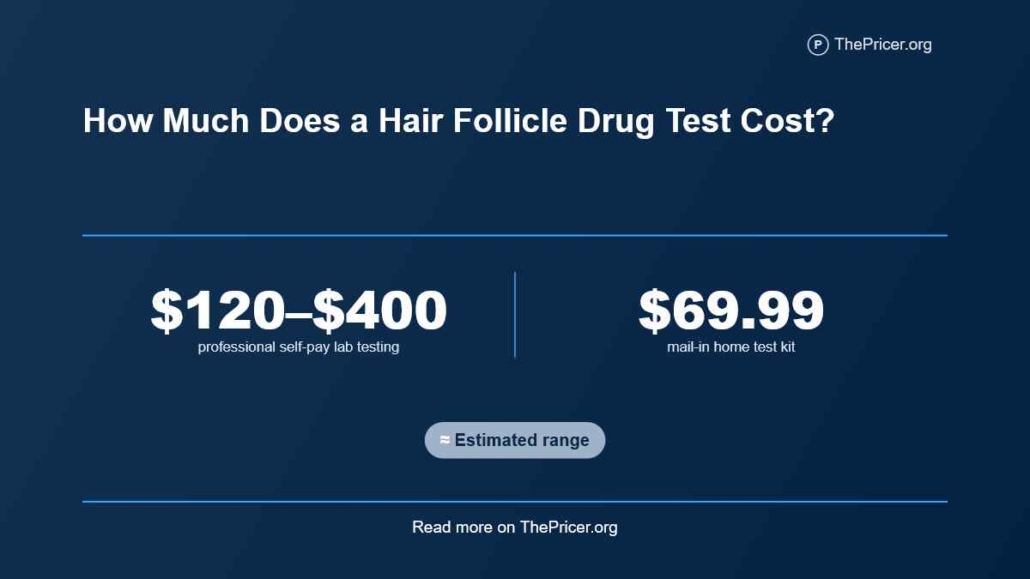
A professional hair drug test, often called a hair follicle drug test, commonly costs about $120 to $400 for self-pay laboratory testing in the United States. One current direct-order hair test menu runs from $119 for a 5-panel test to $389 for a 14-panel test, with a $4 order fee. MRO-reviewed and specialty panels can cost more.
The exact bill depends on panel size, whether professional collection is required, whether confirmatory testing is included, and whether a Medical Review Officer reviews a non-negative result. A mail-in home collection kit can cost much less, but a personal test should not be assumed to satisfy an employer, court, or regulated testing program.
Article Highlights
Jump to sections
- Current professional self-pay hair panels reviewed for this update start near $119 (at $30 per hour, earning that amount would take about 4 hours of work, before taxes) and reach about $389 before small order fees.
- A current mail-in HairConfirm kit sells for $69.99 and includes prepaid return shipping to the laboratory.
- A 1.5-inch head-hair specimen commonly represents about 90 days of drug-use history.
- Professional collection commonly uses about 90 to 120 strands, or roughly 100 milligrams of hair.
- Hair is useful for longer-term patterns, but urine or oral fluid may fit recent-use testing better.
How Much Does a Hair Follicle Drug Test Cost?
Direct-to-consumer laboratory pricing gives a useful current benchmark, but provider and panel design matter. HealthLabs currently lists three hair panel prices at $180 (about 6 hours of work at $30 per hour) for 7 panels, $209 for 9 panels, and $379 for 12 panels. The Request A Test prices in the opening show a lower starting point at $119 for 5 panels and a $389 14-panel option. These are self-pay consumer examples, not employer contract rates or a measured national average.
| Current example | Published price | What changes the bill |
|---|---|---|
| Request A Test 5-panel hair | $119 plus $4 order fee | Basic panel, professional collection |
| Request A Test 14-panel hair | $389 plus $4 order fee | Broader drug panel |
| HealthLabs 7-panel hair | $180 | Different provider and panel design |
| HealthLabs 12-panel hair | $379 | Broader panel |
| HairConfirm mail-in kit | $69.99 | Self-collection for personal testing |
The sample shows a wide spread even before formal review requirements enter the bill. A low advertised price does not make two tests equivalent. One service may include professional specimen collection and confirmatory testing, while another is a self-collected mail-in kit. Employer and legal testing can require identity verification, documented chain of custody, or physician review that a personal kit does not provide. For a personal budget, compare the cash price with every collection, order, and review charge attached to the test.
What the Test Measures
The phrase “hair follicle drug test” is common, but the follicle itself is usually not tested. Quest Diagnostics explains that the specimen is cut hair taken as close to the scalp as possible. The follicle is the pocket below the skin where the strand grows. A true follicle sample would require plucking rather than cutting. The follicle is not tested.
Drugs and metabolites can become incorporated into growing hair after use. A laboratory examines the hair matrix for the drug classes included in the ordered panel. Quest publishes drug classes and testing cutoffs for amphetamines, cocaine, marijuana metabolite, opiates, expanded opiates including oxycodone, and PCP. Panel composition varies by provider and ordered test.
A larger panel changes coverage, not the historical window by itself.
The test is not “zero tolerance.” Professional laboratories use defined screening and confirmation thresholds. The published cutoffs vary by analyte, so a result depends on the ordered panel, laboratory method, specimen quality, and applicable threshold rather than the mere presence of any microscopic trace. This distinction matters when comparing a professional laboratory test with marketing claims that imply detection of every trace at any concentration.
Panel Size Changes the Price
Panel count is one of the most visible price drivers, but the relationship is not linear. In the Request A Test examples already cited, moving from a 5-panel test at $119 (about 4 hours of work at $30 per hour) to a 14-panel test at $389 adds $270 before the common order fee. HealthLabs shows another pattern, moving from $180 for 7 panels to $209 for 9 panels and $379 for 12 panels. Each provider defines its own analyte mix and pricing structure.
ThePricer calculation using the Request A Test figures puts the payable amount at $123 for the 5-panel order and $393 for the 14-panel order after the $4 fee. The broader order is about 220% more expensive than the smaller one. Using the cited HealthLabs prices, the move from 7 panels to 12 panels adds $199, about 111% of the 7-panel price. Those comparisons show why panel count should not be treated as a fixed price-per-drug formula.
A smaller panel can match the request when it covers every substance the requester needs. Paying for more panel categories adds little value if the extra analytes are irrelevant to the testing purpose.
Read the analyte list before ordering. A 5-panel from one provider can be configured differently from an expanded panel elsewhere. If the requester names a particular substance, confirm that the purchased panel includes it rather than assuming a larger number covers every drug.
Collection and Lab Processing
Professional hair collection is designed to produce enough specimen for screening and any needed confirmation. Labcorp says collection uses about 100 milligrams, commonly 90 to 120 strands, cut at the scalp. The collector then secures the sample and completes chain-of-custody documentation before shipment to the laboratory.

Labcorp describes an initial immunoassay screening process followed by mass-spectrometry confirmation for presumptive positive specimens. Negative specimens are often reported within 48 to 72 hours after laboratory receipt, while confirmation can add about another 72 hours. Other consumer testing services quote longer windows, especially when confirmatory work is needed.
Professional collection also reduces ambiguity about who supplied the specimen and how it was handled before laboratory receipt. That documentation can matter when a third party will rely on the result.
Home collection changes the workflow. The current $69.99 HairConfirm kit includes a collection process, prepaid shipment, laboratory screening, and confirmation of positive screens. Compared with the $123 5-panel professional-order example above, the upfront difference is $53.01. That price gap buys different documentation and collection conditions, so it should not be treated as a like-for-like substitute for a workplace or court-directed test.
Detection Window and Limits
Hair testing is valued for its longer look-back period. A standard test using about 1.5 inches of head hair can represent several months of history because scalp hair grows at roughly one-half inch per month, with real growth rates varying by person. Psychemedics notes that routine hair testing cannot date drug use to a particular day or week.
That longer window does not make hair the right specimen for every question. Hair testing is better suited to patterns of use across weeks or months than to very recent use. Quest says its hair testing fits longer-term patterns, while urine is better suited to recent-use situations such as post-accident or reasonable-suspicion testing.
A 90-day window is not a promise that every use event will be found or dated. Hair growth varies from person to person, drugs take time to appear in hair above the scalp, and laboratory panels have cutoffs. Routine hair testing also does not pinpoint the exact day a substance was used. Claims that an ordinary 1.5-inch head-hair test routinely proves use a year earlier should be treated with caution.
Hidden Costs and Result Review
The base test price may not be the final payable amount. Request A Test adds a $4 service fee to current hair-test orders. It also sells MRO-reviewed hair testing at a higher price. Its current page lists a 14-panel MRO price of $419, compared with $389 for the non-MRO 14-panel version, and quotes 8 to 20 business days for positive MRO-reviewed results. With the same $4 order fee, the totals become $423 and $393.
The $30 difference is about 7.6% of the non-MRO payable amount. An MRO is a licensed physician who reviews laboratory drug-test results in the context of the testing program and may evaluate legitimate prescription explanations for certain findings. This review can matter when the result will be used for employment or another formal purpose, while the longer positive-result timeline can matter when a deadline is involved.
Other charges depend on the provider and the reason for testing. A broader panel, MRO review, specialty analytes, or a different collection arrangement can change the quote. Ask whether the advertised price includes collection, confirmation of a presumptive positive, result review, and any order fee. Those details make a larger difference than the headline panel number alone.
Workplace and Legal Use
Private-employer testing should not be confused with federal workplace rules. SAMHSA’s current federal FAQ says urine and oral fluid are authorized specimen types under the federal Mandatory Guidelines. A hair test purchased for a private program should not be assumed to meet those federal specimen rules.
A hair result obtained for a private program cannot be assumed to satisfy a federal or regulated testing requirement. Private employers also need to account for state and local law. SAMHSA notes that state rules vary widely on who may be tested, how testing may be conducted, and what workplace policies may require. One employer may permit hair in a private program while another job or agency requires a different specimen and review process.
The same distinction matters when a third party requests testing. A mail-in kit can provide private information at a lower price, but self-collection may not match the requesting party’s specimen, identity, or chain-of-custody requirements. Follow the written testing instructions before buying a kit or booking a collection. Get the accepted specimen type, collection method, laboratory requirements, and result-review rules in writing before paying. A valid personal test can still be unusable for the intended program when its required process is different.
When Hair Testing Fits the Goal
Hair testing can make sense when the goal is a longer historical window and the requesting program permits hair as the specimen. It is less suitable when the main question is very recent use or compliance with a rule that requires another specimen type. Personal testing also has different documentation needs from a test that another organization will rely on.
Price should follow purpose. Paying $389 for a 14-panel test is poor value if the requester only accepts a specific 5-panel urine test. Paying $69.99 for a home hair kit can also be wasted money if a formal program requires professional collection and chain of custody. The cheapest test is only useful when it answers the required question.
Makes sense if
- You need a longer look-back period and hair is accepted for the intended use.
- The named drug panel matches the substances that need to be screened.
- You need professional collection and documented specimen handling.
Does not make sense if
- The testing program requires an authorized specimen type other than hair.
- The purpose is post-accident testing or another recent-use question.
- A self-collected result will not meet the requesting party’s chain-of-custody rules.
For related price comparisons, see current costs for drug and alcohol testing, blood testing, and lie detector testing.
Answers to Common Questions
How much is a 5-panel hair drug test?
A current professional self-pay example reviewed here costs $119 plus a $4 order fee. Expanded 5-panel configurations can cost more when extra analytes are included.
How far back does a hair drug test go?
A standard 1.5-inch head-hair specimen commonly represents about 90 days. Hair growth and drug incorporation vary, so that period is an approximate look-back rather than an exact calendar record.
How much hair is needed?
Professional laboratories commonly request about 100 milligrams of head hair, often described as roughly 90 to 120 strands, cut close to the scalp.
Can a home hair drug test be used for employment?
Do not assume it can. A personal mail-in kit may lack the professional collection, identity verification, chain of custody, or review required by an employer or regulated program.
Can an employer require a hair drug test?
Whether an employer can require or accept hair testing depends on the job, employer policy, state and local law, and any federal rules covering the position. The requesting program should identify the accepted specimen and collection process.
Disclosure: Educational content, not medical advice. Pricing varies by provider, location, and insurance. Confirm eligibility, coverage, and out-of-pocket costs with a licensed clinician and your insurer. See our methodology and corrections policy.