
How Much Does a Mantis Shrimp Cost?
Updated on | Written by Alec Pow
This article was researched using 14 sources. See our methodology and corrections policy.
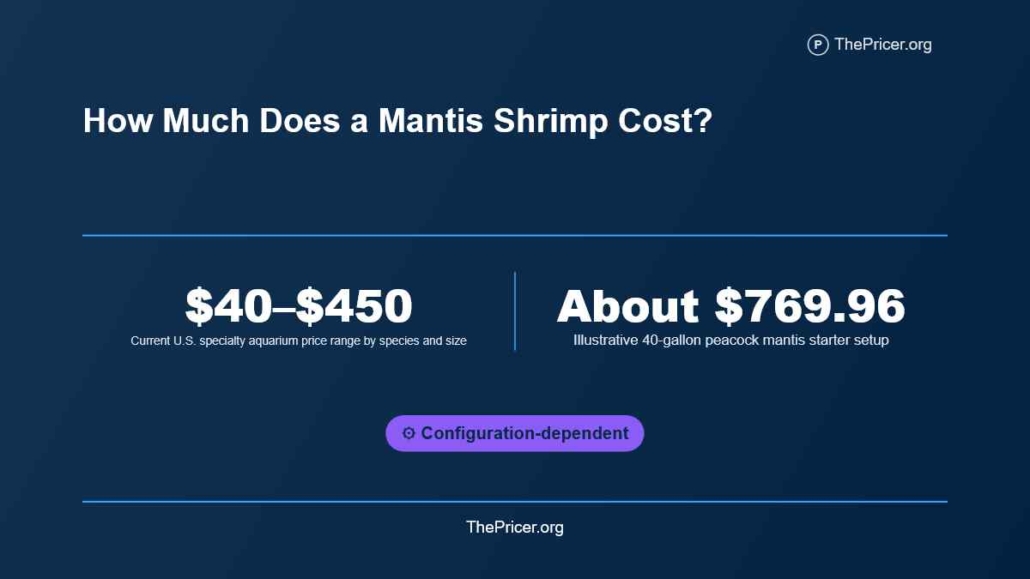
A live mantis shrimp currently costs about $40 to $450 in the U.S. specialty aquarium market, depending on species and size. Smaller green mantis shrimp sit near the low end, while large zebra or bumble bee mantis shrimp can reach several hundred dollars. Current peacock mantis shrimp examples start near $140, with another quarantined seller listing the species at $149.99.
The animal is only part of the purchase. Mantis shrimp are marine crustaceans in the order Stomatopoda, not true shrimp, and larger species need dedicated saltwater housing with filtration, heat, salt mix, substrate, hiding structure, and secure containment. A buyer starting without aquarium equipment can spend several times the livestock price before the animal arrives.
Article Highlights
Jump to sections
- Current specialist listings reviewed for this update span about $39.99 to $449.99 (at $30 per hour, earning that amount would take about 0.2 to 1.9 full-time workdays, before taxes) per mantis shrimp.
- Current peacock mantis shrimp examples include $139.99 and $149.99 listings.
- A tiger mantis shrimp is currently listed at $79.99, while a green mantis shrimp is listed at $39.99.
- Large zebra or bumble bee mantis shrimp can cost $249.99 to $449.99 before shipping.
- An illustrative 40-gallon peacock mantis starter setup using current retail examples reaches about $769.96 before saltwater, a salinity meter, a lid, tax, and livestock shipping.
- Mantis shrimp do not inject venom. Human injuries are mechanical wounds caused by their raptorial appendages or tail spines.
How Much Does a Mantis Shrimp Cost?
There is no useful single price based only on length. Species, collection difficulty, availability, size class, seller handling, and quarantine can change the amount by hundreds of dollars. Blue Zoo Aquatics currently shows mantis shrimp listings from $39.99 for a green mantis shrimp, with tiger mantis shrimp at $79.99 (about 2.7 hours of work at $30 per hour), purple spot mantis shrimp at $89.99, and peacock mantis shrimp starting at $139.99. Those figures are seller examples rather than a national average.
The upper end changes sharply with larger spearers. The retailer’s detailed zebra or bumble bee listing runs from $129.99 for a small specimen to $449.99 for a jumbo animal over 9.5 inches. The table keeps those current examples separate instead of blending unrelated species into one artificial size range.
| Current listing example | Advertised price | Price scope |
|---|---|---|
| Green mantis shrimp | $39.99 | Small-species listing |
| Tiger mantis shrimp | $79.99 | Current species listing |
| Purple spot mantis shrimp | $89.99 | Current species listing |
| Peacock mantis shrimp | From $139.99 | Current starting price |
| Zebra or bumble bee mantis shrimp, small | $129.99 | Over 1 to 1.5 inches |
| Zebra or bumble bee mantis shrimp, jumbo | $449.99 | Over 9.5 inches |
The zebra or bumble bee size ladder shows why the old article’s broad small, medium, and large ranges were unreliable. The same listed species rises from $129.99 to $449.99, an increase of $320 or about 246%. A buyer who sees one cheap juvenile listing cannot safely project that price onto a much larger specimen. Species identity and size class both belong beside the dollar figure.
Species Changes the Price
The name mantis shrimp covers hundreds of stomatopod species with very different adult sizes and hunting methods. Aquarium buyers most often encounter smashers with club-like raptorial appendages or spearers with sharp appendages used to seize softer prey. That difference affects housing, feeding, availability, and price. A small green mantis shrimp cannot be treated as a cheaper version of a large peacock or zebra mantis shrimp because the animals may need different tank sizes and burrow structures.
Peacock mantis shrimp, Odontodactylus scyllarus, are among the most recognizable smashers. A quarantined-fish specialist currently advertises peacock mantis shrimp at $149.99 and zebra at $179.99. The same seller describes peacocks as reaching roughly 3 to 7 inches and recommends larger housing for zebra mantis shrimp because that spearer can become much longer.
Availability can make the price less predictable than ordinary pet-store livestock. A rare size class may disappear from stock for weeks or months. A buyer comparing two sellers should check the scientific name, size, condition, feeding status, quarantine treatment, live-arrival terms, and shipping policy before deciding that one animal is cheaper. Species identification matters financially because buying the wrong mantis shrimp can force a tank upgrade after the animal grows.
What the First Order Really Costs
The livestock price is only the first line of a new setup. A 40-gallon breeder is a practical size to model for a peacock mantis shrimp because specialist care guidance commonly places adults in roughly the 30-to-55-gallon class. Petco currently lists an Aqueon 40-gallon breeder at $149.99. A compatible 40-gallon metal stand at $119.99 is another current retail example.
Instead of inventing a long equipment shopping list from unrelated products, a current saltwater bundle gives a cleaner cost anchor. Bulk Reef Supply lists a 40-gallon saltwater starter kit for $359.99. The bundle includes a hang-on-back filter, a 200-watt heater, 40 pounds of dry rock, 40 pounds of live reef sand, two circulation pumps, a thermometer, food, and bottled bacteria. The aquarium itself is not included.
Using the $149.99 (about 5 hours of work at $30 per hour) tank, $119.99 stand, $359.99 marine starter bundle, and a small peacock mantis shrimp at $139.99 produces an equipment-and-livestock floor of $769.96. The animal accounts for about 18% of that total. The calculation excludes saltwater or salt mix, a salinity meter, a secure lid, taxes, livestock shipping, and any upgraded tank material.
That gap is the useful buying lesson. A shopper who budgets only $139.99 for the animal can underestimate the project by several hundred dollars when starting from an empty room. Someone who already owns a mature, suitable marine system faces a very different bill because much of the setup cost has already been paid.
Smashers and Spearers
A mantis shrimp aquarium should be designed around the exact species rather than around the word “shrimp.” Peacock mantis shrimp are smashers that use hard, club-like appendages against snails, crabs, and other hard prey. They shelter in cavities and benefit from secure rockwork or another den. Zebra mantis shrimp are spearers that spend much of their time in deep burrows, so tank footprint and sand depth become much bigger budget variables.
This distinction can turn a seemingly similar livestock price into a very different project. A peacock may fit a 30-to-55-gallon dedicated system, while a large zebra can justify a 55-to-75-gallon or larger aquarium with a much deeper sand bed. Bigger tanks mean more salt mix, substrate, stand capacity, water volume, and often stronger filtration. The difference can add hundreds of dollars before the animal itself is considered.

Mantis shrimp are poor candidates for a typical mixed reef or community tank because many species will prey on snails, crabs, shrimp, or fish. Dedicated housing also makes maintenance safer. Readers comparing the broader expense of marine livestock can use the cost of pet fish ownership as a starting point, while the cuttlefish cost guide shows another specialized marine animal with housing demands that extend beyond the animal’s purchase price.
Shipping and Replacement
Live marine animals are often sent by overnight service, so the advertised mantis shrimp price may not equal the amount paid at checkout. Shipping terms vary by seller, order size, weather, destination, and guarantee. Dr. Reef states that livestock ships by UPS overnight and lists free shipping only above $500. A single $149.99 peacock mantis shrimp is far below that threshold, so the buyer should check the actual delivered price before comparing it with a local store.
Guarantee terms create another cost difference. A replacement animal may receive store credit while the original shipping charge remains nonrefundable. That means a dead-on-arrival claim does not always reset the purchase to zero additional cost. Read the seller’s photo deadlines, eligibility rules, weather exclusions, and whether replacement shipping is charged again.
The same logic applies to local purchases. A shop specimen that costs $20 more than an online listing may still be cheaper if there is no overnight freight and the buyer can inspect the animal before purchase. The most useful number is the delivered cost of the correct species in acceptable condition, not the smallest livestock number on a search page.
Are Mantis Shrimp Safe to Keep?
Mantis shrimp can injure people, but the mechanism is physical trauma rather than venom. A peer-reviewed review of aquatic-animal injuries states that crustaceans do not produce venom. That directly contradicts the old claim that mantis shrimp can inject toxins through their claws.
Documented injuries are real. A 2021 medical paper reviewed human cases involving mantis shrimp and found documented mantis shrimp injuries involving lacerations from raptorial appendages and wounds from tail spines. The paper describes pain, bleeding, tissue damage, and scars in reported cases. Aquarium owners should use tools such as feeding tongs and avoid placing fingers near a mantis shrimp’s den or trying to grab the animal by hand.
The famous glass-breaking story also needs careful wording. Powerful smashers can crack aquarium glass, but it is not accurate to say they routinely shatter any tank wall. Risk depends on species, animal size, glass thickness, where the den sits, and whether the animal repeatedly strikes the panel. Some specialist sellers recommend acrylic for larger smashers. The practical financial point is that the cheapest thin aquarium may be a poor place to economize when housing a large peacock mantis shrimp.
Why the Punch and Eyes Matter
The biology is unusual enough to justify space in a cost article because it explains the animal’s housing and handling needs. Research on peacock mantis shrimp measured limb-impact forces from 400 to 1,501 newtons and found a second force pulse produced when cavitation bubbles collapse. The study describes impact plus cavitation forces. The water is not simply “evaporated” by the claw, as the old article claimed.
The visual system is equally unusual but is often simplified into misleading claims. A review of stomatopod vision found up to 16 functional photoreceptors involved in ultraviolet, spatial, color, and polarization vision. Some species can detect circular polarization. That does not mean every mantis shrimp sees the same way or that having more receptor classes automatically gives them “better” color vision than every other animal.
Mantis shrimp are also not freshwater animals. They are marine crustaceans. That distinction removes the unrelated “rainbow shrimp” section from the old version because freshwater ornamental shrimp belong to a different group and have different prices and care needs. Readers looking for food-market shrimp rather than a live stomatopod can compare current shrimp prices by the pound. The two markets should not be mixed.
When a Mantis Shrimp Makes Sense
A mantis shrimp can be a good fit for an aquarist who wants a dedicated predatory-invertebrate display and is comfortable maintaining saltwater chemistry. Smaller species may cost less than many marine fish, yet a large peacock or zebra mantis shrimp is not a cheap impulse pet. Housing, live shipping, and species-specific care can make the first purchase several times higher than the animal’s listed price.
It is also a poor choice when the goal is a peaceful community aquarium. Many mantis shrimp will attack compatible-looking tank mates, and moving the animal later can be difficult once it establishes a defended den. Buying the correct species first avoids paying twice for a larger tank, deeper substrate, replacement livestock, or a second aquarium.
Makes sense if
- You want a dedicated saltwater species tank.
- You can identify the species before purchase and build around its adult size.
- You are comfortable feeding a predatory marine crustacean without hand contact.
- You have room in the budget for shipping, filtration, salt, substrate, and secure housing.
Does not make sense if
- You want to add one to a peaceful reef without accepting losses among tank mates.
- You are choosing a tank only from the mantis shrimp’s current juvenile size.
- You expect the listed animal price to represent the full startup cost.
- You want an animal that can be handled directly.
Answers to Common Questions
How much is a peacock mantis shrimp?
Current reviewed examples include a starting price of $139.99 at one specialist retailer and a $149.99 quarantined listing at another. Shipping may be extra.
What is the cheapest mantis shrimp in the current examples?
The lowest reviewed specialist listing is a green mantis shrimp at $39.99. That should not be treated as the price of every small mantis shrimp because species has a strong effect on cost.
Can a mantis shrimp break aquarium glass?
A large smasher can crack glass under some conditions, especially after repeated strikes. Tank material, panel thickness, species, animal size, and den placement all affect the risk.
Are mantis shrimp venomous?
No. Mantis shrimp can cause painful mechanical injuries with their raptorial appendages or tail spines, but crustaceans are not venom-producing animals.
How long can a peacock mantis shrimp live?
Specialist aquarium guidance commonly places a peacock mantis shrimp’s captive lifespan around three to six years with suitable care. Lifespan varies with species, age at purchase, health, water quality, diet, and husbandry.
Disclosure: Educational content, not medical advice. Pricing varies by provider, location, and insurance. Confirm eligibility, coverage, and out-of-pocket costs with a licensed clinician and your insurer. See our methodology and corrections policy.